
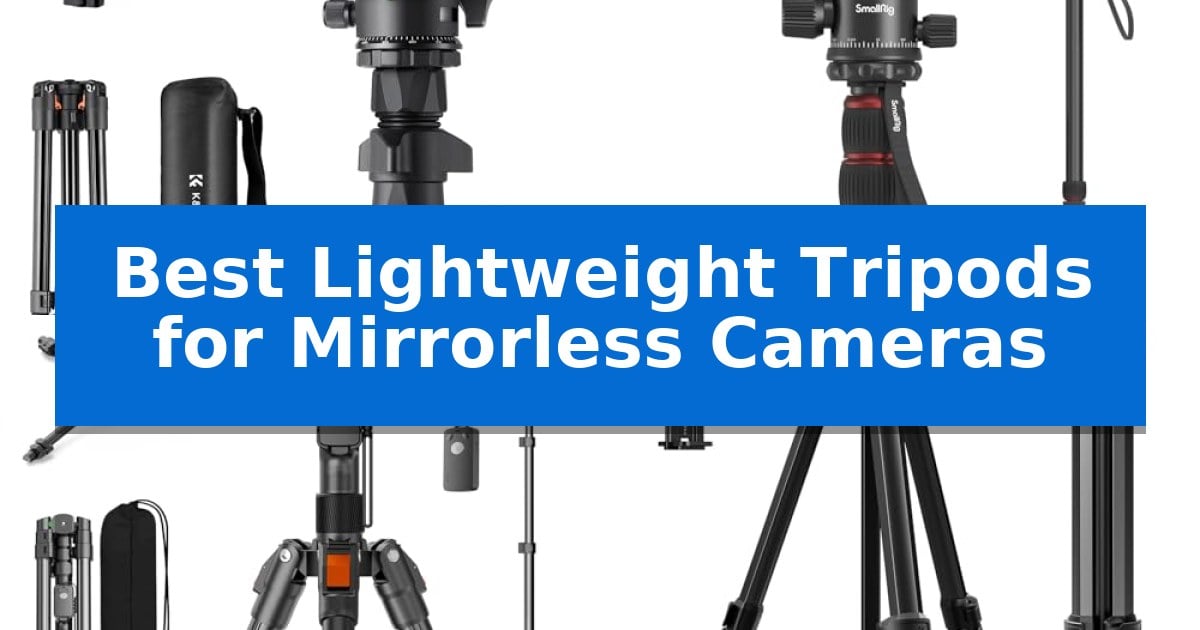
Finding the right support for your gear is essential when you want to capture sharp, long-exposure shots or steady video without carrying heavy equipment. The Best Lightweight Tripods for Mirrorless Cameras are designed to balance portability with the stability required for modern, high-resolution sensors.
Whether you are hiking to a remote landscape or filming vlogs on the go, these tripods provide the necessary foundation for your mirrorless system. We have analyzed several models to help you identify which features—such as load capacity, foldability, and head type—best match your specific shooting style.
You may also want to compare Best Lightweight Tripods for Hiking, Best Lightweight Tripods for Filmmaking, and Best Lightweight Tripods for Broadcast.
Best Lightweight Tripods for Mirrorless Cameras
Quick Comparison
| Product | Best For | Key Strength | Score |
|---|---|---|---|
| K&F Concept K234A0+BH-28L Camera Tripod | Best Overall | Ultra-portable design that folds down to 15.5 inches for easy transport. | 4.9 |
| SmallRig 15551 Camera Tripod | Versatile two-in-one monopod design | 2-in-1 design allows for quick conversion between tripod and monopod modes. | 4.3 |
| XXZU 75-inch Camera Tripod | Quick-release convenience for travelers | 3-in-1 modular design allows for tripod, monopod, and selfie stick functionality. | 4.7 |
| K&F Concept A305A3+BH-40 Camera Tripod | High load capacity for telephoto | High 22lb load capacity supports heavy professional camera and lens combinations. | 4.9 |
| K&F Concept A305A3+FH-04 Camera Tripod | Fluid head for smooth video | Precision fluid head for smooth 360° panning and tilting. | 4.5 |
How We Chose
- Weight and Folded Size: Assessing how easily the tripod fits into standard carry-on luggage or hiking packs.
- Load Capacity: Verifying the maximum weight the tripod can support to ensure it handles mirrorless bodies with various lenses.
- Head Versatility: Evaluating the functionality of ball heads or fluid heads for precision positioning and smooth movement.
- Build Material and Durability: Checking the construction quality to ensure long-term reliability in outdoor environments.
- Height Adjustability: Measuring the range of motion from low-angle macro shots to full-height eye-level operation.
1 K&F Concept K234A0+BH-28L Camera Tripod — Ultra-portable for long hikes
Achieving a stable platform for mirrorless photography while minimizing pack weight is essential for long-distance travel. The K&F Concept K234A0+BH-28L Camera Tripod addresses this by utilizing a 4-section leg design that collapses to just 15.5 inches, allowing it to fit easily into standard carrying bags while maintaining a total weight of only 2.53 lbs.
This tripod offers significant flexibility through its 360-degree ball head, which supports a load capacity of up to 17.6 lbs. This capacity is sufficient for most mirrorless camera setups and lenses, while the integrated panning dial provides the precision required for landscape compositions. The inclusion of a quick flip leg lock system enables rapid height adjustments, moving from a minimum of 20.4 inches to a maximum of 64.1 inches in seconds.
Versatility is further enhanced by the ability to perform center column inverted installation, which facilitates low-angle photography or specialized macro shots. The tripod utilizes a standard 1/4-inch thread, ensuring broad compatibility with most cameras and Arca-Swiss quick-release plates, making it a functional choice for photographers who switch between different gear setups.
While the lightweight aluminum construction is optimized for portability, users should consider that the tripod's stability in high-wind environments may be influenced by its lower base weight. It remains a practical solution for those prioritizing mobility and ease of setup during outdoor excursions.
Best for: Travel photographers and vloggers who require a compact, lightweight support system for mirrorless cameras and mobile setups.
Skip if: Professional photographers requiring heavy-duty stability for long-exposure work in high-wind conditions or those using exceptionally heavy telephoto lenses that exceed the 17.6 lb load limit.
PROS
- Ultra-portable design that folds down to 15.5 inches for easy transport.
- High load capacity of 17.6 lbs despite the lightweight 2.53 lb frame.
- Efficient flip leg locks for rapid deployment in the field.
- Versatile center column allows for inverted shooting angles.
CONS
- Lower base weight may require extra care in windy outdoor conditions.
- Aluminum construction is durable but lacks the extreme rigidity of carbon fiber alternatives.
2 SmallRig 15551 Camera Tripod — Versatile two-in-one monopod design
The SmallRig 15551 Camera Tripod provides a versatile foundation for mirrorless setups by integrating a 2-in-1 design that converts from a standard tripod into a monopod. This flexibility allows photographers to transition between stationary shots and mobile, travel-focused shooting without needing to carry separate support gear.
Engineered for stability, the system utilizes a magnesium aluminum alloy construction capable of supporting up to 33 lbs in a vertical orientation. The 36mm metal ball-head offers 360-degree rotation, facilitating precise horizontal and vertical framing. For macro photography or low-angle perspectives, the central column can be inverted, providing creative control over camera positioning.
Practicality for content creators is enhanced by three 1/4" threaded holes on the bracket, which serve as mounting points for accessories like magic arms, monitors, or mobile phones. The 4-section legs feature quick-release flip-locks for rapid height adjustments ranging from 16 inches to 71 inches. Despite its height, the tripod folds down to a compact 16.9 inches, making it suitable for transport.
Broad compatibility is ensured through standard 1/4"-20 and 3/8"-16 threads. Users should note that when utilizing heavy telephoto zoom lenses, a dedicated tripod mount ring is recommended to maintain proper balance on the ball head. While the aluminum build provides a robust base, it represents a trade-off in weight compared to carbon fiber alternatives.
Best for: Content creators and travelers who need a versatile, height-adjustable support system that converts into a monopod.
Skip if: Users requiring an ultra-lightweight carbon fiber tripod or those using heavy telephoto lenses without a dedicated mount ring.
PROS
- 2-in-1 design allows for quick conversion between tripod and monopod modes.
- High load capacity of up to 33 lbs in a vertical position.
- Integrated accessory mounting with three 1/4" threaded holes on the bracket.
- Compact folded size of 16.9 inches for easier portability.
CONS
- Requires additional mounting hardware for balanced use with heavy telephoto lenses.
- Aluminum construction is heavier than carbon fiber alternatives.
3 XXZU 75-inch Camera Tripod — Quick-release convenience for travelers
Achieving stable, versatile support for mirrorless camera setups while maintaining a lightweight profile is essential for mobile photography. The XXZU 75-inch Camera Tripod addresses this through its aluminum alloy construction and a 3-in-1 detachable center column design, which allows it to function as a standard tripod, a monopod, or a selfie stick for varied shooting angles.
This tripod offers significant flexibility with its 360° ball head, enabling smooth transitions between landscape and portrait orientations. For outdoor use, the 3-level angle adjustment allows the legs to spread nearly horizontally, reaching a minimum height of 15.35 inches for low-angle macro photography. The inclusion of a built-in remote control with a 10m range provides added convenience for group shots or long-exposure work.
Stability is managed through thickened tubes and anti-slip rubber feet, supplemented by a bottom hook for adding counterweights in windy conditions. The unit is designed for portability, folding down to 14.17 inches and weighing only 2.18 lbs, making it a practical choice for those who need to minimize pack weight without sacrificing height, as it extends up to 75 inches.
Compatibility is broad, featuring a standard 1/4-inch screw for cameras and a phone holder for mobile devices. An additional 1/4-inch screw hole on the frame allows for the attachment of external accessories like microphones or LED lights, creating a modular base for content creators.
Best for: Travelers and content creators who require a versatile, multi-functional support system that transitions between tripod, monopod, and low-angle shooting modes.
Skip if: Professional photographers using heavy cinema rigs or long telephoto lenses that exceed the 17.64lb vertical load capacity.
PROS
- 3-in-1 modular design allows for tripod, monopod, and selfie stick functionality.
- Extensive height range from 15.35 inches to 75 inches.
- Integrated 360° ball head with real-time level calibration.
- Lightweight and compact folding design for travel.
CONS
- Load capacity decreases to 6.61lb when tilted at a 45-degree angle.
4 K&F Concept A305A3+BH-40 Camera Tripod — High load capacity for telephoto
Achieving a balance between stability and portability is essential for field photography, and the K&F Concept A305A3+BH-40 Camera Tripod addresses this by offering a robust 22lb maximum load capacity in a frame that weighs only 2.9 pounds. This tripod is engineered to support heavy full-frame DSLR setups or telephoto lenses while remaining compact enough to fit inside standard 20-inch carry-on luggage.
The A305A3+BH-40 provides significant flexibility for diverse shooting environments. Its height is adjustable from 19 inches to 73 inches, allowing for everything from low-angle macro work to eye-level portraiture. The 40mm ball head features a 360° panoramic base for smooth panning, and the ability to tilt the head down to 90° facilitates vertical orientation shooting without requiring additional adapters.
Durability and versatility are integrated into the design through several mechanical choices. The aluminum construction ensures a sturdy base, while the reversible central column allows for inverted shooting positions. For added stability in windy conditions or on uneven terrain, the tripod includes an integrated hook to hang stabilizing weights. The package also includes a phone and tablet holder, broadening its utility beyond traditional cameras to include mobile video production.
Practicality in the field is supported by the inclusion of a 1/4" quick release plate, which enables rapid mounting and dismounting of equipment. While the tripod is designed for ease of use, the manufacturer notes that users should ensure the head is tightened clockwise after locking the panorama knob to maintain secure positioning during panoramic sequences.
Best for: Travel photographers and videographers who require a lightweight, compact support system capable of handling heavy DSLR or mirrorless camera setups.
Skip if: Users who require a dedicated professional video tripod with a fluid head for cinematic panning or those who prioritize maximum rigidity over portability.
PROS
- High 22lb load capacity supports heavy professional camera and lens combinations.
- Compact 2.9lb design fits into standard carry-on luggage for travel.
- Versatile 19" to 73" height range accommodates a wide variety of shooting angles.
- Includes phone and tablet holder for multi-device compatibility.
CONS
- Manual tightening required for the ball head to prevent rotation during panoramic shots.
- Aluminum build may be less vibration-dampening than carbon fiber alternatives.
5 K&F Concept A305A3+FH-04 Camera Tripod — Fluid head for smooth video
Achieving stable, professional-grade camera support while maintaining a low profile is essential for travel photography. The K&F Concept A305A3+FH-04 Camera Tripod addresses this by integrating a precision fluid head into a compact, aluminum frame, allowing for smooth 360° panoramic rotation and precise tilt adjustments for video and stills.
Designed for portability, this 2.9 lb tripod folds down to the size of a water bottle, making it a practical choice for carry-on luggage. Despite its lightweight build, it offers a maximum load capacity of 6.6 lb, providing sufficient support for most mirrorless cameras and camcorders. The 5-section leg design with flip locks enables rapid height adjustments ranging from 19 inches to 73 inches.
Versatility is a core component of this design, featuring a reversible center column that facilitates low-angle shooting for macro photography or unique perspectives. The inclusion of a 1/4" screw on the quick-release plate and a bundled phone/tablet holder ensures compatibility across various devices, while the integrated cold shoe allows for the direct attachment of microphones or LED lights.
Stability is further enhanced by non-slip rubber feet and a center hook for added weight in windy conditions. This tripod serves as a comprehensive solution for vloggers and creators who require a balance of mobility and functional control without the bulk of traditional studio equipment.
Best for: Travelers and vloggers who need a lightweight, compact tripod with fluid head capabilities for smooth video panning and tilting.
Skip if: Users requiring support for heavy cinema rigs or telephoto lenses exceeding the 6.6 lb weight limit should look for a more robust, heavy-duty tripod system.
PROS
- Precision fluid head for smooth 360° panning and tilting.
- Ultra-compact design that folds to the size of a water bottle.
- Versatile height range from 19 to 73 inches with a reversible center column.
- Wide compatibility including a phone/tablet holder and cold shoe mount.
CONS
- 6.6 lb load limit restricts use with heavier professional camera setups.
Best Lightweight Tripods for Mirrorless Cameras Buying Guide
Understanding Tripod Weight and Portability
For mirrorless photographers, the primary advantage of a lightweight tripod is the ability to carry it for extended periods without fatigue. Aluminum alloy construction is a common standard that offers a balance between weight reduction and structural integrity, making it ideal for travel.
When evaluating portability, consider the folded length of the tripod. Models that collapse to under 16 inches are generally easier to strap to the side of a camera bag, ensuring you are more likely to bring your support gear along on every outing.
Load Capacity and Stability
Even a lightweight tripod must be sturdy enough to prevent camera shake. Always check the maximum payload rating, which indicates the weight the tripod can support while remaining stable. For mirrorless setups, a capacity of 15 to 20 pounds is often more than sufficient for most lens combinations.
Stability is also influenced by the number of leg sections. While more sections allow for a more compact folded size, they can sometimes introduce slight flex. Look for quick-release flip locks or twist locks that provide a secure, vibration-free hold once the legs are fully extended.
The Importance of Head Types
The tripod head is your primary interface for framing shots. A 360-degree ball head is highly versatile, allowing for rapid adjustments in both horizontal and vertical orientations, which is perfect for landscape and street photography.
If your focus is on video production, a fluid head is a superior choice. These heads are engineered to provide smooth, dampened movement during pans and tilts, preventing the jerky footage often associated with standard ball heads.
Versatility for Creative Angles
Many modern tripods feature a reversible center column, which allows you to mount the camera upside down. This is an invaluable feature for macro photography or getting extremely low-angle shots that would otherwise be impossible.
Some models also offer a 2-in-1 design, allowing you to detach one leg and convert it into a monopod. This adds significant value for sports or wildlife photographers who need the mobility of a monopod but the stability of a tripod when conditions allow.
Compatibility and Accessories
Ensure your tripod uses a standard 1/4-inch screw mount, which is compatible with virtually all mirrorless cameras. Many kits also include an Arca-Swiss compatible quick-release plate, which is the industry standard for fast camera mounting and removal.
Look for additional features like a cold shoe mount on the tripod bracket for attaching microphones or LED lights, or a bottom hook for hanging a camera bag to add extra ballast in windy conditions.
Frequently Asked Questions
Can these tripods support full-frame mirrorless cameras?
Yes, most of these tripods are rated for payloads well above the weight of standard full-frame mirrorless bodies and common lenses, provided you stay within the specified load limit.
What is the benefit of a fluid head over a ball head?
A fluid head provides dampened, smooth motion, which is essential for professional-looking video pans and tilts, whereas a ball head is designed for speed and flexibility in still photography.
Are these tripods suitable for air travel?
Most of these models are designed to fold down to sizes that fit easily into standard carry-on luggage, making them excellent companions for air travel.
How do I ensure my tripod is stable on uneven ground?
Look for tripods with independently adjustable leg angles. This allows you to spread the legs wider or at different lengths to maintain a level base on rocky, uneven, or sloped terrain.
Can I use these tripods with my smartphone?
Many of these tripods include or are compatible with universal smartphone holders, making them versatile tools for both dedicated cameras and mobile content creation.
Conclusion: Our Top Pick
Selecting the right support gear depends on whether you prioritize pure portability or specialized video functionality. For most mirrorless users who need a reliable, all-around solution, the K&F Concept K234A0+BH-28L Camera Tripod stands out as an excellent choice due to its balance of weight, height, and ease of use.
This model offers the necessary stability for sharp photography while remaining compact enough for long hikes. By choosing a tripod that matches your specific camera weight and shooting style, you ensure your equipment is always ready to capture the perfect shot.