
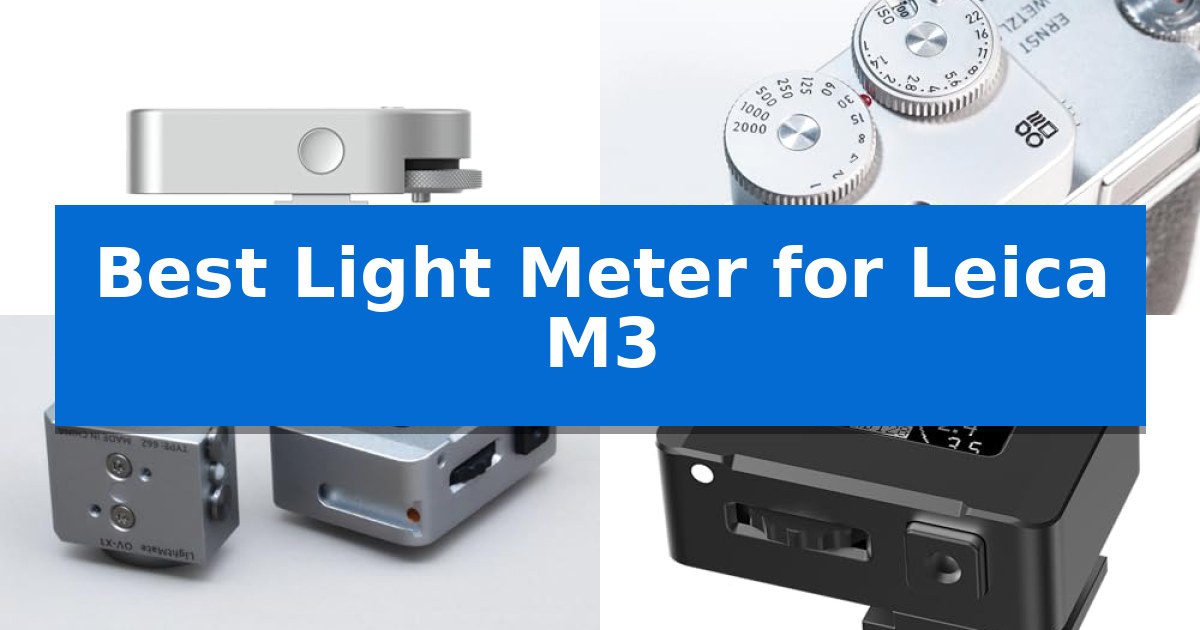
Achieving perfect exposure on a classic rangefinder requires a reliable tool that respects the camera's mechanical heritage. Finding the Best Light Meter for Leica M3 involves balancing modern sensor accuracy with the compact, unobtrusive form factor essential for street photography.
Whether you prioritize a classic aesthetic that complements the M3's build or require advanced digital features like OLED displays and rechargeable batteries, selecting the right meter transforms your workflow. We have evaluated the latest shoe-mounted options to help you find the perfect match for your film photography needs.
You may also want to compare Best Light Meter for Large Format Photography, Best Light Meter for Flash Photography, and Best Light Meter for Filmmaking.
Best Light Meter for Leica M3
Quick Comparison
| Product | Best For | Key Strength | Score |
|---|---|---|---|
| antonKUNZE KEKS M-eter | Best Overall | Shutter speed coupling eliminates manual setting transfers. | 4.9 |
| DOOMO MADE Meter D | Classic metal aesthetic | All-metal construction provides a durable and aesthetically matching build for vintage cameras. | 4.7 |
| LightNova Area 2S Light Meter | Includes optical viewfinder | Includes a dedicated OV-X1 17° Retro Viewfinder for precise target metering. | 4.4 |
| LightNova Lite 2R Light Meter | Ultra-compact profile | Ultra-compact 1.24oz weight ensures minimal impact on camera balance. | 4.8 |
| LightNova LightMate AirPro | Tactile manual dials | Tactile, independent dials for aperture, ISO, and shutter speed. | 4.5 |
How We Chose
- Compatibility with the Leica M-series shoe mount.
- Metering accuracy and sensor reliability in varying light conditions.
- Form factor and weight to maintain the balance of the camera body.
- Ease of use, including dial tactile feedback and display clarity.
- Battery life and charging convenience for field reliability.
1 antonKUNZE KEKS M-eter — Seamless Leica M integration
Achieving precise exposure settings on a vintage Leica M3 requires a reliable light meter that respects the camera's mechanical heritage. The antonKUNZE KEKS M-eter integrates directly with your camera by adopting the housing design and shutter speed coupling of the classic Leica MR meter, eliminating the need for manual transfer of settings between the meter and the camera body.
Engineered for modern usability, this meter features a 1.3-inch OLED display that provides clear, bright readings in various lighting conditions. It utilizes a high-precision VEML7700 ambient light sensor with 16-bit digital resolution, paired with an optimized formula designed to deliver stable and accurate metering performance.
The device is powered by a rechargeable USB-C battery, offering over 10 hours of runtime on a single charge. For long-term maintenance, the lithium battery is designed to be replaceable, ensuring the meter remains functional even after years of use. The system supports a wide range of adjustments, including exposure compensation, aperture and ISO levels, and user-defined max/min aperture settings.
Compatibility extends across the Leica M-mount range, including the M1, M2, M3, M4, M4-2, M4P, MA, MD, and MD2. With a weight of approximately 0.33 pounds, it maintains a compact profile that complements the M-series form factor without adding significant bulk to your setup.
Best for: Photographers using Leica M-series cameras who want a coupled, modern light meter that integrates seamlessly with vintage shutter speed dials.
Skip if: Users who prefer a standalone, non-coupled light meter or those who require a device that does not rely on a rechargeable battery.
PROS
- Shutter speed coupling eliminates manual setting transfers.
- USB-C rechargeable battery with over 10 hours of runtime.
- High-precision VEML7700 sensor for accurate ambient light measurement.
- Bright 1.3-inch OLED display for easy visibility.
CONS
- Battery-dependent operation requires periodic recharging.
- Specific compatibility limited to Leica M-mount camera bodies.
2 DOOMO MADE Meter D — Classic metal aesthetic
The DOOMO MADE Meter D is a compact, shoe-mounted light meter designed to complement the aesthetic of vintage cameras like the Leica M3. Constructed with an all-metal design and featuring an exquisitely textured finish, it integrates seamlessly onto the camera's accessory shoe without adding significant bulk.
Functionality is centered around a 30° average metering system, which provides consistent readings across a variety of lighting conditions. The device is built to handle diverse film stocks, including positive film, and offers a broad ISO range of 25-6400 in 1/3 stop increments. This flexibility allows photographers to maintain precise control over their exposure settings.
Operation is intuitive, featuring an aperture range of 1-22 in half-stop increments and a shutter speed range of 1-1/2000s. These controls are designed for quick adjustments in the field, ensuring that the metering process does not impede the shooting experience. The unit's small footprint of 403516mm ensures it remains unobtrusive during use.
This light meter is a specialized tool for those who prefer manual exposure management on mechanical rangefinders. It balances a classic look with the modern requirement for accurate light measurement, providing a reliable reference for film photographers who value both form and function.
Best for: Photographers using vintage rangefinder cameras who require a compact, shoe-mounted metering solution with manual exposure control.
Skip if: Users who prefer integrated TTL metering or those who require a high-speed, automated digital metering system for complex lighting environments.
PROS
- All-metal construction provides a durable and aesthetically matching build for vintage cameras.
- Broad ISO range of 25-6400 allows for versatility with various film types.
- Compact dimensions ensure the meter does not obstruct the camera's viewfinder or handling.
- Precise control with 1/3 stop ISO and half-stop aperture adjustments.
CONS
- Manual operation requires constant adjustment, which may be slower than integrated systems.
- Shoe-mounted design occupies the camera's accessory port, preventing the use of other shoe-mounted accessories.
3 LightNova Area 2S Light Meter — Includes optical viewfinder
Achieving precise exposure settings on a classic rangefinder requires a reliable external meter that complements the camera's minimalist aesthetic. The LightNova Area 2S Light Meter integrates a dedicated OV-X1 17° Retro Viewfinder that mounts directly to the device's vfPort(TM) interface, allowing for accurate target metering without obstructing the camera's own rangefinder window.
This ultra-compact device features a 0.96" Large OLED Screen that provides high-visibility readouts, which can be adjusted for brightness when working in outdoor conditions. It supports both Aperture Priority and Shutter Priority modes, making it a versatile tool for manual film cameras. Users can toggle between Full and X step values for aperture, and Full or 1/3 step values for shutter speed, ensuring compatibility with the specific control dials of a vintage M-series body.
Beyond standard metering, the unit includes Digital Depth Of Field calculation, which assists with hyperfocal distance settings for street photography. It also offers Exposure Compensation and ND filter compensation, providing flexibility when using various lens filters. The internal rechargeable battery is designed for longevity, offering over 20 hours of operation and a standby time exceeding 6 months, with convenient USB-C charging.
The LightNova Area 2S Light Meter is a specialized tool for photographers who prefer a dedicated, external metering solution that maintains the compact form factor of their film setup. While it requires mounting to the camera or carrying it as a separate accessory, its combination of a dedicated optical viewfinder and advanced digital features makes it a practical choice for manual exposure control.
Best for: Photographers using manual film cameras who require a compact, dedicated light meter with an integrated optical viewfinder for precise spot metering.
Skip if: Users who prefer a built-in TTL metering system or those who do not want the additional bulk of an external meter mounted to their camera's accessory shoe.
PROS
- Includes a dedicated OV-X1 17° Retro Viewfinder for precise target metering.
- Features a clear 0.96" Large OLED Screen with adjustable brightness.
- Offers Digital Depth Of Field calculation for hyperfocal street photography.
- Long-lasting rechargeable battery with USB-C charging.
CONS
- Requires mounting to the camera's accessory port, which may affect overall camera balance.
- External metering requires an extra step compared to modern built-in systems.
4 LightNova Lite 2R Light Meter — Ultra-compact profile
Maintaining the classic aesthetic of a rangefinder while ensuring accurate exposure requires a compact tool that does not obstruct the viewfinder. The LightMate Lite 2R Light Meter addresses this by offering an ultra-compact 1.24oz design that mounts directly to the camera's cold shoe, keeping your setup streamlined and portable.
This device features a 0.96-inch OLED screen that provides clear visibility, with adjustable brightness settings to suit varying lighting conditions. Its 30-degree field of view metering lens is engineered to handle common ambient light scenarios, while the inclusion of both aperture priority and shutter priority modes offers flexibility for different shooting styles.
Beyond basic metering, the unit supports advanced functions including exposure compensation, ND filter compensation, and depth of field calculation. Users can customize the interface by modifying frame and focal length settings, and the rechargeable battery provides over 20 hours of operation, with convenient USB-C charging.
The LightMate Lite 2R Light Meter is designed for practical field use, featuring an adjustable cold shoe position to ensure compatibility with various film cameras. Its interface includes helpful additions like a measurement completion prompt light and an automatic shutdown timer to preserve battery life during extended outings.
Best for: Photographers using film rangefinders who require a lightweight, unobtrusive, and highly adjustable metering solution.
Skip if: Users who prefer a traditional, non-digital metering experience or those who require a wider or narrower field of view than the fixed 30-degree lens provides.
PROS
- Ultra-compact 1.24oz weight ensures minimal impact on camera balance.
- Versatile metering modes including aperture and shutter priority.
- Built-in rechargeable battery with over 20 hours of life.
- Advanced features like depth of field calculation and ND filter compensation.
CONS
- Fixed 30-degree field of view may not suit all specialized metering needs.
5 LightNova LightMate AirPro — Tactile manual dials
Achieving accurate exposure on a classic rangefinder requires a tool that respects the vintage aesthetic while providing modern precision. The LightNova LightMate AirPro integrates a 35-degree wide-angle metering system into a compact, full-metal body, making it a fitting companion for the Leica M3. Its design prioritizes tactile feedback, allowing photographers to adjust settings without looking away from the viewfinder.
The device features three independent dials for aperture, ISO, and shutter speed, each providing audible and tactile confirmation of adjustments. This manual-first approach is complemented by versatile shooting modes, including Aperture Auto, Shutter Auto, and Manual. For those who prefer specific settings, the meter supports half-stop resolution and allows for independent ISO values beyond standard scales, ensuring compatibility with various film stocks.
Durability and portability are central to its construction. The full metal shell is built to withstand the rigors of street photography while remaining small enough to carry alongside a camera kit. A built-in rechargeable battery, charged via USB-C, provides over 20 hours of active use, with a standby time exceeding six months, ensuring the meter is ready whenever the light changes.
Customization extends to the interface, where users can select from over 10 exposure indicators in Manual mode. The dual LED cardinal point indicators can be tailored to preferred colors, allowing for a personalized shooting experience. Whether shooting in high-contrast environments or subtle indoor light, the ±0.1EV accuracy provides the reliable data needed to master manual exposure.
Best for: Photographers using vintage film cameras who prioritize tactile, manual control and a compact, durable form factor.
Skip if: Users who require a built-in hot-shoe mount or a dedicated incident metering dome, as this model focuses on reflective metering.
PROS
- Tactile, independent dials for aperture, ISO, and shutter speed.
- Durable full metal body with an ultra-compact footprint.
- High-precision ±0.1EV metering with wide-angle 35-degree coverage.
- USB-C rechargeable battery with over 20 hours of life.
CONS
- Reflective metering only, lacking an incident light dome.
- Manual-focused interface may require a learning curve for those accustomed to fully automated systems.
Best Light Meter for Leica M3 Buying Guide
Understanding Metering Modes
Most modern shoe-mounted meters offer multiple modes, such as aperture priority or shutter priority. These modes allow you to lock in one variable while the meter suggests the other, which is vital for quick adjustments during street photography.
Some advanced models also include average metering or spot metering capabilities. Understanding how your meter calculates light—whether it is a 30-degree or 35-degree field of view—ensures you can compensate for high-contrast scenes effectively.
Build Quality and Material
Since you are pairing a meter with a precision-engineered camera like the M3, the build quality of the accessory matters. All-metal designs often provide better durability and a tactile experience that matches the vintage aesthetic of the camera.
Consider the weight and dimensions of the unit. A bulky meter can obstruct the viewfinder or make the camera top-heavy, potentially affecting your handling and focus speed.
Display and Visibility
The transition from analog needles to OLED displays has significantly improved readability in low-light environments. Look for meters that offer adjustable brightness settings to ensure you can see your exposure data without being distracted by a glowing screen.
Some displays are designed to be minimalist, showing only essential exposure values, while others provide more comprehensive data like depth-of-field calculations. Choose based on how much information you need at a glance.
Power and Battery Life
Modern light meters have moved away from disposable coin cells toward rechargeable USB-C batteries. This is a major convenience for photographers who travel or shoot frequently, as it eliminates the need for spare batteries.
Check the rated battery life and standby time. A meter that can last over 20 hours of active use and hold a charge for months in standby is ideal for the occasional film shooter.
Integration and Ergonomics
The best meters often feature customizable cold shoe positions, allowing you to shift the meter's placement to avoid blocking your view or interfering with the camera's controls. This level of physical customization is a key factor in long-term usability.
Tactile feedback is another crucial ergonomic element. Dials that provide audible or physical clicks allow you to adjust settings without taking your eye away from the viewfinder, keeping your focus on the subject.
Frequently Asked Questions
Will these light meters fit all Leica M cameras?
Most shoe-mounted meters are designed for the standard cold shoe found on the Leica M3, M2, M4, and other M-series cameras. However, always check the specific compatibility list for your model to ensure a secure fit.
How accurate are digital shoe-mounted meters compared to handheld ones?
Modern shoe-mounted meters use high-precision sensors like the VEML7700, which offer excellent accuracy for film photography. While they may not replace a dedicated incident light meter for studio work, they are highly effective for reflective metering in the field.
Do I need to calibrate these meters?
Most modern digital meters come pre-calibrated. However, many allow for exposure compensation adjustments, which you can use to fine-tune the readings to match your preferred film stock or personal metering style.
Can I use these meters with ND filters?
Yes, many of the listed models include specific functions for ND filter compensation. This allows you to adjust the meter's output to account for the light reduction caused by your filter.
What is the benefit of an OLED screen on a light meter?
An OLED screen provides high contrast and clarity, making it much easier to read your exposure settings in both bright sunlight and dim indoor conditions compared to traditional LCD or needle-based displays.
Conclusion: Our Top Pick
For those seeking the most integrated experience, the antonKUNZE KEKS M-eter stands out as the best choice. Its design, which draws inspiration from the classic Leica MR meter, offers a unique coupling mechanism that simplifies the exposure process by eliminating the need to manually transfer shutter speeds.
With its high-precision sensor and rechargeable USB-C battery, it balances modern technical performance with the mechanical soul of the Leica M3. While other options offer different aesthetic or viewfinder advantages, the KEKS M-eter provides the most seamless, user-friendly workflow for rangefinder enthusiasts.