
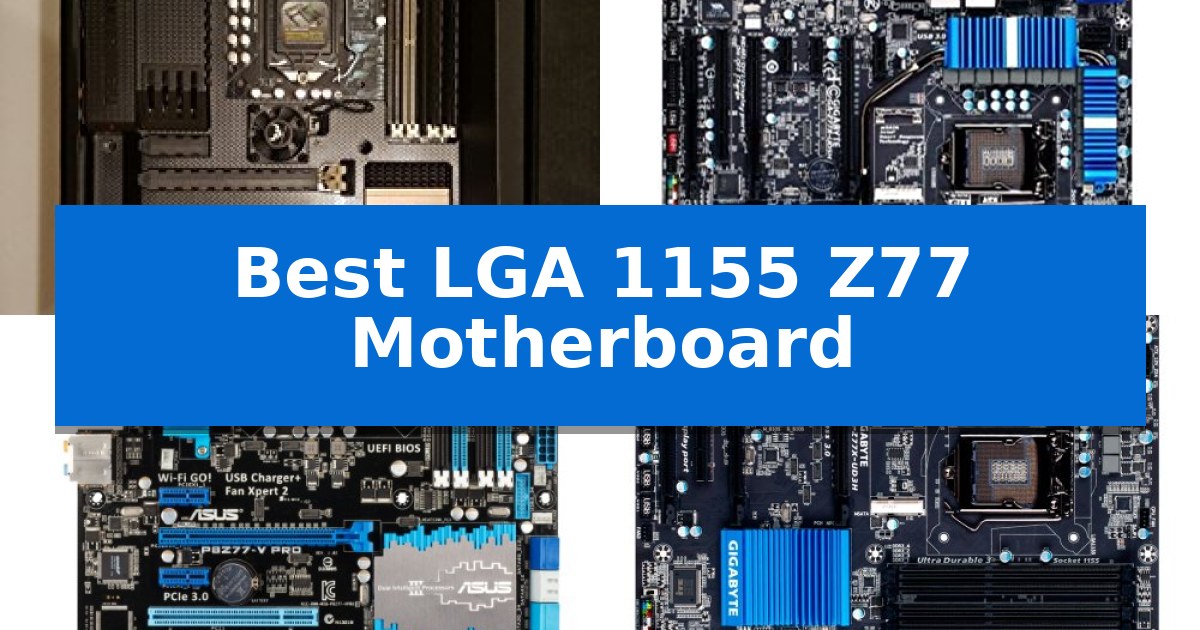
Building or maintaining a system around the Intel LGA 1155 socket requires a reliable foundation that balances legacy hardware support with modern connectivity. The Best LGA 1155 Z77 Motherboard serves as the critical bridge for these processors, offering essential features like SATA 6Gb/s, USB 3.0, and PCIe 3.0 support to keep older platforms functional and efficient.
Whether you are reviving a vintage workstation or optimizing a secondary gaming rig, selecting the right board depends on specific needs like cooling management, multi-GPU capabilities, or advanced networking. This guide examines five distinct Z77 models to help you identify which board provides the stability and feature set required for your specific build requirements.
You may also want to compare Best LGA 1155 Motherboard for i7-3770K, Best LGA 1151 Z390 Motherboard for i9-9900K, and Best LGA 1151 Motherboard for 9th Gen.
Best LGA 1155 Z77 Motherboard
Quick Comparison
| Product | Best For | Key Strength | Score |
|---|---|---|---|
| ASUS Sabertooth Z77 Motherboard | Best Overall | Thermal Armor Technology with integrated turbo fan for active cooling | 4.9 |
| Gigabyte Z77X-UD5H Motherboard | Dual LAN for advanced networking | Dual Gigabit LAN ports for enhanced network reliability. | 4.7 |
| ASUS P8Z77-V PRO Motherboard | Streamlined BIOS updates and control | USB BIOS Flashback allows for simple, button-press BIOS updates. | 4.5 |
| Gigabyte Z77X-UD3H Motherboard | Versatile multi-GPU support | Versatile multi-GPU support via 2-Way CrossFireX and SLI. | 4.5 |
| Intel DZ77GA-70K Motherboard | Stable performance for enthusiast builds | Intel Z77 chipset support for LGA 1155 processors | 4.6 |
How We Chose
- Socket and Chipset Compatibility: Ensuring full support for Intel LGA 1155 processors and the Z77 platform.
- Expansion and Connectivity: Assessing the availability of PCIe slots, SATA 6Gb/s ports, and USB 3.0 integration.
- Thermal Management: Evaluating cooling solutions such as integrated fans, heat sinks, and thermal monitoring software.
- Networking and Audio: Comparing onboard LAN configurations and audio codec quality for specialized use cases.
- BIOS and Control Features: Examining the ease of firmware updates and system tuning tools available to the user.
1 ASUS Sabertooth Z77 Motherboard — Built for extreme long-term durability
The ASUS Sabertooth Z77 Motherboard prioritizes system longevity through its specialized Thermal Armor Technology, which utilizes an integrated turbo fan and shunt design to actively manage airflow across critical components. This board is engineered for users who require a stable foundation for an LGA 1155 processor, emphasizing durability through military-standard certified TUF Capacitors, Chokes, and MOSFETS.
Beyond its thermal management, the board features Thermal Radar for real-time temperature monitoring, allowing for precise control over cooling solutions. To further protect the internal hardware, the Dust Defender system covers unused slots and connectors, preventing debris accumulation and extending the lifespan of the motherboard's interface points.
Connectivity and performance are enhanced by ASUS USB 3.0 Boost, which offers Normal, Turbo, and UASP modes to optimize data transfer speeds for compatible devices. The integration of Dual Intelligent Processors 3—incorporating EPU, TPU, and SMART DIGI+ Power Control—provides a comprehensive suite for managing system power and performance efficiency via the included AI Suite II software.
This motherboard is a robust choice for those building a reliable workstation or gaming rig on the Z77 platform. While it offers advanced thermal features and power management, users should ensure their chassis has sufficient clearance for the Thermal Armor design, as it adds a distinct physical profile to the ATX board.
Best for: Users building a high-durability LGA 1155 system who prioritize thermal management and component longevity.
Skip if: Users with compact, small-form-factor cases where the Thermal Armor design may interfere with component clearance or airflow.
PROS
- Thermal Armor Technology with integrated turbo fan for active cooling
- Military-standard certified TUF components for enhanced durability
- Dust Defender protection for slots and connectors
- USB 3.0 Boost with UASP support for improved data performance
CONS
- Physical footprint of the Thermal Armor may require specific chassis clearance
2 Gigabyte Z77X-UD5H Motherboard — Dual LAN for advanced networking
The Gigabyte Intel Z77 LGA 1155 AMD CrossFireX/NVIDIA SLI Dual LAN Dual UEFI BIOS ATX Motherboard GA-Z77X-UD5H provides a robust foundation for LGA 1155 processors by integrating dual Gigabit LAN ports, catering to users who require redundant network connectivity or advanced traffic management. This ATX motherboard leverages the Intel Z77 Express chipset to support a wide range of Intel Core i7, i5, i3, Pentium, and Celeron CPUs.
Designed for versatility, the board features four DDR3 DIMM sockets capable of supporting up to 32 GB of system memory with XMP support. Expansion options are extensive, offering three PCI Express x16 slots that support multi-GPU configurations via AMD CrossFireX and NVIDIA SLI technologies. The storage interface is equally comprehensive, including two SATA 6Gb/s connectors, four SATA 3Gb/s connectors, and an onboard mSATA connector for compact SSD integration.
Connectivity is a primary focus, highlighted by a high-density USB configuration that includes up to 10 USB 3.0/2.0 ports provided by the chipset and VIA hubs. The back panel is well-equipped with D-Sub, DVI-D, HDMI, and DisplayPort outputs, alongside an eSATA 6Gb/s port and IEEE 1394a support. For audio enthusiasts, the board utilizes the Realtek ALC898 codec with X-Fi Xtreme Fidelity and EAX Advanced HD 5.0 technologies.
The physical layout includes integrated power, reset, and Clear CMOS buttons, along with voltage measurement points for precise system tuning. With its Dual UEFI BIOS and multiple fan headers, the Gigabyte Z77X-UD5H Motherboard offers a stable environment for both standard builds and performance-oriented configurations requiring reliable power delivery and thermal management.
Best for: Users seeking a feature-rich LGA 1155 platform with dual LAN connectivity and extensive multi-GPU support.
Skip if: Users who do not require multi-GPU configurations or dual network ports may find the board's complexity and size unnecessary for basic computing needs.
PROS
- Dual Gigabit LAN ports for enhanced network reliability.
- Support for AMD CrossFireX and NVIDIA SLI multi-GPU setups.
- Comprehensive storage options including mSATA and multiple SATA 6Gb/s ports.
- Integrated onboard controls like power and reset buttons for easier testing.
CONS
- Large ATX form factor may not fit in compact PC cases.
- High number of legacy and specialized ports may be redundant for modern, streamlined builds.
3 ASUS P8Z77-V PRO Motherboard — Streamlined BIOS updates and control
The ASUS P8Z77-V PRO Motherboard simplifies system maintenance through its USB BIOS Flashback feature, which allows users to update the BIOS by simply plugging in a USB drive and pressing a dedicated button. This LGA 1155 board is built for the Z77 chipset, providing a stable foundation for compatible processors while offering advanced power management tools.
For users focused on system efficiency, the SMART DIGI+ Power Control provides flexible adjustments to improve power efficiency and performance scaling for both the CPU and RAM. This is complemented by Fan Xpert 2, which includes an auto-tuning function to optimize fan speed settings for each individual fan connected to the board, ensuring tailored cooling based on system needs.
Connectivity and data management are central to this design. The board features Wi-Fi GO!, which enables multimedia management, remote control capabilities, and quick data sharing within a home environment. Additionally, ASUS USB 3.0 Boost technology allows users to set USB 3.0 devices into Normal, Turbo, or UASP modes to improve read and write performance.
With its ATX form factor and support for DDR3 2400 memory, this motherboard balances high-end control features with practical daily utility. The combination of automated fan tuning and streamlined BIOS updates makes it a functional choice for those managing complex home desktop setups.
Best for: Users who prioritize convenient system maintenance and granular control over power, cooling, and data transfer speeds.
Skip if: Users who require compatibility with newer CPU sockets or modern DDR4/DDR5 memory standards, as this board is limited to the LGA 1155 platform.
PROS
- USB BIOS Flashback allows for simple, button-press BIOS updates.
- Fan Xpert 2 provides automated, individual fan speed optimization.
- SMART DIGI+ Power Control enables precise adjustments for system stability.
- USB 3.0 Boost offers multiple modes to enhance data transfer performance.
CONS
- LGA 1155 socket limits CPU compatibility to older processor generations.
- DDR3 memory support is not compatible with modern DDR4 or DDR5 standards.
4 Gigabyte Z77X-UD3H Motherboard — Versatile multi-GPU support
The Gigabyte Intel Z77 LGA 1155 AMD CrossFireX/NVIDIA SLI W/HDMI,DVI,DispayPort Dual UEFI BIOS ATX Motherboard GA-Z77X-UD3H provides a robust foundation for legacy LGA 1155 builds, centered around the Intel Z77 Express Chipset. This board is engineered for versatility, offering extensive connectivity options including HDMI, DVI, and DisplayPort outputs, making it a capable choice for systems requiring integrated graphics or multi-monitor configurations.
Designed with expansion in mind, the board features three PCI Express x16 slots that support 2-Way AMD CrossFireX and NVIDIA SLI technology. This allows for significant graphics performance scaling for users running multiple GPUs. The memory subsystem is equally flexible, with four DDR3 DIMM sockets supporting up to 32 GB of system memory and XMP (Extreme Memory Profile) modules for optimized performance.
Storage and peripheral connectivity are well-supported through a variety of interfaces. The board includes two SATA 6Gb/s connectors and four SATA 3Gb/s connectors, alongside an mSATA connector for compact storage solutions. For external devices, the VIA VL800 chip facilitates high-speed data transfer via multiple USB 3.0/2.0 ports, while the back panel provides a comprehensive array of I/O including eSATA 6Gb/s and optical S/PDIF Out.
Usability is enhanced by integrated hardware controls, including onboard power, reset, and Clear CMOS buttons, as well as Voltage Measurement Points for advanced tuning. The inclusion of a Dual UEFI BIOS provides a redundant safety net for firmware management, ensuring the system remains accessible even if a BIOS update is interrupted. This combination of legacy support and functional design makes it a reliable choice for specific LGA 1155 requirements.
Best for: Users building a high-performance LGA 1155 system who require multi-GPU support and extensive storage connectivity.
Skip if: Users who do not require multi-GPU configurations or those looking for a modern platform with native support for current CPU and memory standards.
PROS
- Versatile multi-GPU support via 2-Way CrossFireX and SLI.
- Comprehensive connectivity including USB 3.0, eSATA, and triple display outputs.
- Dual UEFI BIOS for enhanced system stability and recovery.
- Onboard diagnostic tools like voltage measurement points and physical power/reset buttons.
CONS
- Limited to DDR3 memory and LGA 1155 processors.
- Reliance on third-party chips for additional USB 3.0 and eSATA functionality.
5 Intel DZ77GA-70K Motherboard — Stable performance for enthusiast builds
The Intel Z77 Extreme Series DZ77GA-70K Socket LGA 1155 ATX Motherboard serves as a foundation for legacy enthusiast builds, centered around the Intel Z77 chipset. This ATX board is engineered to support the LGA 1155 socket, providing a specific interface for users maintaining or upgrading systems based on that architecture.
Connectivity and expansion are primary design focuses for this model. It features PCI Express 3.0 support for graphics and expansion cards, alongside SATA 6Gb/s ports for high-speed storage integration. The inclusion of Dual Gigabit LAN offers robust networking capabilities, while the rear I/O panel provides a versatile array of ports, including HDMI, USB 3.0, Firewire, and e-SATA.
The board utilizes Realtek HD Audio for integrated sound processing, ensuring standard audio output without requiring dedicated sound cards. Its ATX form factor ensures compatibility with standard mid-tower and full-tower cases, making it a straightforward choice for those replacing a failed board or building within the constraints of the LGA 1155 ecosystem.
When selecting this motherboard, it is important to note that it is provided as the motherboard only, requiring users to source their own compatible processors, memory, and cooling solutions. The DZ77GA-70K is built to provide a stable, feature-rich environment for the Z77 platform, prioritizing essential connectivity for legacy hardware.
Best for: Enthusiasts and system builders looking to maintain or upgrade existing LGA 1155 desktop configurations.
Skip if: Users requiring modern CPU socket compatibility or those who prefer a complete system bundle rather than a standalone motherboard.
PROS
- Intel Z77 chipset support for LGA 1155 processors
- Dual Gigabit LAN for enhanced network connectivity
- Comprehensive I/O including USB 3.0, Firewire, and HDMI
- PCI Express 3.0 and SATA 6Gb/s support for modern component interfacing
CONS
- Motherboard only package requires separate purchase of CPU and RAM
- Limited to legacy LGA 1155 socket architecture
Best LGA 1155 Z77 Motherboard Buying Guide
Understanding LGA 1155 Z77 Compatibility
The LGA 1155 socket is compatible with second and third-generation Intel Core processors. When selecting a Z77 chipset motherboard, it is vital to verify that your specific CPU generation is supported by the board's BIOS version, as some boards may require an update to recognize newer Ivy Bridge chips.
Ensure your case supports the ATX form factor common to these boards. Check the physical dimensions to confirm that your power supply cables reach the 8-pin ATX 12V connector and that your CPU cooler clearance is sufficient, especially if using boards with tall thermal armor or heat sink designs.
Thermal Management and Durability
Motherboards designed for long-term use often feature enhanced thermal solutions. Look for boards that utilize Thermal Armor or integrated fans to direct airflow over critical components like capacitors and MOSFETs, which can significantly improve stability during extended operation.
TUF-certified components are often used in high-durability models to ensure the board can withstand rigorous conditions. If you are building a system that will run 24/7 or in a dusty environment, features like Dust Defender slots can prevent debris buildup and extend the life of your connectors.
Expansion and Multi-GPU Support
The Z77 chipset natively supports PCIe 3.0, which is essential if you intend to use modern graphics cards without significant bandwidth bottlenecks. Verify the number of PCI Express x16 slots if you plan to run AMD CrossFireX or NVIDIA SLI configurations.
Consider the layout of the expansion slots. Some boards provide better spacing for dual-GPU setups, which is crucial for airflow between cards. Always check the physical slot configuration to ensure your secondary cards do not obstruct essential headers or ports on the motherboard.
Networking and Storage Connectivity
For users requiring advanced network stability, some boards offer Dual LAN configurations. This allows for redundancy or the ability to bridge connections, which is particularly useful for server-like tasks or specialized home networking setups.
Storage needs are met through a mix of SATA 6Gb/s and SATA 3Gb/s ports. If you are using high-speed SSDs, prioritize boards with more native 6Gb/s ports. Additionally, some boards include an mSATA connector, providing a convenient way to add a small-form-factor boot drive without occupying a standard drive bay.
BIOS Updates and System Tuning
Modernizing a legacy system is easier with user-friendly BIOS tools. Features like USB BIOS Flashback allow you to update your firmware using only a USB drive, which is a lifesaver if you do not have a CPU that is immediately compatible with the board's current BIOS version.
Look for software suites that offer real-time thermal detection and fan control. These tools enable you to optimize fan speeds based on individual component temperatures, ensuring your system remains quiet during light tasks and cool during heavy workloads.
Frequently Asked Questions
Can I use an Ivy Bridge CPU with any Z77 motherboard?
Most Z77 motherboards support Ivy Bridge processors, but you may need to perform a BIOS update first. Check the manufacturer's website for the specific CPU support list and the required BIOS version.
What is the benefit of the Z77 chipset over older chipsets?
The Z77 chipset offers native support for USB 3.0 and PCIe 3.0, providing faster data transfer speeds and better compatibility with modern graphics cards compared to earlier 6-series chipsets.
Are these motherboards compatible with Windows 10 or 11?
While the hardware is older, these boards are generally compatible with Windows 10. Windows 11 may present challenges due to strict CPU and TPM requirements, which are not natively met by the LGA 1155 platform.
Do I need special RAM for these motherboards?
These boards use DDR3 memory. Ensure your RAM modules are compatible with the board's supported frequencies, typically ranging from 1066 MHz to 2400 MHz depending on the specific model.
What does the 'TUF' designation mean on ASUS boards?
TUF stands for 'The Ultimate Force.' It indicates that the motherboard uses high-durability components, such as military-standard capacitors and chokes, designed for extreme longevity and stability.
Conclusion: Our Top Pick
Selecting the right foundation for your LGA 1155 build is essential for longevity and performance. After reviewing the available options, the ASUS Sabertooth Z77 Motherboard stands out as the most robust choice for users prioritizing long-term reliability and thermal management.
With its specialized Thermal Armor technology and military-grade components, this board is engineered to withstand demanding environments. While other models in this list offer specific advantages like dual LAN or versatile multi-GPU support, the Sabertooth provides the most comprehensive feature set for maintaining a stable, high-performance system for years to come.