
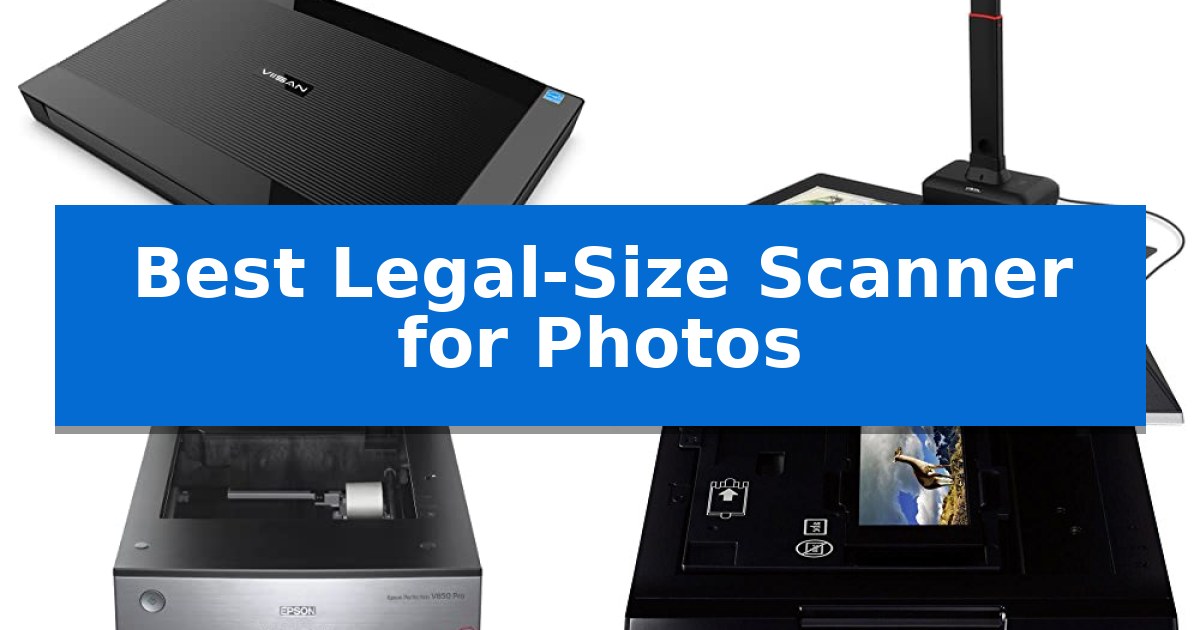
Digitizing oversized prints, legal documents, or large-format artwork requires hardware that goes beyond standard letter-sized scanning capabilities. Finding the Best Legal-Size Scanner for Photos means balancing scan area, resolution, and the specific technology needed to handle delicate originals without damage.
Whether you are archiving family photo albums or digitizing professional design work, selecting the right scanner depends on your workflow and the physical size of your media. This guide evaluates five distinct models to help you identify which device best fits your specific digitization project.
You may also want to compare Best Legal-Size Printer, Copier, and Scanner for Home Offices, Best Legal-Size Printer Scanner, and Best Legal-Size Flatbed Scanner.
Best Legal-Size Scanner for Photos
Quick Comparison
| Product | Best For | Key Strength | Score |
|---|---|---|---|
| VIISAN 3120 A3 Flatbed Scanner | Best Overall | Large A3 scanning area for oversized documents. | 4.9 |
| VIISAN S21 A2 Book Scanner | Captures Extra Large Formats | Large format A2 scanning area supports documents up to 594×420 mm. | 4.9 |
| Epson Perfection V850 Pro Scanner | Professional Quality Photo Restoration | Dual lens system for optimized scanning results across different media types. | 4.8 |
| Epson Perfection V550 Photo Scanner | Restores Faded Film and Prints | 6400 dpi optical resolution for high-quality enlargements | 4.3 |
| Canon CanoScan LiDE 400 Scanner | Slim Design for Standard Photos | Ultra-slim 0.4-inch profile for easy storage and space efficiency. | 4.6 |
How We Chose
- Maximum scan area and document format support.
- Optical resolution and color depth capabilities.
- Scanning speed for high-volume or large-format tasks.
- Compatibility with operating systems and driver support.
- Ease of use features like auto-scan or document flattening.
1 VIISAN 3120 A3 Flatbed Scanner — Handles Oversized Documents Easily
The VIISAN 3120 A3 Flatbed Scanner simplifies the digitization of large-format materials through its expansive 11.98" x 16.8" scanning area. This device is specifically engineered for users who need to capture oversized items like painting albums, CAD drawings, and newspapers without the need for complex stitching software.
Equipped with a CIS sensor and an LED light source, the scanner requires no warm-up time, allowing for immediate operation. It achieves a maximum optical resolution of 1200 x 1200 dpi, providing 48-bit color depth for detailed image reproduction. For high-efficiency workflows, the Auto-Scan function triggers the capture process automatically once the lid is closed.
The unit features a frameless and narrow boundary design, which accommodates thick books and magazines that might otherwise be difficult to position on a standard flatbed. Users can utilize the four-panel buttons to quickly initiate scanning, printing, or PDF creation. It is compatible with Windows TWAIN, WIA, and MacOS ICA drivers, ensuring integration with standard desktop operating systems.
To maintain image quality, the scanner includes a universal power adapter compatible with standard global voltage requirements. While the scanner is highly capable for flat paper documents, it is important to note that it is not intended for three-dimensional objects, which may result in blurred output. Regular maintenance, such as cleaning the glass, is recommended to prevent the appearance of white lines during the scanning process.
Best for: Users requiring a large-format flatbed scanner for digitizing oversized documents, books, and artwork up to A3 size.
Skip if: Users who need to scan three-dimensional objects or require a compact, portable device for travel.
PROS
- Large A3 scanning area for oversized documents.
- No warm-up time due to LED light source.
- Auto-Scan function for efficient continuous operation.
- High optical resolution up to 1200 dpi.
CONS
- Not suitable for three-dimensional items.
- WIA driver limited to 600 dpi.
2 VIISAN S21 A2 Book Scanner — Captures Extra Large Formats
Digitizing large-format archives requires a device capable of capturing expansive surfaces without the limitations of traditional flatbed glass. The VIISAN S21 A2 Book Scanner addresses this by utilizing an overhead document camera design, allowing for a maximum capture area of 594×420 mm. This setup is specifically engineered for users who need to scan oversized manuscripts, maps, and large journals that exceed standard legal-size constraints.
The scanner achieves high-resolution output up to 26MP, with software-enhanced capabilities reaching 600 DPI to ensure fine detail in historical documents or photographic prints. Its 90-degree foldable hinge and adjustable height allow the camera to switch between A2 and A3 formats, providing the flexibility needed for different document sizes. Integrated 3-level LED light control helps maintain consistent illumination, though the manufacturer advises against using the lights in already bright environments or on highly reflective, glary paper surfaces.
Workflow efficiency is managed through the bundled scanning software, which includes intelligent image processing features. This software can automatically flatten curved pages, remove fingerprints, repair damaged edges, and split double-page spreads into individual files. The inclusion of multi-language OCR allows for the conversion of scanned materials into editable formats like Word, Excel, or PDF, streamlining the transition from physical archives to digital storage.
Compatibility is a primary consideration for this unit. The VIISAN S21 A2 Book Scanner is a UVC/UAC compliant device, enabling it to function as a camera for remote collaboration or video recording. Users should note that the bundled OfficeCam software is restricted to x64 and x86 architectures on Windows and macOS; it is not compatible with ARM-based devices such as the Surface Pro X. The unit includes a scan pad and a manual button to facilitate quick, hands-free image capture.
Best for: Archivists and researchers requiring a high-resolution overhead solution for scanning oversized documents, maps, and bound books up to A2 size.
Skip if: Users operating on ARM-based hardware or those who require a traditional flatbed scanner for high-pressure contact scanning of fragile, non-flat items.
PROS
- Large format A2 scanning area supports documents up to 594×420 mm.
- Intelligent software provides automatic page flattening and fingerprint removal.
- High resolution 26MP sensor captures fine details for archival quality.
- Adjustable overhead design with a 90-degree foldable hinge for portability.
CONS
- Incompatible with ARM-based devices such as the Surface Pro X.
- Not recommended for use with highly reflective or glary paper.
3 Epson Perfection V850 Pro Scanner — Professional Quality Photo Restoration
Achieving high-fidelity digital archives requires precision optics, and the Epson Perfection V850 Pro Scanner addresses this with an exclusive dual lens system. This hardware-level design automatically selects the optimal lens for the task, ensuring clarity whether you are scanning standard photos or high-resolution transparencies.
The device is engineered for demanding workflows, featuring a 6400 dpi resolution that captures minute details and textures. To ensure professional-grade color accuracy and depth, it utilizes a 4.0 Dmax tonal range, which provides smooth gradations and maintains integrity in deep shadow areas. This combination of high resolution and dynamic range makes it a capable tool for digitizing legacy photo collections.
Usability is enhanced by Digital ICE technology, which is integrated to assist in the restoration process by identifying and reducing the appearance of surface defects on physical prints. The scanner is compatible with a wide range of operating systems, including Windows and Mac OS X, allowing for integration into various existing computing environments.
Measuring 19.8 inches in width and 12.1 inches in length, the unit is built with a substantial footprint to accommodate larger media. While its weight of 20.9 pounds reflects its robust construction, it remains a stationary solution for those prioritizing image quality and archival-grade performance over portability.
Best for: Professional photographers and archivists requiring high-resolution digital preservation of photos and transparencies.
Skip if: Users seeking a compact, portable, or lightweight scanner for casual, occasional document scanning.
PROS
- Dual lens system for optimized scanning results across different media types.
- 6400 dpi resolution for capturing fine detail and professional-grade clarity.
- 4.0 Dmax tonal range provides excellent shadow detail and smooth color transitions.
- Digital ICE technology assists in the digital restoration of damaged physical media.
CONS
- Substantial 20.9-pound weight makes the unit difficult to move or store frequently.
- Large physical footprint requires significant dedicated desk space.
4 Epson Perfection V550 Photo Scanner — Restores Faded Film and Prints
Preserving physical archives requires precision, and the Epson Perfection V550 Photo Scanner addresses this by integrating a built-in transparency unit specifically for 35mm slides, negatives, and film. This design choice allows users to digitize delicate historical media alongside standard documents, making it a versatile tool for both personal photo restoration and office-grade scanning tasks.
Performance is driven by a 6400 dpi optical resolution, which enables the creation of sharp, vivid reproductions suitable for enlargements up to 17 x 22 inches. The device utilizes Digital ICE technology to automatically detect and remove the appearance of dust and scratches from film, simplifying the restoration process. For those managing large batches of prints, the scanner features auto edge detection that identifies multiple photos on the scan bed and saves them as individual files.
Efficiency is a core component of the hardware, featuring ReadyScan LED technology that eliminates warmup time and removes mercury from the light source. The unit connects via Hi-Speed USB 2.0 and includes ABBYY FineReader Sprint Plus OCR software to convert scanned documents into editable text, enhancing productivity for administrative workflows.
With a 48-bit color depth, the scanner captures true-to-life colors, ensuring that digital copies remain faithful to the original media. While the unit provides robust restoration tools, users should note its physical footprint, measuring 11.2 inches in width and 19.1 inches in length, which requires dedicated desk space for operation.
Best for: Users who need a versatile scanner capable of digitizing both standard documents and high-resolution film or photo negatives.
Skip if: Users who require a compact, portable scanner or those who do not have a need for film and negative digitization.
PROS
- 6400 dpi optical resolution for high-quality enlargements
- Digital ICE technology for automated dust and scratch removal
- ReadyScan LED technology for instant scanning with no warmup
- Auto edge detection for efficient multi-photo scanning
CONS
- Large physical footprint may not fit on smaller desks
5 Canon CanoScan LiDE 400 Scanner — Slim Design for Standard Photos
Preserving physical memories requires a reliable bridge between analog prints and digital archives. The Canon CanoScan LiDE 400 Slim Scanner addresses this need with a remarkably compact footprint, measuring just 0.4 inches in height, which allows it to fit easily into crowded workspaces or storage areas when not in use.
This scanner simplifies the digitization process by utilizing a single USB Type-C cable for both data transfer and power, reducing cable clutter. It is engineered for efficiency, capable of scanning documents and photos in as fast as 8 seconds. For those looking to maintain high fidelity, the device supports a 4800 x 4800 dpi resolution, ensuring that fine details in your photographs are captured accurately.
Usability is a core focus, highlighted by the inclusion of 'EZ' buttons. These controls facilitate an auto scan mode that intelligently detects the item being digitized, alongside dedicated buttons for generating editable and searchable PDF files. To further refine your output, the scanner includes integrated image enhancement tools, such as color restore and dust removal, which help revitalize older or worn photographs during the scanning process.
While this model excels at handling standard document and photo sizes up to 8.50 x 11.69 inches, its slim design prioritizes portability and desk space. It is an effective solution for users who require a dedicated, high-resolution tool for personal photo collections and standard office documents without the bulk of traditional flatbed hardware.
Best for: Home users and hobbyists who need a space-saving, high-resolution solution for digitizing standard-sized photos and documents.
Skip if: Users requiring support for legal-size documents (8.5 x 14 inches) or those needing a high-volume automatic document feeder will find this flatbed model insufficient.
PROS
- Ultra-slim 0.4-inch profile for easy storage and space efficiency.
- Single USB Type-C connection handles both power and data.
- High 4800 x 4800 dpi resolution for detailed image capture.
- Integrated image enhancement tools like dust removal and color restore.
CONS
- Limited to standard letter size scanning area.
- Lacks an automatic document feeder for multi-page batch scanning.
Best Legal-Size Scanner for Photos Buying Guide
Understanding Scan Area and Format
The primary differentiator for a legal-size scanner is its physical bed or capture area. While standard scanners are limited to 8.5 x 11 inches, legal-size and large-format scanners provide the necessary surface area to capture 11 x 17 inch or larger documents in a single pass.
Choosing the right size prevents the need for stitching multiple images together, which often results in alignment errors or visible seams. Always verify the maximum dimensions supported by the scanner bed to ensure your largest photos fit comfortably.
Resolution and Image Quality
For photo restoration and archiving, optical resolution is critical. A higher DPI (dots per inch) allows you to capture fine details, textures, and color gradients that are essential for high-quality enlargements or professional printing.
Look for scanners that offer at least 600 to 1200 DPI for photos. Higher resolution settings are particularly beneficial if you plan to crop or edit your images later, as they provide more data for software-based enhancements.
Sensor Technology: Flatbed vs. Overhead
Flatbed scanners use CIS or CCD sensors to capture images by moving a light source directly beneath the glass. This is ideal for flat, high-resolution photo scanning where contact with the glass is possible.
Overhead document cameras, or book scanners, use a camera mounted above the document. These are superior for thick books, bound albums, or fragile items that cannot be laid flat, often featuring software to flatten curved pages automatically.
Software and Workflow Integration
The software bundle included with your scanner determines how easily you can manage your digital files. Features like auto-crop, edge detection, and OCR (Optical Character Recognition) can significantly reduce the time spent on post-processing.
Ensure the scanner is compatible with your current operating system, whether Windows or macOS. Some high-resolution features may require specific proprietary software, so check driver support for your preferred platform before purchasing.
Maintenance and Longevity
Scanners, particularly flatbed models, require regular cleaning to prevent dust or debris from appearing as lines on your scans. Look for designs that are easy to access and clean, as this will extend the life of your device.
Consider the build quality and warranty support offered by the manufacturer. A reliable scanner should have a sturdy lid hinge and a robust sensor unit that can withstand frequent use over several years.
Frequently Asked Questions
Can I scan 3D objects with these scanners?
Most flatbed scanners use CIS sensors designed specifically for flat paper images. Scanning 3D objects on a flatbed can lead to blurred results. Some overhead scanners are better suited for capturing 3D objects.
Do I need special software for 1200 DPI scanning?
Yes, for some models, the maximum optical resolution may only be accessible through the manufacturer's provided software, as standard system drivers like WIA may have lower limits.
What is the difference between A3 and A2 scanning?
A3 is roughly 11.7 x 16.5 inches, while A2 is significantly larger at 16.5 x 23.4 inches. Choose based on the largest document you intend to digitize.
How do I remove white lines from my scans?
White lines are typically caused by dust or debris on the scanner glass. Simply cleaning the glass surface with a soft, lint-free cloth usually resolves this issue.
Are these scanners compatible with ARM-based computers?
Compatibility varies by model. Always check the manufacturer's specifications, as some scanning software is optimized only for x64 or x86 architectures and may not support ARM devices.
Conclusion: Our Top Pick
Selecting the right equipment is essential for preserving your large-format media. For most users needing a balance of high resolution, speed, and a generous scan area, the VIISAN 3120 A3 Flatbed Scanner stands out as the most versatile choice for legal-size and oversized document digitization.
While other models offer specialized features like film restoration or overhead capture, the VIISAN 3120 provides a reliable, high-resolution flatbed experience that handles large documents efficiently. Ensure your workspace can accommodate its footprint before finalizing your purchase.