
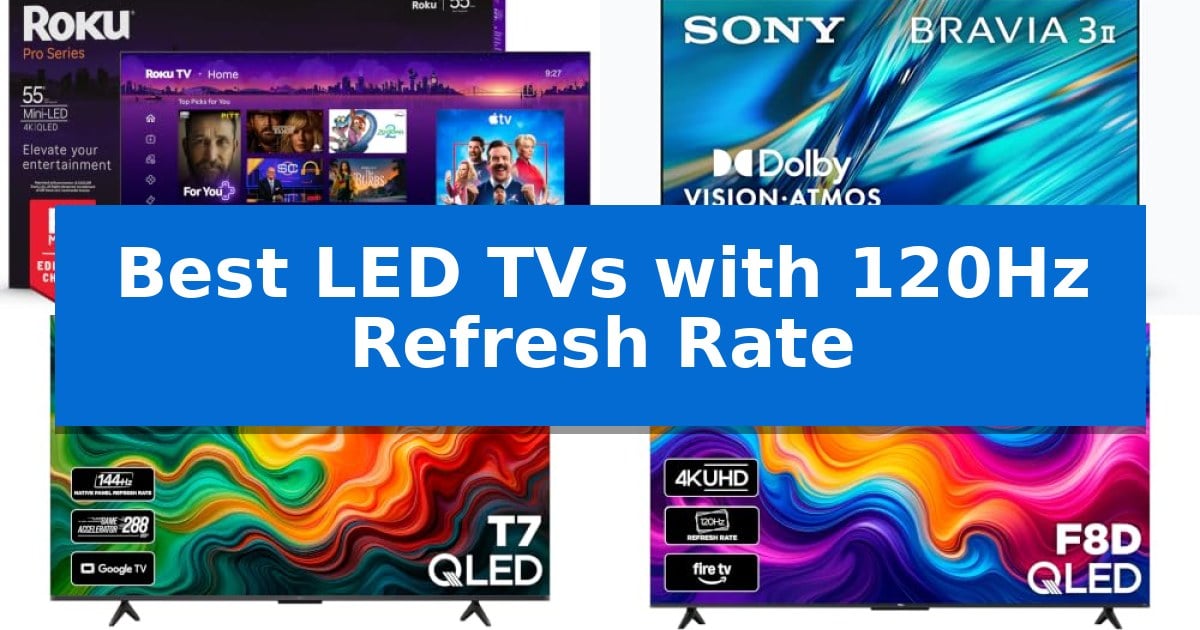
Finding the right display for fast-paced content requires more than just high resolution. When watching live sports or engaging in competitive gaming, the ability to render frames quickly is essential to eliminate blur and stutter. The Best LED TVs with 120Hz Refresh Rate provide the necessary frame-per-second throughput to ensure that every movement remains crisp and fluid, regardless of how intense the action becomes on screen.
Selecting a television with a native high refresh rate involves balancing panel technology, input lag, and smart features. Whether you are looking for deep contrast for movies or responsive connectivity for your console, understanding how these displays handle motion is key to a satisfying setup. We have analyzed the latest options to help you identify which model aligns with your specific viewing habits and hardware requirements.
You may also want to compare Best LED TVs Under 40 Inches, Best LED TVs Under 30 Inches, and Best LED TVs Over 75 Inches.
Best LED TVs with 120Hz Refresh Rate
Quick Comparison
| Product | Best For | Key Strength | Score |
|---|---|---|---|
| Roku Pro Series Smart TV | Best Overall | 120Hz refresh rate for fluid motion in gaming and sports. | 4.9 |
| Sony BRAVIA 3 II LED Smart TV | Optimized for PlayStation Gaming | HDMI 2.1 support across four ports for 4K/120Hz gaming. | 4.5 |
| TCL T7 Series Smart TV | High-Performance Motion Clarity | Native 120Hz refresh rate for fluid motion clarity. | 4.5 |
| TCL F8D Series Smart TV | Bright Picture for Lit Rooms | Native 120Hz refresh rate for fluid motion | 4.5 |
How We Chose
- Native 120Hz refresh rate support for blur-free motion.
- Integration of VRR (Variable Refresh Rate) and ALLM (Auto Low Latency Mode) for gaming.
- Panel brightness and contrast capabilities, including QLED and Mini-LED technologies.
- Connectivity options, specifically the presence of HDMI 2.1 ports for high-bandwidth signals.
- Smart platform usability and integration with home ecosystem devices.
1 Roku Pro Series Smart TV — Best for Intuitive Navigation
The Roku 55-Inch Pro Series Smart TV is engineered for fluid motion, utilizing a native 120Hz refresh rate to ensure smooth transitions during fast-paced sports and high-intensity gaming. This display integrates advanced QLED Mini-LED technology, which leverages thousands of individual diodes to produce deeper contrast and vivid color accuracy.
Designed for seamless integration, the unit features a custom mount that allows the screen to sit flush against the wall, maintaining a clean aesthetic. The Roku Smart Picture Max system uses AI to automatically refine incoming signals, adjusting sharpness and color settings in real-time to optimize the visual output for various content types.
For gaming enthusiasts, the Roku 55-Inch Pro Series Smart TV includes an automatic game mode that activates Freesync Premium Pro, ALLM, and VRR to minimize screen tearing and latency. The audio experience is supported by Roku Soundstage Audio and Dolby Atmos, providing immersive sound through side-firing speakers.
Usability is prioritized through the included Backlit Voice Remote Pro, which is fully rechargeable and features a built-in remote finder activated by a button on the TV chassis. The interface is built on the Roku platform, offering a simplified home screen and a dedicated star key that allows users to turn off the display while keeping the audio stream active.
Best for: Users who prioritize a simplified smart interface and high-refresh-rate gaming features in a slim, wall-mountable design.
Skip if: Viewers seeking a larger screen size or those who require specific advanced professional calibration tools not included in the Roku Smart Picture Max AI suite.
PROS
- 120Hz refresh rate for fluid motion in gaming and sports.
- Mini-LED QLED panel for enhanced contrast and brightness.
- Rechargeable backlit remote with integrated remote finder.
- Tool-less stands with two height options for flexible placement.
CONS
- Fixed 55-inch size may not suit all room dimensions.
- AI-only picture optimization limits manual calibration depth.
2 Sony BRAVIA 3 II LED Smart TV — Optimized for PlayStation Gaming
The Sony BRAVIA 3 II LED Smart TV is engineered with a focus on high-performance gaming and cinematic immersion, featuring a dedicated 120Hz refresh rate that ensures fluid motion for both sports and fast-paced action. Its XR Processor utilizes AI scene recognition to dynamically optimize color, contrast, and clarity, while XR Clear Image technology works to reduce noise and restore detail in real-time.
Designed with the PlayStation 5 in mind, this model includes specialized gaming features such as Auto HDR Tone Mapping and Auto Genre Picture Mode. The inclusion of four HDMI 2.1 ports supports 4K/120Hz, Variable Refresh Rate (VRR), and Auto Low Latency Mode (ALLM), providing a responsive interface for high-performance gaming setups.
Visuals are enhanced by XR Triluminos Pro, which reproduces over a billion colors, and support for Dolby Vision and Dolby Atmos creates a surround-sound experience. The X-Balanced Speakers are integrated to deliver improved sound resolution and deeper bass, housed within a Flush Surface design that minimizes the bezel for a clean, modern aesthetic.
The Google TV interface provides access to a vast library of content, now integrated with Gemini AI to assist with content discovery and smart home control. Owners also receive 5 movie credits and a 12-month subscription to SONY PICTURES CORE, offering high-quality streaming options right out of the box.
Best for: This TV is best for PlayStation 5 gamers and movie enthusiasts who prioritize high-refresh-rate gaming and AI-enhanced cinematic picture quality.
Skip if: Skip this model if you require a larger screen size, as this specific unit is limited to a 43-inch form factor.
PROS
- HDMI 2.1 support across four ports for 4K/120Hz gaming.
- AI-driven picture optimization via the XR Processor.
- PS5-exclusive features like Auto HDR Tone Mapping.
- Immersive audio support with Dolby Atmos and DTS:X.
CONS
- Limited to 43-inch size, which may not suit large living room setups.
3 TCL T7 Series Smart TV — High-Performance Motion Clarity
Achieving fluid motion in fast-paced content requires hardware capable of high-speed signal processing. The TCL 55 Inch T7 Series 4K 120Hz QLED Smart Google TV addresses this by integrating a native 120Hz refresh rate panel, ensuring that rapid movements in sports and gaming remain sharp and free of motion blur.
Beyond its refresh rate, the TCL T7 Series Smart TV utilizes the TCL AIPQ Pro Processor to manage image quality. This component works alongside Quantum Dot Technology (QLED) to expand color reproduction across the DCI-P3 color space, while HDR PRO+ support—including Dolby Vision and HDR10+—optimizes contrast and brightness for high-dynamic-range content.
For gamers and home theater enthusiasts, the inclusion of Game Accelerator 240 and VRR (Variable Refresh Rate) provides tools to synchronize the display with console output, reducing potential screen tearing. Audio is handled through Dolby Atmos processing, which provides spatial sound capabilities for a more immersive experience.
Connectivity is centered around four HDMI inputs, including one with eARC for seamless integration with external soundbars or receivers. The Google TV interface consolidates streaming services, while built-in Chromecast and Apple AirPlay 2 support offer flexible content sharing options from mobile devices.
The 55-inch form factor, measuring 48.2 inches in width and 27.9 inches in height, fits standard media consoles. With Voice Control compatibility for Alexa, Google Assistant, and Apple HomeKit, the unit provides multiple avenues for hands-free management of your entertainment environment.
Best for: Gamers and sports fans who require a native 120Hz refresh rate and VRR support for smooth, high-motion content.
Skip if: Users who prioritize ultra-wide viewing angles or specific OLED-level contrast ratios, as this QLED model uses a different panel technology.
PROS
- Native 120Hz refresh rate for fluid motion clarity.
- QLED Quantum Dot Technology for vibrant color reproduction.
- Game Accelerator 240 and VRR support for optimized gaming performance.
- Comprehensive HDR support including Dolby Vision and HDR10+.
CONS
- Wi-Fi 5 connectivity may be slower than newer Wi-Fi 6 or 7 standards for high-bandwidth streaming.
4 TCL F8D Series Smart TV — Bright Picture for Lit Rooms
The TCL F8D Series Smart TV is engineered for high-motion content, utilizing a native 120Hz refresh rate paired with Motion Rate 480 to maintain clarity during fast-paced sports and action sequences. This 50-inch model integrates Quantum Dot Color technology, which covers nearly the entire DCI-P3 spectrum, ensuring that 4K visuals remain vivid and accurate across various lighting conditions.
For gamers, the display includes Variable Refresh Rate (VRR) and Auto Game Mode (ALLM), which work in tandem to reduce input lag and provide a more responsive experience. The Game Accelerator 240 feature further optimizes motion handling, making this a capable choice for those who prioritize smooth transitions in competitive or fast-moving titles.
The television features a High Brightness LED Backlight designed to combat glare in well-lit rooms, supported by Dolby Vision HDR and HDR10+ for enhanced contrast and deeper black levels. Audio is handled by built-in speakers with Dolby Atmos and DTS Virtual:X support, providing a multi-dimensional sound profile without requiring an external soundbar.
Connectivity is robust, offering four HDMI inputs—including one with ARC/eARC—alongside Bluetooth 5.4 and Apple AirPlay 2. The integrated Fire TV platform provides a centralized hub for streaming, while Alexa+ allows for natural voice commands to manage smart home devices, view live camera feeds, and navigate content libraries.
Best for: This TV is best for users who need a responsive display for gaming and fast-motion sports while maintaining smart home integration.
Skip if: Skip this model if you require a screen larger than 50 inches or if your specific setup demands more than one high-bandwidth HDMI 2.1-style port for advanced multi-console configurations.
PROS
- Native 120Hz refresh rate for fluid motion
- Quantum Dot Color for wide color gamut coverage
- VRR and Auto Game Mode for reduced input lag
- Alexa+ integration for comprehensive smart home control
CONS
- 50-inch fixed size may be too small for large home theater spaces
Best LED TVs with 120Hz Refresh Rate Buying Guide
Understanding Refresh Rates and Motion
A 120Hz refresh rate means the television updates the image on the screen 120 times per second. This is double the standard 60Hz rate found on entry-level displays, resulting in significantly smoother motion during fast camera pans in sports or rapid movements in video games. When paired with motion enhancement technologies, this high refresh rate effectively reduces the ghosting and blurring that can occur during high-speed sequences.
It is important to distinguish between native refresh rates and software-based motion interpolation. A native 120Hz panel provides a hardware-level advantage that cannot be replicated by software alone. For gamers, this native capability is often paired with Variable Refresh Rate (VRR), which synchronizes the TV's refresh rate with the output of the gaming console to prevent screen tearing.
Connectivity and HDMI 2.1
To take full advantage of a 120Hz panel, your source device must be able to send a 4K 120Hz signal, which requires HDMI 2.1 connectivity. Not all HDMI ports on a television are created equal; often, only one or two ports on a set will support the full bandwidth required for high-frame-rate gaming. Always check that your chosen model has enough high-speed ports to accommodate your consoles and soundbars simultaneously.
The inclusion of eARC (enhanced Audio Return Channel) on these ports allows for high-quality, uncompressed audio transmission to compatible soundbars or receivers. This ensures that your audio setup keeps pace with the visual performance, creating a cohesive home theater experience without the need for complex cabling.
Panel Technology: QLED and Mini-LED
Many modern 120Hz displays utilize QLED (Quantum Dot Technology), which uses a layer of nanoparticles to enhance color volume and brightness. This results in more vibrant, true-to-life colors that cover a wider spectrum than traditional LED panels. When combined with Mini-LED backlighting, these TVs can achieve deeper blacks and higher peak brightness, providing a more impactful HDR experience.
The trade-off with high-brightness panels is often related to room lighting. Displays with high peak brightness are generally better suited for well-lit rooms where glare might otherwise wash out the image. Conversely, in dark-room environments, the precision of local dimming zones becomes the primary factor in maintaining contrast and preventing light bleed.
Gaming-Specific Features
Beyond the refresh rate, gamers should look for features like Auto Game Mode (ALLM) and Freesync Premium Pro. ALLM automatically switches the TV to its lowest latency setting when it detects a gaming console, ensuring that controller inputs are registered instantly. This is critical for competitive titles where every millisecond counts.
Some models also include a dedicated Game Menu or dashboard, allowing users to quickly adjust picture settings, enable crosshairs, or monitor frame rates without navigating through deep system menus. These tools provide a streamlined experience that keeps the focus on gameplay rather than technical configuration.
Smart Platform Ecosystems
The smart platform powering your TV determines how easily you can access content. Whether it is Roku TV, Google TV, or Fire TV, each offers a different approach to navigation and app availability. Consider which ecosystem integrates best with your existing smart home devices, such as voice assistants or mobile casting protocols like AirPlay 2.
User interfaces vary in complexity, with some platforms prioritizing content recommendations while others focus on a clean, simplified home screen. A responsive processor is essential for a smooth experience, as it ensures that apps launch quickly and the interface remains snappy even when switching between high-demand streaming services.
Frequently Asked Questions
Do I need an HDMI 2.1 cable for 120Hz gaming?
Yes, to achieve 4K resolution at 120Hz, you must use a high-bandwidth HDMI cable (often labeled Ultra High Speed) connected to an HDMI 2.1 port on both the TV and the source device.
Is 120Hz necessary for watching movies?
Most movies are filmed at 24 frames per second. While a 120Hz TV is not strictly necessary for movies, it can help with motion processing to reduce judder, provided the TV supports proper motion handling settings.
What is the difference between native 120Hz and motion rate?
Native 120Hz refers to the physical panel's ability to refresh 120 times per second. 'Motion Rate' or similar marketing terms often combine the panel's native speed with software-based backlight strobing or frame insertion to simulate smoother motion.
Can I use a 120Hz TV with a standard 60Hz console?
Yes, a 120Hz TV is backward compatible with 60Hz devices. The TV will simply refresh at the rate provided by the source device.
Does a 120Hz refresh rate increase power consumption?
Generally, running a panel at a higher refresh rate and higher brightness settings can increase power consumption compared to standard 60Hz operation, though the impact is usually minimal for most users.
Conclusion: Our Top Pick
Selecting the right display depends on balancing your specific needs for gaming, sports, or cinematic viewing. For those seeking a versatile option that excels in ease of use and visual performance, the Roku 55-Inch Pro Series Smart TV stands out as a top choice. Its combination of a 120Hz refresh rate, AI-powered picture optimization, and an intuitive interface makes it a strong contender for any living room setup.
While the Roku Pro Series offers excellent motion clarity and gaming features like Freesync Premium Pro, ensure your room layout accommodates the 55-inch size and that you have the necessary high-speed HDMI cables to support its full capabilities. By focusing on these core requirements, you can enjoy a fluid and immersive viewing experience.