
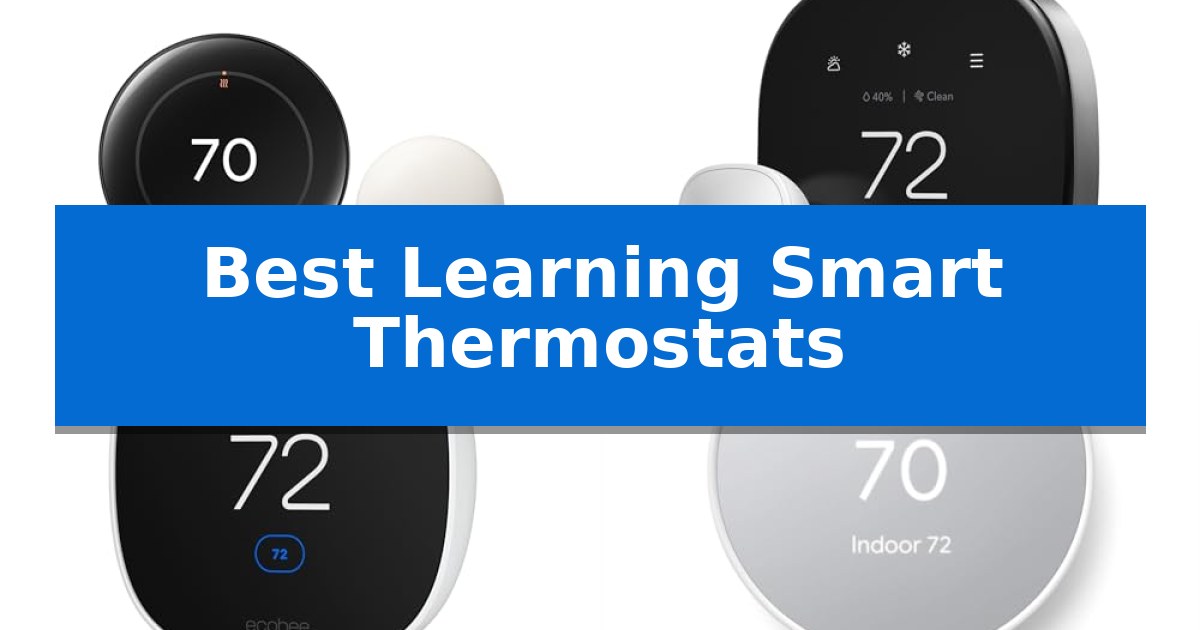
Managing your home's climate shouldn't require constant manual adjustments or complex programming. The Best Learning Smart Thermostats utilize advanced algorithms to understand your temperature preferences and daily routines, automatically creating schedules that maximize both comfort and energy efficiency.
Whether you are looking to reduce utility costs or integrate climate control into a broader smart home ecosystem, selecting the right device depends on your specific HVAC system and automation needs. We have analyzed the leading models to help you find a solution that balances intelligent features with ease of use.
You may also want to compare Best Learning Microscopes, Best Learning Laptops, and Best Learning Apps for Android Tablets.
Best Learning Smart Thermostats
Quick Comparison
| Product | Best For | Key Strength | Score |
|---|---|---|---|
| Google Nest Learning Thermostat | Best Overall | Matter compatibility for seamless smart home integration. | 4.9 |
| ecobee Smart Thermostat Premium | Occupancy Sensing for Room Comfort | SmartSensor inclusion for room-specific temperature management. | 4.4 |
| ecobee Smart Thermostat Essential | Efficient Scheduling for Busy Homes | Energy-saving scheduling that optimizes heating and cooling based on occupancy. | 4.3 |
| Google Nest Thermostat | Budget-Friendly Energy Saving Automation | ENERGY STAR certified for efficient energy management | 4.5 |
| Sensi Lite Smart Thermostat | Simple Geofencing Energy Control | No C-wire required for most standard home HVAC installations. | 4.5 |
How We Chose
- HVAC System Compatibility: Verification of support for standard 24V systems and C-wire requirements.
- Automation Capability: Assessment of AI-driven learning, occupancy sensing, and geofencing features.
- Smart Home Integration: Compatibility with major platforms like Google Home, Alexa, and Apple HomeKit.
- Energy Management: Availability of usage reports, eco-modes, and scheduling flexibility.
- Installation Complexity: Ease of setup and availability of power-extending accessories.
1 Google Nest Learning Thermostat — Advanced AI-Driven Climate Learning
The Google Nest Learning Thermostat (4th gen) simplifies climate management through its Dynamic Farsight display, which offers a 60% larger viewing area compared to its predecessors. This device is engineered to learn your preferences and environmental factors, such as how sunlight naturally warms your home, to optimize heating and cooling cycles automatically.
Installation is designed for versatility, as the unit is compatible with most 24V systems including heat pumps, forced air, and radiant heating, typically requiring no C-wire. For integrated smart home management, it supports Matter and allows for remote adjustments via the Google Home app or voice commands through Siri, Alexa, and Google Assistant.
To address uneven temperatures, this package includes the Nest Temperature Sensor (2nd gen). By placing this sensor in specific rooms, you can prioritize comfort in frequently used spaces rather than just the area where the thermostat is mounted. The system also features Adaptive Eco, which intelligently adjusts temperatures when you are away to support energy savings.
Visibility into your energy usage is enhanced through the app, where the thermostat requests permission before implementing schedule changes. This transparency ensures you remain in control of your home's climate while benefiting from the device's automated learning capabilities.
Best for: Homeowners seeking an automated, energy-efficient climate control system that integrates with major smart home ecosystems and addresses temperature inconsistencies across multiple rooms.
Skip if: Users who prefer a purely manual thermostat without remote connectivity, app-based scheduling, or AI-driven learning features.
PROS
- Matter compatibility for seamless smart home integration.
- No C-wire required for most standard 24V heating and cooling systems.
- Dynamic Farsight display provides clear, readable information from across the room.
- Included temperature sensor helps manage hot and cold spots in specific rooms.
CONS
- Requires app permission for schedule changes, which may not suit users wanting a 'set and forget' system without digital interaction.
2 ecobee Smart Thermostat Premium — Occupancy Sensing for Room Comfort
Managing home comfort often requires balancing energy efficiency with consistent temperature control across multiple rooms. The ecobee Smart Thermostat Premium addresses this by utilizing an included SmartSensor to monitor occupancy and temperature in specific rooms, preventing the common issue of overheating or overcooling areas that are currently unoccupied.
Beyond basic scheduling, this device features a built-in radar occupancy sensor that learns your daily routine to automatically adjust settings for comfort and energy savings. It is ENERGY STAR certified, with the manufacturer noting potential energy bill savings of up to 26% compared to a static hold temperature. The unit also integrates an air quality monitor that tracks indoor air health and provides maintenance reminders for furnace filters.
The hardware is designed for versatility, featuring a large, vibrant display with a metal finish and a built-in smart speaker compatible with Siri or Alexa. This allows for voice control of home systems and streaming audio. For added security, the thermostat can detect smoke alarm sounds and alert you remotely, provided you have an active subscription. It also supports two-way talk and live streaming when paired with an ecobee Smart Doorbell Camera.
Installation is designed for accessibility, including a Power Extender Kit (PEK) for systems lacking a C-wire and a trim kit for a clean aesthetic. The device is compatible with approximately 95% of HVAC systems, and users can verify their specific setup via the manufacturer's online compatibility checker. A 3-year manufacturer warranty is included to support long-term operation.
Best for: Homeowners seeking to optimize energy usage and comfort across multiple rooms using occupancy-based automation and voice-controlled smart home integration.
Skip if: Users who do not have a compatible HVAC system or those who prefer a basic, non-connected manual thermostat without smart features or subscription-based security services.
PROS
- SmartSensor inclusion for room-specific temperature management.
- Built-in air quality monitor with filter change alerts.
- Broad HVAC compatibility with included Power Extender Kit.
- Integrated voice assistant support for Siri and Alexa.
CONS
- Subscription required for advanced security features like smoke alarm detection.
- Apple home hub required to enable Siri functionality.
3 ecobee Smart Thermostat Essential — Efficient Scheduling for Busy Homes
Maintaining an ideal home climate while managing energy consumption is a primary goal for many households. The ecobee Smart Thermostat Essential addresses this by providing automated scheduling that adjusts heating and cooling based on your presence, helping to reduce energy costs by up to 23% annually compared to a constant 72-degree hold.
## Best Learning Smart Thermostats
### 1 ecobee Smart Thermostat Essential – Efficient Scheduling for Busy Homes
The ecobee Smart Thermostat Essential features a color touchscreen for manual adjustments, though it also integrates with the ecobee app for remote monitoring. It is designed for broad compatibility, working with approximately 85% of HVAC systems, including gas, oil, electric, and heat pump configurations. For homes lacking a C-wire, the system supports the use of a separately sold Power Extender Kit (PEK) to facilitate installation.
Beyond basic temperature control, the device includes eco+ Smart Features such as indoor humidity detection and a schedule assistant. These tools allow for time-of-use adjustments, enabling the thermostat to preheat or precool your home when energy rates are lower. The unit is also compatible with major smart home ecosystems, including Apple HomeKit, Google Assistant, and Alexa, allowing for voice-controlled climate management.
To expand its monitoring capabilities, the thermostat can be paired with optional SmartSensors. These sensors detect both temperature and movement in specific rooms, providing more granular control over your home's comfort. With its compact 3.62-inch by 3.62-inch footprint, the unit is designed to fit discreetly on most walls.
Best for: Homeowners seeking an energy-efficient, app-controlled thermostat that integrates with major smart home ecosystems.
Skip if: Users who require a C-wire installation and are unwilling to purchase a separate Power Extender Kit for older HVAC systems.
PROS
- Energy-saving scheduling that optimizes heating and cooling based on occupancy.
- Broad compatibility with 85% of HVAC systems.
- Integrated eco+ Smart Features for humidity detection and peak-hour energy management.
- Seamless smart home ecosystem integration with Apple, Google, and Amazon platforms.
CONS
- Requires separate purchase of a Power Extender Kit for homes without a C-wire.
- SmartSensors sold separately for multi-room monitoring.
4 Google Nest Thermostat — Budget-Friendly Energy Saving Automation
Managing home energy consumption often feels like a constant balancing act between comfort and utility costs. The Google Nest Thermostat addresses this by utilizing ENERGY STAR certified automation to adjust temperatures when you leave the house, ensuring you are not heating or cooling an empty space.
Designed for modern connectivity, this Wi-Fi enabled device integrates seamlessly with Google Home, Google Assistant, and Matter-certified voice assistants. Users can manage their climate settings remotely via the Google Home app on Android or iPhone, providing flexibility to adjust temperatures from anywhere.
The Google Nest Thermostat includes a Savings Finder feature that proactively suggests schedule tweaks to improve efficiency. Additionally, the system provides HVAC monitoring, which tracks your heating and cooling performance and sends alerts if the system detects potential issues, helping to simplify routine maintenance.
Installation is straightforward for many households, as the unit is designed to function without a C wire in most setups. However, users with specific configurations—such as heating-only, cooling-only, zone-controlled, or heat pump systems—may require a C wire or a compatible power accessory to ensure consistent operation.
Best for: Homeowners seeking an energy-efficient, app-controlled thermostat that integrates with Google Home and Matter-certified ecosystems.
Skip if: Users with complex HVAC systems like heat pumps or zone-controlled setups who are unable to provide a C wire or compatible power accessory.
PROS
- ENERGY STAR certified for efficient energy management
- Remote control via smartphone app for temperature adjustments
- HVAC monitoring alerts for system maintenance
- Matter-certified compatibility for broad smart home integration
CONS
- C wire requirement for specific HVAC system types
5 Sensi Lite Smart Thermostat — Simple Geofencing Energy Control
Managing home climate efficiency often relies on complex wiring, but the Sensi Lite Smart Thermostat simplifies this by offering a design that functions without a C-wire in most residential setups. This ENERGY STAR-certified device focuses on streamlining energy management through a compact, intuitive interface that integrates directly with existing HVAC equipment.
The Sensi Lite Smart Thermostat provides actionable energy savings, with the manufacturer noting potential reductions of about 23% on HVAC energy usage. Users can leverage flexible scheduling, geofencing, and remote access via the mobile app to ensure comfort levels are maintained only when necessary. These features are supported by detailed usage reports, allowing for a clearer understanding of heating and cooling patterns.
Installation is designed for a DIY approach, aided by a built-in level and straightforward, step-by-step instructions. Once installed, the unit offers robust privacy protections, as the manufacturer does not sell personal information or use thermostat activity data for advertising or targeting purposes. The device is compatible with Android and iOS platforms for convenient remote management.
While the unit is designed to work in most homes, users with specific systems—such as heating-only, cooling-only, or heat pump configurations—may require a C-wire or an additional power accessory to ensure consistent operation. Its compact 0.88 x 5.07 x 3.13-inch dimensions make it a discreet addition to any wall, backed by a 3-year warranty.
Best for: Homeowners seeking an energy-efficient, DIY-friendly smart thermostat that prioritizes data privacy and remote scheduling.
Skip if: Users with specialized HVAC systems that lack a C-wire and who are unable or unwilling to install a compatible power accessory.
PROS
- No C-wire required for most standard home HVAC installations.
- ENERGY STAR-certified design helps reduce HVAC energy consumption by approximately 23%.
- Privacy-focused policy ensures personal data is not sold or used for targeted advertising.
- Easy DIY installation process includes a built-in level and simplified setup steps.
CONS
- Requires a C-wire or power accessory for specific heating-only, cooling-only, or heat pump systems.
Best Learning Smart Thermostats Buying Guide
Understanding HVAC Compatibility
Before purchasing, it is critical to confirm that your chosen thermostat is compatible with your existing heating and cooling equipment. Most smart thermostats require a C-wire (common wire) to provide constant power, though many modern units include a Power Extender Kit (PEK) or are designed to function without one in specific configurations.
Always utilize the manufacturer's online compatibility checker to verify your system type—whether it is gas, electric, oil, forced air, or a heat pump—before finalizing your purchase to avoid installation hurdles.
The Role of Occupancy and Proximity Sensing
Advanced thermostats use occupancy sensors or radar technology to detect when a room is in use. This allows the device to prioritize comfort in occupied spaces rather than maintaining a uniform temperature throughout the entire home, which can lead to significant energy waste.
Models that include remote SmartSensors are particularly effective for multi-story homes or rooms with inconsistent temperatures, as they provide localized data that the main unit uses to balance the climate more effectively.
Energy Saving Automation
The primary benefit of a learning thermostat is its ability to create an energy-efficient schedule based on your habits. By learning when you leave for work or go to sleep, the device can automatically adjust the temperature to reduce system runtime.
Look for features like geofencing, which uses your smartphone's location to trigger 'Away' modes, and Adaptive Eco settings that leverage outdoor weather data to find the most efficient way to reach your desired indoor temperature.
Smart Home Ecosystem Integration
Integration with voice assistants like Alexa, Siri, and Google Assistant allows for hands-free temperature adjustments. If you have a specific smart home preference, ensure the thermostat supports your preferred ecosystem to enable seamless voice control and automation routines.
Support for the Matter standard is becoming increasingly important, as it ensures better interoperability between devices from different manufacturers, future-proofing your smart home setup.
Installation and Design Considerations
While many smart thermostats are designed for DIY installation, the physical design and display interface are also important. A larger, high-resolution display can make it easier to read information from across the room, while features like Dynamic Farsight can provide useful data like the time or weather at a glance.
Consider the aesthetic impact of the device on your wall, as well as the intuitiveness of the companion mobile app, which will serve as your primary interface for monitoring energy usage and adjusting settings remotely.
Frequently Asked Questions
Do I need a C-wire for all smart thermostats?
Not necessarily. While a C-wire is the standard for providing constant power, many modern smart thermostats include a Power Extender Kit (PEK) or are engineered to work without one in most homes. Always check your specific system compatibility first.
How do remote sensors improve comfort?
Remote sensors detect temperature and occupancy in specific rooms. This prevents the thermostat from relying solely on the temperature at the wall unit, allowing it to balance comfort in rooms that are actually being used.
Can I control my thermostat while away from home?
Yes, all smart thermostats featured here offer mobile app connectivity, allowing you to adjust temperatures, view usage reports, and change schedules from anywhere using your smartphone or tablet.
Will a smart thermostat save me money?
Smart thermostats are designed to reduce energy consumption by automatically adjusting temperatures when you are away or asleep. Many models are Energy Star certified and provide specific data on how much energy you are saving.
What is geofencing in a thermostat?
Geofencing uses your smartphone's location to determine if you are home or away. When you leave a designated radius, the thermostat can automatically switch to an energy-saving mode, and it can return to your preferred temperature as you approach home.
Conclusion: Our Top Pick
For those seeking the most sophisticated climate automation, the Google Nest Learning Thermostat stands out as the premier choice. Its ability to learn your schedule, combined with advanced features like natural heating and cooling adjustments and the included temperature sensor, makes it a highly effective tool for maintaining home comfort while optimizing energy usage.
While it offers powerful AI-driven capabilities, users should ensure their HVAC system is compatible via the manufacturer's online tool before installation. Its seamless integration with the Google Home app and support for major voice assistants provide a user-friendly experience that simplifies daily climate management.