
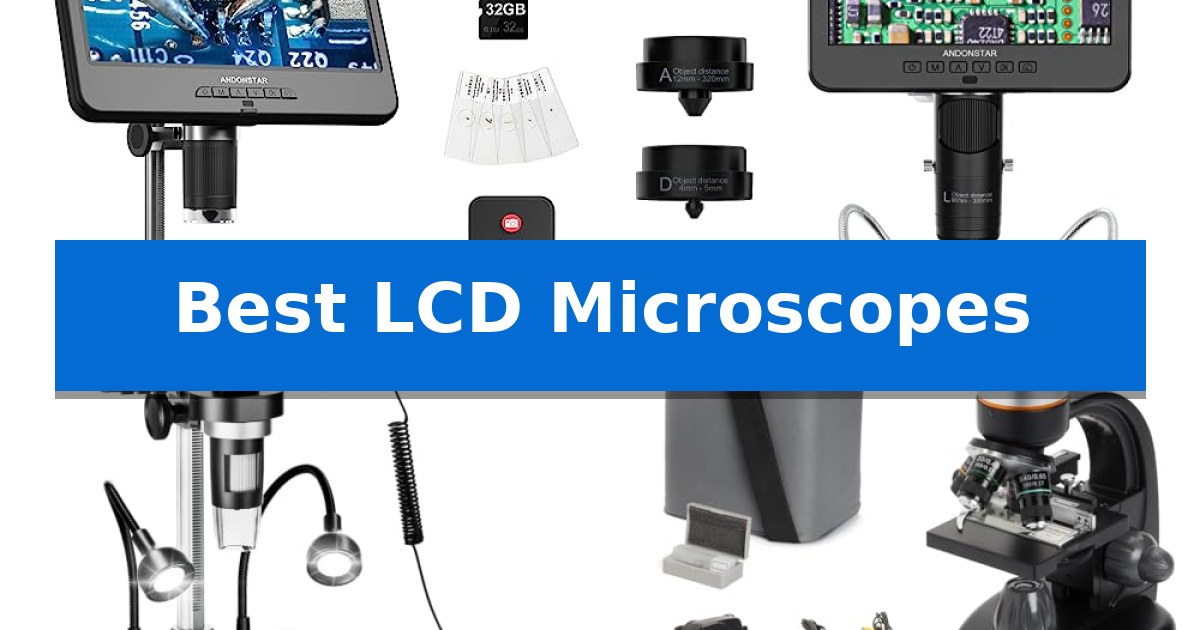
Finding the right magnification tool can transform how you approach detailed work, whether you are inspecting rare coins, soldering intricate circuit boards, or exploring biological specimens. The Best LCD Microscopes bridge the gap between traditional optical viewing and modern digital convenience, providing a clear, shared view that reduces eye strain during long sessions.
Selecting the right model depends on your specific workspace and the nature of your subjects. From large-scale screens for group demonstrations to specialized multi-lens systems for electronics repair, these devices offer versatile solutions for hobbyists and professionals alike. We have analyzed the leading options to help you choose the tool that best fits your technical requirements.
You may also want to compare Best LCD Home Theater Projectors Under $400, Best LCD Home Theater Projectors, and Best LCD HD Projectors.
Best LCD Microscopes
Quick Comparison
| Product | Best For | Key Strength | Score |
|---|---|---|---|
| Andonstar AD210 Digital Microscope | Best Overall | Large 10.1-inch IPS display for clear, detailed viewing. | 4.9 |
| Andonstar AD246S-M Digital Microscope | Versatile Multi-Lens System | Versatile 3-lens system covering soldering, coin, and biological applications. | 4.8 |
| TOMLOV DM9 Digital Microscope | Precision for Coin Collectors | 7-inch integrated LCD screen for comfortable, shared viewing. | 4.3 |
| Celestron TetraView LCD Microscope | Ideal for Educational Labs | Built-in 5MP digital camera for direct image and video capture. | 4.8 |
| Aikokkl LP050 Soldering Microscope | Hands-Free Electronics Repair | Hands-free C-clamp mount for stable, ergonomic operation. | 4.4 |
How We Chose
- Display clarity and screen size for comfortable, extended viewing sessions.
- Magnification range and lens adaptability for different subject types.
- Stand stability and working distance to accommodate soldering or coin inspection.
- Connectivity options for external monitoring and digital image documentation.
- Ease of use for capturing, storing, and sharing high-resolution visual data.
1 Andonstar AD210 Digital Microscope — Best for Large-Scale Viewing
The Andonstar AD210 Digital Microscope provides a specialized solution for detailed inspection tasks, featuring a large 10.1-inch IPS display with a 178-degree viewing angle. This design choice allows for clear, wide-angle observation of electronics, coins, and biological samples without the need for an external monitor.
Engineered for versatility, the unit includes an upgraded metal stand that reaches a maximum height of 12.6 inches, offering a flexible 1cm to 26cm adjustable working distance. This range accommodates various tasks, from soldering intricate circuit boards to examining larger items like silver dollars, while the three-type LED illumination system—including top, side, and bottom lights—ensures optimal visibility across different materials.
Functionality is further enhanced by a powerful remote control, which allows users to capture 1080p video and 12MP photos while minimizing camera shake. The device comes equipped with a 32GB memory card and card reader, simplifying the process of recording and transferring high-resolution visual data for documentation or sharing.
Designed for both professional and hobbyist applications, the kit includes a biological slide kit and a bottom light stage for microscopic exploration. The Andonstar AD210 Digital Microscope balances these advanced features with a robust build, making it a comprehensive tool for those requiring precise magnification and stable, high-quality imaging in a single, integrated system.
Best for: Users requiring a versatile, all-in-one digital microscope for electronics repair, coin collecting, and biological slide observation.
Skip if: Users who require extreme portability or a handheld form factor, as the large 10.1-inch display and sturdy metal stand are designed for stationary, desktop use.
PROS
- Large 10.1-inch IPS display for clear, detailed viewing.
- Adjustable 1cm to 26cm working distance suitable for diverse tasks.
- Versatile three-type LED illumination for varied lighting needs.
- Comprehensive kit including a 32GB memory card and slide accessories.
CONS
- Stationary design due to the large display and heavy-duty metal stand.
- Requires dedicated desk space for the 12.6-inch height capacity.
2 Andonstar AD246S-M Digital Microscope — Versatile Multi-Lens System
The Andonstar AD246S-M Digital Microscope differentiates itself through a versatile 3-lens system that allows users to switch between specialized optics for soldering, coin inspection, and biological slide observation. By utilizing a 7-inch LCD screen alongside 2160P UHD video recording capabilities, this device provides a clear, magnified view of microscopic details while offering the flexibility to output to a larger HDMI monitor for group demonstrations or detailed analysis.
Designed with a pro boom arm stand measuring 7 by 7.8 by 13 inches, the microscope offers significant adjustability to accommodate a wide work envelope. The metal construction is specifically suited for high-temperature environments, making it a robust choice for electronics repair and soldering tasks. Users can easily adjust the object distance via the bracket knob and fine-tune focus using the dedicated wheel.
Beyond its hardware, the system includes professional measurement software for Windows, enabling users to calculate area and measure object lengths directly on a PC. The inclusion of a wireless remote control allows for distance operation, which is particularly useful for maintaining image stability during high-magnification tasks or educational presentations. Brightness is managed through eight intensity levels of adjustable LED lighting.
The kit is designed for all-purpose utility, supporting up to 2000x magnification depending on the lens and display configuration. It comes equipped with a 32GB Micro SD card for immediate image and video storage, along with essential accessories like prepared slides and tweezers, ensuring the system is ready for diverse applications right out of the box.
Best for: Electronics technicians and hobbyists who require a versatile, multi-lens system for soldering, coin grading, and biological observation.
Skip if: Users who need a portable, handheld microscope for field work, as the pro boom arm stand and external power requirements make this a stationary desktop solution.
PROS
- Versatile 3-lens system covering soldering, coin, and biological applications.
- Pro boom arm stand provides extensive adjustability for large work areas.
- 2160P UHD output supports high-definition viewing on the built-in screen or external monitors.
- Professional measurement software allows for precise digital analysis on Windows PCs.
CONS
- Stationary design requires a dedicated desk space due to the size of the boom arm stand.
- Manual lens swapping requires removing and installing screws, which may be less convenient than a turret-style system.
3 TOMLOV DM9 Digital Microscope — Precision for Coin Collectors
Achieving clarity when inspecting coins or fine electronics requires more than a standard magnifying glass. The TOMLOV DM9 Digital Microscope simplifies this process by integrating a 7-inch LCD screen, allowing users to view enlarged details directly without needing to squint or lean into an eyepiece.
This device is built for precision, featuring a stable metal base and an 8.5-inch metal stand that minimizes shaking during delicate tasks like soldering or examining mint marks. The 1200X magnification capability, combined with 10 LEDs—including two flexible gooseneck lights—ensures that surface textures and solder joints are illuminated clearly from multiple angles to reduce glare.
Beyond real-time observation, the TOMLOV DM9 Digital Microscope serves as a documentation tool with its 12MP camera and 1080P video recording. Findings are saved directly to the included 16GB memory card, making it straightforward to track collection records or project progress. For those requiring a larger display, the unit supports PC connection for Windows and Mac, facilitating easier sharing during demonstrations or detailed circuit board inspections.
The system is designed for versatility, with a heat-resistant base that supports light soldering work and a wired remote for convenient control. Whether you are a collector documenting error coins or a hobbyist working on small electronics, this microscope provides a practical, all-in-one solution for close-up exploration.
Best for: Coin collectors and hobbyists who need a stable, screen-integrated solution for documenting and inspecting small components.
Skip if: Users who require professional-grade optical glass lenses or extreme laboratory-level magnification beyond the capabilities of digital zoom.
PROS
- 7-inch integrated LCD screen for comfortable, shared viewing.
- Stable metal stand and base designed to reduce vibration during precision work.
- Flexible gooseneck lights that allow for customizable illumination to minimize glare.
- 16GB storage included for immediate photo and video documentation.
CONS
- Wired remote control may be less convenient than wireless alternatives for some users.
- Fixed stand height requires manual adjustment for changing magnification levels.
4 Celestron TetraView LCD Microscope — Ideal for Educational Labs
The Celestron TetraView LCD Digital Microscope simplifies specimen analysis by integrating a full-color 4.3" TFT LCD screen directly into the device, eliminating the need for traditional eyepieces during observation. This design allows multiple users to view cellular specimens simultaneously, making it a practical choice for classroom environments or collaborative lab work.
Equipped with a built-in 5MP digital camera, this microscope captures high-resolution images and records video at 20 fps. The onboard software manages these functions, while the included 2GB micro SD card provides sufficient storage for over 1200 images, facilitating the documentation of lab reports and educational lessons.
The device offers a wide range of magnification, scaling from 40x up to 1600x with digital zoom. To support immediate use, the package includes 7 prepared slides, a dust cover, and a rugged canvas carrying case with a shoulder strap for transport. An AV out cable is also provided, allowing for external viewing on a projector or television.
Power and connectivity are managed via a 4-plug international AC adapter, ensuring compatibility across different regions. The unit is backed by a two-year warranty and access to US-based technical support, providing a structured framework for long-term maintenance and troubleshooting.
Best for: Students and educators needing an all-in-one digital microscopy solution for classroom demonstrations and lab documentation.
Skip if: Users requiring professional-grade optical clarity for advanced research or those who prefer traditional binocular eyepieces over digital screens.
PROS
- Built-in 5MP digital camera for direct image and video capture.
- 4.3" TFT LCD screen enables group viewing without eyepieces.
- Comprehensive accessory kit including prepared slides and a carrying case.
- Two-year warranty with US-based support.
CONS
- Digital-only viewing limits traditional optical observation methods.
- Fixed screen size may be restrictive for detailed analysis compared to external monitor setups.
5 Aikokkl LP050 Soldering Microscope — Hands-Free Electronics Repair
The Aikokkl LP050 Soldering Microscope simplifies intricate electronics work by providing a hands-free, magnified view of circuit boards and solder joints. Its C-clamp mounting system secures the device to your workspace, allowing you to focus on delicate repairs without holding the camera steady.
Equipped with a 5-inch IPS display, this microscope helps reduce eye and neck strain during extended sessions. It offers up to 1000X digital magnification, which is controlled by manually adjusting the physical distance between the lens and the subject, followed by fine-tuning with the silver focus wheel.
For those needing a larger display, the unit features a Plug & Play PC view that functions without the need for specialized drivers or third-party software. Users can simply select the camera mode and connect to a computer, using built-in applications like Windows Camera or Mac Photo Booth to view the feed.
To document repairs, the device supports a Micro SD card (up to 32GB, not included), which is required to save high-resolution photos and record 1080P video. The flexible goose-neck arm allows for versatile positioning, making it suitable for inspecting micro-details on irregular objects or PCB components.
Best for: Electronics hobbyists and technicians who need a hands-free, dedicated display for soldering and PCB inspection.
Skip if: Users who require an auto-focus camera or a device capable of capturing full-screen views of large objects.
PROS
- Hands-free C-clamp mount for stable, ergonomic operation.
- 5-inch IPS screen provides a clear, dedicated view for detailed work.
- Plug & Play PC connectivity requires no additional software or drivers.
- Flexible goose-neck arm adapts to tight or irregular workspaces.
CONS
- Manual focus requires physical distance adjustment rather than auto-focus.
- Micro SD card not included, which is required for saving images or video.
Best LCD Microscopes Buying Guide
Understanding Magnification and Working Distance
Magnification is often the first specification buyers look for, but it must be balanced with working distance. For tasks like soldering or working on electronics, you need enough clearance between the lens and your subject to maneuver tools safely. A higher magnification is useless if the lens sits too close to the board to allow for iron movement.
Conversely, coin collectors often require a lower magnification range to view an entire coin at once, while needing the ability to zoom in on specific mint marks or errors. Look for models that offer adjustable working distance or interchangeable lenses to ensure the microscope adapts to your specific project needs.
The Importance of Display Technology
The primary advantage of an LCD microscope is the integrated screen, which eliminates the need to squint through a traditional eyepiece. An IPS display is generally preferred for its wider viewing angles and color accuracy, which are critical when identifying subtle variations in coin surfaces or checking solder joint quality.
Consider the physical size of the monitor as well. A larger screen, such as a 10-inch model, is ideal for shared viewing or educational demonstrations, while a more compact 5-inch or 7-inch screen may be sufficient for a crowded workbench where space is at a premium.
Stand Stability and Build Quality
Digital microscopes are highly sensitive to vibration. A sturdy metal base and a heavy-duty stand are essential to prevent image shake, especially at higher magnification levels where even the slightest movement is amplified. A stable stand also ensures that the microscope remains in position during hands-on tasks.
Look for stands that offer smooth, precise height adjustment. Some models feature boom arm stands that provide greater flexibility for positioning the camera over irregular objects or large circuit boards, allowing you to reach areas that a standard vertical column might miss.
Connectivity and Documentation
Modern digital microscopes serve as more than just viewing tools; they are also documentation devices. Ensure the model you choose supports Micro SD card storage for saving high-resolution photos and 1080p or 2160P videos. This is invaluable for keeping records of collections or documenting repair progress.
Many units also offer HDMI or USB output, allowing you to connect the microscope to a larger external monitor or a computer. This is particularly useful for professional presentations or when you need to perform detailed measurements using specialized software on a PC.
Lighting and Illumination Control
Proper lighting is the difference between a clear image and a washed-out, glare-filled mess. Look for microscopes with adjustable LED illumination. Top lights are standard for opaque objects like coins, while bottom lighting is a specific requirement for transparent biological slides.
Flexible gooseneck lights are a significant advantage, as they allow you to direct light from multiple angles to highlight surface textures or reduce glare on metallic components. Being able to control the intensity of these lights ensures you can achieve the perfect balance for any subject.
Frequently Asked Questions
Do I need a computer to use an LCD microscope?
No, most LCD microscopes are designed as standalone units with built-in screens. You can view, capture, and save images directly on the device. However, many models offer PC connectivity if you want to use a larger screen or specialized measurement software.
What is the difference between optical and digital zoom?
Optical zoom uses the physical lenses to magnify the image, maintaining clarity. Digital zoom enlarges the pixels on the screen, which can lead to a loss of image quality at higher levels. Always prioritize optical magnification for the sharpest results.
Can I use a soldering microscope for coin collecting?
Yes, many digital microscopes are versatile enough for both. The key is to ensure the stand provides enough working distance to view the entire coin and that the lighting can be adjusted to minimize glare on the coin's metallic surface.
Why is my image blurry at high magnification?
Blurriness at high magnification is often caused by a lack of stability or improper focus. Ensure your stand is tightened, the surface is vibration-free, and you are slowly adjusting the focus wheel. Also, check that your working distance is within the lens's optimal range.
Do these microscopes come with storage for photos?
Most models include a slot for a Micro SD card to store photos and videos. Some kits include a card, while others require you to purchase one separately. Always check the product specifications to see if a card is included.
Conclusion: Our Top Pick
Choosing the right tool depends on your specific project, but for those seeking a versatile, high-quality solution, the Andonstar AD210 Digital Microscope stands out as a top choice. Its large 10.1-inch IPS display provides an excellent, clear view, while the upgraded metal stand offers the stability needed for both delicate soldering and detailed coin inspection.
This model's ability to handle various tasks—from biological slide observation to electronics repair—makes it a highly adaptable instrument. With its comprehensive accessory kit and easy-to-use remote control, it provides a well-rounded experience for both hobbyists and professionals who need a reliable, all-purpose digital microscope.