
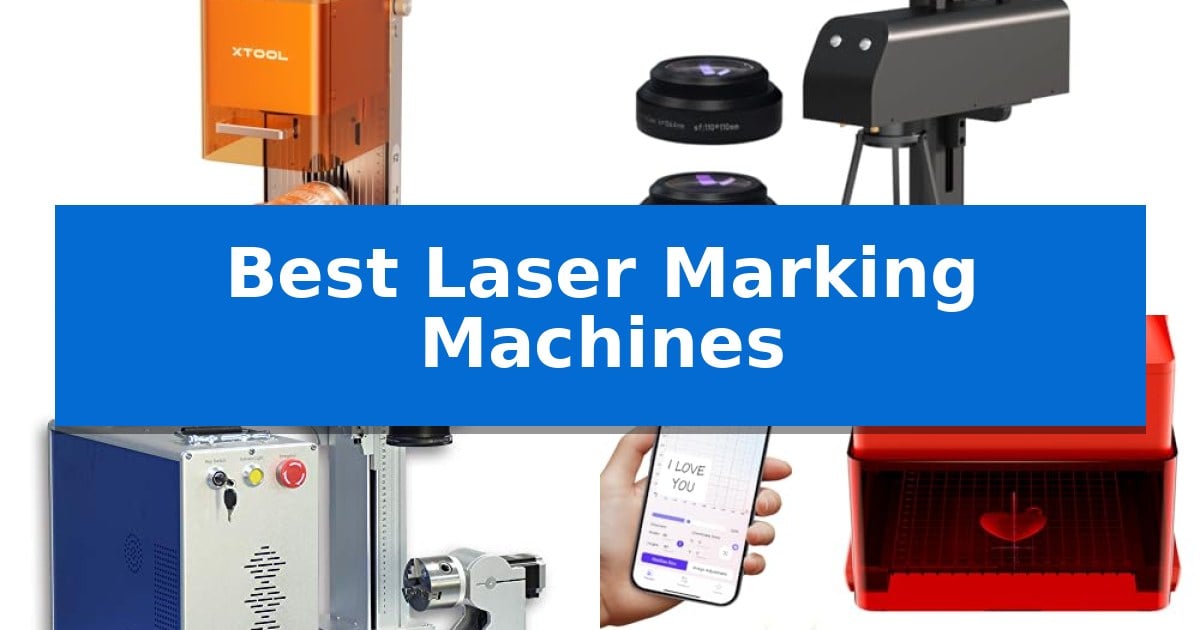
Finding the right equipment for permanent metal marking can be a complex task, especially when balancing the need for high-resolution detail against the requirement for industrial-grade durability. Whether you are a small business owner looking to personalize jewelry or a workshop manager needing to scale production, the Best Laser Marking Machines offer varying levels of power, portability, and material compatibility to suit your specific workflow.
Selecting the right unit requires careful consideration of laser source types, such as fiber or infrared, and understanding how these technologies interact with different metallic surfaces. This guide examines five distinct marking solutions, analyzing their technical capabilities and practical design features to help you determine which machine aligns with your production volume and workspace constraints.
Best Laser Marking Machines in 2026: Precision Metal Customization
Quick Comparison
| Product | Best For | Key Strength | Score |
|---|---|---|---|
| xTool F2 Dual Laser Engraver | Best Overall | Dual-laser versatility combining IR and diode technologies for a wide range of materials. | 4.9 |
| ComMarker B4 Fiber Laser Engraver | Best for Jewelry and Metal Precision | 2-in-1 design allows for both desktop and handheld operation. | 4.6 |
| SFX 100W MOPA Fiber Laser Marker | Industrial Power for Large Areas | JPT MOPA M7 laser source offers exceptional control over pulse duration and frequency. | 4.8 |
| AlgoLaser Pixi Infrared Laser Engraver | Compact Choice for Detailed Personalization | 1064nm infrared laser provides superior detail on metals compared to standard diode lasers. | 4.4 |
| XINCHENG PRECISION SFX Pro Laser Marker | Best Battery-Powered Mobile Marking | 176lbs electromagnetic base for secure, hands-free attachment to metal surfaces. | 4.8 |
How We Chose
- Laser Source and Wavelength: Assessing the suitability of fiber and infrared sources for specific metal types and marking depths.
- Operational Speed and Efficiency: Comparing marking speeds and the ability to handle batch processing or complex designs.
- Precision and Alignment: Evaluating the accuracy of positioning systems, including cameras and autofocus features.
- Portability and Design: Analyzing the physical footprint, weight, and enclosure safety for different workspace settings.
- Control and Compatibility: Reviewing the ease of software integration and standalone operation capabilities.
1 xTool F2 Dual Laser Engraver — Fastest for Small-Batch Metal Marking
Achieving professional-grade metal marking and intricate engraving requires a system that balances speed with precision. The xTool F2 5W IR & 15W Diode Dual Laser Engraver distinguishes itself by integrating two distinct laser sources into a single, compact desktop unit, allowing users to switch between deep metal marking and detailed material cutting without changing hardware.
At the core of this machine is a dual-laser system featuring a 15W diode laser for 3D embossing and cutting, paired with a 5W infrared (IR) laser specifically engineered for vivid, dark marking on over 300 materials, including various metals. This versatility is supported by an ultra-fast 6000mm/s engraving speed, which significantly reduces processing time for small-batch production.
Precision is managed through a built-in 50MP camera, which provides real-time workspace visualization and ensures 0.1 mm alignment accuracy. This feature minimizes material waste by allowing users to preview designs directly on the workpiece. The machine also boasts a 0.00199" motion accuracy, ensuring that high-resolution details are captured with clarity.
Designed for portability and ease of use, the xTool F2 weighs only 4.6 kg and features a fully enclosed, leak-proof design that supports safe operation in retail or workshop environments. It arrives fully assembled, and the inclusion of built-in material presets simplifies the setup process for users moving between different project types.
For those scaling their operations, the system is compatible with accessories like the Slide Extension and RA3 rotary tool, which facilitate batch processing for items such as phone cases and coasters. The integrated fan system, combined with an optional purifier, ensures that fumes are managed effectively during indoor use.
Best for: Small-batch commercial customization and on-site personalization services requiring both metal marking and material cutting.
Skip if: You require a large-format laser engraver for processing oversized industrial sheets, as this unit is optimized for desktop-scale and small-batch projects.
PROS
- Dual-laser versatility combining IR and diode technologies for a wide range of materials.
- High-speed performance reaching up to 6000mm/s for efficient batch processing.
- Integrated 50MP camera for precise alignment and reduced material waste.
- Portable, fully enclosed design suitable for retail or mobile customization services.
CONS
- Desktop-focused form factor limits the maximum size of materials that can be processed compared to larger industrial machines.
2 ComMarker B4 Fiber Laser Engraver — Best for Jewelry and Metal Precision
Achieving precise metal marking requires a tool capable of high-speed accuracy and material versatility. The ComMarker B4 Fiber Laser Engraver distinguishes itself with a high-speed precision galvanometer that supports marking speeds up to 15,000mm/s, ensuring efficient throughput for both small-batch jewelry production and industrial tagging needs.
This system functions as a 2-in-1 desktop and handheld unit, providing flexibility for marking stationary items or larger objects that cannot fit under the standard workspace. It includes two field lenses—110x110mm and 200x200mm—allowing users to adjust the marking area based on the scale of their project. The device is compatible with LightBurn and EzCad2 software, facilitating a streamlined workflow for importing common graphic formats like DXF, AI, and JPG.
Designed for diverse material compatibility, the ComMarker B4 Fiber Laser Engraver handles stainless steel, aluminum, gold, silver, copper, and various non-transparent plastics. With a 1064nm laser wavelength and a minimum line width of 0.01mm, it is capable of achieving fine detail and an engraving depth of 0.3-0.5mm. Safety is integrated through an emergency switch and a design that meets Class 1 laser product standards.
The package includes a comprehensive set of accessories, such as a foot switch for hands-free operation, a positioner, and protective 1064nm goggles. Its compact volume and weight make it a practical addition to workshops where space is at a premium, while the automatic lifting mechanism simplifies the setup process for different material thicknesses.
Best for: Jewelry makers and small-scale manufacturers requiring high-precision marking on metals and plastics.
Skip if: Users who need to cut through thick materials, as this fiber laser is optimized for surface marking and shallow engraving rather than deep cutting.
PROS
- 2-in-1 design allows for both desktop and handheld operation.
- High-speed galvanometer enables rapid marking up to 15,000mm/s.
- Dual lens kit provides flexibility for different marking area sizes.
- LightBurn compatibility ensures ease of use with industry-standard software.
CONS
- Shallow engraving depth of 0.3-0.5mm limits its use for deep cutting applications.
3 SFX 100W MOPA Fiber Laser Marker — Industrial Power for Large Areas
Precision manufacturing requires equipment capable of handling diverse materials with high repeatability. The SFX 100W MOPA Fiber Laser Marker is built for these demanding environments, featuring a JPT MOPA M7 laser source that provides a pulse duration of 2-500ns and a repetition rate frequency of 1-4000kHz. This flexibility allows for specialized tasks such as aluminum black marking, color marking on stainless steel, and precise peeling of coatings on sensitive materials.
Designed for high-throughput workflows, the system utilizes an imported laser scanning system that achieves marking speeds up to 7m/s. The unit maintains a re-position precision of 0.002mm, ensuring consistency across large-scale projects. With a 300x300mm marking area, it accommodates larger workpieces, while the included 80mm rotary axis enables engraving on cylindrical objects, expanding the machine's utility beyond flat surfaces.
Usability is enhanced by the 800mm heightened tower, which provides the vertical clearance necessary for taller items. The system is Lightburn compatible via EZCAD2, offering a familiar interface for design and control. Its electrical-optical conversion efficiency of up to 70% reflects its industrial-grade engineering, designed to minimize energy waste during extended operation cycles.
This machine is a robust solution for users in the electronics and semiconductor industries who require deep engraving capabilities up to 2mm. While it offers significant power and versatility, the 100W output and industrial footprint are tailored for dedicated workshop spaces rather than portable or hobbyist setups.
Best for: Industrial-grade metal processing and large-area engraving tasks that require precise pulse control and high-speed operation.
Skip if: You are a hobbyist with limited workspace or a budget that does not justify the cost of a high-power industrial MOPA fiber system.
PROS
- JPT MOPA M7 laser source offers exceptional control over pulse duration and frequency.
- High-speed marking capability up to 7m/s with 0.002mm precision.
- Versatile application range including color marking on stainless steel and coating removal.
- Large 300x300mm marking area combined with an included rotary axis.
CONS
- Large industrial footprint requires a dedicated, permanent workspace.
- High power output may be excessive for simple, low-depth engraving needs.
4 AlgoLaser Pixi Infrared Laser Engraver — Compact Choice for Detailed Personalization
The AlgoLaser Pixi Infrared Laser Engraver distinguishes itself through a specialized 1064nm infrared laser module, engineered specifically for precise surface marking on metals and select dark plastics. Unlike standard diode lasers, this infrared technology creates cleaner, finer marks on materials such as stainless steel, aluminum, and jewelry, making it a targeted solution for detailed personalization tasks like logos, names, and QR tags.
Designed for standalone operation, the unit features a 3.5" smart touchscreen integrated with the AlgoOS control system. This interface allows users to preview, adjust, and initiate engraving projects directly from the machine, eliminating the need for a constant PC connection. The system supports app-based control, streamlining the workflow for small personalization studios and hobbyists who prioritize ease of use.
The device utilizes a compact desktop design, ensuring it fits into home studios or small workshops without requiring the footprint of industrial equipment. While optimized for surface marking, it is not intended for wood cutting or deep engraving applications. Users are advised to maintain a clean, properly focused surface to achieve the most consistent results on reflective metals.
Safety and maintenance are central to the AlgoLaser Pixi Infrared Laser Engraver experience. The manufacturer includes a 1-year warranty and emphasizes the necessity of wearing proper laser safety goggles during operation, particularly when working with reflective surfaces. Its portability and specialized focus make it a practical choice for creators focused on high-detail metal accessories and custom gifts.
Best for: Small business owners and creators requiring precise, detailed surface marking on metal jewelry, tags, and accessories.
Skip if: Users who require a machine capable of cutting wood, performing deep engraving, or handling large-scale industrial material fabrication.
PROS
- 1064nm infrared laser provides superior detail on metals compared to standard diode lasers.
- Standalone operation via 3.5" touchscreen and AlgoOS removes the need for a dedicated PC.
- Compact, portable form factor ideal for small creative workspaces and home studios.
- Simplified workflow designed specifically for beginners and small-scale personalization.
CONS
- Limited application scope as it is not designed for wood cutting or deep engraving.
- Reflective metal surfaces may require slower marking speeds or specialized sprays for optimal results.
5 XINCHENG PRECISION SFX Pro Laser Marker — Best Battery-Powered Mobile Marking
Achieving precise, high-speed engraving on immobile or large-scale metal components is simplified by the XINCHENG PRECISION SFX Pro Laser Marker, which utilizes a powerful 176lbs electromagnetic base to secure the marking head directly to the workpiece. This design eliminates the need for manual stabilization, allowing for consistent, high-precision results across a 100x100mm marking area.
The system is built for field mobility, weighing only 13lbs and powered by an integrated 216Wh lithium battery. It supports marking speeds up to 7000mm/s with a line width as fine as 0.03mm, utilizing a 1064nm wavelength fiber laser. The unit includes a built-in fan and illumination to assist with visibility and cooling during extended operation, while an OD4+ protective cover is included for operator safety.
Operation is streamlined through an 8-inch capacitive touchscreen that runs a Linux-based EZCAD system, removing the requirement for an external computer. Users can import files and adjust marking parameters directly on the device. The inclusion of an infrared autofocus system and dual red preview lines further ensures that alignment remains accurate for serial numbers, barcodes, and logos.
Designed for professional workshops and flexible production environments, the machine is backed by a one-year full-machine warranty. The combination of the electromagnetic grip and portable form factor makes this a specialized tool for technicians who need to perform industrial-level marking on parts that cannot be moved to a traditional stationary laser station.
Best for: Technicians and production teams requiring high-precision, mobile laser marking on large or immobile metal surfaces.
Skip if: Users who primarily perform high-volume, stationary production line marking where a fixed-base, non-battery-powered system would provide better ergonomics and continuous power.
PROS
- 176lbs electromagnetic base for secure, hands-free attachment to metal surfaces.
- Integrated 216Wh lithium battery enables true portable operation without external power.
- 8-inch touchscreen with built-in EZCAD eliminates the need for a separate computer.
- High-speed marking capability up to 7000mm/s with 0.03mm precision.
CONS
- 13lbs weight may be cumbersome for extended handheld use without the magnetic mount.
- 100x100mm marking area limits the size of patterns that can be marked in a single pass.
Best Laser Marking Machines Buying Guide
Understanding Laser Source Technology
The core of any marking machine is its laser source, with fiber lasers and infrared lasers being the most common for metal applications. Fiber lasers are typically favored for their high power and ability to mark deep into metals like stainless steel, aluminum, and copper, making them ideal for industrial serial numbers or permanent branding.
Infrared lasers, often operating at a 1064nm wavelength, are highly effective for fine surface marking. They provide a cleaner, more detailed finish on jewelry and nameplates, often requiring less power than fiber counterparts while still delivering high-contrast results on reflective surfaces.
Evaluating Marking Speed and Batch Efficiency
For businesses scaling their output, marking speed is a critical metric. Machines capable of high-speed galvanometer scanning can complete intricate designs in seconds, significantly reducing the time per unit. This is particularly important for batch processing where consistency across hundreds of items is required.
Look for features like slide extensions or automated rotary axes if your production involves cylindrical items like tumblers or rings. These accessories allow for seamless transitions between different product shapes, ensuring that your workflow remains efficient without constant manual adjustment.
Precision Alignment and Camera Systems
Eliminating material waste is essential for cost-effective personalization. Many modern machines now include built-in cameras that visualize the workspace, allowing for real-time alignment of your design onto the physical object. This ensures that even small or irregularly shaped items are marked with high accuracy.
High-resolution motion accuracy is another factor that dictates the clarity of your final mark. Machines with precise galvanometer systems can capture minute details, ensuring that logos, QR codes, and fine text remain legible even at very small scales.
Portability and Workspace Constraints
The physical design of the machine should match your operational environment. If you need to move your services to fairs, pop-ups, or different areas of a workshop, a portable desktop laser with a lightweight build is preferable. These units often feature integrated fans and protective enclosures to maintain safety without requiring bulky external ventilation.
For stationary industrial use, larger tower-style machines offer stability and larger marking areas. These are better suited for permanent setups where the machine will handle heavy-duty tasks or large-format items that require a fixed, robust platform.
Software Integration and Ease of Use
The software ecosystem determines how easily you can import files and adjust parameters. Compatibility with industry-standard software like LightBurn or EzCad is a major advantage, as it provides a familiar interface for managing layers, power settings, and frequency.
Standalone operation is a growing trend, with many machines now featuring integrated touchscreens and onboard operating systems. This allows you to run projects directly from the machine, reducing the need for a dedicated PC and simplifying the setup process for beginners.
Frequently Asked Questions
What is the difference between fiber and infrared lasers for metal marking?
Fiber lasers are generally more powerful and better suited for deep engraving and high-speed industrial marking on various metals. Infrared lasers (1064nm) are specialized for fine, high-contrast surface marking, making them ideal for jewelry and detailed personalization.
Do I need a computer to operate these machines?
Many modern laser markers now offer standalone operation via built-in touchscreens and onboard software. However, some industrial-grade machines still require a PC connection running software like LightBurn or EzCad for complex file management.
Can these machines mark on non-metal materials?
Some fiber and infrared markers have limited capability to mark on non-transparent plastics or coated materials. Always check the machine's specifications to ensure it is compatible with the specific material you intend to use.
How do I ensure safety when using a laser marker?
Safety is paramount. Look for machines with Class 1 laser safety ratings, which typically include fully enclosed designs and protective viewing windows. Always wear appropriate laser safety goggles when operating open-frame or handheld units.
What is the benefit of a rotary axis accessory?
A rotary axis allows the laser to mark around the circumference of cylindrical objects like tumblers, rings, or pens. It rotates the item in sync with the laser, ensuring the design is wrapped correctly without distortion.
Conclusion: Our Top Pick
When choosing the right equipment, the xTool F2 Dual Laser Engraver stands out as a versatile solution for creators who need both the speed for batch processing and the precision for detailed metal marking. Its dual-laser system provides the flexibility to handle a wide range of materials, while the integrated 50MP camera ensures that every mark is perfectly aligned, minimizing material waste.
For those prioritizing portability, the xTool F2 is an excellent choice due to its compact, enclosed design that is ready for on-site use. While industrial-grade fiber machines offer more power for deep engraving, this unit provides the best balance of user-friendly operation and high-quality results for small-batch production and personalized gift services.