
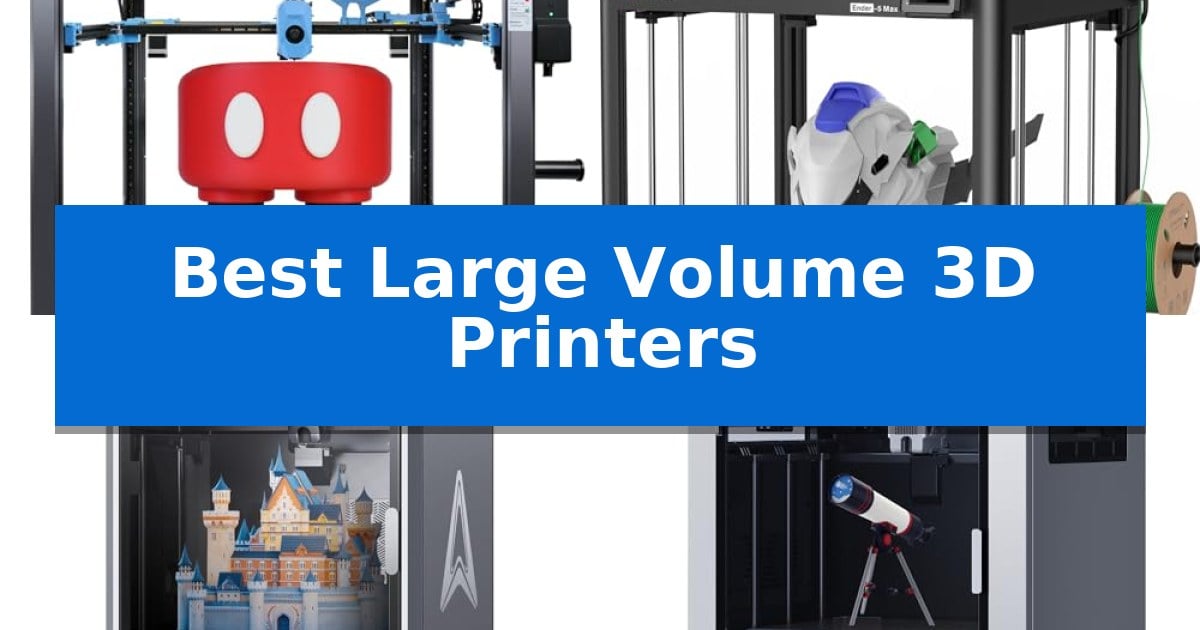
When your projects outgrow standard desktop machines, finding the right hardware becomes a critical bottleneck for your workflow. Whether you are producing full-scale prototypes, industrial components, or oversized collectibles, the Best Large Volume 3D Printers offer the necessary build space to complete complex models in a single print, eliminating the need for tedious assembly or partitioning.
Selecting a large-format printer requires balancing raw build volume with structural stability, heating capabilities, and speed. Our guide examines the latest machines designed to handle massive prints without sacrificing precision, helping you determine which system best fits your production requirements and material needs.
Best Large Volume 3D Printers in 2026
Quick Comparison
| Product | Best For | Key Strength | Score |
|---|---|---|---|
| Sovol SV08 Max 3D Printer | Best Overall | Massive 500x500x500mm build volume for large-scale projects. | 4.9 |
| Creality Ender 5 Max 3D Printer | High-Speed Farm Production | Expansive 400mm³ build volume for oversized parts. | 4.3 |
| Creality K2 Plus Combo 3D Printer | Advanced Multi-Color Large Format | Extra-large 350mm cubic build volume for oversized models and batch production. | 4.9 |
| QIDI Max4 Combo 3D Printer | Heated Chamber for Industrial Materials | Ultra-large 390×390×340mm build volume for printing large parts in one piece. | 4.9 |
| Longer LK10 Plus 3D Printer | Fast Klipper-Powered Large Prints | Spacious 320×320×400mm build volume for large-format projects. | 4.9 |
How We Chose
- Build Volume: Measured maximum dimensions to ensure compatibility with large-scale prototypes and batch production.
- Motion System Stability: Assessed the use of CoreXY kinematics and linear rails to minimize vibration during high-speed operation.
- Thermal Management: Evaluated nozzle temperature ranges and heated chamber capabilities for compatibility with engineering-grade filaments.
- Automation and Monitoring: Considered the inclusion of auto-leveling sensors, AI failure detection, and remote management tools.
- Production Throughput: Analyzed acceleration rates and flow-rate specifications to determine real-world print speed capabilities.
1 Sovol SV08 Max 3D Printer — Massive 500mm Build Volume
Scaling up production requires hardware that balances massive capacity with precise motion control. The Sovol SV08 Max 3D Printer addresses this by offering a substantial 500x500x500mm build volume, allowing for the creation of large-scale prototypes and industrial parts in a single print cycle.
Engineered with CoreXY kinematics, this machine minimizes moving mass to support high-speed operation up to 700mm/s. The design utilizes XYZ full linear rails to reduce vibration, ensuring that the structural integrity of large prints is maintained even at high acceleration rates of 40,000 mm/s².
Accuracy is managed through an advanced Eddy Current Sensor system, which performs contactless bed leveling to detect surface deviations automatically. This ensures a consistent first layer across the expansive print bed without requiring manual calibration before every session.
The printer is equipped with a 300°C high-temp nozzle and a 50mm³/s high-flow hotend, providing compatibility with a wide range of materials including PLA, TPU, PETG, ABS, and various carbon-fiber composites. For ongoing oversight, a built-in 1280×720 HD camera supports remote monitoring and integration with Obico for failure detection.
Users looking to expand capabilities can utilize the reserved interface for a Heated Chamber module, which is available as a separate upgrade. This modular approach allows the system to adapt to more demanding high-temperature filaments as project requirements evolve.
Best for: Users requiring a massive 500mm build volume for large-scale industrial prototypes and oversized props.
Skip if: Users with limited workspace or those who primarily print small, intricate parts that do not benefit from a large-format footprint.
PROS
- Massive 500x500x500mm build volume for large-scale projects.
- CoreXY kinematics and linear rails for high-speed, stable printing.
- Eddy Current Sensor for automated, high-accuracy bed leveling.
- 300°C high-temp nozzle compatible with diverse advanced filaments.
CONS
- Heated Chamber module must be purchased separately.
- Large physical footprint requires significant dedicated workspace.
2 Creality Ender 5 Max 3D Printer — High-Speed Farm Production
Scaling production for oversized prototypes or high-volume print farms requires hardware that balances speed with a massive build area. The Creality Ender 5 Max 3D Printer addresses this need with an expansive 400×400×400 mm build volume, allowing creators to produce large-scale models without the structural compromises of splitting files into smaller parts.
Engineered for high-throughput environments, the printer utilizes a CoreXY structure capable of reaching speeds up to 700 mm/s. This performance is supported by a 1000W rapid-heating bed and a direct-drive dual-gear extruder, which ensures consistent material flow and adhesion across a wide range of filaments including PLA, PETG, ABS, and ASA.
Reliability in continuous operation is managed through a reinforced die-cast aluminum frame that minimizes vibration during rapid movements. Precision is further enhanced by an X-axis linear rail, while the 64-point auto-leveling system and automatic Z-offset eliminate the need for manual bed calibration, streamlining the setup process for both individual users and busy print farms.
For studio management, the device integrates WLAN multi-printer control and grouped management features. A tri-color status indicator provides immediate visual feedback on print progress, making it a practical choice for businesses looking to organize and scale their 3D printing workflows efficiently.
Best for: Businesses and creators requiring high-speed, large-scale production and multi-printer farm management.
Skip if: Users with limited workspace or those who only require small-format printing will find the large footprint and industrial-focused feature set unnecessary.
PROS
- Expansive 400mm³ build volume for oversized parts.
- High-speed CoreXY system supporting up to 700 mm/s.
- Automated 64-point leveling and Z-offset for consistent first layers.
- WLAN-enabled multi-printer control for farm management.
CONS
- Large physical footprint requires significant dedicated workspace.
3 Creality K2 Plus Combo 3D Printer — Advanced Multi-Color Large Format
Scaling up additive manufacturing requires hardware that balances sheer capacity with intelligent automation, and the Creality K2 Plus Combo 3D Printer addresses this by integrating a massive 350x350x350mm build volume with a sophisticated multi-material management system. This machine is built for those who need to produce large-scale prototypes or high-volume batches without the constant manual intervention typically required by smaller desktop units.
The core of the system is the CFS (Creality Filament System), which enables multi-color printing by supporting up to 16 colors when four units are linked. It features intelligent RFID detection that automatically identifies filament types and colors, while the automatic relay function ensures that if one spool runs out, the printer seamlessly switches to another, minimizing downtime during long, unattended print jobs.
Performance is driven by industry-grade FOC step-servo motors that allow for high-speed printing up to 600mm/s and accelerations of 30000mm/s². To maintain precision at these speeds, the printer utilizes a rigid Matrix frame structure made from aerospace-grade aluminum alloy, which works in tandem with a dual Z-axis system and four linear rods to ensure the print bed remains stable and level throughout the entire vertical travel range.
The Creality K2 Plus Combo 3D Printer is also equipped with a high-temp nozzle capable of reaching 350°C and an active chamber heating system that maintains a constant 60°C, making it highly effective for engineering-grade filaments like ASA and PPA. With dual AI cameras monitoring for spaghetti failures and flow rate optimization, the printer provides a robust, automated workflow for complex, high-strength parts.
Best for: Users requiring large-format, multi-color, or high-temperature engineering material printing with advanced automation.
Skip if: Users with limited workspace or those who only print small, single-color PLA models will find the large footprint and complex CFS system unnecessary.
PROS
- Extra-large 350mm cubic build volume for oversized models and batch production.
- Multi-color capability with intelligent automatic filament selection and relay.
- High-speed performance supported by FOC step-servo motors and rigid frame construction.
- Active chamber heating and high-temp nozzle for advanced engineering materials.
CONS
- Large physical footprint requires significant dedicated workspace.
- Complex multi-component system may have a steeper learning curve than standard entry-level printers.
4 QIDI Max4 Combo 3D Printer — Heated Chamber for Industrial Materials
Printing large-scale industrial parts and complex prototypes requires a machine capable of maintaining consistent thermal conditions across a significant build area. The QIDI Max4 Combo 3D Printer addresses this with a substantial 390×390×340mm build volume, which is 55% larger than its predecessor, allowing for the creation of massive components in a single print run without the need for splitting.
To ensure structural integrity and surface quality, the printer utilizes closed-loop motors on X/Y axes and a 2mm lead screw on the Z-axis, supporting high-speed operation up to 800mm/s. The 65℃ active heated chamber is a critical feature for users working with high-temperature, abrasive materials like carbon fiber-reinforced nylon, PC, or PPS-CF, as it mitigates warping and ensures proper layer adhesion.
Usability is enhanced through a built-in AI camera that monitors for print failures, such as spaghetti-like errors, and pauses the process to preserve materials. For those requiring advanced production capabilities, the system integrates with the QIDI BOX to facilitate 16-color and multi-material printing, supported by intelligent filament management that tracks levels and pauses automatically when supplies run low.
The full-surface silicone heated bed provides even heat distribution, while the 40mm³/s high-flow hotend with a hardened steel nozzle is engineered to handle the demands of industrial-grade filaments. While the Polar Cooler system is available to further optimize conditions for specific high-temp materials, it is sold separately, making the base unit a robust foundation for professional and enthusiast workflows.
Best for: Professionals and enthusiasts requiring a large-format printer capable of handling industrial-grade, high-temperature materials.
Skip if: Users who do not require an extra-large build volume or those who do not work with high-temperature industrial filaments may find the footprint and specialized heating features excessive for their needs.
PROS
- Ultra-large 390×390×340mm build volume for printing large parts in one piece.
- 65℃ active heated chamber essential for high-temperature material stability.
- AI-powered failure detection to save time and material.
- High-flow hotend capable of processing abrasive industrial filaments.
CONS
- Polar Cooler system must be purchased as a separate accessory.
- Large physical footprint may require significant dedicated workspace.
5 Longer LK10 Plus 3D Printer — Fast Klipper-Powered Large Prints
Scaling up your 3D printing projects requires a machine capable of handling substantial dimensions without sacrificing precision. The Longer LK10 Plus 3D Printer addresses this need with a generous 320×320×400mm build volume, providing the necessary space for large-scale prototyping, engineering components, or batch production tasks in a single print job.
Beyond its physical capacity, this printer integrates Klipper firmware to achieve high-speed operation, reaching print speeds of up to 500mm/s and acceleration of 10000mm/s². This configuration is designed to reduce wait times for complex models while maintaining structural stability through its dual Z-axis design and TMC2209 silent drivers.
Reliability during long print cycles is supported by an auto bed leveling system utilizing eddy current sensors, which provides real-time surface compensation and accurate Z-offset calibration. The inclusion of a high-flow dual-gear direct drive extruder ensures consistent filament feeding, offering compatibility with a wide range of materials including PLA, PETG, ABS, TPU, and Nylon.
For added convenience, the machine features dual-band WiFi (2.4GHz & 5GHz) for remote management, alongside safety features like filament runout detection and power-loss recovery. These additions help mitigate the risk of failed prints during extended operation, making the system suitable for both beginners and experienced makers.
Best for: Makers and engineers requiring a large build area for rapid prototyping and batch production of functional parts.
Skip if: Users with limited workspace or those who only print small, simple objects that do not require a high-volume build plate.
PROS
- Spacious 320×320×400mm build volume for large-format projects.
- High-speed printing capabilities up to 500mm/s via Klipper firmware.
- Dual-gear direct drive extruder for reliable material flow.
- Automated bed leveling and Z-offset calibration for consistent first layers.
CONS
- Large physical footprint requires significant dedicated workbench space.
Best Large Volume 3D Printers Buying Guide
Understanding Build Volume Requirements
The primary advantage of these machines is the ability to print large objects without splitting them into smaller, fragile parts. When choosing a printer, consider the maximum dimensions of your typical projects. A larger build volume allows for greater design freedom, but it also necessitates a more robust frame to prevent shifting during the print process.
Ensure your workspace can accommodate the physical footprint of these machines. Many large-format printers require significant clearance for moving parts and external filament management systems, so verify the total dimensions before committing to a specific model.
Thermal Control and Material Compatibility
Printing with advanced materials like ABS, ASA, or carbon-fiber-reinforced filaments requires precise thermal control. Look for printers that offer high-temperature nozzles and, ideally, an active heated chamber. These features prevent warping and ensure that large parts maintain dimensional accuracy as they cool.
If you plan to work with industrial-grade materials, the ability to maintain a stable internal temperature is non-negotiable. A heated chamber significantly improves the success rate for large, complex prints that are otherwise prone to delamination or shrinkage.
Motion Systems and Print Precision
At high speeds, a printer's motion system is the most common point of failure for print quality. CoreXY kinematics are preferred for large printers because they reduce the moving mass of the print head, allowing for faster acceleration and reduced ringing or ghosting on the surface of your prints.
Look for machines that utilize linear rails instead of standard wheels. Linear rails provide superior rigidity and smoother movement, which is essential when the print head must travel long distances across a large build plate.
Automation for Large-Scale Production
Large prints take a long time, making reliability features essential. Automatic bed leveling using eddy current or pressure sensors is vital for ensuring a perfect first layer across a massive surface area. Without reliable leveling, a failed first layer can waste days of printing time and significant amounts of filament.
AI-powered cameras and remote monitoring systems provide peace of mind by detecting failures like spaghetti-like extrusions or nozzle clogs. These tools allow you to pause or stop a print remotely, saving both time and material during long production runs.
High-Speed Performance and Throughput
Speed is not just about the nozzle movement; it is about the entire extrusion system's ability to keep up. High-flow nozzles and powerful extruders are necessary to maintain consistent material deposition at high speeds. If the extruder cannot melt filament fast enough, you will experience under-extrusion at higher print speeds.
Check the acceleration specifications of the printer. High acceleration allows the machine to reach its target speed quickly, which is critical for reducing total print time on large, complex geometries.
Frequently Asked Questions
Do I need a heated chamber for all large prints?
A heated chamber is primarily necessary for materials prone to warping, such as ABS, ASA, and PC. For standard materials like PLA or PETG, a heated bed is usually sufficient.
How does CoreXY improve large-format printing?
CoreXY systems keep the motors stationary and reduce the weight of the moving print head, which minimizes vibration and allows for faster, more precise movements across large distances.
What is the benefit of an eddy current sensor?
An eddy current sensor provides high-speed, contactless bed leveling that detects surface deviations with high accuracy, ensuring a consistent first layer without manual calibration.
Can I print multi-color parts on these machines?
Some models, like the Creality K2 Plus Combo, support multi-color printing through external filament management systems that handle automatic selection and switching.
What should I look for in a direct drive extruder?
A direct drive extruder provides better control over filament retraction and is generally more reliable for flexible materials like TPU compared to Bowden-style systems.
Conclusion: Our Top Pick
For users prioritizing massive build capacity and high-speed performance, the Sovol SV08 Max 3D Printer stands out as an exceptional choice. Its 500mm build volume and CoreXY architecture provide the stability and space required for industrial-scale prototyping and oversized projects.
While its size requires a dedicated workspace, the combination of high-flow extrusion and advanced leveling sensors makes it a reliable workhorse for demanding production needs. It is the most capable option for those who need to scale up their output without compromising on print precision.