
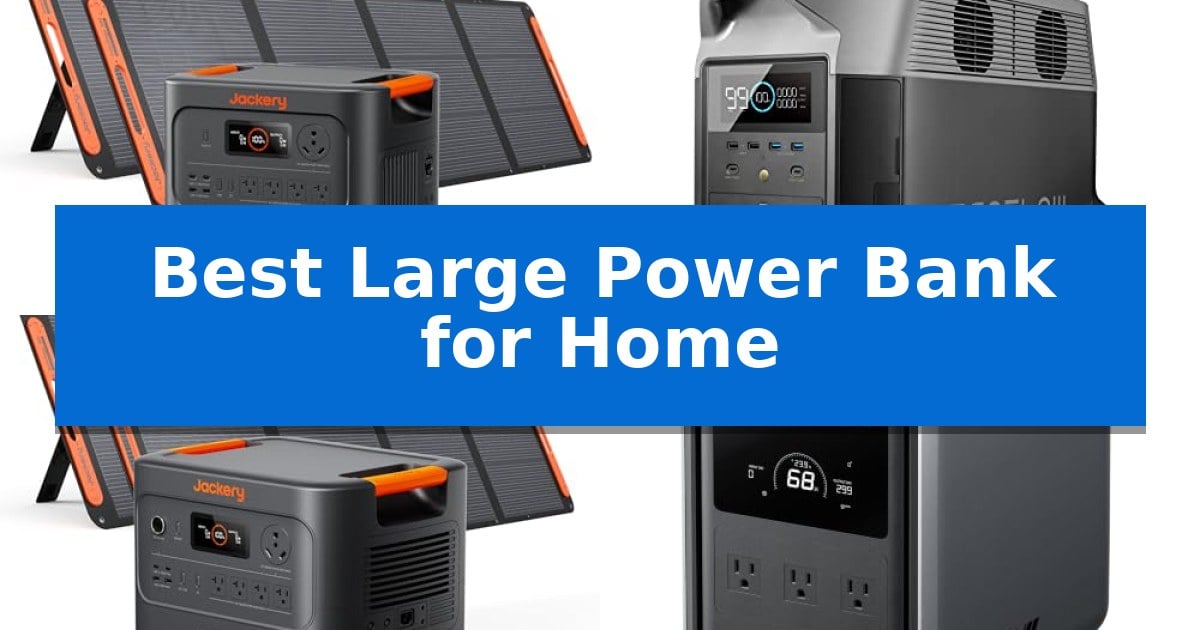
When an unexpected power outage strikes, maintaining access to essential appliances like refrigerators, lights, and communication devices becomes a priority. Finding the Best Large Power Bank for Home requires balancing total energy capacity with the power output needed to run your most critical household equipment during an emergency.
Selecting the right unit involves evaluating how much runtime you need and how quickly the system can replenish its energy. Whether you are preparing for short-term disruptions or seeking a more robust off-grid solution, the following options provide reliable, high-capacity energy storage designed to keep your home running smoothly.
Best Large Power Bank for Home in 2026
Quick Comparison
| Product | Best For | Key Strength | Score |
|---|---|---|---|
| Jackery HomePower 3600 Plus | Best Overall | High 3600W output capable of running heavy appliances. | 4.9 |
| EF ECOFLOW DELTA Pro | Maximum Expandable Capacity | Expandable capacity up to 25kWh with extra batteries. | 4.3 |
| Jackery HomePower 3000 | Seamless UPS Backup | High-capacity 3072Wh battery with a powerful 3600W output. | 4.5 |
| Anker SOLIX S2000 | High Efficiency Runtime | 10,000-cycle LFP battery for long-term durability. | 4.6 |
| Jackery Explorer 1000 v2 | Fastest Emergency Charging | 1,500W AC output with 3,000W surge capacity for heavy appliances. | 4.7 |
How We Chose
- Total energy capacity measured in watt-hours to determine potential runtime for household essentials.
- Continuous AC power output capability to ensure compatibility with high-draw appliances like refrigerators and heaters.
- Charging versatility, including solar input, AC wall charging speeds, and hybrid replenishment options.
- Safety features such as battery management systems, thermal protection, and cycle life longevity.
- Portability and design factors, including weight, handle ergonomics, and ease of integration into a home environment.
1 Jackery HomePower 3600 Plus — Best for Large Households
Maintaining power during an unexpected outage requires a robust solution capable of handling high-demand appliances. The Jackery HomePower 3600 Plus offers a substantial 3584Wh capacity and 3600W AC output, providing enough energy to sustain a three-person household for over two weeks. Its luggage-style design with integrated wheels and a telescopic handle ensures that this heavy-duty unit remains mobile, allowing for easy transport between rooms or to a garage.
Safety and longevity are central to the unit's construction. It utilizes high-temp resistant ceramic membrane battery cells tested at 302 °F to prevent thermal runaway, ensuring reliable operation even in extreme conditions as low as -4 °F. With a lifespan rated for 6,000 cycles, this system is engineered for long-term home backup needs.
Versatility in power management is achieved through its dual voltage (120V & 240V in parallel) capabilities, allowing the system to run demanding appliances like pumps, heaters, and dryers. The plug-and-play design simplifies the setup process, enabling users to integrate the unit into their home environment without requiring complex electrical installations.
Recharging the system is efficient, with four available methods. Users can achieve a full charge in just 2 hours via hybrid AC+DC, or utilize solar, AC, or gas generator inputs. The unit's automotive-grade CTB tech contributes to a compact form factor that is 34% smaller and 29.3% lighter than comparable models in its class.
Best for: Large households requiring a high-capacity, mobile backup solution for essential appliances during extended power outages.
Skip if: Users living in small apartments or those who require a lightweight, handheld power bank for charging only small mobile devices.
PROS
- High 3600W output capable of running heavy appliances.
- Expandable capacity up to 21kWh per unit.
- Fast 2-hour recharge time using hybrid AC+DC.
- Durable LFP battery with a 6,000-cycle lifespan.
CONS
- Heavy 77.16-pound weight despite the portable design.
- Separate shipping for solar panels and the power station.
2 EF ECOFLOW DELTA Pro — Maximum Expandable Capacity
Maintaining power during outages or supporting high-demand equipment requires a robust energy solution. The EF ECOFLOW DELTA Pro is built for this purpose, featuring a substantial 3600Wh LFP battery capacity that serves as a reliable foundation for home backup or off-grid needs.
This unit provides significant versatility through its 3600W AC output, which can be pushed to 4500W with X-Boost technology. For those requiring even more power, you can pair two units to reach a total of 7200W. With 15 output methods, including USB-C (100W) and multiple AC outlets, it accommodates a wide range of household and professional devices simultaneously.
Efficiency is central to its design, utilizing X-Stream fast charging technology. This allows the unit to reach a full charge in as little as 1.8 hours via 240V outlets or 2.7 hours using standard 1800W wall outlets. It also supports solar charging with up to 23% conversion efficiency, providing a practical way to replenish energy during extended use.
Integration into a home setup is managed through the EcoFlow app, which connects via Wi-Fi or Bluetooth. This interface allows for real-time monitoring of charge levels, temperature, and input/output settings. The system is also expandable up to 25kWh when combined with additional batteries or smart generators, offering a scalable approach to energy storage.
Best for: Homeowners seeking a high-capacity, expandable power backup system capable of running heavy-duty appliances during outages.
Skip if: Users looking for a lightweight, portable power bank for mobile charging or small electronics will find the 99-pound weight and large footprint impractical.
PROS
- Expandable capacity up to 25kWh with extra batteries.
- High 3600W AC output supports heavy-duty appliances.
- Fast charging capabilities via multiple input sources including EV stations.
- Comprehensive app control for monitoring and customization.
CONS
- Heavy 99-pound weight limits portability.
- Large physical dimensions require dedicated storage space.
3 Jackery HomePower 3000 — Seamless UPS Backup
The Jackery HomePower 3000 distinguishes itself as a high-capacity power solution, utilizing advanced CTB technology to achieve a 3072Wh capacity while remaining 47% smaller and 43% lighter than comparable models. This design choice prioritizes space efficiency without sacrificing the ability to provide a robust 3600W AC output and a 7200W surge capacity, making it a capable choice for maintaining essential home appliances like refrigerators and WiFi routers during outages.
Reliability during emergencies is supported by a UL-certified UPS that enables a seamless switch to battery power within ≤20ms. This rapid response ensures that sensitive equipment, such as medical refrigerators or security cameras, continues to operate without interruption. The unit is built with LiFePO4 batteries rated for 4,000 cycles while retaining 70% capacity, providing a durable foundation for long-term home backup needs.
Versatility is integrated into the hardware through a wide array of connection options, including AC, USB-C, USB-A, and DC ports. The inclusion of dual 100W PD ports allows for fast charging of mobile devices, while the dedicated TT-30 RV port offers plug-and-play compatibility for recreational vehicles. Charging the unit is equally flexible, supporting a full recharge in 1.7 hours via hybrid AC and DC inputs or through solar integration with SolarSaga 200W panels.
The system incorporates ChargeShield 2.0 technology, which uses AI algorithms to optimize charging speeds and extend the overall lifespan of the battery. The physical construction features a honeycomb-style bottom shell for added stability, and the integrated inverter design simplifies the setup process. Users should note that the unit and its associated solar panels are shipped separately and may arrive in different packages.
Best for: Homeowners seeking a high-capacity, compact UPS solution for maintaining essential appliances during power outages.
Skip if: Users requiring a lightweight, ultra-portable power bank for frequent travel or hiking will find the 59.52-pound weight and large form factor impractical.
PROS
- High-capacity 3072Wh battery with a powerful 3600W output.
- ≤20ms UPS switching for uninterrupted power to critical devices.
- Durable LiFePO4 chemistry supporting 4,000 charge cycles.
- Compact design using CTB technology for improved space efficiency.
CONS
- Heavy 59.52-pound weight limits portability for mobile use cases.
- Separate shipping of the power station and solar panels may lead to staggered delivery times.
4 Anker SOLIX S2000 — High Efficiency Runtime
Maintaining power to essential home appliances during an outage requires a reliable energy source, and the Anker SOLIX S2000 is engineered specifically for this purpose. With a focus on efficiency, this unit features a 6W idle power draw and 10% higher efficiency, enabling it to keep a refrigerator running for up to 35 hours.
The Anker SOLIX S2000 is built around a 2,010Wh LiFePO4 battery, utilizing 314Ah LFP cells that support a 15-year lifespan equivalent to 10,000 charge cycles. Despite its high capacity, the unit is designed for portability, measuring 8.2 x 11.1 x 12.7 inches and weighing 35.7 lbs, which is 30% smaller and 25% lighter than the industry average.
Versatility in power delivery and recharging is central to its design. The station provides 1,500W of continuous output and 3,000W of peak output, capable of powering 99% of home essentials. Users can recharge the device through six different methods, including solar input up to 400W, AC power, or a car outlet.
For home office or critical appliance setups, the Anker SOLIX S2000 functions as a seamless UPS with a switchover time of less than 10 milliseconds. The unit features eight total outlets, with a thoughtful front-and-rear layout that separates everyday devices from always-on appliances to maintain a clutter-free environment.
Best for: Homeowners seeking a compact, long-lasting power backup solution for essential appliances and home office equipment.
Skip if: Users who require a 12V DC port for specific automotive or specialized gear will find this model unsuitable due to its absence.
PROS
- 10,000-cycle LFP battery for long-term durability.
- Compact and lightweight design relative to its 2kWh capacity.
- Seamless UPS functionality with
- Efficient power management with low idle draw.
CONS
- No 12V DC port included for legacy device compatibility.
5 Jackery Explorer 1000 v2 — Fastest Emergency Charging
Maintaining power during unexpected outages or managing off-grid energy needs requires a reliable, high-capacity solution. The Jackery Explorer 1000 v2 distinguishes itself with a 1,070Wh capacity and a robust 1,500W AC output, capable of handling surge peaks up to 3,000W to support essential household appliances like refrigerators and electric pots.
Efficiency is central to its design, featuring one-hour fast charging when the emergency function is enabled via the Jackery App. This allows for rapid replenishment from 0% to 100%, ensuring the unit is ready when needed. For long-term utility, the device utilizes a durable LFP battery rated for over 4,000 charge cycles, providing a lifespan that exceeds 10 years while maintaining significant capacity.
Versatility is provided through a comprehensive array of ports, including two USB-C ports with 100W PD fast charging, one USB-A port, a DC car port, and three pure sine wave AC outlets. The integrated Smart App Control offers additional flexibility, allowing users to toggle between high-speed charging, a 30 dB quiet mode for overnight use, and an energy efficiency mode to suit specific household requirements.
Despite its power, the unit remains portable at 23.8 lbs and includes a foldable handle for easy transport. The package includes a 200W solar panel, offering a sustainable way to maintain power levels during extended grid failures. With a 5-year coverage period, this system is engineered for those who prioritize both immediate emergency readiness and long-term energy reliability.
Best for: Homeowners seeking a reliable, fast-charging emergency power source capable of running essential appliances during grid outages.
Skip if: Users requiring a lightweight, pocket-sized power bank for mobile device charging will find this 23.8-pound unit excessive for their needs.
PROS
- 1,500W AC output with 3,000W surge capacity for heavy appliances.
- One-hour fast charging capability via the Jackery App.
- Durable LFP battery with a 10-year lifespan rating.
- 100W PD USB-C ports for rapid device charging.
CONS
- Heavy 23.8 lb weight limits portability compared to smaller power banks.
- Separate shipping for the generator and solar panel may delay full system arrival.
Best Large Power Bank for Home Buying Guide
Understanding Capacity and Runtime
The primary metric for any large power bank is its watt-hour (Wh) capacity, which dictates how much energy is stored. For home backup, a higher capacity allows you to run appliances for longer periods without needing to recharge. It is essential to calculate the total wattage of the devices you intend to power to estimate your required runtime accurately.
Consider that larger capacities often result in heavier units. While a 3kWh or higher system is excellent for multi-day outages, it may be less portable than a 1kWh unit. Balance your need for extended runtime against the physical space and mobility requirements of your household.
Power Output and Appliance Compatibility
AC power output is the maximum wattage a power station can deliver at once. Ensure the unit you choose has a high enough continuous output to start and run your specific appliances. Many refrigerators and pumps have a high starting surge, so look for units that explicitly state their surge peak capacity to prevent the system from shutting down during startup.
Check the number and type of available ports. A good home backup solution should offer multiple AC outlets, USB-C ports for mobile devices, and specialized ports like TT-30 for RV or specific high-draw equipment. Having a variety of ports ensures you can charge multiple devices simultaneously without needing extra adapters.
Charging Efficiency and Methods
In a prolonged emergency, the ability to recharge your power bank is just as important as its capacity. Look for units that support fast charging via AC wall outlets, which can often restore a significant percentage of battery life in under three hours. This is crucial for topping off your power supply between outages.
Solar compatibility is a vital secondary charging method. If the grid remains down for an extended period, solar panels provide a sustainable way to replenish your power station. Ensure the unit supports the solar input wattage you plan to use to maximize charging efficiency during daylight hours.
Battery Chemistry and Longevity
Most modern high-capacity power stations utilize LiFePO4 (LFP) battery chemistry. This technology is favored for its safety, thermal stability, and long cycle life. LFP batteries can often withstand thousands of charge cycles while retaining a significant portion of their original capacity, making them a durable investment for home backup.
Always check the rated cycle life provided by the manufacturer. A higher cycle count indicates that the battery will remain functional for many years, even with frequent use. This longevity reduces the total cost of ownership and ensures the device is ready when you need it most.
Safety and Integration Features
Look for built-in Uninterruptible Power Supply (UPS) functionality if you need to keep sensitive electronics, such as home office equipment or medical devices, running without interruption. A fast switchover time (typically under 20ms) ensures that your devices do not lose power when the grid goes down.
Advanced Battery Management Systems (BMS) are essential for protecting against overcharge, over-discharge, and thermal runaway. These systems monitor the health of the battery cells in real-time, providing peace of mind that the unit is safe to operate inside your home.
Frequently Asked Questions
How do I calculate how long a power bank will run my fridge?
Divide the power station's total watt-hour capacity by the average wattage of your refrigerator. For example, a 3000Wh unit powering a 100W fridge would theoretically run for 30 hours, though you should account for about 15-20% energy loss due to inverter efficiency.
Can I leave these power stations plugged in all the time?
Many modern power stations are designed to act as a pass-through or UPS system, meaning they can stay plugged into a wall outlet to remain charged. However, always consult the manufacturer's manual for specific guidelines on long-term storage and maintenance.
What is the difference between continuous output and surge output?
Continuous output is the power the unit can provide indefinitely. Surge output is a temporary, higher power level the unit can handle for a few seconds, which is necessary to start motors in appliances like refrigerators or air conditioners.
Are solar panels necessary for home backup?
While not strictly necessary for short outages, solar panels are highly recommended for long-term emergencies. They allow you to generate your own power when the electrical grid is unavailable for days or weeks.
Do I need a professional to install these systems?
Most portable power stations are designed for plug-and-play use and do not require professional installation. However, if you are integrating them into your home's electrical panel via a transfer switch, you should consult a licensed electrician.
Conclusion: Our Top Pick
When evaluating the options for home backup, the Jackery HomePower 3600 Plus stands out as a versatile and robust choice for households requiring significant energy capacity. Its ability to provide 3600W of output and expandability options makes it well-suited for running essential appliances during extended power outages.
While other models offer specific benefits like faster emergency charging or higher portability, the combination of safety features, high-cycle LFP battery technology, and user-friendly design makes this unit a dependable foundation for your home's emergency power strategy.