
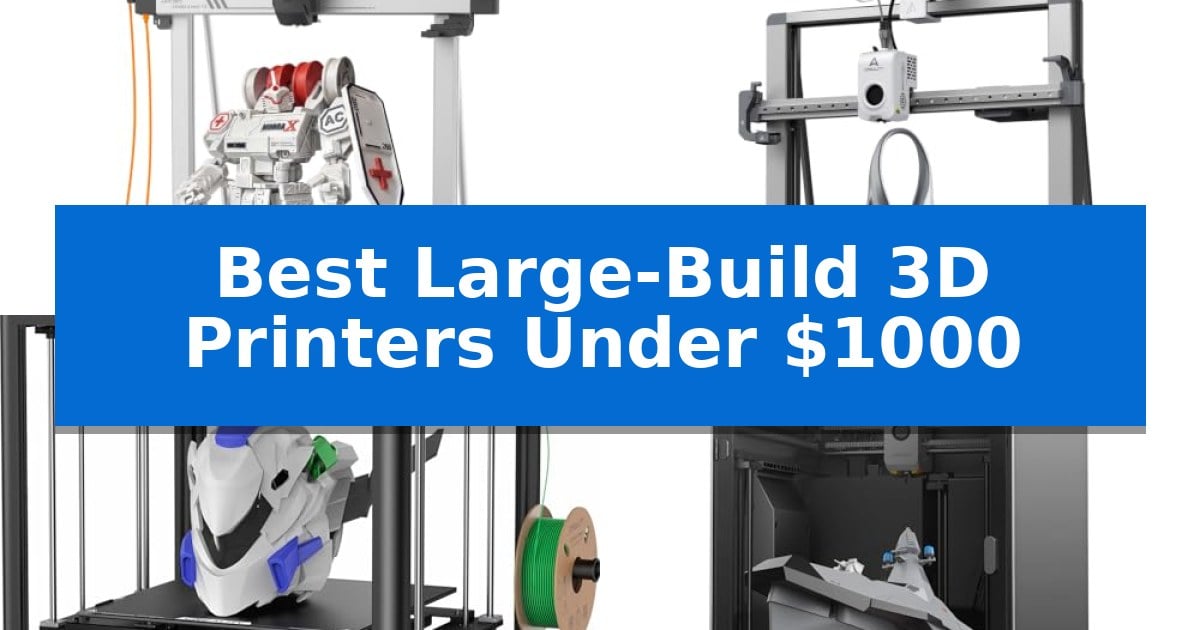
Finding a reliable machine that handles expansive projects without breaking your budget is a common challenge for makers and small-business owners. When you need to print large prototypes, cosplay props, or functional parts in a single piece, the Best Large-Build 3D Printers Under $1000 offer the necessary volume and stability to get the job done.
These printers are designed to balance high-speed output with the structural integrity required for massive prints. Whether you are looking for an enclosed chamber for engineering materials or a high-speed open-frame system for rapid prototyping, this guide breaks down the top options currently available to help you maximize your production capabilities.
Best Large-Build 3D Printers Under $1000 in 2026: Scale Up Your Prints
Quick Comparison
| Product | Best For | Key Strength | Score |
|---|---|---|---|
| Anycubic Kobra 3 Max V2 | Best Overall | Expansive 88L build volume for large-scale creations. | 4.9 |
| Creality Ender 3 V3 Mega | Large Format with High-Speed Precision | Massive 420mm⊃3 build volume for large-format projects. | 4.6 |
| Creality Ender 5 Max | Stable Frame for Tall Models | Expansive 400mm³ build volume for oversized prototypes. | 4.6 |
| Anycubic Kobra S1 Max Combo | Enclosed Chamber for Engineering Materials | Massive 350x350x350mm build volume for large-scale projects. | 4.4 |
| Creality K2 Pro Combo | Advanced Multicolor Production Power | 300x300x300mm build volume for large-scale projects. | 4.9 |
How We Chose
- Build Volume: We prioritized machines offering at least 300mm in all dimensions to accommodate large-scale, single-piece printing.
- Material Compatibility: We assessed the hotend temperature and chamber design to see which printers handle advanced filaments like TPU, ABS, or ASA.
- Speed and Acceleration: We reviewed the rated print speeds and acceleration capabilities to identify machines that minimize downtime on long, complex prints.
- Structural Stability: We looked for reinforced frames, linear rails, and CoreXY systems that maintain precision despite the increased mass of large models.
- Automation Features: We considered the inclusion of auto-leveling, flow control, and filament management systems that simplify the workflow for large-scale production.
1 Anycubic Kobra 3 Max V2 — Massive Volume for Oversized Projects
The Anycubic Kobra 3 Max V2 provides an expansive 88L build volume, measuring 16.5"x16.5"x19.7", which allows for the creation of large-scale props, reliefs, and functional parts in fewer individual pieces. This printer is engineered for efficiency, featuring a high-speed capability of up to 600mm/s and 10,000mm/s² acceleration, significantly reducing the time required to complete large projects.
Equipped with a 300°C full-metal hotend, this machine offers versatility across various materials including PLA, PETG, and TPU. The optimized extrusion path is designed to ensure consistent filament feeding and retraction, which is critical for maintaining reliability during long, complex print jobs.
Precision is managed through one-click calibration and smart flow adjustment, which work to minimize vibration marks and excess material. These features help produce smoother surfaces and cleaner details on finished models, while the Anycubic Slicer Next software provides preset parameters to simplify the preparation process.
For those looking to expand their creative capabilities, the system supports multicolor printing when paired with one or two Anycubic ACE 2 Pro units, enabling up to 8-color output. Users can also monitor and adjust their prints remotely using the Anycubic App, providing flexibility in managing the printing workflow.
Best for: Users requiring a large-format build volume for oversized projects who want high-speed performance and the option for multicolor printing.
Skip if: Users with limited workspace or those who only print small, simple objects that do not require an 88L build capacity.
PROS
- Expansive 88L build volume for large-scale creations.
- High-speed printing up to 600mm/s.
- 300°C full-metal hotend for material versatility.
- Multicolor printing support with optional ACE 2 Pro units.
CONS
- Large physical footprint requires significant dedicated workspace.
2 Creality Ender 3 V3 Mega — Large Format with High-Speed Precision
The Creality Ender 3 V3 Mega provides a massive 420 × 420 × 420mm build volume, allowing for the production of large-scale prototypes, cosplay props, and functional parts in a single piece. This expansive workspace reduces the need for splitting models, which minimizes assembly time and eliminates visible seams on large prints.
Engineered for versatility, the printer supports 85A, 90A, and 95A TPU flexible filaments alongside standard materials like PLA and PETG. An optimized extrusion system ensures reliable feeding for flexible components, while the dual gear extruder promotes consistent material flow. For high-speed requirements, the unit achieves print speeds up to 500mm/s with 8,000mm/s⊃2 acceleration, supported by vibration compensation to maintain surface quality.
Operational efficiency is managed through 81-point auto leveling, which establishes a consistent first layer across the large platform. Maintenance is simplified by a quick-swap hotend design, facilitating rapid nozzle changes or repairs. The printer also includes smart filament management, featuring an automatic relay that switches to a secondary spool when the primary runs out, as well as sensors for filament runout and tangle detection.
Connectivity and control are handled via WLAN multi-printer control, allowing for streamlined management in workshop or small-batch production environments. With a weight of approximately 46.7 pounds and a robust frame, this machine is built to handle extended print cycles for demanding projects.
Best for: Makers and small-batch producers who require a large build volume for printing functional parts, cosplay props, or flexible TPU components.
Skip if: Users with limited workspace or those who only print small-scale items will find the 420mm footprint and overall machine size unnecessary for their needs.
PROS
- Massive 420mm⊃3 build volume for large-format projects.
- High-speed printing capabilities up to 500mm/s with vibration compensation.
- Flexible filament support for 85A–95A TPU materials.
- Smart filament management with automatic spool relay and tangle detection.
- 81-point auto leveling for consistent first-layer adhesion.
CONS
- Large physical footprint requires significant dedicated workspace.
- Heavier unit weight compared to standard-sized desktop 3D printers.
3 Creality Ender 5 Max — Stable Frame for Tall Models
Achieving consistent results across large-scale projects requires a machine that balances volume with structural stability. The Creality Ender 5 Max addresses this by offering an expansive 400×400×400 mm build volume housed within a rigid, die-cast aluminum frame designed to minimize vibration during high-speed operation.
Engineered for efficiency, the printer utilizes a CoreXY structure capable of reaching speeds up to 700 mm/s. This performance is supported by a 1000W rapid-heating bed that reaches operational temperatures in minutes, ensuring that large prints or batch production runs can begin with minimal downtime.
Reliability in continuous production is managed through a direct-drive dual-gear extruder with hardened gears, which provides the consistent feeding force necessary to reduce clogging during long print cycles. The machine also integrates a 64-point auto-leveling system with an automatic Z-offset, removing the need for manual first-layer calibration.
For studio environments, the Creality Ender 5 Max supports WLAN multi-printer control and grouped management, allowing users to monitor multiple units simultaneously via a tri-color status indicator. This connectivity, paired with a precise X-axis linear rail, makes it a practical choice for those scaling up their 3D printing output.
Best for: Businesses and creators requiring high-speed, large-format production with multi-printer management capabilities.
Skip if: Users with limited workspace or those who only require small-scale, hobbyist-level printing will find the large footprint and industrial feature set unnecessary.
PROS
- Expansive 400mm³ build volume for oversized prototypes.
- High-speed CoreXY system supporting up to 700 mm/s.
- Automated 64-point leveling for consistent first-layer adhesion.
- WLAN-based multi-printer control for farm management.
CONS
- Large physical footprint requires significant dedicated workspace.
4 Anycubic Kobra S1 Max Combo — Enclosed Chamber for Engineering Materials
The Anycubic Kobra S1 Max Combo provides a massive 350x350x350mm build volume, enabling the production of full-scale industrial prototypes and large enclosures in a single piece without the need for splitting or gluing. This expansive workspace is supported by a fully-enclosed CoreXY structure, which utilizes a solid all-metal frame to maintain stability and eliminate wobbling during high-speed operations.
Engineered for efficiency, this system supports print speeds up to 600mm/s and 20,000mm/s² acceleration, significantly reducing project timelines. The inclusion of the ACE 2 Pro allows for native 4-color printing, with the potential to expand to 16 colors, eliminating the need for manual filament swaps during complex multi-color builds.
For advanced material compatibility, the printer features a 65°C heated chamber and a 350°C hotend. This thermal management system is designed to prevent warping and cracking when working with engineering-grade filaments such as ABS, ASA, and TPU. The setup is further refined by LeviQ 3.0 49-point auto-leveling, which works in tandem with real-time flow dynamics calibration to ensure consistent first-layer adhesion.
As a comprehensive solution for professional and hobbyist needs, the Anycubic Kobra S1 Max Combo balances high-speed output with the structural integrity required for functional parts. It is a suitable choice for those prioritizing large-format production and multi-material capabilities within an enclosed environment.
Best for: Engineers and designers requiring a large, enclosed build volume for high-speed, multi-color functional prototyping.
Skip if: Users with limited workspace or those who do not require an enclosed chamber for advanced engineering materials.
PROS
- Massive 350x350x350mm build volume for large-scale projects.
- Native 4-color printing capability with ACE 2 Pro integration.
- 65°C heated chamber for reliable printing of advanced materials.
- 600mm/s high-speed printing to reduce project completion time.
CONS
- Large physical footprint may be restrictive for smaller work areas.
5 Creality K2 Pro Combo — Advanced Multicolor Production Power
Achieving large-scale 3D printing projects requires a machine capable of balancing speed with structural precision. The Creality K2 Pro Combo addresses this with a substantial 300x300x300mm build volume, providing the necessary space for ambitious prototypes or high-volume batch production without sacrificing stability.
Engineered for high-performance workflows, this system utilizes FOC step-servo motors and linear rails to reach print speeds of up to 600mm/s with 20,000mm/s² acceleration. To maintain consistency during long prints, it features active chamber heating that reaches up to 60°C, which is essential for preventing warping when working with professional-grade materials like ASA, PPA-CF, and PET-CF.
The integration of the CFS Smart Filament System enables advanced multicolor and multi-material printing with support for up to 16 colors. This system automates filament identification and feeding, while the high-performance direct drive extruder—equipped with hardened steel gears—ensures reliable extrusion for abrasive carbon-fiber composites. Maintenance is simplified through a quick-swap hotend design.
Precision is further supported by Smart Dual AI Cameras. The chamber camera provides 24-hour monitoring and failure detection, while the nozzle-mounted AI camera performs real-time flow rate optimization and pressure advance tuning. Combined with intelligent auto-leveling that probes only the active print area, the Creality K2 Pro Combo is built to minimize setup time and ensure reliable first-layer adhesion.
Best for: Professional creators and engineers requiring high-speed, multicolor, and large-format printing with advanced material compatibility.
Skip if: Users seeking a compact, entry-level machine for simple PLA projects will find the complex multi-material system and large footprint unnecessary.
PROS
- 300x300x300mm build volume for large-scale projects.
- 600mm/s high-speed printing with FOC step-servo motors.
- Active chamber heating up to 60°C for professional materials.
- 16-color capability via the integrated CFS Smart Filament System.
- Dual AI cameras for real-time flow tuning and failure detection.
CONS
- Large physical footprint requires significant dedicated workspace.
- High-speed operation necessitates a stable, vibration-free surface.
Best Large-Build 3D Printers Under $1000 Buying Guide
Understanding Build Volume Requirements
The primary reason to invest in these machines is the build volume. A larger workspace allows you to print oversized items without the need for cutting, gluing, or post-processing multiple smaller parts. This not only saves time but also results in structurally stronger finished models.
When selecting a printer, consider the specific dimensions of your most common projects. While a 300mm cube is standard for many, some models offer even greater depth or height, which can be critical for tall vertical prints or long horizontal prototypes.
Material Versatility and Thermal Management
Not all filaments behave the same way, especially when printing large objects. High-temperature hotends are essential for working with materials like PETG or TPU, which require specific heat profiles to prevent clogging and ensure layer adhesion.
For advanced materials like ABS or ASA, an enclosed chamber or active heating is highly recommended. These features maintain a stable environment, significantly reducing the risk of warping or cracking during long print cycles.
The Importance of Structural Rigidity
As a print grows in size and height, the mechanical stresses on the printer increase. A rigid all-metal frame and high-quality linear rails are vital to minimize vibrations that can cause surface artifacts or layer shifts.
Printers utilizing a CoreXY structure often provide better stability at high speeds compared to traditional bed-slingers. This design keeps the build plate moving only on the Z-axis, which is crucial for maintaining precision on heavy, tall models.
Automation and Workflow Efficiency
Large prints can take days to complete, making filament runout detection and automatic filament relay essential features. These tools allow the printer to pause or switch spools automatically, preventing failed prints due to empty material rolls.
Additionally, auto-leveling systems are non-negotiable for large build plates. Achieving a perfect first layer across a 400mm surface manually is nearly impossible, so a reliable multi-point leveling sensor is a key productivity booster.
Speed vs. Quality Trade-offs
While high-speed printing (up to 600mm/s) is a major selling point, it is important to balance speed with the desired surface finish. High-speed settings often require vibration compensation and smart flow control to ensure that the increased speed does not compromise the structural integrity of the part.
For functional parts where strength is more important than aesthetics, you may find that slightly lower speeds provide more consistent results. Always check if the printer offers software presets that allow you to toggle between speed-focused and quality-focused modes.
Frequently Asked Questions
Do I need an enclosed printer for large prints?
It depends on the material. If you are printing with PLA, an open frame is usually sufficient. However, for materials prone to warping like ABS, ASA, or PPA, an enclosed chamber is necessary to maintain consistent temperatures.
How does build volume affect print time?
Larger prints naturally take longer due to the volume of material being deposited. High-speed printers help mitigate this, but the total time is primarily determined by the model's geometry and the layer height settings you choose.
Is auto-leveling accurate on large beds?
Yes, modern printers use multi-point leveling (ranging from 49 to 81 points) to map the bed surface. This ensures that even if the bed has slight variations, the printer compensates to maintain a consistent first layer.
Can I print flexible materials on these large printers?
Many of these models feature direct-drive extruders specifically designed to handle flexible filaments like TPU. Check the specifications for the supported Shore hardness range to ensure compatibility with your specific filament.
What is the benefit of a CoreXY system?
A CoreXY system provides superior stability and speed by keeping the build plate stationary on the X and Y axes. This reduces the moving mass, allowing for faster, more precise movements, which is especially beneficial for tall, heavy prints.
Conclusion: Our Top Pick
When evaluating the options for large-scale production, the Anycubic Kobra 3 Max V2 stands out as the most versatile choice for those needing a massive 88L build volume. Its combination of a 300°C hotend and high-speed capabilities makes it well-suited for a wide range of projects, from oversized props to functional engineering parts.
While other models offer specific advantages like enclosed chambers or multi-color systems, the Kobra 3 Max V2 provides the best balance of size, speed, and ease of use for the price. It is a reliable workhorse for any maker looking to scale up their creative output without the complexity of more expensive industrial machines.