
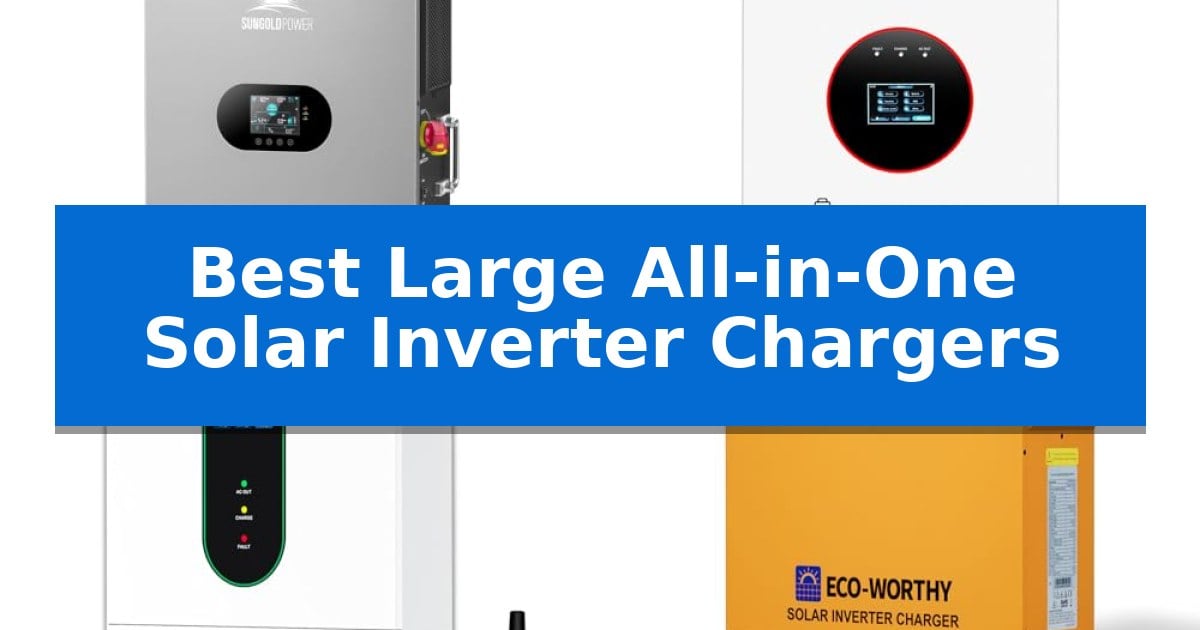
Finding the right power solution for a large off-grid home or remote cabin requires balancing high-capacity output with reliable energy management. The Best Large All-in-One Solar Inverter Chargers integrate essential components—the inverter, solar charge controller, and battery charger—into a single, streamlined unit to simplify complex electrical installations.
Whether you are looking to run heavy-duty appliances like well pumps and air conditioners or need a scalable system that grows with your energy demands, these all-in-one units provide the necessary flexibility. We have evaluated top-tier models to help you identify which system matches your specific household load, battery chemistry, and installation requirements.
Best Large All-in-One Solar Inverter Chargers in 2026
Quick Comparison
| Product | Best For | Key Strength | Score |
|---|---|---|---|
| SUNGOLDPOWER FR12K-B Solar Inverter | Best Overall | 12,000W continuous output with selectable 120V/240V split-phase power. | 4.9 |
| Liniotech 12kW Solar Inverter | Scalable for Massive Power Needs | High-capacity 12kW output suitable for demanding home and commercial loads. | 4.6 |
| PROSOLI 12000W Solar Hybrid Inverter | High-Efficiency Split Phase Output | Scalable output supporting up to 6 units for a 72kW maximum. | 4.9 |
| ECO-WORTHY 3500W Solar Inverter | Flexible Parallel Connection Options | Scalable power output up to 21KW via parallel connection of up to six units. | 4.8 |
| LiTime 3500W Solar Inverter | Space-Saving Design for Cabins | All-in-one design integrates MPPT, inverter, and charger to save installation space. | 4.4 |
How We Chose
- Continuous Power Output: Assessing the unit's ability to handle high-wattage household appliances and surge loads.
- Scalability and Parallel Capability: Evaluating how easily systems can be expanded by linking multiple units for increased total power.
- Solar Input Flexibility: Analyzing the MPPT controller range and the ability to handle diverse PV array orientations.
- Battery and Grid Compatibility: Checking support for various battery chemistries and the flexibility of AC input/output switching modes.
- Monitoring and Control: Reviewing the accessibility of system data through integrated touchscreens or remote communication protocols.
1 SUNGOLDPOWER FR12K-B Solar Inverter — Best for Large Home Backup
Managing high-demand off-grid energy needs requires a robust power solution capable of handling significant loads. The SUNGOLDPOWER FR12K-B 12000W 48V All in one Solar Inverter provides a continuous 12,000W output with selectable 120V/240V split-phase power, making it a capable choice for running large household appliances, well pumps, and power tools.
This unit features dual independent MPPT solar inputs, which allow for a maximum PV array power of 6600W per input. This design provides flexibility for installations on roofs with varying orientations, helping to optimize solar energy utilization. The system is built for versatility, supporting 48V battery types including AGM, Sealed, Gel, Flooded, and Lithium, with a user-defined mode for specific battery requirements.
For those planning for future energy growth, the inverter supports parallel operation of up to 6 units. This scalability allows users to increase total system capacity without needing to replace existing hardware. Safety and control are integrated through built-in Rapid Shutdown (RSD) support, integrated AC circuit breakers, and an intuitive color touchscreen interface for monitoring.
The SUNGOLDPOWER FR12K-B is designed for practical installation in homes, cabins, and farms. It includes a Smart Load output feature that assists in the automatic management of non-essential appliances. While it offers high power density, users should account for its 61.8-pound weight and dimensions when planning their mounting location.
Best for: This inverter is best for large-scale off-grid home, farm, or cabin setups requiring high continuous power output and the ability to scale capacity over time.
Skip if: Skip this model if you have limited physical space for mounting or if your energy requirements are small enough to be handled by a lower-capacity, single-phase system.
PROS
- 12,000W continuous output with selectable 120V/240V split-phase power.
- Scalable design supporting parallel operation of up to 6 units.
- Dual MPPT inputs for flexible solar array configuration.
- Broad battery compatibility including Lithium and various lead-acid types.
CONS
- Heavy physical footprint at 61.8 pounds, requiring sturdy mounting.
- High capacity may be excessive for smaller, basic off-grid setups.
2 Liniotech 12kW Solar Inverter — Scalable for Massive Power Needs
Managing high-demand energy requirements for off-grid homes or commercial backup systems requires a robust power foundation, and the Liniotech 12kW Off-Grid Solar Inverter is engineered to address these heavy-duty needs. This all-in-one unit provides a 12kW Pure Sine Wave Output, ensuring stable electricity for sensitive appliances while supporting both split-phase and single-phase North American power configurations.
The system centers on efficiency through its Dual MPPT Solar Charge Controllers, which offer a combined 12,000W capacity. With a wide 90–500V input range, it accommodates diverse high-voltage solar array designs, maximizing energy harvest. Users can manage storage via compatibility with 48V Lithium and Lead-Acid batteries, featuring adjustable charging up to 220A for rapid replenishment.
Integration and scalability are core to its design, offering Smart Monitoring via WiFi, USB, RS485, and GPRS, allowing for remote diagnostics through the Liniotech mobile app. For projects requiring more than the base capacity, the inverter supports stacking up to 6 units, enabling a total system output of 72kW to suit growing power demands.
While the unit offers extensive power and flexibility, its size and capacity are tailored for substantial installations. It is a comprehensive solution for those prioritizing high-output, expandable energy management in remote or backup-critical environments.
Best for: Large-scale off-grid homes and commercial backup systems requiring high-output, expandable power.
Skip if: Small residential setups or mobile applications where a 12kW capacity and multi-unit stacking capability exceed the actual energy requirements.
PROS
- High-capacity 12kW output suitable for demanding home and commercial loads.
- Dual MPPT controllers with a wide voltage range for flexible solar array configuration.
- Scalable architecture allows parallel connection of up to 6 units for 72kW total power.
- Versatile battery support including LiFePO4, AGM, and GEL chemistries.
CONS
- Large physical footprint and high capacity may be overkill for standard residential needs.
3 PROSOLI 12000W Solar Hybrid Inverter — High-Efficiency Split Phase Output
Managing high-power household energy demands requires a robust solution, and the PROSOLI 12000W Solar Hybrid Inverter provides a significant capacity for scaling power needs through its support for up to 6 units in parallel. This configuration allows for a maximum combined output of 72kW, catering to demanding setups that require both single-phase and split-phase (120V/240V) operation.
The unit features a tap-sensitive touch screen with LED indicators, allowing users to monitor system data and adjust critical settings such as battery charging current and solar/grid priority directly from the menu. It is designed to work with a wide range of battery types, including 48V AGM, Sealed, Gel, Flooded, and Lithium, and includes a user-defined mode for broader compatibility.
Efficiency is central to its design, utilizing 2 independent MPPT solar controllers that reach up to 99% efficiency in real-time with a maximum PV input current of 22A per controller. The system is built to prioritize solar energy for household loads, which can reduce grid dependence by over 50% while maintaining a seamless transition between power sources to prevent blackouts.
Safety and longevity are addressed through integrated overcurrent and short-circuit protection, which the manufacturer notes can help boost equipment lifespan by 30%. The inverter is physically substantial, weighing 57 pounds, and is engineered to handle high-power appliances such as air conditioners and electric vehicle chargers without interruption.
Best for: High-power households and off-grid setups requiring scalable, split-phase power and flexible battery compatibility.
Skip if: Users with limited space or those who do not require high-capacity, parallel-capable power systems will find this unit unnecessarily large and complex.
PROS
- Scalable output supporting up to 6 units for a 72kW maximum.
- Dual MPPT controllers with 99% efficiency for optimized solar harvesting.
- Versatile battery support including Lithium and various lead-acid types.
- Split-phase output (120V/240V) for heavy-duty home appliances.
CONS
- Heavy physical footprint at 57 pounds, requiring dedicated installation space.
- Complex setup required for parallel operation and advanced energy management.
4 ECO-WORTHY 3500W Solar Inverter — Flexible Parallel Connection Options
The ECO-WORTHY 3500W Solar Inverter provides a robust foundation for off-grid energy management by integrating a 3.5KW pure sine wave inverter with an 80A MPPT solar controller. This 3-in-1 device is designed to handle a maximum PV input power of 4400W, offering a versatile solution for users looking to manage home energy storage through a centralized unit.
Engineered for scalability, the system features a superior parallel-connection capability that allows up to six devices to be linked together. This configuration can deliver a high power output of up to 21KW, supporting both single-phase and split-phase setups to meet demanding electrical requirements. The unit also includes a 20ms switching uninterruptible power supply, ensuring a transition between power sources when needed.
Flexibility is a core design element, as the system supports four charging modes and three operating modes, including PV-priority and battery-priority settings. It is compatible with both lead-acid and lithium batteries, allowing for diverse storage setups. Users can manage parameters via the integrated LCD screen and buttons or utilize remote monitoring features to track data in real time.
Safety is addressed through seven layers of protection, including safeguards against short-circuits, overloads, and reverse connections. Due to the technical nature of 48V off-grid systems, professional installation is recommended to ensure proper setup and operational safety.
Best for: Homeowners and off-grid enthusiasts requiring a scalable, high-capacity power system that can be expanded via parallel connections.
Skip if: Users without electrical installation experience or those seeking a plug-and-play solution that does not require professional assistance for a 48V system.
PROS
- Scalable power output up to 21KW via parallel connection of up to six units.
- Versatile battery compatibility supporting both lithium and lead-acid chemistries.
- Integrated 80A MPPT controller with 4400W maximum PV input power.
- Comprehensive safety suite including seven layers of electrical protection.
CONS
- Professional installation required for 48V off-grid systems to ensure safety.
- Technical complexity necessitates electrical expertise for proper configuration.
5 LiTime 3500W Solar Inverter — Space-Saving Design for Cabins
Managing off-grid power and home energy storage requires a reliable, centralized system. The LiTime 3500W Solar Inverter simplifies this by integrating an MPPT controller, inverter, and charger into a single, space-saving unit. Designed for efficiency, it delivers pure sine wave output and supports a peak surge of up to 6000W, making it a practical choice for cabins and residential backup power.
This all-in-one functionality provides significant flexibility through four charging modes—Solar Only, Utility Priority, Solar Priority, and Hybrid—alongside multiple output configurations. Users can optimize their energy consumption to reduce reliance on traditional utility sources. The unit is compatible with various 48V battery types, including lead-acid and lithium, and features an integrated UPS function that automatically switches to battery power in milliseconds during outages to protect sensitive electronics.
Built for durability and ease of management, the system includes intelligent cooling fans and comprehensive protection against short-circuits, over-temperature, and overload conditions. Advanced monitoring is supported via RS485 communication, allowing users to track battery status such as voltage and current. Real-time data is accessible through the built-in LCD display, ensuring stable performance for long-term energy storage setups.
With a compact footprint of approximately 16.77 by 13.22 inches, the device is designed to fit into tight installation spaces. It is backed by AIG Product Liability Insurance, providing an added layer of assurance for home energy management systems. This unit balances high-capacity power delivery with the convenience of a unified, protective design.
Best for: Off-grid cabins and home energy storage systems requiring a compact, all-in-one power management solution.
Skip if: Users who require a power output higher than 3500W or those who do not utilize a 48V battery system.
PROS
- All-in-one design integrates MPPT, inverter, and charger to save installation space.
- Built-in UPS function ensures seamless power transition for sensitive electronics during outages.
- Flexible energy management with multiple charging and output priority modes.
- Advanced monitoring via RS485 and integrated LCD display.
CONS
- Limited to 48V battery systems, restricting compatibility with other voltage configurations.
- 1-year warranty period is relatively short for a permanent home energy installation.
Best Large All-in-One Solar Inverter Chargers Buying Guide
Understanding Power Capacity and Surge Requirements
The primary factor in selecting an inverter is its continuous power output. For a large home, you need a system that can handle the simultaneous draw of major appliances like refrigerators, well pumps, and HVAC systems. Always calculate your total peak load to ensure the inverter's continuous rating is sufficient.
Equally important is the surge capacity. Many motors and compressors require a significant burst of power to start. An inverter that cannot handle these spikes may trip or shut down, leading to potential equipment damage or system downtime.
Scalability Through Parallel Operation
If your energy needs are expected to grow, look for inverters that support parallel operation. This feature allows you to connect multiple identical units to function as a single, larger system. This modular approach is often more cost-effective than replacing a smaller unit with a larger one later.
Ensure the units you choose are specifically designed for parallel stacking. Check the manufacturer's limit on the number of units that can be linked, as this will dictate the maximum potential capacity of your future power system.
MPPT Controller and Solar Array Design
The Maximum Power Point Tracking (MPPT) controller is the heart of your solar system. A unit with dual MPPT inputs allows you to connect two separate solar arrays, which is highly beneficial if your roof has different orientations or shading issues.
Pay close attention to the Maximum PV Open Circuit Voltage (VOC). This specification determines how many solar panels you can wire in series. Exceeding this voltage can permanently damage the inverter, so precise array design is essential.
Battery Chemistry and Charging Flexibility
Not all inverters handle every battery type equally. While most modern units are compatible with LiFePO4 (Lithium), AGM, and Gel batteries, you must verify that the inverter's charging profile can be customized to your specific battery's requirements.
The charging current is another critical spec. A higher charging current allows you to replenish your battery bank faster when grid or generator power is available, which is vital for maintaining system uptime during periods of low solar production.
Monitoring and System Protection
Modern all-in-one inverters should provide clear, real-time data. Look for units with intuitive touchscreens or mobile app connectivity via WiFi or RS485. These tools allow you to monitor battery health, solar yield, and load status without needing to access the hardware directly.
Safety features such as short-circuit protection, overload management, and integrated circuit breakers are non-negotiable. These protections ensure that your investment is shielded from electrical faults and extend the overall lifespan of your solar energy system.
Frequently Asked Questions
Can I use these inverters with both lithium and lead-acid batteries?
Yes, most of the listed all-in-one solar inverters are compatible with multiple battery chemistries, including LiFePO4, AGM, GEL, and flooded lead-acid batteries, often featuring a user-defined mode for specific settings.
What does split-phase output mean for my home?
Split-phase output (120V/240V) allows the inverter to power standard North American household appliances. It provides 120V for regular outlets and 240V for heavy-duty appliances like dryers, well pumps, or central air conditioning.
Is it possible to install these systems myself?
While the units are designed for easier installation than component-based systems, working with high-voltage DC and AC power is dangerous. It is highly recommended to hire a professional electrician for the installation to ensure safety and code compliance.
What happens if my load exceeds the inverter's capacity?
Most hybrid inverters are designed to handle moderate overloads through grid-supplementation or by switching to utility power if configured. However, exceeding the rated capacity significantly will trigger protective shutdowns to prevent damage.
Do I need to buy a separate charge controller?
No, these are 'all-in-one' units, meaning they have the MPPT solar charge controller built directly into the chassis, which simplifies wiring and reduces the total footprint of your power system.
Conclusion: Our Top Pick
When selecting the best solution for a large-scale off-grid setup, the SUNGOLDPOWER FR12K-B Solar Inverter stands out for its robust 12,000W continuous output and versatile 120V/240V split-phase capabilities. Its ability to support parallel operation for up to 6 units makes it an excellent foundation for systems that need to scale as your energy demands increase over time.
While this unit provides significant power, always ensure your battery bank and solar array are sized appropriately to match its high capacity. Professional installation is strongly advised to safely manage the high-voltage inputs and outputs required for a system of this scale.