
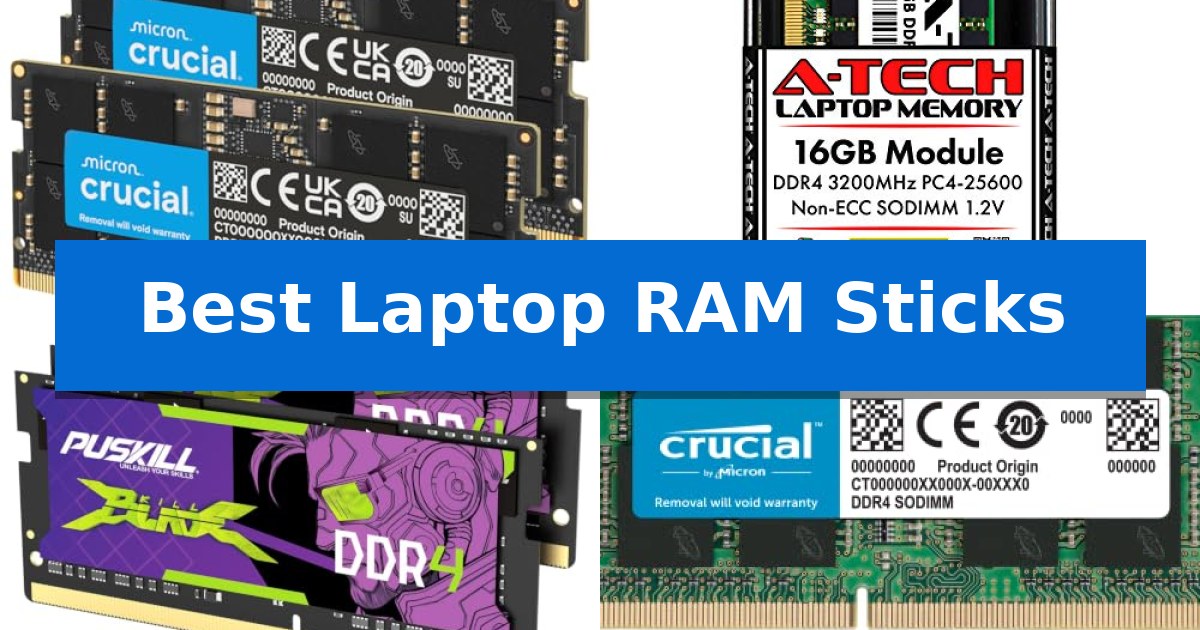
Finding the right memory upgrade can be the most effective way to breathe new life into a sluggish computer. Whether you are dealing with frequent system stutters during heavy multitasking or looking to improve your frame rates in modern games, selecting the Best Laptop RAM Sticks requires matching your machine's specific generation and capacity requirements.
Upgrading your memory is often a straightforward process, but it demands precision regarding compatibility. From the latest high-speed DDR5 modules for modern processors to essential DDR3L replacements for older notebooks, we have analyzed the top options to help you identify the perfect fit for your hardware.
Best Laptop RAM Sticks in 2026: Boost Speed and Multitasking
Quick Comparison
| Product | Best For | Key Strength | Score |
|---|---|---|---|
| Crucial DDR5 SODIMM | Best Overall | Versatile frequency support (5600MHz, 5200MHz, or 4800MHz) for broad system compatibility. | 4.9 |
| A-Tech DDR4 SODIMM | Reliable standard for DDR4 systems | 16GB capacity provides a significant boost for multitasking and memory-intensive applications. | 4.6 |
| PUSKILL DDR4 SODIMM Kit | Budget-friendly dual-channel boost | 32GB dual-channel capacity for improved multitasking. | 4.3 |
| Crucial DDR4 SODIMM | Easy compatibility for mainstream laptops | Easy installation process suitable for non-technical users. | 4.5 |
| Timetec DDR3L SODIMM | Essential upgrade for older notebooks | Dual-voltage support for 1.35V and 1.5V systems | 4.5 |
How We Chose
- Generation Compatibility: Ensuring the module matches the motherboard's DDR3, DDR4, or DDR5 architecture.
- Frequency and Timing: Analyzing the rated MHz and latency to confirm they align with your CPU's memory controller capabilities.
- Capacity and Configuration: Evaluating whether single or dual-channel kits provide the necessary bandwidth for your specific workload.
- Form Factor and Voltage: Verifying the SODIMM pin count and power requirements to ensure physical and electrical compatibility.
1 Crucial DDR5 SODIMM — Modern DDR5 for latest processors
Upgrading your laptop's memory to the Crucial 32GB DDR5 RAM Kit (2x16GB) provides a significant boost for multitasking and system responsiveness. Designed for modern computing, this kit operates at speeds of 5600MHz, 5200MHz, or 4800MHz, allowing it to adapt to the specific requirements of your hardware while improving overall system flow.
This 262-Pin SODIMM memory is engineered for DDR5 compatibility, making it an ideal choice for users running 12th Gen Intel Core or AMD Ryzen 7000 Series processors. The kit supports Intel XMP 3.0 and AMD EXPO profiles, which simplifies the process of achieving optimized performance settings on supported motherboards.
Beyond general productivity, the Crucial DDR5 SODIMM is built to handle intensive workloads and accelerated gaming. Its 1.1V operating voltage and 1Rx8 configuration reflect the efficiency of the DDR5 standard. As a product of Micron, each module undergoes rigorous component and module-level testing to ensure consistent operation.
Installation is straightforward for compatible systems, as the SODIMM form factor is specifically sized for laptops. With a Limited Lifetime Warranty included, this kit offers a reliable path to extending the utility of your current machine by increasing available memory capacity.
Best for: Users looking to upgrade their 12th Gen Intel or Ryzen 7000 series laptop with high-speed, reliable DDR5 memory for multitasking and gaming.
Skip if: Users with older laptops that utilize DDR4 memory slots, as this DDR5 module is not backward compatible.
PROS
- Versatile frequency support (5600MHz, 5200MHz, or 4800MHz) for broad system compatibility.
- Optimized for modern processors including Intel Core and AMD Ryzen 7000 series.
- Supports Intel XMP 3.0 and AMD EXPO for easier performance tuning.
- Rigorous testing backed by 42 years of Micron memory expertise.
CONS
- DDR5-only compatibility prevents use in older DDR4-based laptop systems.
2 A-Tech DDR4 SODIMM — Reliable standard for DDR4 systems
Upgrading your system's memory is a direct way to improve multitasking and application responsiveness, and the A-Tech DDR4 SODIMM offers a straightforward path for compatible notebooks and mini PCs. This 16GB module operates at a standard 3200MHz frequency, providing a reliable capacity boost for systems that support the DDR4 interface.
Engineered as a non-ECC unbuffered module, this memory stick adheres to JEDEC standards with a 1.2V operating voltage. It is designed for a simple plug-and-play installation, making it accessible for users looking to enhance their hardware without complex configuration. The module is built with high-quality DRAM components to ensure long-term stability during operation.
Compatibility is essential when selecting memory, and this module is specifically intended for systems that utilize 260-pin SO-DIMM slots. It is not compatible with desktop DIMM slots or ECC-specific memory architectures. Before installation, it is necessary to verify that your specific laptop or mini PC supports the 3200MHz speed and the 16GB capacity per slot to ensure proper system recognition.
To provide peace of mind, the product is backed by a Limited Lifetime Warranty covering defects in materials and workmanship. This support structure, combined with the module's rigorous testing for reliability, makes it a practical choice for users aiming to extend the utility of their existing mobile computing hardware.
Best for: Users looking to increase multitasking capacity in laptops or mini PCs that support 260-pin DDR4 SO-DIMM memory.
Skip if: You have a desktop computer requiring full-sized DIMMs or a system that requires ECC memory or does not support DDR4 technology.
PROS
- 16GB capacity provides a significant boost for multitasking and memory-intensive applications.
- Plug-and-play installation allows for quick upgrades without technical expertise.
- Limited Lifetime Warranty offers long-term support against manufacturing defects.
- JEDEC standard compliance ensures broad compatibility with supported DDR4 systems.
CONS
- System-specific compatibility requirements mean it will not work in desktop or non-DDR4 systems.
- Capacity and speed limits of the host motherboard must be verified before purchase.
3 PUSKILL DDR4 SODIMM Kit — Budget-friendly dual-channel boost
Upgrading your laptop memory is often the most effective way to improve system responsiveness, and the PUSKILL 32GB DDR4 3200MHz RAM (2x16GB) SODIMM CL22 Laptop kit provides a straightforward path to that goal. This dual-channel kit is designed for users who need to handle demanding multitasking, such as running gaming software alongside streaming tools and multiple browser tabs without experiencing stutter.
The PUSKILL 32GB DDR4 3200MHz RAM features a 3200MHz frequency and CL22-22-22-52 timing, which offers a performance increase for laptops currently running on slower 2666MHz memory. By utilizing a dual-channel architecture, the kit maximizes the memory bandwidth available to the CPU, which can lead to faster level loading in games and smoother operation during intensive tasks.
Installation is designed to be a true plug-and-play experience. The modules require no manual BIOS tuning or configuration; once installed into the SODIMM slots, the system automatically recognizes the 3200MHz speed. This makes it a practical choice for users looking for a performance boost without the complexity of manual memory overclocking.
Each kit is burn-in tested to ensure stability and compatibility, and the product is backed by a limited lifetime warranty. Operating at a standard 1.2V, these modules are built to integrate into existing laptop power profiles while providing a reliable capacity upgrade for aging or new gaming systems.
Best for: Users looking for a simple, high-capacity memory upgrade to improve multitasking and gaming performance on compatible DDR4 SODIMM laptops.
Skip if: Users with laptops that do not support DDR4 memory or those whose systems are capped at a lower frequency than 3200MHz, as the RAM will not reach its rated speed.
PROS
- 32GB dual-channel capacity for improved multitasking.
- Plug-and-play installation with no BIOS configuration required.
- Burn-in tested for guaranteed stability and compatibility.
- Limited lifetime warranty included.
CONS
- CL22 latency may not be suitable for users seeking ultra-low latency performance.
- DDR4 standard is not compatible with newer DDR5-based laptop slots.
4 Crucial DDR4 SODIMM — Easy compatibility for mainstream laptops
Upgrading a laptop's memory is one of the most effective ways to improve multitasking and system responsiveness, and the Crucial 16GB DDR4 RAM is engineered specifically for this purpose. This SODIMM 260-pin module operates at 3200MHz, providing a significant boost for users looking to handle more demanding applications without system lag.
Designed for seamless integration, this memory module is compatible with a wide range of systems, including those running 13th Gen Intel Core and AMD Ryzen 7000 processors. The Crucial DDR4 SODIMM utilizes a 1.2V power draw and is available in 1Rx8 or 2Rx8 configurations, ensuring it fits the standard requirements for modern laptop architectures.
Installation is straightforward, as the module is built for user-friendly upgrades that do not require advanced technical skills. Crucial provides a System Scanner and Upgrade Selector to verify compatibility before purchase, which helps eliminate guesswork. With 42 years of memory expertise from Micron, the hardware is rigorously tested at both component and module levels to ensure long-term reliability.
The Crucial 16GB DDR4 RAM is backed by a Limited Lifetime Warranty, offering peace of mind for those looking to extend the life of their existing hardware. By choosing this module, users gain a reliable, high-speed memory solution that fits easily into standard laptop slots, making it a practical choice for improving overall computing efficiency.
Best for: Mainstream laptop users seeking a reliable, high-speed memory upgrade to improve multitasking and system performance.
Skip if: Users with laptops requiring DDR5 memory or those with motherboards that do not support 3200MHz speeds should look for alternative specifications.
PROS
- Easy installation process suitable for non-technical users.
- 3200MHz speed significantly improves multitasking and system responsiveness.
- Rigorous testing and Micron quality ensure high reliability.
- Guaranteed compatibility tools provided by the manufacturer.
CONS
- DDR4 interface is not compatible with newer laptops requiring DDR5 memory.
5 Timetec DDR3L SODIMM — Essential upgrade for older notebooks
Revitalizing an aging notebook often begins with addressing memory bottlenecks, and the Timetec DDR3L SODIMM provides a straightforward path to increased capacity. This 8GB module is engineered to integrate seamlessly into systems requiring DDR3 or DDR3L memory, offering a reliable hardware refresh for older laptops, mini PCs, and all-in-one devices.
The module operates at a frequency of 1600MHz with a CL11 latency, ensuring it meets standard performance requirements for DDR3-based architectures. A key technical advantage is its dual-voltage capability, as it is designed to function at both 1.35V and 1.5V. This flexibility allows the stick to maintain compatibility with a broader range of hardware configurations, including those that strictly require low-voltage (DDR3L) memory.
Built as a 2Rx8 Dual Rank configuration, this 204-pin SODIMM features a green PCB design and is rigorously tested to meet industry standards. The module is non-ECC and unbuffered, making it a standard choice for consumer-grade mobile computing environments. For users concerned with long-term reliability, the manufacturer includes a guaranteed lifetime warranty and provides access to United States-based technical support.
When installing this memory, ensure your specific device supports 8GB modules within its available SODIMM slots, as older chipsets may have limitations on maximum addressable memory. This upgrade is best suited for users looking to extend the functional lifespan of their existing hardware without investing in a new machine.
Best for: Users looking to upgrade or expand the memory capacity of older laptops and mini PCs compatible with DDR3/DDR3L standards.
Skip if: Users with modern laptops requiring DDR4 or DDR5 memory, or those whose systems have a maximum RAM capacity already reached.
PROS
- Dual-voltage support for 1.35V and 1.5V systems
- Lifetime warranty coverage
- Standard 1600MHz frequency for broad compatibility
- Rigorous quality testing standards
CONS
- DDR3L/DDR3 interface is incompatible with newer DDR4 or DDR5 slots
Best Laptop RAM Sticks Buying Guide
Understanding Memory Generations
The most critical step in your upgrade is identifying your laptop's supported memory generation. DDR5 is the current standard for modern high-performance systems, offering higher bandwidth and power efficiency. DDR4 remains the most common standard for mainstream laptops from the last several years, while DDR3L is typically found in older notebooks.
These generations are not interchangeable. A DDR5 slot will not accept a DDR4 module, and vice versa. Always consult your laptop manufacturer's manual or use a system scanner tool to confirm exactly which generation your motherboard supports before making a purchase.
Frequency and Latency Explained
Memory speed is measured in MHz, which dictates how quickly data can be accessed. While higher frequencies like 5600MHz offer better performance for demanding tasks, your laptop's processor must also support that speed. If you install faster RAM than your CPU can handle, the system will typically downclock the memory to a supported speed.
Latency, often denoted as CL (CAS Latency), represents the delay between a command being issued and the data being available. Lower latency is generally better, but for most users, ensuring the RAM is compatible and runs in a dual-channel configuration provides a more noticeable performance gain than minor latency differences.
The Importance of Dual-Channel Memory
Most modern laptops benefit significantly from running memory in a dual-channel configuration. This requires two identical sticks of RAM installed in the correct slots, allowing the processor to access two data paths simultaneously rather than one.
If your laptop has two slots, purchasing a kit of two matching modules is often the best way to ensure stability and maximum bandwidth. This configuration is particularly beneficial for gaming, video editing, and running multiple resource-heavy applications at once.
Voltage and Power Requirements
Laptop memory operates at specific voltages, such as 1.1V for DDR5 or 1.2V for DDR4. Using a module with the incorrect voltage can lead to system instability or prevent the laptop from booting entirely.
Older standards like DDR3L were designed to operate at lower voltages (1.35V) compared to standard DDR3 (1.5V). Always verify that your chosen module matches the voltage requirements of your system to prevent hardware damage or power management issues.
Installation and Compatibility Checks
Before installing your new RAM, ensure your laptop is powered off and the battery is disconnected if possible. SODIMM modules are designed for easy, plug-and-play installation; they should slide into the slot at an angle and click into place when pressed down.
If your system does not recognize the new memory, double-check that the module is fully seated in the slot. In some cases, a BIOS update may be required to ensure the motherboard correctly identifies higher-capacity modules or newer memory standards.
Frequently Asked Questions
Can I mix different brands of RAM in my laptop?
While it is possible to mix brands, it is highly recommended to use identical modules with the same frequency, latency, and capacity to ensure stability and optimal dual-channel performance.
How do I know the maximum RAM capacity my laptop supports?
You should check your laptop manufacturer's official specifications or use a system scanner tool. Many laptops have a hard limit on the total gigabytes they can address.
Does faster RAM always make my laptop faster?
Only if your system is currently bottlenecked by memory speed or capacity. If your CPU is the limiting factor, upgrading to faster RAM may provide little to no noticeable improvement.
What is the difference between SODIMM and DIMM?
SODIMM is the smaller form factor designed specifically for laptops and mini PCs, whereas DIMM is the larger form factor used in desktop computers.
Is it better to have more RAM or faster RAM?
For most users, having enough capacity (e.g., 16GB or 32GB) to avoid swapping data to your storage drive is more important than the speed of the RAM.
Conclusion: Our Top Pick
When upgrading your system, the Crucial DDR5 SODIMM stands out as the premier choice for modern laptops requiring the latest memory standards. Its support for high frequencies and compatibility with current Intel and AMD processors make it a reliable solution for improving multitasking and overall system responsiveness.
While this module offers excellent performance, always verify your laptop's specific generation support before purchasing. If your system is limited to DDR4 or DDR3L, ensure you select the appropriate generation to maintain compatibility and system stability.