
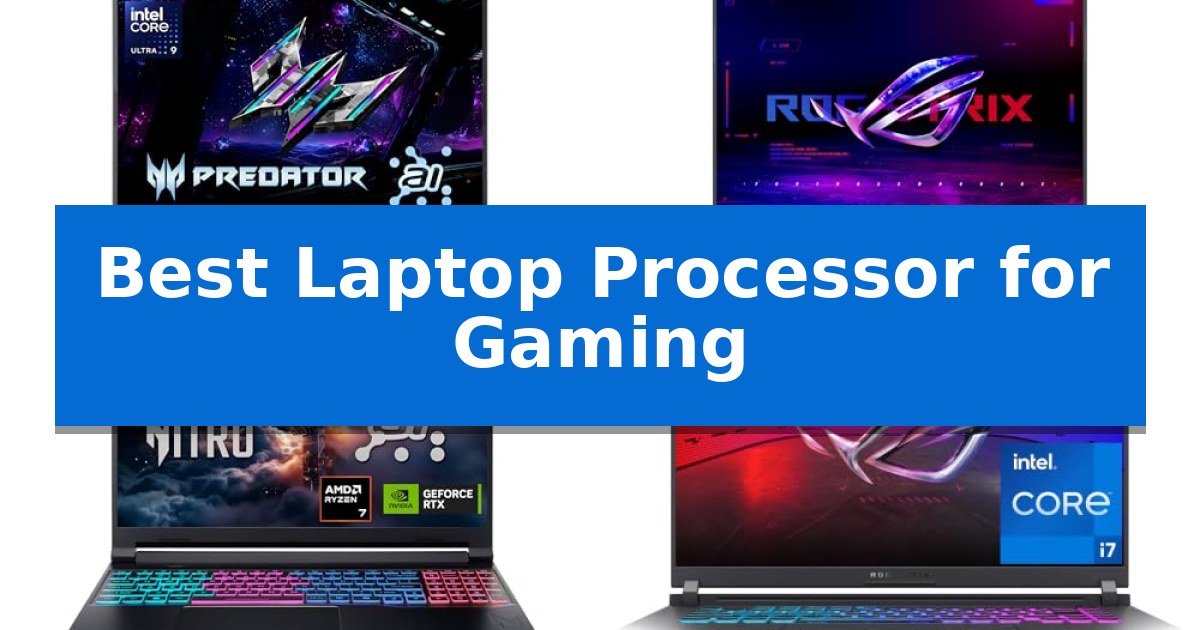
Finding the Best Laptop Processor for Gaming requires balancing raw clock speeds with thermal management and modern AI-driven efficiency. A high-performance CPU is the engine that drives your gaming experience, ensuring that complex physics, world-building, and background processes don't bottleneck your graphics card during intense sessions.
Whether you prioritize portable power or desktop-class performance, the right processor choice dictates your machine's longevity and responsiveness. We have analyzed current hardware configurations to help you identify which mobile platform best aligns with your specific gaming demands and performance expectations.
Best Laptop Processor for Gaming in 2026: Maximize Your Frame Rates
Quick Comparison
| Product | Best For | Key Strength | Score |
|---|---|---|---|
| Acer Predator Helios Neo 14 | Best Overall | Intel Core Ultra 9 285H processor provides significant computational power for gaming and AI tasks. | 4.9 |
| ASUS ROG Strix G16 | Next-Level Processing Speed | AMD Ryzen 9 9955HX provides high-end processing power for demanding games. | 4.6 |
| Acer Nitro V 16S | High-Fidelity Ray Tracing | AI-powered performance via the AMD Ryzen 7 260 CPU and RTX 5060 GPU. | 4.9 |
| ASUS ROG Strix G16 (2025) Gaming Laptop | Advanced Thermal Efficiency | Advanced thermal cooling with liquid metal and vapor chamber technology. | 4.5 |
| ASUS ROG Strix G18 | Massive Immersive Display | Intel Core i9 14900HX processor provides high-level computing power. | 4.3 |
How We Chose
- Processing power and architecture efficiency for modern AAA titles.
- Thermal management capabilities to prevent performance throttling.
- Integration with high-speed memory and storage interfaces.
- AI-accelerated task handling for streaming and background optimization.
- Compatibility with high-refresh-rate display technologies.
1 Acer Predator Helios Neo 14 — AI-Accelerated Gaming Power
The Acer Predator Helios Neo 14 brings high-end processing power to a compact 14.5-inch form factor, utilizing the Intel Core Ultra 9 processor 285H to manage demanding gaming workloads. This machine integrates an NPU for AI-driven background tasks, allowing the system to prioritize gaming performance while handling streaming or audio optimization simultaneously.
Graphics performance is driven by the NVIDIA GeForce RTX 5070, which leverages the Blackwell architecture and 798 AI TOPS to facilitate advanced ray tracing and neural rendering. The inclusion of DLSS 4 with Multi Frame Generation helps maintain high frame rates and visual fidelity, supported by fifth-generation Tensor Cores that accelerate complex neural processing.
Visuals are rendered on a 165Hz WQXGA matte display with a 16:10 aspect ratio and 100% sRGB color gamut coverage. To maintain stability during intense sessions, the laptop employs 5th Gen AeroBlade 3D fans, liquid metal thermal grease, and vector heat pipes, ensuring that the internal components remain within efficient operating temperatures.
Connectivity and expansion are well-represented with a Thunderbolt 4 port, multiple USB 3.2 Gen 2 ports, and an HDMI 2.1 interface capable of supporting high-resolution output. The device also features 32GB of LPDDR5X memory and a 1TB PCIe Gen 4 SSD, with an additional M.2 slot available for future storage expansion.
Best for: Gamers and creators who require desktop-level processing and AI-accelerated graphics in a portable 14.5-inch chassis.
Skip if: Users who prioritize a larger screen real estate for immersive gaming or those who require extensive internal drive bays beyond the two M.2 slots provided.
PROS
- Intel Core Ultra 9 285H processor provides significant computational power for gaming and AI tasks.
- NVIDIA Blackwell architecture with 798 AI TOPS enables advanced ray tracing and neural rendering.
- Advanced thermal management system featuring liquid metal and 5th Gen AeroBlade 3D fans.
- High-speed connectivity options including Thunderbolt 4, Wi-Fi 6E, and HDMI 2.1.
CONS
- Compact 14.5-inch display may be limiting for users accustomed to larger desktop-replacement monitors.
- Onboard memory is fixed, limiting the ability to upgrade RAM after purchase.
2 ASUS ROG Strix G16 — Next-Level Processing Speed
The ASUS ROG Strix G16 centers its performance around the AMD Ryzen 9 9955HX Processor, a high-end chip designed to handle demanding gaming workloads. This laptop integrates the NVIDIA GeForce RTX 5070 GPU, which utilizes the NVIDIA Blackwell architecture to support advanced features like DLSS 4 for enhanced visual fidelity and frame generation.
Visuals are rendered on a 16-inch 16:10 FHD+ display that features a 165Hz refresh rate and a 3ms response time, ensuring fluid motion for fast-paced titles. To maintain stability during extended sessions, the system employs ROG Intelligent Cooling with Tri-Fan technology, a full-width heatsink, and full-surround vents to manage thermal output effectively.
For system responsiveness, the device includes 16GB of DDR5-5600MHz memory paired with a 1TB PCIe Gen 4 SSD for storage. Users can optimize their gaming experience using the MUX Switch, which routes frames directly from the dedicated GPU to improve performance by 5-10%, while Advanced Optimus manages power efficiency by toggling between the integrated and dedicated graphics automatically.
The chassis features a customizable RGB lightbar that can be synchronized with other peripherals or disabled via Stealth Mode for a more professional aesthetic. Connectivity is supported by Wi-Fi 6E, providing a modern wireless standard for low-latency online gaming.
Best for: Gamers seeking a high-performance machine with advanced thermal management and a high-refresh-rate display.
Skip if: Users who require more than 16GB of RAM for professional-grade content creation or heavy multitasking workflows.
PROS
- AMD Ryzen 9 9955HX provides high-end processing power for demanding games.
- Tri-Fan cooling system effectively manages heat during intensive tasks.
- MUX Switch allows for a direct GPU connection to boost frame rates.
- 165Hz/3ms display offers smooth visuals for competitive gaming.
CONS
- 16GB of RAM may be limiting for advanced multitasking or professional creative software.
- 5.51-pound weight makes the device less portable compared to thinner ultrabook-style gaming laptops.
3 Acer Nitro V 16S — High-Fidelity Ray Tracing
The Acer Nitro V 16S distinguishes itself through the integration of the AMD Ryzen 7 260 processor, which delivers up to 38 AI Overall TOPS to handle demanding gaming and AI-driven workloads. This machine is engineered for users who require a balance of high-fidelity graphical output and efficient processing power for both entertainment and content creation.
Equipped with the NVIDIA GeForce RTX 5060 Laptop GPU based on the Blackwell architecture, this laptop provides 572 AI TOPS to support advanced features like full ray tracing and DLSS 4. The inclusion of fourth-gen RT Cores and fifth-gen Tensor Cores allows for sophisticated neural rendering, which enhances frame rates and image quality during intensive gaming sessions.
Visual fidelity is supported by a 16-inch WUXGA 1920 x 1200 display that offers 100% sRGB color coverage and a 180Hz refresh rate. This combination ensures fluid motion and accurate color reproduction, which is essential for fast-paced action and detailed creative tasks.
Internal hardware includes 32GB of DDR5 5600MHz memory and a 1TB PCIe Gen 4 SSD. The system provides two PCIe M.2 slots, with one slot available for future storage expansion, ensuring that the Acer Nitro V 16S can accommodate growing libraries of games and large project files.
Best for: Gamers and content creators who require AI-accelerated performance and high-refresh-rate visuals for demanding applications.
Skip if: Users seeking a lightweight or ultra-portable device, as the 4.63-pound chassis and 16-inch form factor are designed for stationary high-performance tasks.
PROS
- AI-powered performance via the AMD Ryzen 7 260 CPU and RTX 5060 GPU.
- 180Hz refresh rate display with 100% sRGB coverage for smooth and accurate visuals.
- 32GB DDR5 memory provides substantial headroom for multitasking.
- Expandable storage with an available PCIe M.2 slot.
CONS
- Heavier form factor at 4.63 pounds may limit portability.
- Fixed 32GB RAM limit prevents further memory upgrades beyond the pre-installed capacity.
4 ASUS ROG Strix G16 (2025) Gaming Laptop — Advanced Thermal Efficiency
Maximizing frame rates and maintaining thermal stability during intense gaming sessions requires a processor capable of handling high-demand tasks without throttling. The ASUS ROG Strix G16 (2025) Gaming Laptop addresses this by pairing the Intel Core i7 Processor 14650HX with a sophisticated ROG Intelligent Cooling system, utilizing an end-to-end vapor chamber and Conductonaut extreme liquid metal to ensure consistent performance.
Beyond the CPU, this machine integrates the NVIDIA GeForce RTX 5060 Laptop GPU, which leverages the NVIDIA Blackwell architecture and DLSS 4 technology to enhance visual fidelity and frame generation. The hardware is supported by 16GB of DDR5-5600MHz memory and a 1TB PCIe Gen 4 SSD, facilitating quick load times and smooth multitasking for modern game libraries.
Visuals are rendered on a 165Hz FHD+ display featuring a 16:10 aspect ratio and a specialized ACR film designed to improve contrast while minimizing glare. The chassis also includes a 360° RGB light bar that can be fully disabled via Stealth Mode for users who prefer a professional, understated aesthetic in non-gaming environments.
Connectivity and thermal management remain central to the design, with Wi-Fi 7 support for low-latency networking and a tri-fan technology array that keeps the internal components cool under load. This configuration provides a balanced foundation for gamers seeking high-refresh-rate performance in a portable 16-inch form factor.
Best for: Gamers who require high-performance processing and advanced thermal management for sustained, high-refresh-rate gaming sessions.
Skip if: Users who prioritize extreme portability or a lightweight chassis, as the advanced cooling system and 16-inch form factor result in a heavier, more substantial build.
PROS
- Advanced thermal cooling with liquid metal and vapor chamber technology.
- High-refresh 165Hz display with glare-reducing ACR film.
- NVIDIA Blackwell architecture support for modern graphical features like DLSS 4.
- Stealth Mode for versatile lighting control.
CONS
- Substantial weight due to the robust cooling and 16-inch chassis design.
5 ASUS ROG Strix G18 — Massive Immersive Display
The ASUS ROG Strix G18 (2025) centers its performance around the Intel Core i9 Processor 14900HX, a high-end mobile chip designed to handle intensive gaming workloads. This processor is paired with the NVIDIA GeForce RTX 5070 Laptop GPU, which utilizes the NVIDIA Blackwell architecture to support advanced features like DLSS 4 and Max-Q technologies for optimized graphical output.
To maintain stability during extended gaming sessions, the system employs ROG Intelligent Cooling. This thermal solution integrates an end-to-end vapor chamber, tri-fan technology, and Conductonaut extreme liquid metal applied directly to the chipset. These components work in tandem to manage heat, allowing the hardware to operate effectively under load.
The laptop features an 18-inch FHD+ 16:10 display with a 144Hz refresh rate and 3ms response time. ASUS has included a new ACR film on the panel, which is designed to enhance contrast and minimize glare. For memory and storage, the unit comes equipped with 32GB of DDR5-5600MHz RAM and a 1TB PCIe Gen 4 SSD, capable of reaching throughput speeds up to 7,000MB/s.
Aesthetically, the device includes a full-surround RGB lightbar that synchronizes with the keyboard and other ROG peripherals. For users who require a more professional appearance, the Stealth Mode allows for the complete deactivation of all lighting effects. The unit is housed in an Eclipse Gray chassis measuring approximately 0.93 inches in thickness.
Best for: Gamers who prioritize a large, immersive display and high-end processing power for demanding titles.
Skip if: Users who require a highly portable device, as the 10-pound weight and 18-inch form factor are designed for stationary desktop-replacement use.
PROS
- Intel Core i9 14900HX processor provides high-level computing power.
- NVIDIA Blackwell architecture GPU supports modern graphical technologies.
- Advanced thermal management using liquid metal and tri-fan cooling.
- Fast 1TB PCIe Gen 4 SSD with high raw throughput.
CONS
- Heavy 10-pound chassis limits portability.
- Large 18-inch footprint requires significant desk space.
Best Laptop Processor for Gaming Buying Guide
Understanding CPU and GPU Synergy
The Best Laptop Processor for Gaming does not work in isolation; it must be paired with a capable GPU to avoid bottlenecks. High-end processors like the Intel Core Ultra 9 or AMD Ryzen 9 series are designed to feed data to powerful graphics cards, ensuring that your frame rates remain high even in CPU-intensive scenarios.
When selecting a laptop, look for balanced configurations where the CPU does not significantly outclass the GPU, or vice versa. This synergy ensures that your investment provides the best possible visual fidelity and smooth motion across all your favorite games.
Thermal Management and Sustained Performance
Gaming laptops generate significant heat, and a powerful processor is only as good as the cooling system supporting it. Technologies like liquid metal thermal grease and vapor chambers are essential for maintaining peak clock speeds during long gaming sessions.
If a laptop lacks adequate cooling, the processor will automatically reduce its speed to prevent damage, leading to noticeable frame drops. Always prioritize models that feature advanced airflow designs, such as tri-fan technology or vector heat pipes, to ensure consistent performance.
Memory and Storage Standards
Modern gaming requires fast data access, making DDR5 memory and PCIe Gen 4 SSDs the current gold standard. Faster memory allows the processor to retrieve game assets quickly, which is critical for reducing load times and preventing stuttering in open-world environments.
Ensure your chosen laptop supports memory expansion if you plan to keep the machine for several years. Having at least 32GB of RAM is increasingly recommended for high-fidelity gaming and multitasking, such as streaming while playing.
Display and Refresh Rate Compatibility
Your processor must be able to push enough frames to keep up with your display's refresh rate. A 165Hz or 180Hz display provides a fluid experience, but only if the CPU and GPU can render frames at that speed consistently.
Features like NVIDIA G-SYNC and Advanced Optimus help synchronize the display with the GPU output, eliminating screen tearing and stutter. This integration is vital for competitive gaming where every millisecond counts.
The Role of AI in Modern Gaming
Newer processors now include dedicated NPU (Neural Processing Unit) cores to handle AI-driven tasks. This offloads work like background noise cancellation, streaming optimizations, and even AI-upscaling technologies like DLSS 4 from the main CPU and GPU cores.
By utilizing these AI resources, your system can maintain higher frame rates and better image quality without sacrificing performance. Look for processors that explicitly mention AI TOPS horsepower to ensure your laptop is ready for the next generation of gaming software.
Frequently Asked Questions
Is an Intel Core i9 always better than an AMD Ryzen 7 for gaming?
Not necessarily. While i9 processors often offer higher peak clock speeds, modern AMD Ryzen chips are highly efficient and often provide better thermal performance, which can lead to more consistent frame rates in thin-and-light gaming laptops.
How much RAM do I need for modern gaming?
For most modern titles, 16GB is the minimum, but 32GB is recommended if you plan to stream, use background applications, or play memory-intensive open-world games.
Does the processor affect my screen resolution?
The processor handles the game logic and asset preparation, while the GPU handles the rendering. However, at lower resolutions, the CPU becomes more important for achieving high frame rates, whereas at 4K, the GPU becomes the primary bottleneck.
What is a MUX switch and why does it matter?
A MUX switch allows the laptop to bypass the integrated graphics and connect the display directly to the dedicated GPU. This can improve gaming performance by 5-10% by reducing latency.
Can I upgrade my laptop processor later?
In almost all modern gaming laptops, the processor is soldered to the motherboard and cannot be upgraded. It is essential to choose the performance level you need at the time of purchase.
Conclusion: Our Top Pick
Selecting the right hardware is a balance of power, cooling, and future-readiness. For those seeking the best overall experience, the Acer Predator Helios Neo 14 stands out as a highly capable machine. It combines the advanced Intel Core Ultra 9 processor with robust cooling and AI-acceleration to deliver consistent performance across a wide range of titles.
While other models offer larger screens or different thermal configurations, this unit provides a well-rounded package for gamers who need desktop-level power in a portable form factor. Ensure you verify that the specific configuration meets your storage and memory needs before finalizing your purchase.