
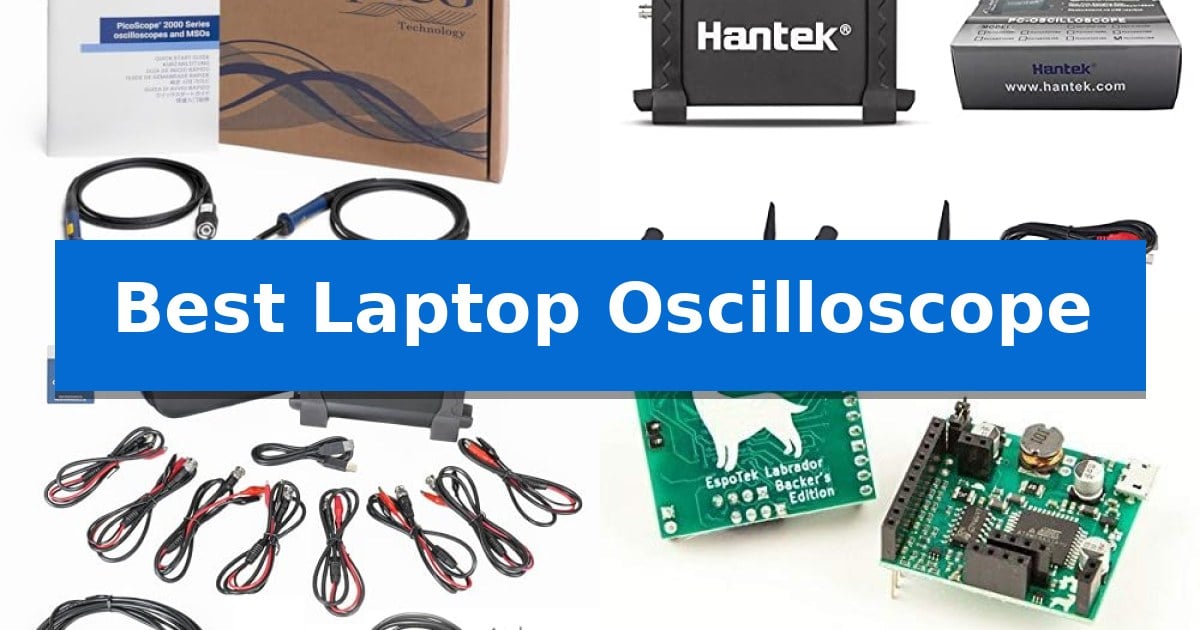
When you need to diagnose complex electronic signals away from a traditional workbench, a portable solution becomes essential. The Best Laptop Oscilloscope transforms your computer into a powerful diagnostic station, allowing you to visualize waveforms, analyze serial protocols, and troubleshoot circuits with ease.
Selecting the right tool depends on your specific environment, whether you are working on automotive systems, hobbyist electronics, or professional circuit design. We have evaluated several USB-based oscilloscopes to help you identify which device offers the right balance of channel count, bandwidth, and software features for your mobile setup.
Best Laptop Oscilloscope in 2026: Portable Signal Analysis
Quick Comparison
| Product | Best For | Key Strength | Score |
|---|---|---|---|
| Pico Technology PicoScope 2204A Oscilloscope | Best Overall | Ultra-compact, travel-friendly design that fits easily in a laptop bag. | 4.9 |
| Hantek 6022BE USB Oscilloscope | Reliable entry-level PC-based capture | USB-powered operation eliminates the need for bulky external power adapters. | 4.8 |
| Hantek 1008C Automotive Diagnostic Oscilloscope | Specialized for vehicle system testing | 8-channel capability for simultaneous monitoring of complex automotive systems. | 4.5 |
| EspoTek Labrador USB Oscilloscope | Versatile all-in-one maker tool | All-in-one functionality combining five essential diagnostic tools in a single device. | 4.5 |
| Hantek 6022BL Logic Analyzer Oscilloscope | Dual-purpose signal and logic analysis | Dual-functionality combining a 2-channel oscilloscope and 16-channel logic analyzer. | 4.4 |
How We Chose
- Input bandwidth and sampling rate capabilities for signal fidelity.
- Channel count and compatibility with specific diagnostic tasks like automotive or logic analysis.
- Software interface usability and availability of advanced measurement tools.
- Portability and power requirements for field-ready operation.
- Versatility of additional features like waveform generation or protocol decoding.
1 Pico Technology PicoScope 2204A Oscilloscope — Advanced analysis in a compact frame
The Pico Technology PicoScope 2204A Oscilloscope transforms a standard laptop into a versatile diagnostic workstation by leveraging a compact, USB-powered design. This 2-channel device provides a 10 MHz bandwidth and a 100 MS/s maximum sampling rate, making it a highly portable solution for engineers and hobbyists who need to perform signal analysis on the go.
Equipped with PS7 software for Windows, Linux, and Mac, the unit functions as an advanced oscilloscope, spectrum analyzer, and both a function and arbitrary waveform generator. It includes a 10,000 waveform circular buffer and features mask limit testing, advanced math, and filtering capabilities, allowing for efficient debugging of complex designs directly from a computer screen.
Designed for convenience, the PicoScope 2204A is small enough to fit into a laptop bag and draws its power directly through a USB 2.0 connection, which is also compatible with USB 3.0/3.1 ports. The kit comes ready to use with two passive probes, ensuring that users have the necessary hardware to begin measurements immediately upon setup.
While this model offers robust analysis tools, it is important to note that it is not compatible with PicoScope 7 Automotive Software. Users requiring specialized automotive diagnostic features should look toward the dedicated 4425A or 4225A models instead.
Best for: Engineers and electronics hobbyists who require a highly portable, USB-powered diagnostic tool for signal analysis and waveform generation.
Skip if: Users who specifically need automotive-grade diagnostic software or advanced features not supported by the 2204A series.
PROS
- Ultra-compact, travel-friendly design that fits easily in a laptop bag.
- Versatile functionality including spectrum analysis and waveform generation in one unit.
- USB-powered operation eliminates the need for external power supplies.
- Continuous software improvements provided through free, lifetime updates.
CONS
- Incompatible with automotive-specific software versions.
- Limited to 10 MHz bandwidth, which may not suit high-frequency applications.
2 Hantek 6022BE USB Oscilloscope — Reliable entry-level PC-based capture
The Hantek 6022BE USB Oscilloscope provides a streamlined approach to signal analysis by utilizing a single USB 2.0 connection for both data transfer and power delivery. This design eliminates the need for external power supplies, making it a practical choice for users who require a portable, space-saving diagnostic tool for workbench or field environments.
Engineered with a compact industrial design, this unit features an anodized-aluminum enclosure with protective rubber ends. It offers two-channel signal capture with a 20 MHz bandwidth and a 48 MSa/s maximum real-time sample rate, supported by up to 1 M memory depth per channel for detailed waveform observation.
The device includes a comprehensive suite of measurement and analysis tools, such as 20 automatic measurements, FFT spectrum analysis, waveform math, and X-Y display modes. These features enable users to perform pass/fail checking and cursor measurements directly through their computer interface.
This complete starter package ensures immediate utility by including two passive probes, a USB communication cable, and the necessary software media. It is built to integrate into existing PC setups, providing an accessible entry point for digital storage oscilloscope functionality without requiring dedicated bench space.
Best for: Engineers and hobbyists needing a portable, PC-based oscilloscope for basic signal analysis and field diagnostics.
Skip if: Users requiring high-bandwidth performance or standalone operation without a computer connection should look for traditional benchtop oscilloscopes.
PROS
- USB-powered operation eliminates the need for bulky external power adapters.
- Compact aluminum enclosure provides durability and portability for field use.
- Comprehensive software tools include FFT analysis and 20 automatic measurements.
- Complete starter kit includes two passive probes and all necessary cables.
CONS
- PC-dependency requires a computer connection for all operations and display.
- 20 MHz bandwidth limits the device to lower-frequency signal analysis.
3 Hantek 1008C Automotive Diagnostic Oscilloscope — Specialized for vehicle system testing
The Hantek 1008C PC USB 8CH Automotive Diagnostic Digital Oscilloscope serves as a specialized tool for technicians and hobbyists who require a multi-channel interface for vehicle system analysis. By leveraging a USB 2.0 connection to a Windows-based PC, this device transforms a standard laptop into a comprehensive diagnostic station capable of monitoring ignition, sensor, bus, and actuator signals.
Engineered for versatility, the unit features 8 analogue channels with 12 bits of resolution and a 2.4MSa/s real-time sampling rate. This allows users to capture and visualize complex automotive data with a 4K memory depth. Beyond general-purpose oscilloscope tasks, the system includes a programmable signal generator with an LVTTL output level and a frequency range of 0-250KHz, which is useful for simulating crankshaft and camshaft signals during troubleshooting.
The software suite provides access to more than 80 automotive diagnostic functions, enabling users to quickly assess the stability of charging and starting systems. With 20 automatic measurement modes selectable via one-key operation, the interface is designed to provide intuitive signal readings, making it a practical choice for those learning basic circuit diagnostics or performing repairs on home appliances and automobiles.
Measuring 8.8 inches in length and weighing only 0.68 pounds, the Hantek 1008C is a compact, portable solution for field diagnostics. While it requires a PC connection to function, its integration of diagnostic, oscilloscope, and signal generator capabilities into a single hardware unit offers a streamlined approach for users who need to manage multiple signal paths simultaneously.
Best for: Automotive technicians and electronics hobbyists who need an 8-channel diagnostic tool for vehicle system troubleshooting via a Windows PC.
Skip if: Users who require a standalone, battery-powered handheld oscilloscope or those who operate exclusively on macOS or Linux platforms.
PROS
- 8-channel capability for simultaneous monitoring of complex automotive systems.
- Includes over 80 pre-configured automotive diagnostic functions for rapid testing.
- Integrated programmable signal generator for simulating engine sensors.
- Compact and lightweight design for easy transport between workstations.
CONS
- Requires a Windows PC via USB 2.0 to operate and display data.
- No standalone display or battery power for field use without a computer.
4 EspoTek Labrador USB Oscilloscope — Versatile all-in-one maker tool
The EspoTek Labrador USB Oscilloscope functions as a comprehensive, all-in-one laboratory tool designed for makers who need to interface directly with their computer. By consolidating multiple instruments into a single, compact device, it streamlines workspace management for those working on Windows, Mac, Linux, Android, or Raspberry Pi platforms.
This device integrates five distinct functions into one unit: a 2-channel oscilloscope with 750ksps, a 2-channel arbitrary waveform generator at 1MSPS, and a 2-channel logic analyzer capable of 3MSPS with serial decoding. These capabilities allow users to visualize signals and analyze digital communication protocols directly through a connected host system.
Beyond signal analysis, the hardware includes a power supply providing 4.5 to 15V with 0.75W maximum output and closed-loop feedback, alongside a built-in multimeter for measuring voltage, current, resistance, and capacitance. This versatility makes it a practical choice for troubleshooting circuits or prototyping electronics without requiring separate, bulky bench equipment.
Given its small form factor and USB connectivity, the EspoTek Labrador USB Oscilloscope is suited for portable diagnostic tasks or space-constrained environments. While it offers a broad range of diagnostic tools, users should ensure their specific signal requirements align with the stated sampling rates and power output limits to maintain signal integrity during testing.
Best for: Makers and engineers requiring a compact, multi-instrument diagnostic tool for prototyping and circuit troubleshooting.
Skip if: Users requiring high-bandwidth signal analysis or high-power supply output beyond the 0.75W limit will need dedicated benchtop instrumentation.
PROS
- All-in-one functionality combining five essential diagnostic tools in a single device.
- Broad platform compatibility including Windows, Mac, Linux, Android, and Raspberry Pi.
- Compact, portable design suitable for limited workspaces or mobile electronics work.
- Integrated serial decoding within the logic analyzer for digital signal analysis.
CONS
- Limited power output of 0.75W restricts the device to low-power circuit testing.
- Sampling rates are optimized for general maker projects rather than high-speed professional signal analysis.
5 Hantek 6022BL Logic Analyzer Oscilloscope — Dual-purpose signal and logic analysis
The Hantek 6022BL Logic Analyzer Oscilloscope offers a compact, portable solution for signal analysis by integrating a 2-channel 20MHz oscilloscope with a 16-channel logic analyzer into a single, USB-powered device. Its anodised aluminium casing provides a durable, heat-resistant exterior that is designed for portability, measuring just 8 inches in length.
Designed for versatility in technical applications, this device connects directly to a PC via a USB 2.0 port, eliminating the need for an external power supply. It features over 20 automatic measurement functions and a PASS/FAIL check capability, making it suitable for product line maintenance or field work where space is limited.
The unit utilizes a standard USBXITM interface, allowing it to integrate into existing setups or be used as a standalone instrument for notebook computers. Its small footprint and robust construction ensure it remains a practical tool for professionals who require a combination instrument that fits easily into a travel kit.
While this device provides significant functionality in a small form factor, users should note that it relies entirely on a PC connection for operation and interface. It is optimized for those who prioritize portability and multi-functionality over the dedicated, high-power requirements of large desktop-only laboratory equipment.
Best for: Technicians and engineers who require a portable, dual-purpose signal and logic analysis tool for field maintenance or mobile setups.
Skip if: Users who require high-bandwidth performance or a standalone benchtop unit that does not rely on a PC connection for interface and power.
PROS
- Dual-functionality combining a 2-channel oscilloscope and 16-channel logic analyzer.
- USB-powered design eliminates the need for bulky external power supplies.
- Durable anodised aluminium casing offers enhanced wearability and heat resistance.
- Highly portable dimensions suitable for business travel and field service.
CONS
- PC-dependent operation requires a constant USB connection to a computer.
- Limited bandwidth of 20MHz may not suit high-frequency signal analysis.
Best Laptop Oscilloscope Buying Guide
Understanding Bandwidth and Sampling
Bandwidth determines the highest frequency signal your oscilloscope can capture accurately. For most general electronics and hobbyist projects, a 10 MHz to 20 MHz bandwidth is sufficient to observe standard digital and analog signals.
The sampling rate is equally critical, as it dictates how often the device records the signal. A higher sampling rate prevents aliasing and ensures that fast-transient events are captured clearly, which is vital for debugging high-speed communication lines.
Channel Count and Diagnostic Needs
Most portable oscilloscopes offer two channels, which is standard for comparing a signal input against an output. However, specialized tasks like automotive diagnostics often require eight channels to monitor multiple sensors, ignition systems, and actuators simultaneously.
Consider whether your work involves logic analysis. If you are debugging microcontrollers or digital buses, a device that supports both analog signal capture and digital logic analysis provides a significant advantage in a single, compact package.
Software and Analysis Tools
The effectiveness of a laptop-based oscilloscope is largely defined by its software interface. Look for platforms that support automatic measurements, FFT spectrum analysis, and serial protocol decoding to speed up your troubleshooting process.
Ensure the software is compatible with your operating system, whether you use Windows, macOS, or Linux. Some advanced software packages offer continuous updates, which can add new features and improve measurement accuracy over the life of the device.
Portability and Power Efficiency
A primary benefit of these devices is their USB-powered design, which eliminates the need for bulky external power supplies. This makes them ideal for field service, where you may only have access to your laptop's battery.
Check the physical dimensions and build quality of the enclosure. Anodized aluminum or reinforced housings provide better durability for travel, while compact designs ensure the device fits comfortably in a standard laptop bag alongside your other tools.
Versatility for Maker Projects
Many modern USB oscilloscopes function as all-in-one instruments. Beyond signal capture, some units include built-in arbitrary waveform generators, multimeters, and programmable power supplies.
These multi-function tools are excellent for makers and students who need a comprehensive lab setup that fits on a crowded desk or in a small project box, reducing the amount of hardware you need to carry.
Frequently Asked Questions
Do I need an external power supply for these oscilloscopes?
Most USB-based oscilloscopes are powered directly through the USB connection to your laptop, making them highly portable for field work.
Can I use these devices for automotive diagnostics?
Standard 2-channel oscilloscopes can perform basic automotive tests, but specialized 8-channel models are designed specifically for complex vehicle system testing.
Are these oscilloscopes compatible with Mac and Linux?
Compatibility varies by model. While many support Windows, you should verify if the specific device's software supports your preferred operating system.
What is the difference between an oscilloscope and a logic analyzer?
An oscilloscope measures varying signal voltages over time, while a logic analyzer captures and displays digital signals to help debug communication protocols.
Can I use these for high-frequency RF work?
Portable USB oscilloscopes typically have bandwidths in the 10-20 MHz range, which is generally not sufficient for high-frequency RF applications.
Conclusion: Our Top Pick
For users seeking a balance of advanced analysis and portability, the Pico Technology PicoScope 2204A Oscilloscope stands out as the most capable option. Its combination of 10 MHz bandwidth, 100 MS/s sampling rate, and robust software support makes it a reliable choice for both simple tests and complex design debugging.
While other models offer specialized features like 8-channel automotive support or all-in-one maker functionality, the PicoScope 2204A provides the most refined experience for general-purpose signal analysis. Its compact, USB-powered design ensures it remains a versatile tool in any mobile technician's kit.