
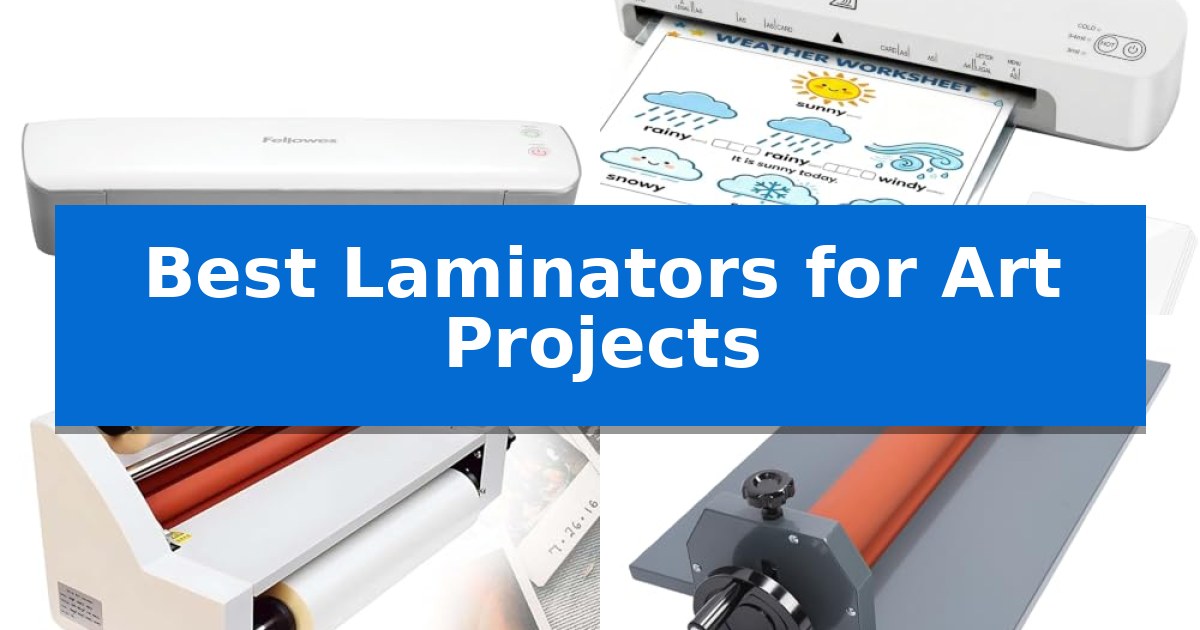
Preserving delicate artwork requires the right equipment to ensure your creations remain vibrant and protected from environmental damage. Whether you are a teacher preparing classroom materials or a professional artist looking to finish large-scale prints, finding the right tool is essential for achieving a smooth, bubble-free finish.
We have evaluated the Best Laminators for Art Projects to help you navigate the differences between thermal heat-based systems and manual cold-press machines. From compact desktop units to wide-format rollers, our guide breaks down the features that matter most for your specific creative workflow.
Best Laminators for Art Projects in 2026
Quick Comparison
| Product | Best For | Key Strength | Score |
|---|---|---|---|
| Fellowes Ion 95 Thermal Laminator | Best Overall | Manual roller release lever for easy jam removal and sheet re-centering. | 4.9 |
| Binditek 13-Inch Thermal Laminator | Fast Warm-Up for Large Art | 13-inch wide entry supports large posters and blueprints. | 4.4 |
| Zhenmaster 13-Inch Roll Laminator | Professional Precision for Creative Work | Advanced dual-heating system for smooth, bubble-free results. | 4.4 |
| Aramox Cold Laminating Machine | Electricity-Free Manual Lamination | Electricity-free operation via a reliable hand-crank mechanism. | 4.4 |
| UYCVT Manual Cold Laminator | Adjustable Rollers for Thick Media | Adjustable roller spacing supports materials up to 15mm thick. | 4.5 |
How We Chose
- Entry width capacity to accommodate various paper sizes, including A3 and large posters.
- Heating technology and warm-up speed for thermal models to ensure consistent, even adhesion.
- Roller versatility, specifically the ability to handle both thermal pouches and cold self-adhesive films.
- Jam management features, such as manual release levers, to protect delicate art during the feeding process.
- Build quality and stability, focusing on metal construction for manual models and space-saving profiles for desktop units.
1 Fellowes Ion 95 Thermal Laminator — Compact Pick for Classroom Projects
Preserving student projects and classroom materials requires a reliable sealing method, and the Fellowes Ion 95 Thermal Laminator offers a dedicated, built-in manual roller release lever to ensure projects remain safe even if a sheet is misaligned. This feature allows users to instantly disengage internal roller tension, providing a practical solution for high-priority school supply preparation.
Designed with a compact classroom profile, this machine fits easily on a standard desk and features a lightweight, mobile footprint for easy transport between rooms or storage on a shelf. It supports versatile project needs by offering dual temperatures, accommodating both 3-mil and 5-mil hot thermal pouches for thick sealing, as well as an independent cold mode for delicate self-adhesive sheets.
The unit includes a complete starter bundle featuring 15 assorted laminating pouches, helping users get started immediately. To ensure safety and efficiency, the device is equipped with an energy-saving auto shut-off function, and it is backed by a 1-year warranty for long-term confidence.
While the machine is optimized for standard paper sizes and classroom-focused tasks, its 9.5-inch entry width is specifically tailored for common educational materials like name tags, flashcards, and tracking calendars. The combination of quick warm-up capabilities and simple controls makes it a straightforward tool for those needing to turn printouts into durable, reusable resources.
Best for: Teachers and home office users who need a compact, reliable laminator for small-scale educational projects and reusable classroom materials.
Skip if: Users who require wide-format lamination for large posters or high-volume industrial production will find the 9.5-inch entry width and compact design insufficient for their needs.
PROS
- Manual roller release lever for easy jam removal and sheet re-centering.
- Dual temperature settings supporting both hot thermal and cold self-adhesive pouches.
- Space-saving, compact design ideal for crowded desks and easy storage.
- Energy-saving auto shut-off for added safety and efficiency.
CONS
- Limited 9.5-inch entry width restricts the size of projects that can be laminated.
- Designed primarily for light-duty school or home office use rather than heavy industrial volume.
2 Binditek 13-Inch Thermal Laminator — Fast Warm-Up for Large Art
Preserving artwork and important documents requires a reliable sealing method that prevents wear, moisture, and fading over time. The Binditek 13-Inch Thermal Laminator simplifies this process with a dual-roller heating system that ensures smooth, flat edges on everything from delicate photos to large-scale classroom posters. By providing a consistent heat application, it helps maintain the integrity of your creative projects.
Versatility is a core strength of this machine, as its 13-inch wide entry accommodates a variety of sizes, including Letter, A3, A4, A5, A6, and 11 x 17-inch documents. This eliminates the need to trim or piece together larger blueprints or art prints. The unit features hot and cold lamination modes, allowing users to switch between standard thermal pouches and self-adhesive sheets depending on the heat sensitivity of the project material.
Efficiency is prioritized through a fast 52-second warm-up time for 3 mil pouches, which allows for quick transitions between tasks. The operation is designed for simplicity, utilizing a 4-step process that is accessible for home, school, or office environments. If a pouch is misfed, the integrated ABS jam release lever provides a straightforward way to clear the rollers without damaging the document.
The package includes an all-in-one starter kit containing a paper cutter, corner rounder, hole punch, binder rings, and 30 laminating pouches. This comprehensive set ensures that users have the necessary tools to finish, trim, and organize their art projects immediately upon unboxing, making it a practical solution for those who need a complete finishing station.
Best for: This laminator is best for educators, artists, and office users who need to process various document sizes up to 13 inches wide with quick warm-up requirements.
Skip if: Skip this model if you require industrial-grade, high-volume continuous lamination or need to process materials thicker than 5 mil pouches.
PROS
- 13-inch wide entry supports large posters and blueprints.
- Fast 52-second warm-up reduces wait times for projects.
- ABS jam release allows for easy clearing of misfed pouches.
- All-in-one kit includes essential finishing tools like a cutter and corner rounder.
CONS
- Limited to 5 mil maximum thickness, which may not suit heavy-duty rigid laminating needs.
3 Zhenmaster 13-Inch Roll Laminator — Professional Precision for Creative Work
Achieving a professional finish on creative projects requires consistent heat and precise control, which is exactly what the Zhenmaster 13-Inch Roll Laminator provides through its advanced dual-heating system. This machine is engineered to handle both hot and cold lamination, ensuring smooth, bubble-free results for everything from delicate photos to educational charts.
The unit features a digital thermostat with ±3°C accuracy, allowing for stable temperature management across various film types like BOPP, PET, and PVC. Its 700W motor operates quietly at under 45dB while maintaining a processing speed of up to 43 inches per minute, making it suitable for high-volume tasks in home studios or classrooms.
Versatility is a core design element, as the laminator accommodates material thicknesses ranging from 0.1mm to 5mm. The inclusion of adjustable film tension and clutch-enabled rubber rollers helps prevent common issues like wrinkling or misalignment, ensuring that even complex art projects remain perfectly flat and protected.
Safety and durability are prioritized through an all-metal frame and an intelligent safety protection system that automatically cuts power if abnormal temperatures or faults are detected. These features, combined with a rapid heat-up design, offer a reliable solution for users who need a heavy-duty, consistent tool for long-session creative work.
Best for: Artists, educators, and office users who require a high-capacity, heavy-duty machine for consistent, professional-grade lamination of diverse materials.
Skip if: Users seeking a compact, portable device for occasional, small-scale document lamination may find this heavy-duty roll system unnecessarily large and complex.
PROS
- Advanced dual-heating system for smooth, bubble-free results.
- Precise digital temperature control with ±3°C accuracy.
- Adjustable film tension and rollers for materials up to 5mm thick.
- Quiet operation under 45dB with a robust all-metal frame.
CONS
- Large physical footprint due to heavy-duty construction.
4 Aramox Cold Laminating Machine — Electricity-Free Manual Lamination
Achieving a consistent, smooth finish on large-format art prints and book covers requires precise pressure, which is exactly what the Aramox Cold Laminating Machine provides through its robust metal construction. Designed for those who need to process materials up to 750mm wide, this manual laminator removes the complexity of electrical heating elements, relying instead on a reliable hand-crank mechanism for full control over the lamination process.
This machine is built for versatility in professional environments like art studios and advertising agencies. Its durable metal frame ensures stability during operation, while the ability to handle materials with a maximum thickness of 0.6 inches allows for a wide range of project types, from delicate photography to thicker book covers. The manual operation provides a tactile experience that can be beneficial when working with sensitive media that might otherwise be damaged by heat.
Portability and storage are key considerations for any studio workspace. The Aramox Cold Laminating Machine features a compact and foldable design, measuring 93 x 40.5 x 26cm, which allows it to be tucked away when not in use. This makes it an efficient choice for creators who need professional-grade equipment but have limited floor space or require a mobile setup for on-the-go projects.
The unit comes as a comprehensive package, including the main machine and necessary accessories to get started immediately. By prioritizing a manual, electricity-free design, it offers a straightforward, low-maintenance solution for high-quality cold lamination. It is a practical tool for those who prioritize mechanical reliability and wide-format capability over automated features.
Best for: Artists, photographers, and small studios needing a wide-format, electricity-free solution for cold lamination.
Skip if: Users requiring automated, high-speed thermal lamination or those with very limited table space for a 750mm-wide device.
PROS
- Electricity-free operation via a reliable hand-crank mechanism.
- 750mm wide lamination capacity suitable for large art prints.
- Robust metal construction for long-term durability and stability.
- Foldable design for convenient storage in smaller studio spaces.
CONS
- Manual operation requires more physical effort compared to electric models.
- Large footprint may be cumbersome for users with minimal workspace.
5 UYCVT Manual Cold Laminator — Adjustable Rollers for Thick Media
Preserving large-scale prints and delicate artwork requires a tool that handles various material thicknesses without the need for heat. The UYCVT Manual Cold Laminator stands out for its 650mm width and adjustable roller spacing, which accommodates materials up to 15mm thick. This design choice allows creators to move beyond standard paper documents to mount posters, photos, and even rigid KT boards with ease.
Built with a reinforced metal construction, this unit prioritizes stability during the manual lamination process. The smooth, flexible rubber rollers are engineered to maintain consistent pressure across the entire surface area. By ensuring even adhesion, the machine helps minimize common issues like bubbles, wrinkles, or peeling, providing a clean and professional appearance for your finished projects.
Operation is entirely cordless, relying on a hand-crank mechanism that eliminates the need for electricity. This makes the device a practical choice for environments where power outlets are limited or for users who prefer a quiet, energy-free workflow. Stability is further supported by four anti-slip rubber bases, which keep the machine firmly in place while you turn the crank.
This laminator serves as a versatile solution for diverse creative needs, ranging from wedding photos and book covers to professional advertisements. Its ability to handle both thin films and thicker mounted items makes it a flexible addition to home studios, offices, or school classrooms where varied lamination tasks are common.
Best for: Creators and office users who need to laminate large, thick, or mounted items without the constraints of electricity or heat.
Skip if: Users who require automated, high-speed lamination or those who specifically need thermal lamination for standard office documents.
PROS
- Adjustable roller spacing supports materials up to 15mm thick.
- Cordless manual operation allows for use in any location without power.
- Reinforced metal construction provides enhanced stability during use.
- Smooth rubber rollers ensure even pressure to prevent bubbles and wrinkles.
CONS
- Manual hand-crank operation requires more physical effort than electric models.
- Cold lamination only limits the types of adhesive films that can be used.
Best Laminators for Art Projects Buying Guide
Thermal vs. Cold Lamination
Thermal laminators use internal heating elements to melt the adhesive on specialized pouches, creating a permanent, heat-sealed bond. This method is ideal for standard documents, flashcards, and projects that require high durability and a glossy, professional finish.
Cold laminators rely on pressure-sensitive rollers to apply adhesive sheets without heat. This is the preferred method for heat-sensitive art, such as certain types of thermal-reactive photos, delicate ink-jet prints, or thick mounting boards that might warp under high temperatures.
Understanding Pouch Thickness (Mil)
The term mil refers to the thickness of the laminating pouch, with 3-mil and 5-mil being the most common standards. A 3-mil pouch is flexible and lightweight, making it suitable for documents that need to be handled frequently but remain pliable.
A 5-mil pouch provides significantly more rigidity and protection. This thickness is recommended for art projects, classroom signage, or items that will be displayed on walls and need to resist bending or tearing over long periods.
Entry Width and Project Size
Standard desktop laminators typically feature a 9-inch entry, which is sufficient for letter-sized paper and smaller crafts. If your work involves larger posters, blueprints, or A3-sized art, you must look for a 13-inch wide entry to avoid the need for piecing or cutting your materials.
Always check the maximum thickness capacity of the machine. While most thermal units are designed for paper, some manual cold laminators can handle materials up to 15mm thick, allowing you to laminate items mounted on foam or cardboard.
Jam Prevention and Maintenance
Laminating can be unpredictable, and a misfed sheet can potentially ruin a piece of art. Machines equipped with a manual roller release lever allow you to disengage the rollers instantly, giving you the chance to pull back the project before the adhesive sets permanently.
Regular maintenance for thermal units involves keeping the rollers clean of adhesive residue. Some models feature simple, intuitive controls that make it easier to manage the feeding process, reducing the likelihood of wrinkles or bubbles in the final result.
Portability and Storage
For those working in shared spaces or classrooms, a compact, lightweight design is a major advantage. Models with a streamlined footprint can be easily stowed on a shelf when not in use, keeping your workspace clear for other creative tasks.
Manual cold laminators, while often larger, frequently feature foldable or modular designs. These are excellent for art studios where electricity-free operation is preferred, allowing you to set up your lamination station anywhere without needing a nearby power outlet.
Frequently Asked Questions
Can I use a thermal laminator for all types of art?
No, heat-sensitive materials like certain photo papers or thermal prints can be damaged by the high temperatures of a thermal laminator. Always check the compatibility of your art materials before using heat.
What is the benefit of a 13-inch laminator?
A 13-inch entry width allows you to process larger documents, posters, and A3-sized art without having to fold or piece the material together, resulting in a seamless, professional finish.
Do I need electricity for a cold laminator?
Most manual cold laminators use a hand-crank system, meaning they require no electricity. This makes them portable and safe to use in environments where power outlets are limited or unavailable.
How do I prevent bubbles in my lamination?
Bubbles are often caused by uneven heat or improper feeding. Ensure your machine is fully warmed up before starting, feed the pouch straight, and avoid pulling or pushing the material while it is passing through the rollers.
What is the difference between 3-mil and 5-mil pouches?
3-mil pouches are thinner and more flexible, while 5-mil pouches are thicker and provide greater rigidity. Choose 5-mil for projects that require extra protection and durability.
Conclusion: Our Top Pick
Selecting the right equipment depends on the size of your projects and the sensitivity of your materials. For most classroom and home office needs, the Fellowes Ion 95 Thermal Laminator stands out as an efficient, space-saving solution that handles standard thermal pouches with ease.
Its compact design and manual jam release lever provide the reliability needed for frequent use, making it a practical choice for protecting your creative work. If your projects involve larger formats or heat-sensitive materials, consider the wider-entry thermal or manual cold-press options reviewed above to better suit your specific artistic requirements.