
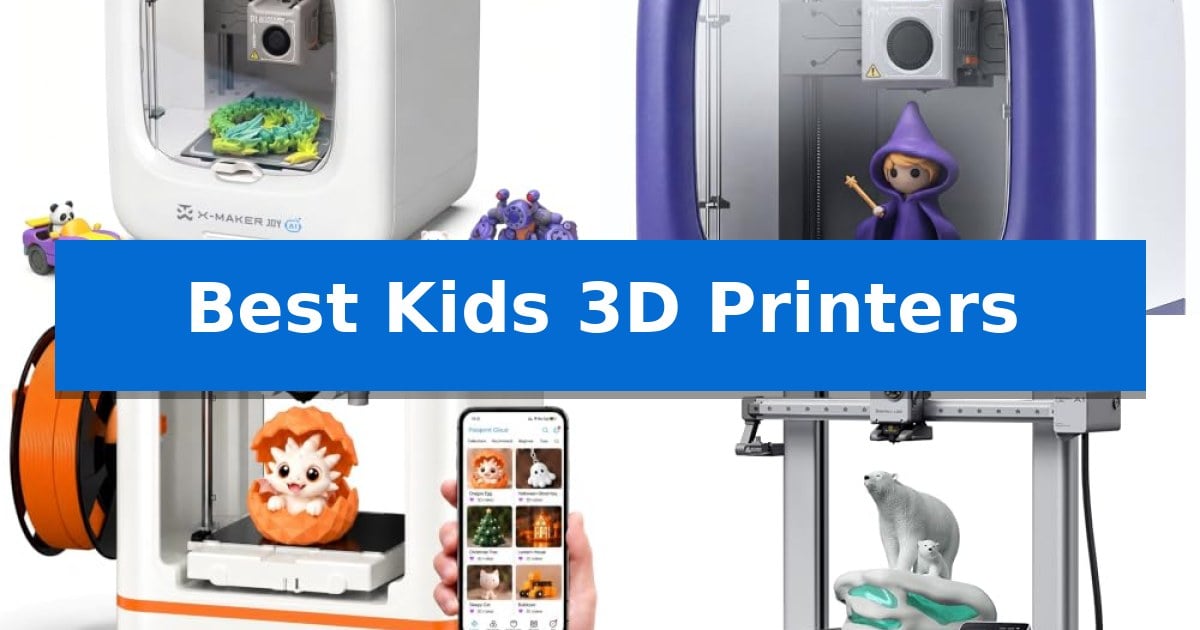
Introducing children to the world of additive manufacturing can spark a lifelong interest in engineering and design. Finding the right equipment requires balancing ease of use with safety features that allow young creators to explore their imagination without constant supervision.
The Best Kids 3D Printers prioritize intuitive interfaces, enclosed build chambers, and pre-loaded model libraries to ensure a frustration-free experience. Whether you are looking for AI-assisted design tools or simple plug-and-play functionality, these machines offer a practical way to turn digital ideas into physical objects.
Best Kids 3D Printers in 2026: Creative Tools for Young Makers
Quick Comparison
| Product | Best For | Key Strength | Score |
|---|---|---|---|
| AOSEED X-MAKER JOY AI+ 3D Printer | Best Overall | AI-powered design tools enable model creation via voice or image prompts. | 4.9 |
| Magic Jimmy 3D Printer | Safest Enclosed Design for Kids | Fully enclosed child-safe design keeps moving parts and heat away from users. | 4.6 |
| Entina Tina2C 3D Printer | Easiest Setup for First-Timers | 5-minute setup with fully assembled hardware. | 4.9 |
| Bambu Lab A1 3D Printer | Fastest High-Precision Learning Tool | Full-Auto Calibration eliminates manual setup hassles. | 4.7 |
| Flashforge Adventurer 5M 3D Printer | Best for Rapid Prototyping Projects | Automatic bed leveling for consistent, hassle-free first layers. | 4.3 |
How We Chose
- Safety features, including fully enclosed printing chambers and non-toxic filament support.
- Ease of assembly, focusing on pre-assembled units or those requiring minimal setup time.
- Software accessibility, prioritizing apps that offer intuitive model libraries and AI-assisted design tools.
- Printing performance, specifically looking for auto-leveling capabilities and reliable print speeds.
- Maintenance requirements, such as quick-swap nozzles and magnetic build plates for easy part removal.
1 AOSEED X-MAKER JOY AI+ 3D Printer — Best for AI-Powered Creative Play
The AOSEED X-MAKER JOY AI+ 3D Printer simplifies the creative process for children by integrating AI-powered design tools that allow users to generate 3D models from voice, text, or image prompts. By removing the need for complex CAD skills, this device enables kids to produce custom figures and avatars directly from their own imagination.
Safety and ease of use are central to its design, featuring an enclosed, pinch-resistant chassis and a leveling-free platform that eliminates common setup frustrations. The unit operates quietly and includes a built-in camera for real-time monitoring via a smartphone app, allowing parents to oversee projects or capture time-lapse videos of the creation process.
Performance-wise, the printer supports speeds up to 400 mm/s, enabling small toy projects to be completed in as little as 20 minutes. It includes filament runout detection to prevent failed prints and a quick-release nozzle for simplified maintenance, ensuring a smoother experience for beginners.
The printer arrives as an all-in-one starter kit, bundled with 8 rolls of PLA filament, a magnetic build plate, and DIY stickers. While it is a versatile tool for STEM learning and home projects, it is important to note that this machine is designed for single-color printing only, meaning multi-color designs require printing separate components for later assembly.
Best for: Families seeking an intuitive, AI-assisted 3D printing experience that prioritizes safety and rapid project completion for children.
Skip if: Advanced users who require multi-color printing capabilities or large-format build volumes for complex, multi-part engineering projects.
PROS
- AI-powered design tools enable model creation via voice or image prompts.
- Enclosed, pinch-resistant design enhances safety for younger users.
- Leveling-free platform simplifies the initial setup and operation.
- Fast printing speeds with peaks up to 400 mm/s for quick project turnaround.
CONS
- Single-color printing limitation requires manual assembly for multi-color designs.
2 Magic Jimmy 3D Printer — Safest Enclosed Design for Kids
Introducing 3D printing to a home or classroom environment requires a balance of safety and accessibility, which is exactly where the Magic Jimmy 3D Printer focuses its design. By utilizing a fully enclosed printing chamber, this device ensures that all hot components and moving parts remain inaccessible to children, providing a secure environment for hands-on learning.
Beyond its physical safety features, the unit is fully assembled and ready to use straight out of the box. Users can connect to Wi-Fi and begin printing immediately without the need for tools or complex manual calibration. The printer supports a wide library of 12,000+ toy models and STEM projects, accessible through dedicated iOS, Android, or Windows applications, while also allowing for the import of custom STL files.
The integration of AI-powered design tools like AI Craft and AI MiniMe allows children to transform sketches, text, or photos into printable 3D objects, fostering spatial reasoning and creative problem-solving. With fast printing speeds of up to 400mm/s, small models can be completed in as little as 20 minutes, while the built-in camera captures time-lapse footage, letting kids observe their creations as they take shape.
Designed for longevity and engagement, the printer uses non-toxic PLA filament and features a magnetic build plate to simplify the removal of finished prints. Its compact footprint, measuring approximately 13.7 by 13.15 inches, makes it a practical addition to desks or school tables for curious young makers.
Best for: Children and students interested in exploring 3D design and fabrication through a safe, enclosed, and AI-assisted platform.
Skip if: Users seeking a large-format printer for professional-grade engineering projects or those who require compatibility with high-temperature industrial filaments.
PROS
- Fully enclosed child-safe design keeps moving parts and heat away from users.
- AI-powered design tools enable children to create custom models from sketches or photos.
- Fast printing speeds allow for quick project completion in as little as 20 minutes.
- Fully assembled out of the box for immediate use without manual setup.
CONS
- Limited to non-toxic PLA filament only, restricting material variety.
- Compact build volume may not accommodate larger, complex 3D projects.
3 Entina Tina2C 3D Printer — Easiest Setup for First-Timers
Introducing the Entina Tina2C 3D Printer, a compact device engineered for immediate use with a 5-minute setup process. By arriving fully assembled and featuring factory presets, this printer removes the technical barriers often associated with entry-level 3D printing, allowing users to begin their first project almost instantly.
The Entina Tina2C 3D Printer integrates seamlessly with the Poloprint Cloud app, providing access to over 3,500 ready-to-print 3D models and 25 DIY projects. The app includes AI-powered tools for text-to-3D and photo-to-3D conversion, which simplifies the creation process for those without prior modeling experience. Connectivity is managed via 2.4GHz WiFi, enabling wireless control and management of print jobs directly from a smartphone or tablet.
Designed for reliability and ease of maintenance, the unit features automatic bed leveling to ensure consistent first-layer adhesion. It also includes power-loss recovery, which allows the machine to resume printing after unexpected power interruptions. The flexible magnetic print bed simplifies the removal of finished parts, while the quick-swap nozzle design reduces the complexity of routine cleaning and maintenance tasks.
With a 3.9 x 3.9 x 3.9-inch build volume, this printer is optimized for home desks and educational environments. Its quiet operation and built-in LED lighting make it suitable for use in shared spaces. While it offers a streamlined experience through its proprietary app, the machine remains versatile by supporting offline printing via TF card and maintaining compatibility with standard slicing software like Cura and Simplify3D.
Best for: Beginners and families seeking a plug-and-play 3D printing experience for STEM projects and creative hobbies.
Skip if: Users who require a large build volume for printing substantial components or those who prefer advanced, manual hardware calibration over app-guided workflows.
PROS
- 5-minute setup with fully assembled hardware.
- Automatic bed leveling for improved print consistency.
- Wireless connectivity via 2.4GHz WiFi and app control.
- Flexible magnetic build plate for easy part removal.
CONS
- Small build volume limited to 3.9 inches in all dimensions.
4 Bambu Lab A1 3D Printer — Fastest High-Precision Learning Tool
Introducing 3D printing to a home environment requires a balance of reliability and ease of use, which is exactly where the Bambu Lab A1 3D Printer excels. By utilizing Full-Auto Calibration, this machine removes the technical barrier of manual bed-leveling and Z-offset adjustments, allowing users to focus on the creative process rather than complex setup procedures.
Performance is driven by an impressive acceleration of 10,000 mm/s², which enables high-speed printing without sacrificing accuracy. To ensure consistent output, the printer employs Active Flow Rate Compensation, an algorithm that adjusts extrusion in real-time to maintain smooth, flawless surfaces on every layer. These features make it a capable tool for those learning the fundamentals of additive manufacturing.
The design prioritizes a user-friendly experience, featuring a simplified touchscreen interface and a 1-Clip quick swap nozzle system that streamlines maintenance. Furthermore, the device operates at a noise level of ≤48 dB thanks to active motor noise canceling, making it suitable for use in shared living spaces or bedrooms without causing significant disruption.
For those looking to expand their capabilities, the printer supports multi-color printing when paired with the AMS lite system. This integration allows for vibrant, multi-material designs, providing a versatile platform for users to bring complex digital models to life with ease.
Best for: Beginners and families seeking a high-speed, low-maintenance 3D printer with automated calibration and quiet operation.
Skip if: Users who require a standalone multi-color printing solution without purchasing the additional AMS lite hardware.
PROS
- Full-Auto Calibration eliminates manual setup hassles.
- Active Flow Rate Compensation ensures consistent print quality.
- Quiet operation (≤48 dB) makes it ideal for home environments.
- High-speed acceleration of 10,000 mm/s² for efficient printing.
CONS
- Multi-color printing requires the separate purchase of the AMS lite system.
5 Flashforge Adventurer 5M 3D Printer — Best for Rapid Prototyping Projects
The Flashforge Adventurer 5M 3D Printer streamlines the creative process with one-click automatic bed leveling, ensuring consistent first-layer adhesion without the need for manual calibration. This feature allows users to focus on design and execution rather than technical setup, making it a practical choice for those new to 3D printing or looking for a more efficient workflow.
Engineered for speed, this printer utilizes a CoreXY structure capable of reaching 600mm/s travel speeds and 20000mm/s² acceleration. These specifications are designed to reduce production cycles significantly, which is beneficial for rapid prototyping projects. The all-metal structure provides the necessary stability to maintain precision even when operating at these high speeds.
Usability is enhanced through a quick 3-second nozzle change system and a high-flow 32mm³/s nozzle that reaches 200°C in just 35 seconds. The 280°C direct drive extruder is paired with dual-fan cooling and vibration compensation to maintain print quality. Users can also monitor progress and adjust settings remotely via the Flash Studio app, providing flexibility in managing print jobs.
The printer includes a dual-sided PEI platform for easy print removal and supports a range of nozzle sizes from 0.25mm to 0.8mm, allowing for adaptability across various project requirements. With its compact footprint and integrated smart features, it offers a balanced approach to high-speed 3D printing.
Best for: Users who prioritize rapid prototyping and require a high-speed, automated printing experience.
Skip if: Users who require a larger build volume than 220x220x220mm or those who prefer a fully enclosed chamber for specific material compatibility.
PROS
- Automatic bed leveling for consistent, hassle-free first layers.
- High-speed printing capabilities up to 600mm/s for rapid prototyping.
- Quick-swap nozzle system for efficient maintenance and versatility.
- Remote monitoring via the Flash Studio app.
CONS
- Fixed build volume of 220x220x220mm may limit larger projects.
Best Kids 3D Printers Buying Guide
Safety and Enclosure
Safety is the primary concern when selecting a 3D printer for a child. Look for fully enclosed designs that prevent accidental contact with the hot nozzle or moving parts during the printing process.
Additionally, ensure the printer is compatible with non-toxic PLA filament. This material is safer for home environments compared to other plastics and does not require specialized ventilation.
Ease of Use and Setup
A plug-and-play experience is essential for maintaining a child's interest. Printers that arrive fully assembled or offer guided setup through a mobile app significantly reduce the barrier to entry.
Features like automatic bed leveling are critical, as they eliminate the need for manual calibration, which is often the most challenging part of 3D printing for beginners.
Design Ecosystems
The value of a 3D printer often lies in the software ecosystem. Access to a curated library of models allows children to start printing immediately without needing to learn complex CAD software.
Many modern printers now include AI-powered design tools that can convert sketches, photos, or text prompts into 3D models, making the creative process more interactive and accessible.
Print Speed and Efficiency
Children often have limited patience, so faster print speeds can help keep them engaged with their projects. Look for models that offer high-speed printing capabilities for smaller, simpler toys.
Efficient design features, such as quick-release nozzles and filament runout detection, help prevent failed prints and make maintenance tasks less intimidating for parents and kids alike.
Monitoring and Connectivity
Built-in cameras provide a great way for parents to monitor progress remotely and for children to create time-lapse videos of their creations. This adds an extra layer of fun to the learning process.
Reliable Wi-Fi connectivity and app-based controls allow for a seamless workflow, enabling users to manage prints, browse models, and receive status alerts directly from a smartphone or tablet.
Frequently Asked Questions
Are these 3D printers safe for young children?
Yes, the models listed feature enclosed designs to protect users from hot components and moving parts, making them suitable for home use.
Do I need to know how to design 3D models?
No, most of these printers come with access to extensive libraries of pre-tested models and AI-powered tools that simplify the creation process.
What type of filament should I use?
These printers are designed for PLA filament, which is non-toxic and widely considered the safest and easiest material for beginners.
How long does a typical print take?
Print times vary based on size and complexity, but many of these printers can complete small toy projects in as little as 20 minutes.
Is manual assembly required?
Most of these models are designed to be plug-and-play, arriving fully assembled or requiring only minimal setup to start printing.
Conclusion: Our Top Pick
For families seeking the most comprehensive and creative experience, the AOSEED X-MAKER JOY AI+ 3D Printer stands out as the premier choice. Its combination of AI-powered design tools, a massive library of pre-tested models, and a focus on safety makes it an ideal long-term educational gift.
While other models offer specific advantages like higher speeds or compact footprints, the AOSEED unit provides the most balanced ecosystem for beginners. It effectively removes the technical hurdles of 3D printing, allowing children to focus on the joy of creating their own toys and STEM projects.