
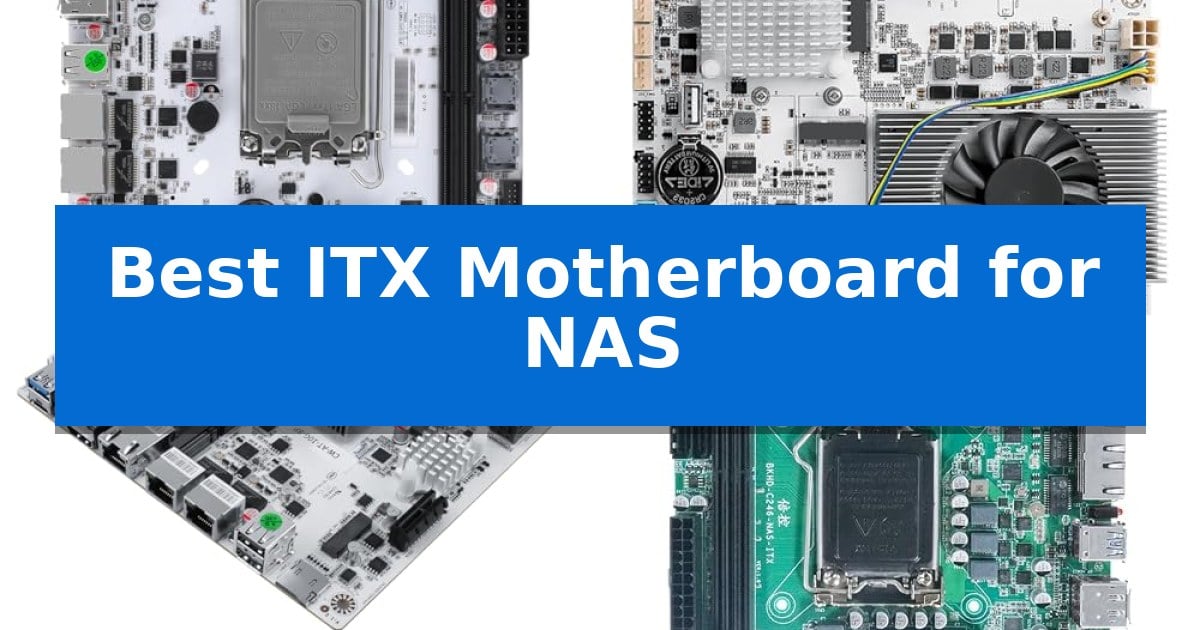
Building a compact server requires balancing physical space constraints with the need for reliable, high-speed data management. Finding the Best ITX Motherboard for NAS is the most critical step, as this component dictates your storage expansion options, networking throughput, and the type of processor you can utilize for your specific workload.
Whether you are planning a home media server or a professional-grade storage appliance, the right motherboard ensures your system remains stable during 24/7 operation. We have analyzed current mini-ITX options to help you identify a board that fits your chassis while providing the necessary SATA ports, M.2 slots, and connectivity for your storage array.
Best ITX Motherboard for NAS in 2026
Quick Comparison
| Product | Best For | Key Strength | Score |
|---|---|---|---|
| StoneStorm Q670 NAS Motherboard | Best Overall | 8-bay SATA connectivity via included SFF-8643 cables. | 4.9 |
| Mrroute N150 Dual 10GbE NAS Motherboard | Fastest Networking for Large Transfers | Dual 10GbE RJ45 ports for high-speed network throughput. | 4.6 |
| StoneStorm N150 8-Bay NAS Motherboard | Compact Pick for High-Capacity Storage | 8-bay SATA expansion via included SFF-8643 cables. | 4.8 |
| UDPTCP C246 NAS Motherboard | Reliable Support for ECC Memory | Four 2.5GbE network ports for high-speed connectivity. | 4.8 |
| MINISFORUM BD775i SE NAS Motherboard | Powerful Processing for Virtualization | High-performance AMD Ryzen 7 7745HX processor for intensive multitasking. | 4.6 |
How We Chose
- Storage Density: Evaluating the number of native SATA ports and M.2 NVMe slots available for cache or primary storage.
- Networking Throughput: Assessing the presence of 2.5GbE or 10GbE ports to ensure network speed does not bottleneck your storage array.
- Processor Compatibility: Verifying socket support and TDP handling for efficient, long-term server operation.
- Form Factor Accuracy: Confirming true mini-ITX dimensions to ensure compatibility with standard SFF NAS chassis.
- Expansion Capability: Checking for PCIe slots that allow for future upgrades like additional network cards or controllers.
1 StoneStorm Q670 NAS Motherboard — Best for High-Performance Desktop CPUs
The StoneStorm Q670 NAS Motherboard provides a specialized foundation for high-density storage builds by integrating an 8-bay SATA interface directly into a compact 6.7" x 6.7" mini-ITX form factor. Designed for users who require significant storage capacity without the footprint of a standard tower, this board utilizes two SFF-8643 cables to manage its extensive drive connectivity.
Performance is driven by the LGA1700 socket, which supports 12th, 13th, and 14th Gen Intel Core processors. The board features two U-DIMM DDR5 slots supporting up to 64GB of memory, with speeds reaching 5600MHz on compatible 13th Gen and newer CPUs. For high-speed caching or OS storage, it includes three M.2 NVMe PCIe 4.0 x4 slots, providing flexible configuration options for performance-critical data.
Networking and remote management are prioritized through dual 2.5GbE ports. Notably, the inclusion of an i226-LM port enables vPro functionality, allowing for remote system repair and management—a critical feature for headless NAS deployments. The board also offers versatile I/O, including a 20Gbps USB-C port and dual 4K display outputs via HDMI 2.0 and DP 1.4.
Expansion capabilities are bolstered by a PCIe 5.0 x16 slot, which can be bifurcated into two x8 signals using jumper caps to support additional network cards or controllers. Users should note that the board requires both 24-pin and 8-pin power connections to operate and may require a brief initialization period for memory detection upon the first boot.
Best for: Users building a high-density, compact NAS who require remote management via vPro and extensive SATA connectivity.
Skip if: Users who do not have a compatible LGA1700 processor or those who require more than two memory slots for high-capacity RAM configurations.
PROS
- 8-bay SATA connectivity via included SFF-8643 cables.
- Remote management support through the i226-LM vPro-enabled port.
- Flexible expansion with a PCIe 5.0 x16 slot that supports signal bifurcation.
- High-speed storage support with three PCIe 4.0 M.2 NVMe slots.
CONS
- Specific power requirements necessitating both 24-pin and 8-pin connectors.
- Limited memory capacity capped at 64GB across two slots.
2 Mrroute N150 Dual 10GbE NAS Motherboard — Fastest Networking for Large Transfers
Building a high-performance home server requires a foundation that balances power efficiency with robust connectivity, and the Mrroute N150 Dual 10GbE NAS Motherboard is engineered specifically for this 24/7 role. Featuring an integrated Intel N150 4-core processor, this board is designed to handle continuous storage tasks while maintaining minimal power draw, making it a suitable choice for those prioritizing energy-efficient, long-term operation.
The board distinguishes itself with dual Intel X550-AT2 10GBASE-T Ethernet ports, providing the high-speed throughput necessary for rapid data backups and intensive file sharing. Storage flexibility is equally prioritized, offering six SATA 3.0 ports and three M.2 2280 NVMe slots. This configuration allows users to mix high-capacity HDDs for mass storage with NVMe drives for cache acceleration, ensuring the system can scale alongside growing data requirements.
Designed for standard Mini-ITX enclosures, the Mrroute N150 Dual 10GbE NAS Motherboard includes a pre-installed dual copper tube cooler with a silent ball-bearing fan. Users requiring custom cooling can swap the bracket to support third-party LGA115X/1700 fans. The board also supports up to 48GB of DDR5 memory via a single SO-DIMM slot, providing sufficient headroom for modern NAS operating systems and containerized applications.
Practicality is integrated through a variety of expansion options, including an M.2 CNVio2 slot for wireless connectivity and dual display outputs (HDMI and eDP) for local management. Note that the board requires both 24-pin and 4-pin power connections to function. Upon initial boot, the system may take several minutes to initialize memory, a standard behavior for this specific hardware configuration.
Best for: Users building a compact, energy-efficient home NAS who require high-speed 10GbE networking and extensive storage expansion.
Skip if: Users who require ECC memory support or a multi-slot PCIe layout for additional hardware expansion cards.
PROS
- Dual 10GbE RJ45 ports for high-speed network throughput.
- Extensive storage options with 6 SATA ports and 3 M.2 NVMe slots.
- Low-power Intel N150 CPU optimized for 24/7 operation.
- Standard Mini-ITX form factor for broad chassis compatibility.
CONS
- Single SO-DIMM slot limits memory configuration options.
- Requires both 24-pin and 4-pin power connections for operation.
3 StoneStorm N150 8-Bay NAS Motherboard — Compact Pick for High-Capacity Storage
Building a high-density storage server requires a foundation that balances physical footprint with I/O throughput, and the StoneStorm N150 8-Bay NAS Motherboard addresses this by integrating 8-bay SATA support directly into a compact 6.7" x 6.7" mini-ITX form factor. This board is engineered for specialized network-attached storage, utilizing two SFF-8643 cables to manage high-capacity drive arrays while maintaining a small chassis profile.
Performance for data-heavy tasks is supported by an onboard 10GbE AQC113C network controller, providing significant bandwidth for professional multimedia environments or security appliances. For additional connectivity, the board includes dual 2.5GbE i226 ports, ensuring stable network redundancy. The system supports up to 48GB of DDR5 memory, allowing for efficient handling of concurrent file requests and background processes.
The board is built around an Intel N150 processor, featuring 4 cores and 4 threads with a 6MB cache, operating at a base TDP of 6W to maintain thermal efficiency. To manage heat during continuous operation, the package includes a dedicated cooling fan. Users can also leverage dual M.2 NVMe 2280 slots for high-speed caching, further optimizing read and write speeds for demanding storage workloads.
Connectivity options are extensive for a mini-ITX board, featuring USB 3.2 10Gbps ports, a Type-C interface, and dual 4K@60Hz display outputs via HDMI 2.0 and DP 1.4. An internal USB 2.0 port is specifically included to facilitate boot-loading for NAS operating systems, streamlining the setup process for custom server builds.
Best for: Users building a high-capacity, compact NAS server who require 10GbE networking and multi-drive expansion in a mini-ITX footprint.
Skip if: Users whose preferred NAS operating system or network environment lacks compatibility with the AQC113C 10GbE NIC chip.
PROS
- 8-bay SATA expansion via included SFF-8643 cables.
- Integrated 10GbE AQC113C and dual 2.5GbE ports.
- Supports up to 48GB DDR5 memory for multitasking.
- Compact mini-ITX form factor with dedicated cooling fan.
CONS
- Specific NIC compatibility requirements for the AQC113C chip.
- Requires 24PIN + 4PIN power connections.
4 UDPTCP C246 NAS Motherboard — Reliable Support for ECC Memory
The UDPTCP C246 NAS Motherboard provides a specialized foundation for high-density storage builds by supporting Intel Xeon E processors and 8th/9th Gen Core CPUs on the LGA1151 socket. This Mini-ITX board is engineered for professional-grade reliability, featuring a high-density moisture-proof fiber circuit board and a robust layout designed to manage intensive data operations in compact environments.
Connectivity is a primary focus for this board, which integrates four i226-V 2.5GbE RJ45 ports to facilitate high-speed data transfers and stable network performance. For storage-heavy configurations, it offers eight SATA3.0 6Gbps ports and two M.2 slots dedicated to NVMe3.0 drives, ensuring ample bandwidth for multi-drive arrays.
Memory management is handled via two DDR4 DIMM slots supporting up to 64GB of capacity, with a specific requirement for pure ECC memory to enhance system stability. The board also includes dual 4K@60Hz display outputs via HDMI and DP, alongside four USB3.0 ports for peripheral connectivity.
When assembling a system with this motherboard, note that it requires both 24-pin and 4-pin power connections. Users should allow for a brief initialization period during the first boot as the system detects memory configurations. This board is a focused choice for those prioritizing ECC support and multi-gigabit networking in a small form factor.
Best for: Users building a compact, high-performance NAS or network appliance that requires ECC memory support and multi-gigabit connectivity.
Skip if: Users who require standard desktop memory, as this board is strictly limited to pure ECC modules.
PROS
- Four 2.5GbE network ports for high-speed connectivity.
- Eight SATA3.0 ports supporting extensive storage arrays.
- Support for pure ECC memory to ensure data integrity.
- Dual 4K display support for versatile monitoring.
CONS
- Strict memory compatibility limited to pure ECC modules.
- Requires dual power inputs (24-pin and 4-pin) for operation.
5 MINISFORUM BD775i SE NAS Motherboard — Powerful Processing for Virtualization
The MINISFORUM BD775i SE NAS Motherboard centers its design around the high-performance AMD Ryzen 7 7745HX processor, featuring 8 cores and 16 threads with a boost clock up to 5.1 GHz. This platform provides the computational density required for demanding NAS environments, particularly for users running multiple virtual machines or containerized services alongside file storage.
Built for high-speed data management, the board includes dual M.2 2280 PCIe 4.0 SSD slots for rapid storage access and supports dual-channel DDR5-5200MHz memory expandable up to 96GB. The integration of a PCIe 5.0 x16 slot with reinforced metal fixings ensures compatibility with modern high-performance expansion cards, preventing physical stress on the slot during long-term operation.
Thermal management is addressed via a pre-installed custom 37mm heatsink, complemented by one 4-pin CPU fan header and two 4-pin system fan headers to support flexible cooling configurations. While the 12cm system fan is not included, the board is engineered to maintain stability under high-speed workloads through this dedicated cooling infrastructure.
Connectivity options are extensive, featuring a 2.5G RJ45 Ethernet port for high-bandwidth networking and triple video outputs (HDMI, DisplayPort, and USB-C) capable of 8K 60Hz resolution. The board also provides a dedicated base for users to install their preferred Wi-Fi card, offering flexibility for those who require specific wireless standards for their network environment.
Best for: Users requiring a high-performance, compact platform for self-built NAS systems that demand significant CPU power for virtualization or data processing.
Skip if: Users who require a pre-assembled, plug-and-play NAS appliance or those who do not have the technical expertise to source and install additional cooling fans and Wi-Fi modules.
PROS
- High-performance AMD Ryzen 7 7745HX processor for intensive multitasking.
- PCIe 5.0 x16 slot with reinforced metal fixings for heavy expansion cards.
- Dual PCIe 4.0 M.2 slots and support for up to 96GB of DDR5 RAM.
- 2.5G RJ45 Ethernet port for fast network throughput.
CONS
- Requires separate purchase of a 12cm cooling fan for optimal operation.
- No pre-installed Wi-Fi card, requiring manual selection and installation.
Best ITX Motherboard for NAS Buying Guide
Understanding Storage Interfaces
The Best ITX Motherboard for NAS must provide sufficient connectivity for your drives. Most compact boards utilize SFF-8643 cables to break out multiple SATA connections, which is essential when you have limited physical space on the PCB. Always verify if your chosen board includes these cables, as they are often required to reach the maximum drive count.
Additionally, consider the role of M.2 NVMe slots. While traditionally used for system drives, modern NAS builds increasingly use these for high-speed read/write caching. Ensure the board supports the appropriate PCIe generation to avoid limiting your SSD performance.
Networking and Data Transfer
For a NAS, the network interface is often the primary bottleneck. Look for boards featuring 2.5GbE or 10GbE ports to maximize the transfer speeds of your storage array. If you are handling large media files or frequent backups, a 10GbE connection can significantly reduce wait times compared to standard Gigabit Ethernet.
Some boards include specialized chips like the AQC113C or Intel i226-LM. These controllers are designed for stability and high-speed throughput, which is vital for maintaining a consistent connection in a server environment.
Processor and Power Efficiency
NAS systems often run 24/7, making power efficiency a key consideration. Many ITX boards are designed to work with T-Series desktop processors or low-power embedded CPUs, which provide a better balance of performance and thermal output for small, enclosed cases.
Always check the TDP support of the motherboard. A board that can handle a 65W processor comfortably will offer more flexibility for virtualization tasks, but ensure your cooling solution is rated to handle the heat generated by the CPU under load.
Form Factor and Chassis Compatibility
A true mini-ITX form factor measures 6.7" x 6.7". While most boards adhere to this, the placement of headers and the height of heatsinks can vary significantly. Before purchasing, verify the internal clearance of your NAS chassis, especially if you plan to use a third-party CPU cooler.
Pay attention to the power connection requirements. Many NAS-specific ITX boards require both a 24-pin and an additional 4-pin or 8-pin CPU power connector. Ensure your power supply unit (PSU) has the necessary cables to support the board's power delivery system.
Memory and ECC Support
Data integrity is paramount in a NAS. If your workload involves sensitive data, look for boards that support ECC (Error Correction Code) memory. This helps prevent data corruption by detecting and fixing memory errors in real-time.
Check the motherboard specifications carefully regarding memory compatibility. Some boards are restricted to DDR4 or DDR5 and may have specific requirements for unbuffered or registered modules. Using the correct RAM type is essential for system stability.
Frequently Asked Questions
Can I use a standard desktop CPU with these NAS motherboards?
Yes, many of these boards feature standard sockets like LGA1700, allowing for the use of compatible desktop processors. However, always check the motherboard's TDP rating and ensure your cooling solution fits the ITX footprint.
What is the benefit of SFF-8643 cables?
SFF-8643 cables allow for high-density storage connections in a compact space. They enable you to connect multiple SATA drives to a single port on the motherboard, which is critical for ITX boards that lack space for eight individual SATA headers.
Do I need a dedicated graphics card for these boards?
Most NAS motherboards include integrated graphics or support processors with integrated UHD graphics, which is sufficient for initial setup and BIOS configuration. A dedicated GPU is generally only needed if you plan to use the NAS for tasks like hardware-accelerated video transcoding.
Why does the motherboard take time to boot the first time?
It is common for these specialized boards to take several minutes to initialize memory training during the first boot. This is a normal part of the hardware detection process and does not indicate a fault.
Can I use these boards for virtualization?
Yes, boards with high core-count support and ample RAM capacity are excellent for virtualization. Features like vPro support on specific Intel controllers can also assist with remote management in a headless server setup.
Conclusion: Our Top Pick
Selecting the right foundation for your storage server is essential for long-term reliability. The StoneStorm Q670 NAS Motherboard stands out as our top recommendation due to its robust support for 12th through 14th Gen Intel processors and its extensive storage connectivity, including 8 SATA ports and 3 M.2 NVMe slots. It offers the best balance of performance and expandability for high-performance desktop CPUs in a compact ITX form factor.
While this board provides excellent features for high-capacity storage, ensure your chosen chassis has adequate airflow to manage the thermal output of a desktop-class processor. By pairing this motherboard with efficient memory and a reliable power supply, you can build a powerful, responsive NAS that meets your specific data management needs for years to come.