
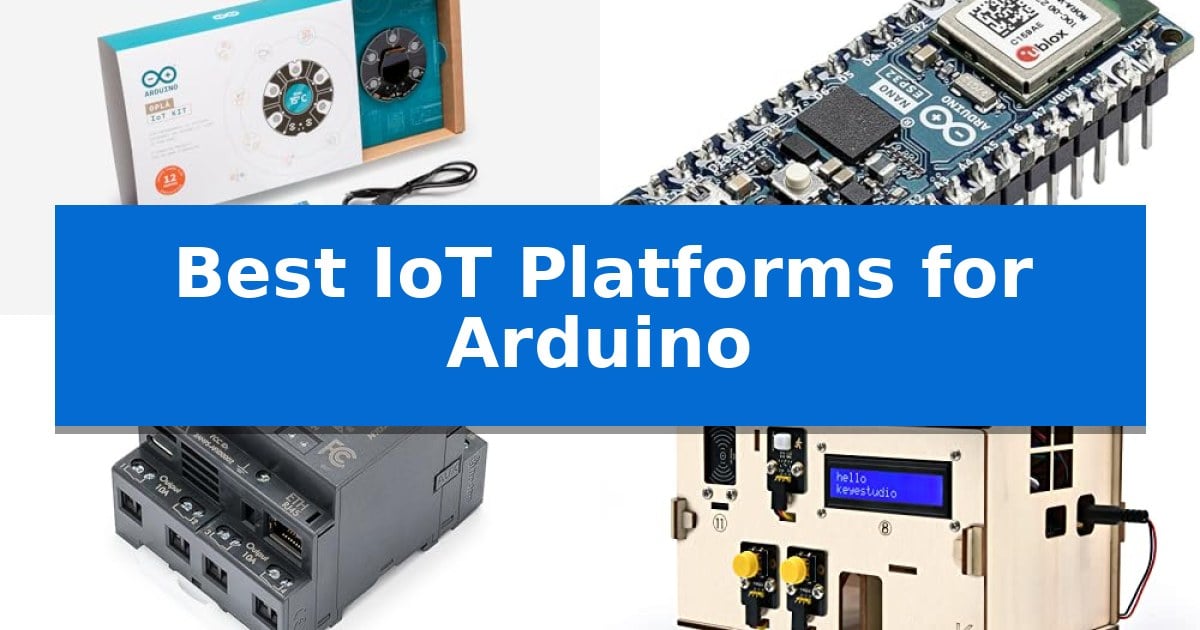
Building a connected ecosystem requires hardware that bridges the gap between physical sensors and digital data. Finding the Best IoT Platforms for Arduino involves selecting components that offer reliable communication, seamless cloud integration, and the processing power necessary to handle real-time automation tasks.
Whether you are developing a smart home interface or an industrial monitoring system, the platform you choose dictates your project's scalability and ease of use. This guide evaluates four distinct Arduino-based solutions, focusing on their specific connectivity features, programming compatibility, and intended use cases to help you make an informed decision.
Best IoT Platforms for Arduino in 2026
Quick Comparison
| Product | Best For | Key Strength | Score |
|---|---|---|---|
| Arduino OPLA IoT Kit | Best Overall | Comprehensive hardware bundle including sensors, actuators, and multiple communication modules. | 4.9 |
| Arduino Nano ESP32 | Compact wireless prototyping | Powerful ESP32-S3 dual-core processor for advanced edge computing. | 4.4 |
| Arduino Opta WiFi | Industrial automation controller | Industrial-grade rugged design for harsh environments | 4.6 |
| KEYESTUDIO ESP32 Smart Home Kit | Hands-on automation projects | Dual-language support for both Arduino C++ and MicroPython. | 4.5 |
How We Chose
- Connectivity Protocols: We assessed support for Wi-Fi, Bluetooth, and industrial standards like Modbus to ensure reliable data transmission.
- Processing Power: We reviewed the onboard microcontrollers to determine their ability to handle complex tasks like machine learning or real-time sensor monitoring.
- Ecosystem Integration: We prioritized boards and kits that work natively with the Arduino IDE and offer extensive library support for rapid development.
- Form Factor and Durability: We examined physical design characteristics, such as industrial-grade housing or compact footprints, to match specific deployment environments.
- Educational and Prototyping Resources: We considered the availability of tutorials and modular components that simplify the transition from concept to functional device.
1 Arduino OPLA IoT Kit — All-in-one learning platform
The Arduino OPLA IoT Kit [AKX00026] serves as a comprehensive, all-in-one hardware ecosystem designed to streamline the transition from basic programming to complex Internet of Things applications. By bundling essential sensors, actuators, and communication modules into a single package, it provides a structured environment for engineers and hobbyists to prototype remote monitoring and automation projects without sourcing disparate components.
Central to the kit's utility is its deep integration with the Arduino ecosystem, ensuring compatibility with the Arduino IDE and access to extensive software libraries. This foundation allows users to implement local and cloud-based communication protocols, including MQTT and HTTP, which are critical for establishing real-time data transmission and remote device control.
The hardware selection is intentionally broad, featuring integrated Wi-Fi, Bluetooth, and LoRa connectivity alongside a suite of sensors for measuring temperature, humidity, light, and motion. These modules enable the construction of diverse systems, ranging from environmental data loggers to sophisticated home automation setups, with support for interfacing with platforms like AWS IoT, Blynk, and ThingSpeak.
To assist in the development process, the kit includes detailed tutorials and example projects that guide users through core IoT concepts. This educational framework is designed to help developers quickly scale from initial setup to deploying functional, end-to-end IoT solutions, making it a practical choice for those looking to explore connected technology.
Best for: Makers and developers seeking an integrated, all-in-one hardware and software platform to rapidly prototype and deploy IoT applications.
Skip if: Users who require specific industrial-grade sensors or specialized communication protocols not included in the standard kit configuration may prefer a modular, custom-built approach.
PROS
- Comprehensive hardware bundle including sensors, actuators, and multiple communication modules.
- Seamless integration with the Arduino IDE and existing software libraries.
- Advanced connectivity support for cloud-based protocols like MQTT and HTTP.
- Included educational resources and example projects for rapid onboarding.
CONS
- Fixed component selection may limit highly specialized or custom hardware requirements.
2 Arduino Nano ESP32 — Compact wireless prototyping
Integrating advanced wireless capabilities into embedded projects requires hardware that balances processing power with connectivity. The Arduino Nano ESP32 serves this purpose by utilizing the ESP32-S3 dual-core Xtensa 32-bit LX7 processor, which reaches speeds up to 240 MHz. This architecture provides the computational overhead necessary for edge-based machine learning, voice recognition, and real-time data processing in compact IoT deployments.
Connectivity is a primary focus for this board, featuring integrated Wi-Fi and Bluetooth 5.0. These protocols allow the device to act as a reliable node within smart home ecosystems or remote sensor networks. By supporting HID (Human Interface Device) profiles, the board extends its utility beyond standard sensing, enabling the creation of custom input peripherals or interactive USB-based controllers that communicate directly with host computers.
Development efficiency is addressed through the inclusion of a USB-C port, which facilitates stable power delivery and faster programming cycles compared to legacy micro-USB interfaces. Furthermore, the board is MicroPython compatible, offering an accessible alternative to C/C++ for developers who prioritize rapid prototyping and streamlined code deployment. This software flexibility makes it a versatile choice for both educational environments and professional embedded engineering.
The Arduino Nano ESP32 is a robust platform for those who need a high-performance, wireless-ready microcontroller in a small form factor. While it excels in connectivity and processing, users should ensure their project requirements align with the specific capabilities of the ESP32-S3 chipset to maximize the board's potential in complex IoT applications.
Best for: Developers and engineers requiring a compact, high-performance microcontroller with integrated Wi-Fi, Bluetooth, and HID support for IoT and machine learning projects.
Skip if: Users who require a board with a different architecture or those whose specific project constraints necessitate a larger form factor with additional physical I/O pins.
PROS
- Powerful ESP32-S3 dual-core processor for advanced edge computing.
- Comprehensive wireless connectivity including Wi-Fi and Bluetooth 5.0.
- HID support for creating custom input devices and virtual controllers.
- USB-C integration for reliable power and efficient programming.
CONS
- Specific chipset architecture may require adjustments for codebases written for non-ESP32 platforms.
3 Arduino Opta WiFi — Industrial automation controller
Industrial automation requires reliable hardware capable of handling complex protocols and harsh environments. The Arduino Opta WiFi [AFX00002] serves as a specialized industrial IoT controller, integrating Wi-Fi connectivity and Modbus RTU/TCP support to facilitate seamless communication between field sensors and cloud-based monitoring systems.
Engineered for demanding settings, this controller features a rugged, industrial-grade design that maintains operational integrity despite exposure to extreme temperatures, humidity, or electromagnetic interference. Its compact form factor allows for straightforward installation within existing control cabinets or factory floor infrastructure.
The board provides extensive flexibility through its comprehensive I/O and sensor integration, including multiple digital I/O pins, analog inputs, and PWM outputs. This hardware configuration enables direct interfacing with a wide array of industrial actuators and monitoring equipment, simplifying the deployment of smart building or machine control applications.
Developers can utilize the established Arduino ecosystem to program and customize the unit via the Arduino IDE. By leveraging existing libraries and development tools, teams can accelerate the prototyping and deployment of automation solutions while ensuring compatibility with standard industrial protocols.
Best for: Industrial automation projects requiring reliable Modbus communication and remote IoT monitoring in harsh environments.
Skip if: Users who do not require industrial-grade ruggedization or Modbus protocol support may find more cost-effective, general-purpose development boards suitable for their needs.
PROS
- Industrial-grade rugged design for harsh environments
- Integrated Modbus RTU & TCP support for PLC compatibility
- Wi-Fi connectivity for remote data exchange
- Broad Arduino IDE compatibility and library support
CONS
- Higher cost compared to non-industrial development boards
4 KEYESTUDIO ESP32 Smart Home Kit — Hands-on automation projects
The KEYESTUDIO ESP32 Smart Home Kit provides a comprehensive, hands-on entry point into IoT development by centering its curriculum around an unassembled wooden house structure. This approach allows users to physically integrate sensors and actuators, transforming abstract coding concepts into a tangible, functioning smart home system.
Designed for both beginners and educators, the kit utilizes the ESP32 development board to facilitate WiFi-controlled automation. Users can manage various components, including RGB lighting, motorized doors, and environmental sensors, directly through a mobile application. This practical application bridges the gap between simple electronics and complex IoT architecture.
The platform supports a dual-language learning path, offering 13 progressive projects in both Arduino C++ and MicroPython. By comparing how the same hardware responds to different programming environments, learners gain a deeper understanding of embedded systems. The included online wiki provides structured support, including wiring diagrams and code explanations, to minimize setup friction.
The kit includes a wide array of hardware, such as DHT11 temperature/humidity sensors, PIR motion sensors, RFID modules, and servo motors. While it provides the necessary modules for a complete project-based learning path, users should note that the kit requires 6x AA batteries which are not included in the package.
Best for: Students, hobbyists, and educators seeking a structured, project-based introduction to IoT and smart home automation using ESP32 hardware.
Skip if: Users who prefer a pre-assembled system or those who do not wish to manage the physical assembly of a wooden structure and external battery power requirements.
PROS
- Dual-language support for both Arduino C++ and MicroPython.
- Comprehensive project-based learning with 13 progressive tutorials.
- Real-world IoT application through mobile app-controlled hardware.
- All-inclusive hardware set including sensors, motors, and an ESP32 board.
CONS
- Batteries are not included, requiring a separate purchase of 6x AA batteries.
- Requires manual assembly of the wooden house structure.
Best IoT Platforms for Arduino Buying Guide
Understanding Connectivity Requirements
The foundation of any IoT project is how it communicates with the outside world. Wi-Fi is essential for most home automation tasks, while Bluetooth is often preferred for short-range device-to-device interaction. For more demanding environments, industrial protocols like Modbus provide the stability needed for reliable data exchange.
Always evaluate your project's environment before selecting a platform. If you are building a system for a factory floor, look for high-interference resistance and ruggedized hardware. For personal hobbyist projects, standard wireless modules integrated into the board are usually sufficient.
Programming and Software Compatibility
The Arduino IDE remains the industry standard for these platforms, providing a massive repository of libraries that can save hours of development time. However, some advanced users may prefer platforms that also support MicroPython, which offers a more streamlined syntax for rapid prototyping.
Consider whether your project requires complex logic or simple sensor data logging. Platforms that support both C++ and Python provide the most flexibility, allowing you to switch languages based on the specific requirements of your application.
Hardware Scalability and Sensors
A platform is only as useful as the data it can collect. Look for kits that include a wide variety of sensors and actuators, such as temperature, humidity, and motion detectors. This modularity allows you to expand your project's capabilities without needing to purchase additional controllers.
If you are planning to build a large-scale system, ensure your chosen platform supports cloud integration services. The ability to interface with platforms like AWS IoT or ThingSpeak is critical for remote monitoring and long-term data analysis.
Power and Deployment Considerations
IoT devices are often deployed in locations where constant power is unavailable. Check the power consumption specifications of your board to see if it can operate effectively on battery power. Some boards feature USB-C for efficient power delivery and stable programming connections.
Physical dimensions also matter. If you are integrating your project into a small enclosure or a wearable device, a compact form factor is vital. Conversely, industrial controllers often require DIN-rail mounting to fit into standard electrical cabinets.
The Importance of Documentation
Even the most powerful hardware can be difficult to use without clear guidance. Prioritize platforms that come with comprehensive tutorials and active community support. This is particularly important for beginners who need step-by-step wiring diagrams and code explanations.
A well-documented project path, such as those found in starter kits, can significantly reduce the learning curve. Look for resources that offer progressive projects, starting from simple LED control and moving toward complex, internet-connected automation.
Frequently Asked Questions
Can I use these platforms for industrial automation?
Yes, but you must select the appropriate hardware. The Arduino Opta WiFi, for example, is specifically designed with a rugged form factor and Modbus support for industrial environments.
Is it better to use C++ or MicroPython?
C++ is the native language of the Arduino ecosystem and offers maximum performance and library support. MicroPython is often easier for beginners and faster for rapid prototyping.
Do I need to buy extra sensors for these kits?
It depends on the kit. The Arduino OPLA IoT Kit and the KEYESTUDIO Smart Home Kit come with a comprehensive set of sensors, while individual boards like the Nano ESP32 require you to source your own sensors separately.
Are these boards compatible with cloud services?
Most modern Arduino IoT-capable boards support standard protocols like MQTT and HTTP, allowing them to interface with popular cloud services like AWS IoT, Blynk, and ThingSpeak.
What is the benefit of the ESP32 chip?
The ESP32 chip provides high-performance, dual-core processing power along with integrated Wi-Fi and Bluetooth, making it an excellent choice for demanding IoT applications.
Conclusion: Our Top Pick
For most users looking to dive into connected projects, the Arduino OPLA IoT Kit stands out as the most versatile option. Its all-in-one design, which includes a wide array of sensors and modules, provides a complete learning environment that removes the guesswork from initial setup and hardware compatibility.
While other boards like the Nano ESP32 or Opta WiFi offer specialized advantages for compact or industrial needs, the OPLA IoT Kit offers the best balance of educational support and functional hardware for a broad range of IoT applications.