
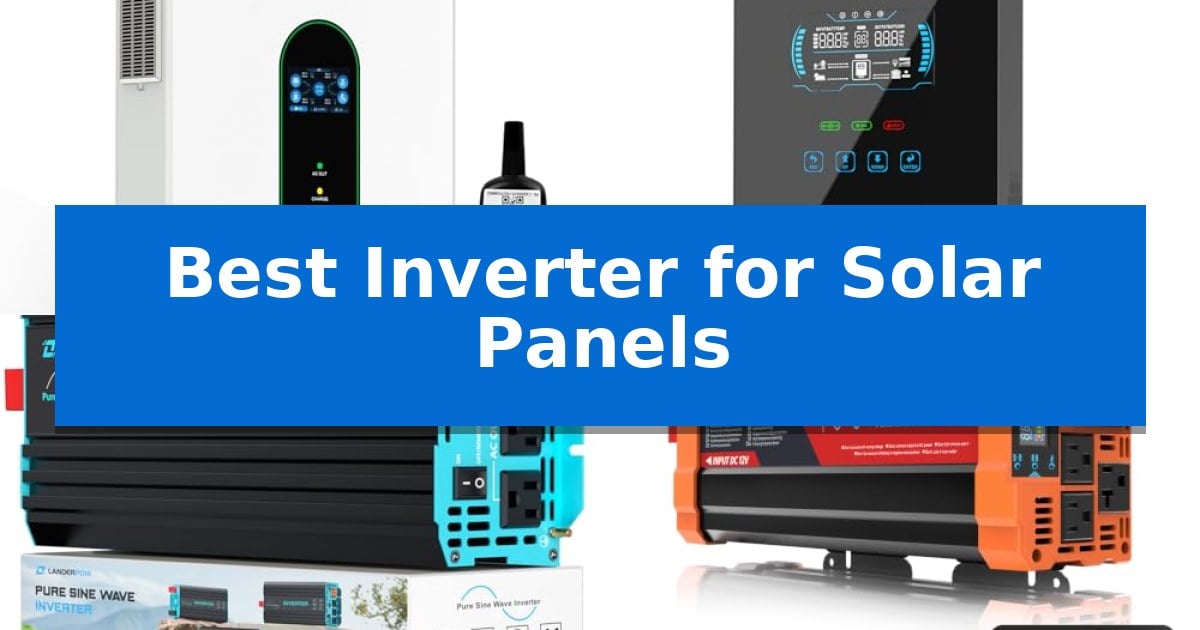
Choosing the Best Inverter for Solar Panels is a critical step in building a reliable energy system, whether you are powering a remote cabin or supplementing your home grid. The right inverter ensures that the DC electricity captured by your panels is converted into stable, usable AC power for your appliances without causing damage to sensitive electronics.
With various hybrid and pure sine wave options available, selecting the right unit depends on your specific load requirements, battery compatibility, and grid-tie needs. This guide examines five leading models to help you understand which technology best supports your long-term energy goals and off-grid performance expectations.
Best Inverter for Solar Panels in 2026
Quick Comparison
| Product | Best For | Key Strength | Score |
|---|---|---|---|
| POWLAND Hybrid Solar Inverter | Best Overall | 12,000W pure sine wave output for heavy-duty appliance support. | 4.9 |
| SUMRY Hybrid Solar Inverter | Battery-Free Solar Operation | Battery-less operation capability using PV input. | 4.5 |
| LANDERPOW Pure Sine Wave Inverter | High-Capacity RV and Solar Power | Pure sine wave output ensures compatibility with sensitive electronics. | 4.6 |
| BELTTT Pure Sine Wave Inverter | Efficient Off-Grid Power Conversion | High 93% conversion efficiency minimizes energy loss during power transformation. | 4.8 |
| Renogy P2 Pure Sine Wave Inverter | Reliable Certified Solar Output | Pure sine wave output protects sensitive electronics and appliances. | 4.9 |
How We Chose
- Continuous and peak power output ratings to ensure compatibility with your specific appliance needs.
- Conversion efficiency percentages to determine how much solar energy is successfully transformed into usable power.
- Compatibility with various battery chemistries, including LiFePO4 and lead-acid, for flexible system design.
- Safety features such as surge protection, short-circuit prevention, and thermal management for long-term reliability.
- Ease of monitoring through integrated displays or remote access to track real-time system performance.
1 POWLAND Hybrid Solar Inverter — Best for Large Off-Grid Systems
Managing high-demand energy loads requires a robust solution capable of handling significant power throughput, which is where the POWLAND Hybrid Solar Inverter distinguishes itself. This unit delivers 12,000W of pure sine wave power, providing the capacity to run heavy appliances like central air conditioning and power tools simultaneously. Its battery-free design allows for direct solar-to-grid energy management, potentially reducing the need for expensive battery storage by up to 40%.
Efficiency is central to its operation, featuring an advanced MPPT controller that achieves 99.9% solar harvesting efficiency. This design extracts more power during low-light conditions, such as dawn and dusk, compared to standard inverters. The system is built for versatility, supporting 48V LiFePO4 and Lead-Acid batteries while offering an anti-backflow feature to intelligently manage surplus energy sent back to the grid.
Durability and ease of use are addressed through an IP65 weatherproof casing, protecting the internal components from rain and dust. The unit includes comprehensive safety features such as overload, short-circuit, and reverse polarity protection. For larger installations, the system supports parallel stacking of up to 6 units, enabling a total power output of 72,000W to meet the needs of extensive off-grid setups.
Operational comfort is prioritized with an ultra-quiet dual-fan cooling system that maintains noise levels at just 45dB. Users can monitor performance via a clear LCD and intuitive LED status lights. With a Smart ECO mode designed to extend battery life by 30%, this inverter balances high-performance power delivery with long-term system maintenance.
Best for: Large off-grid homes and RV parks requiring high-capacity power management and grid-tie flexibility.
Skip if: Users with small-scale, low-power solar setups may find the 12,000W capacity and physical footprint of this unit excessive for their needs.
PROS
- 12,000W pure sine wave output for heavy-duty appliance support.
- 99.9% MPPT efficiency for superior solar harvesting.
- Battery-free design reduces initial system costs.
- Parallel expansion up to 72,000W for scalable power needs.
- IP65 weatherproof rating for reliable outdoor installation.
CONS
- Large physical footprint requires significant installation space.
- High-capacity design may be overkill for smaller residential systems.
2 SUMRY Hybrid Solar Inverter — Battery-Free Solar Operation
The SUMRY Hybrid Solar Inverter distinguishes itself with a tempered glass upper cover and a large 6.25-inch LCD display, providing a clear, high-transparency interface for monitoring real-time solar energy data. Designed for flexibility, this unit supports battery-less operation during daylight hours, allowing users to power loads directly from solar panels when grid power is disconnected and PV input exceeds 120V.
Engineered for versatility, this 4000W rated inverter features an 8000W peak output and integrates a 140A MPPT charge controller with a maximum conversion efficiency of 98%. It is compatible with a wide range of 24V battery chemistries, including AGM, Gel, Lead-acid, Lithium-ion, and LiFePO4, enabling users to configure energy storage priorities between solar, battery, and utility sources.
Reliability is supported by built-in triple cooling fans and comprehensive protection systems against overload, overheat, over-current, and short circuits. The interface includes touchable buttons for adjusting parameters such as charging current and energy priority, while a one-key restoration function simplifies system management for off-grid or emergency power setups.
Installation requires careful adherence to the provided manual, particularly regarding load calculations to ensure total power consumption remains within the rated output range. While the unit can operate without a battery, connecting a compatible 24V battery is recommended to minimize grid power reliance and ensure consistent performance during fluctuations in solar input.
Best for: Off-grid or emergency power setups requiring a flexible, battery-optional hybrid inverter with high-capacity MPPT charging.
Skip if: Users requiring a system for 12V battery banks or those whose total load exceeds the 4000W continuous power rating.
PROS
- Battery-less operation capability using PV input.
- High-efficiency 140A MPPT charge controller.
- Integrated glass-top LCD for intuitive monitoring.
- Wide compatibility with multiple 24V battery types.
CONS
- Battery-less mode requires PV input voltage exceeding 120V.
- Requires 24V battery for optimal grid-reduction performance.
3 LANDERPOW Pure Sine Wave Inverter — High-Capacity RV and Solar Power
Managing high-demand electrical loads in off-grid or mobile environments requires a reliable power conversion solution. The LANDERPOW 3000W Pure Sine Wave Inverter provides 3000W of continuous power with a 6000W surge capacity, ensuring that sensitive electronics like CPAPs, laptops, and microwaves receive stable, grid-quality electricity without the hum or flicker associated with modified sine wave units.
Designed for versatility, this unit features three AC outlets and a hardwired terminal for high-current appliances, alongside integrated 30W USB-C and 5V/3.1A USB ports for mobile device charging. Its >91% conversion efficiency minimizes energy loss, while the included 1AWG pure copper battery cables ensure safe, high-amperage power delivery without overheating during heavy use.
Usability is enhanced by a 15ft wired remote controller equipped with a smart LED screen. This allows for real-time monitoring of battery levels, output, and system errors from a distance, facilitating proactive power management in RVs or remote job sites. The full metal shell construction provides robust heat dissipation and durability against vibrations and accidental impacts.
Safety is integrated through comprehensive protection circuits, including undervoltage, overvoltage, overload, overheating, short circuit, and reverse connection safeguards. The system is supported by a 3-year total coverage plan, consisting of a 1-year replacement guarantee and 2 years of extended support, backed by a detailed visual manual to simplify installation.
Best for: This inverter is best for powering heavy-duty appliances and sensitive electronics in RVs, solar setups, and off-grid environments where grid-quality power is required.
Skip if: Skip this model if you only require low-wattage power for small electronics, as its 3000W capacity and physical footprint may be excessive for basic charging needs.
PROS
- Pure sine wave output ensures compatibility with sensitive electronics.
- High conversion efficiency of over 91% reduces energy waste.
- Integrated remote control with LED display for real-time monitoring.
- Comprehensive safety protections including short circuit and thermal management.
CONS
- Large physical footprint may require significant mounting space in compact vehicles.
- High-wattage capacity is overkill for simple, low-power charging setups.
4 BELTTT Pure Sine Wave Inverter — Efficient Off-Grid Power Conversion
Reliable power conversion for off-grid systems requires equipment that balances high capacity with signal stability. The BELTTT 2000W Pure Sine Wave Inverter addresses this by providing 2000W of continuous power and a 4000W peak surge, making it suitable for running sensitive electronics like televisions and home theater equipment alongside inductive loads.
Efficiency is a core design focus, with the unit achieving over 93% conversion efficiency during operation. This high rate helps minimize energy waste, which is critical when managing limited battery reserves in solar setups, RVs, or remote truck installations.
Usability is enhanced through an integrated high-brightness LCD screen that offers real-time monitoring of input and output voltages, as well as battery and load status. For added convenience, the system includes a 23ft remote controller, allowing users to manage power output from a distance without needing direct access to the main housing.
The unit is built for versatility, featuring dual AC sockets, a 20A outlet, a 5V/2.1A USB port, and a hardwire port to accommodate various connection needs. Safety is managed through a comprehensive suite of protections, including safeguards against undervoltage, overvoltage, overload, short circuits, and reverse connections, all housed within a durable aluminum and plastic frame.
Best for: Off-grid solar setups, RVs, and mobile power needs requiring stable pure sine wave output for sensitive electronics.
Skip if: Users who require a compact, lightweight power solution or those whose specific load requirements fall significantly below the 2000W continuous capacity.
PROS
- High 93% conversion efficiency minimizes energy loss during power transformation.
- Pure sine wave output ensures compatibility with sensitive inductive and capacitive loads.
- Integrated LCD display provides real-time monitoring of voltage and load status.
- Comprehensive safety suite includes protection against short circuits and reverse connections.
CONS
- Physical footprint and weight may be restrictive for space-constrained mobile installations.
5 Renogy P2 Pure Sine Wave Inverter — Reliable Certified Solar Output
The Renogy P2 Pure Sine Wave Inverter provides a reliable 1000W of continuous power by converting 12V DC to 120V AC, making it a practical choice for off-grid solar setups in homes, RVs, or trucks. This unit is engineered to deliver a pure sine wave output, which ensures that sensitive electronics—such as laptops, televisions, and freezers—receive power equivalent to standard grid electricity, preventing buzzing and promoting smoother operation.
Safety and durability are central to its design, featuring a robust metal housing that protects internal components from impact. The device is UL 458 and CSA C22.2 No. 107.1 certified, providing verified safety standards. It includes comprehensive protection mechanisms, including LED indicators for under-voltage, over-voltage, over-temperature, and short-circuit conditions, alongside high-speed ventilation fans to maintain optimal operating temperatures.
For user convenience, the inverter includes a built-in 5V/2.1A USB port, two AC outlets, and an AC terminal block for hardwiring. It also comes with a 16.4ft wired remote controller, allowing for easier management in larger vehicle or home installations. With a conversion efficiency exceeding 90%, it minimizes energy loss during the power transfer process.
When integrating this inverter into a solar system, it is important to note that the power input requires a deep cycle battery with a discharge depth of 80% or higher to ensure consistent performance. The inclusion of two 3Ft 4AWG cables simplifies the initial setup, providing a direct connection path from your battery bank to the inverter.
Best for: Off-grid solar power users requiring a safe, certified, and quiet pure sine wave power source for sensitive electronics in RVs or homes.
Skip if: Users who require more than 1000W of continuous power or those who need integrated Bluetooth or automatic transfer switch (ATS) functionality.
PROS
- Pure sine wave output protects sensitive electronics and appliances.
- UL 458 and CSA certified for verified safety and quality.
- High conversion efficiency of over 90% reduces energy waste.
- Comprehensive protection suite including GFCI and thermal management.
CONS
- Fixed 1000W capacity may be insufficient for high-draw appliances.
- Lacks advanced features like built-in Bluetooth monitoring or ATS.
Best Inverter for Solar Panels Buying Guide
Understanding Inverter Types
The two primary categories you will encounter are hybrid inverters and pure sine wave inverters. A hybrid model is designed to manage multiple power sources simultaneously, such as solar panels, battery banks, and the utility grid, making it an ideal choice for complex, large-scale installations.
In contrast, pure sine wave inverters focus on providing clean, stable power that mimics the quality of the utility grid. This is essential for protecting sensitive electronics like laptops, medical equipment, and modern appliances from the interference often caused by cheaper, modified sine wave alternatives.
Power Capacity and Surge Requirements
When calculating your needs, it is vital to distinguish between continuous power and peak surge power. Continuous power is what the unit provides during normal operation, while peak surge power is the temporary spike required to start inductive loads like refrigerators, power tools, or air conditioners.
Always sum the wattage of all devices you intend to run simultaneously and add a buffer for the startup surge. Selecting an inverter that cannot handle these spikes can lead to frequent shutdowns or damage to the unit's internal components.
Battery Compatibility and Charging
If your system relies on energy storage, ensure the inverter is compatible with your specific battery bank voltage, typically 12V, 24V, or 48V. Many modern hybrid inverters include built-in MPPT charge controllers, which optimize the voltage from your solar panels to charge your batteries more efficiently.
Check the manufacturer's specifications for supported battery chemistries, such as LiFePO4 or AGM/Lead-acid. Using an inverter with smart charging profiles can significantly extend the lifespan of your batteries by preventing overcharging and managing discharge cycles.
Efficiency and Conversion Loss
Conversion efficiency refers to how much energy is lost as heat during the transformation from DC to AC. Higher efficiency ratings, typically 90% or above, mean less energy is wasted, which is crucial for maximizing the output of your solar array.
Low no-load power consumption is also important if your system remains on standby for long periods. An efficient inverter will minimize the draw on your battery bank when your appliances are not actively pulling power.
Safety and Environmental Protection
Solar inverters are often installed in garages, RVs, or outdoor sheds, making them susceptible to dust, moisture, and temperature fluctuations. Look for units with ruggedized housings and active cooling systems, such as dual-fan setups, to maintain performance under load.
Essential safety features should include overload protection, short-circuit protection, and over-temperature monitoring. These safeguards protect both your expensive solar equipment and your home electrical system from potential faults.
Frequently Asked Questions
Can I run my home appliances without a battery?
Some hybrid inverters support battery-free operation, allowing you to power loads directly from solar panels during daylight hours. However, this setup will not provide power at night or during cloudy conditions unless connected to the grid.
What is the benefit of a pure sine wave output?
Pure sine wave output provides clean, consistent electricity identical to grid power. This prevents buzzing in audio equipment, flickering in lights, and potential damage to sensitive electronic components found in modern appliances.
How do I determine the right size inverter?
Calculate the total wattage of all devices you plan to power at the same time. Ensure the inverter's continuous power rating exceeds this total, and its peak surge rating can handle the startup requirements of your largest appliance.
Are these inverters compatible with all solar panels?
Most inverters are compatible with standard solar panels, provided the total voltage and current from your array fall within the inverter's specified MPPT input range. Always verify the voltage limits before installation.
What does MPPT mean in a solar inverter?
MPPT stands for Maximum Power Point Tracking. It is a technology that adjusts the electrical load to ensure your solar panels operate at their most efficient voltage, maximizing the amount of power harvested regardless of weather conditions.
Conclusion: Our Top Pick
For those seeking a robust and versatile power solution, the POWLAND Hybrid Solar Inverter stands out as the top choice for large-scale off-grid systems. Its ability to handle 12,000W of power, combined with a battery-free design and high-efficiency MPPT tracking, makes it an excellent investment for users looking to minimize grid reliance and maximize solar utilization.
While it is a powerful unit, ensure your specific solar array configuration and load requirements align with its 48V architecture. For smaller setups or specific RV needs, the other models reviewed offer specialized features that may better suit more compact or mobile applications.