
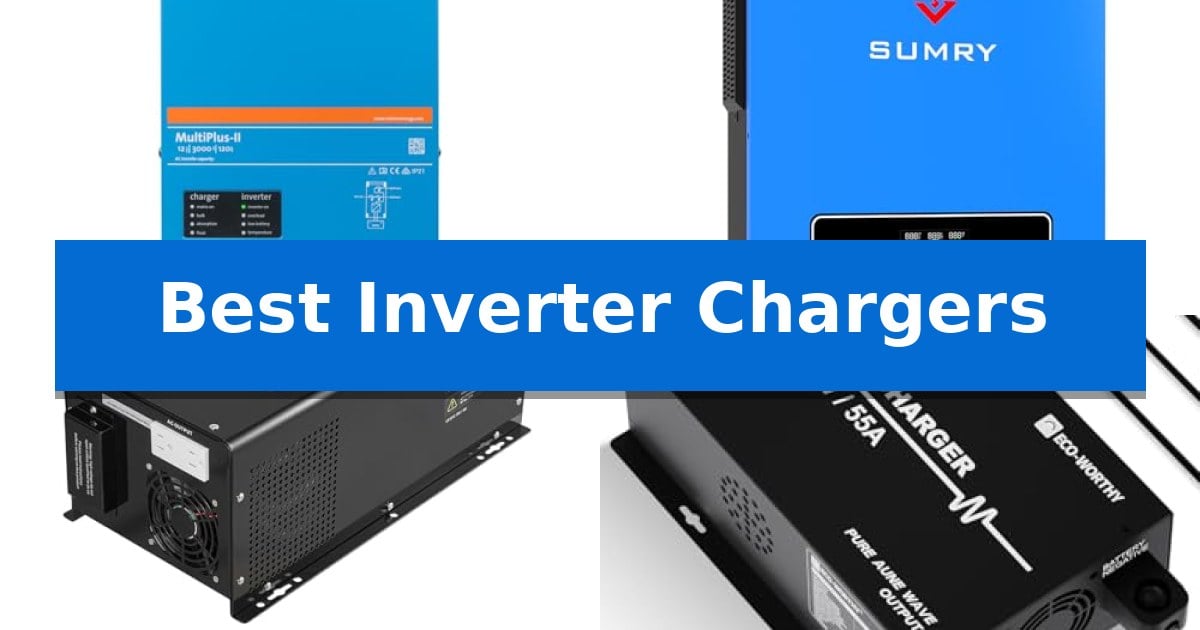
Finding the right power solution requires balancing your energy demands with the reliability of your equipment. Whether you are outfitting a marine vessel, preparing for home grid failures, or managing an off-grid solar setup, the Best Inverter Chargers provide a seamless transition between battery storage and AC power.
These devices serve as the heart of your electrical system, managing battery charging while ensuring your sensitive electronics receive a clean, stable current. By evaluating key features like pure sine wave output, automatic transfer speeds, and battery compatibility, you can select the right unit to keep your essential appliances running without interruption.
Best Inverter Chargers in 2026
Quick Comparison
| Product | Best For | Key Strength | Score |
|---|---|---|---|
| Victron Energy MultiPlus-II Inverter Charger | Best Overall | Rapid 20ms transfer time for uninterrupted power supply. | 4.9 |
| SUMRY Hybrid Solar Inverter Charger | Best for Solar Integration | All-in-one architecture reduces the need for separate charge controllers and inverters. | 4.5 |
| VEVOR Pure Sine Wave Inverter Charger | Flexible Remote Monitoring | Flexible remote monitoring via a 32.8 ft cable and detachable controller. | 4.5 |
| ECO-WORTHY Pure Sine Wave Inverter Charger | Compact UPS for Road Trips | Integrated 2-in-1 design combines a 1000W inverter and 55A charger to save space. | 4.8 |
| AMPINVT Pure Sine Wave Inverter Charger | Versatile Battery Compatibility | Supports multiple battery chemistries including Lithium and AGM. | 4.3 |
How We Chose
- Inverter Efficiency and Waveform Quality
- Automatic Transfer Switch (UPS) Response Time
- Battery Chemistry and Voltage Compatibility
- System Integration and Monitoring Options
- Protection Features Against Overload and Short Circuits
1 Victron Energy MultiPlus-II Inverter Charger — Professional Grade for Marine Use
Reliability in off-grid power management often hinges on how quickly a system can transition during a utility failure, and the Victron Energy MultiPlus-II Inverter Charger addresses this with a rapid 20ms transfer time. This unit acts as a seamless bridge, ensuring that connected loads continue to receive power without interruption when shore or generator sources are disconnected.
Designed for professional-grade applications, this pure sine wave inverter charger is built to handle the demands of marine, yachting, and vehicle-based setups. Its Power Assist feature is a standout capability, intelligently preventing the overload of limited AC sources by supplementing the power supply from the battery when demand spikes.
Scalability is a core strength of this system, allowing users to configure up to 6 units in parallel for increased power output. For more complex electrical requirements, the hardware supports three-phase output configurations, making it a versatile choice for diverse land-based off-grid projects.
With an energy efficiency rating of 93%, the Victron Energy MultiPlus-II Inverter Charger balances high performance with effective power management. Its robust design is certified to UL458 standards, providing a professional-grade solution for those requiring consistent, high-capacity power conversion in mobile or remote environments.
Best for: Professional marine, yachting, and off-grid vehicle applications requiring high-capacity, scalable power management.
Skip if: Users who do not require advanced features like Power Assist or parallel scalability may find a simpler, lower-capacity inverter more cost-effective.
PROS
- Rapid 20ms transfer time for uninterrupted power supply.
- Power Assist technology prevents overloading limited AC sources.
- Scalable design supports up to 6 units in parallel or three-phase configurations.
- Certified to UL458 for professional-grade safety and reliability.
CONS
- High-capacity design may be overkill for basic, low-power residential needs.
2 SUMRY Hybrid Solar Inverter Charger — Best for Solar Integration
The SUMRY Hybrid Solar Inverter Charger provides a versatile power management solution by combining a 3600W inverter with a built-in 120A MPPT solar charge controller. This all-in-one design allows users to manage energy from solar panels, batteries, or utility grids, making it a practical choice for off-grid setups, workshops, or emergency backup systems.
Engineered for flexibility, this unit delivers a pure sine wave output of 110V/120VAC, ensuring stable power for sensitive inductive electronic devices and standard household appliances. It supports a wide PV input voltage range of 60V-500VDC, with a maximum PV input power of 4200W, allowing for significant solar array integration.
A key feature of the SUMRY Hybrid Solar Inverter Charger is its ability to operate with or without a battery. While it is compatible with various 24V battery chemistries including AGM, Gel, Lead-acid, Lithium-ion, and LiFePO4, it can also run loads directly from solar power when grid connectivity is absent and PV input exceeds 120V. This capability provides a pathway for users to scale their power systems over time.
The unit prioritizes safety and ease of use with multiple built-in protections against overload, overheat, over-current, and short circuits. Monitoring system status is simplified through an integrated LCD display that provides real-time input and output information, while silent cooling fans help maintain operational temperature without excessive noise.
Best for: Users seeking an all-in-one hybrid power solution that can integrate solar, battery, and grid inputs for off-grid or backup applications.
Skip if: Users who require a system with integrated remote monitoring capabilities out of the box, as the remote module is sold separately.
PROS
- All-in-one architecture reduces the need for separate charge controllers and inverters.
- Pure sine wave output ensures compatibility with sensitive electronic equipment.
- Battery-less operation allows for direct solar-to-load power usage.
- Flexible input priority settings for solar, battery, or utility power management.
CONS
- Remote monitoring module is not included and must be purchased separately.
- Grid power consumption is inevitable when operating without a battery if PV input is insufficient.
3 VEVOR Pure Sine Wave Inverter Charger — Flexible Remote Monitoring
Managing power during off-grid excursions or unexpected home outages requires a reliable bridge between battery storage and household appliances. The VEVOR Pure Sine Wave Inverter Charger distinguishes itself with a 3000W output capable of delivering stable, uninterrupted power to sensitive electronics like refrigerators, ensuring your essential equipment remains operational when the grid fails.
This unit is engineered for versatility, featuring 5 Smart Working Modes—including AC Priority, Battery Priority, and Generator modes—that allow users to tailor power management to their specific environment. Whether you are setting up a permanent home backup system or managing power in an RV, the device adapts to your energy source and load requirements efficiently.
Installation and monitoring are simplified through the included remote control with a 32.8 ft cable, which allows for convenient system management from a distance. The inverter is designed for quiet operation, maintaining noise levels below 60dB, which is particularly beneficial for confined spaces like campers where noise can be a significant disruption.
Safety remains a priority with comprehensive built-in protections, including overload, short circuit, and over-temperature safeguards. The system is compatible with a wide range of 12V battery chemistries, such as LiFePO4, Lithium-ion, Gel, and AGM, making it a flexible choice for diverse energy storage setups. While powerful, users should note the recommended load per outlet is under 1200W to maintain optimal performance.
Best for: Homeowners and RV enthusiasts seeking a versatile, remote-controllable power solution for 12V battery-based off-grid or backup systems.
Skip if: Users requiring high-wattage output exceeding 1200W per individual outlet or those using battery systems other than 12V.
PROS
- Flexible remote monitoring via a 32.8 ft cable and detachable controller.
- Wide 12V battery compatibility including LiFePO4 and Lithium-ion.
- Quiet operation with noise levels kept under 60dB.
- Comprehensive security protections for both equipment and batteries.
CONS
- Load limitation of under 1200W per individual outlet.
- 12V battery restriction limits use with higher voltage battery banks.
4 ECO-WORTHY Pure Sine Wave Inverter Charger — Compact UPS for Road Trips
Maintaining stable power for sensitive electronics during grid instability requires a reliable bridge between your battery bank and your appliances. The ECO-WORTHY 1000W Pure Sine Wave Inverter Charger serves this need by integrating a 1000W inverter with a 55A battery charger, providing a unified solution for managing power flow in RVs or home setups.
This unit functions as an Uninterrupted Power Supply (UPS), capable of switching to battery power within 20ms during a grid failure. This rapid transition is designed to keep connected devices running without the disruption often caused by power drops. The system utilizes pure sine wave technology, which is essential for delivering clean, stable electricity that protects sensitive electronics from the risks associated with modified wave alternatives.
Beyond its primary power conversion duties, the device includes an intelligent LiFePO4 charger with 0V charging capability, allowing it to wake up BMS-protected lithium batteries. Safety is addressed through a comprehensive suite of protections, including high/low voltage, overload, overcurrent, and short-circuit safeguards. For thermal management, an internal cooling fan engages automatically when the unit reaches 50℃ or a load of 750W.
The physical design is compact, measuring 13.2 x 3.9 x 8.4 inches, making it suitable for installations where space is at a premium. Real-time status monitoring is facilitated by integrated LED indicators and an audible buzzer alarm, ensuring users are alerted to system errors immediately.
Best for: Users needing a compact, integrated UPS solution to maintain power for sensitive appliances during grid failures in RV or off-grid setups.
Skip if: Users requiring more than 1000W of continuous power or those who prefer separate, modular inverter and charger components for easier individual upgrades.
PROS
- Integrated 2-in-1 design combines a 1000W inverter and 55A charger to save space.
- 20ms UPS switching time ensures minimal disruption during power outages.
- Pure sine wave output provides stable, safe power for sensitive electronics.
- 0V charging capability effectively activates BMS-protected LiFePO4 batteries.
CONS
- 1000W continuous output may be insufficient for high-draw appliances exceeding its capacity.
- Internal cooling fan activation is fixed to specific temperature and load thresholds, which may create noise during heavy use.
5 AMPINVT Pure Sine Wave Inverter Charger — Versatile Battery Compatibility
Managing power stability for sensitive electronics requires more than a standard inverter; the AMPINVT Pure Sine Wave Inverter Charger integrates an inverter, battery charger, and AC auto-transfer switch into one unit. This device is engineered to provide a continuous stable pure sine wave output, ensuring that connected equipment remains protected from surge interference.
Designed for versatility, the unit supports a wide range of battery types including Li-ion, LiFePO4, Sealed, Gel, AGM, and Flooded batteries. Users can customize settings to match their specific battery chemistry, and the adjustable charging current allows for fine-tuning between 0-15A, with the ability to disable the charging function entirely when needed.
Operational flexibility is a core strength, featuring five distinct working modes including AC priority, battery priority, generator, ECO, and unattended modes. The inclusion of a built-in AVR stabilizer helps maintain voltage consistency, while comprehensive safety protocols—such as over-temperature, overload, and short-circuit protection—manage power delivery during fluctuations.
With a high transfer efficiency above 90%, this inverter is built to handle demanding loads. Its robust construction is reflected in its 19-pound weight and compact 12.2-inch height, making it a substantial component for off-grid or backup power systems requiring reliable, isolated power management.
Best for: Users needing a versatile, all-in-one power solution that integrates charging, inversion, and automatic transfer for various battery chemistries.
Skip if: Those requiring a lightweight, portable power station for mobile use, as this unit is designed for stationary, hard-wired installation.
PROS
- Supports multiple battery chemistries including Lithium and AGM.
- Integrated AC auto-transfer switch and AVR stabilizer.
- High transfer efficiency exceeding 90%.
- Customizable charging current settings.
CONS
- Requires stationary installation due to 19-pound weight.
- Limited to 1200W output capacity.
Best Inverter Chargers Buying Guide
Understanding Pure Sine Wave Output
A pure sine wave inverter is essential for powering sensitive electronic equipment. Unlike modified sine wave units, which can cause interference or damage to delicate components, pure sine wave technology provides a clean, stable current that mimics the power delivered by your local utility grid.
This is particularly important for appliances with motors, such as refrigerators, or sensitive medical devices and computers. Choosing an inverter that guarantees this output ensures your equipment operates efficiently and remains protected from electrical noise or surge damage.
The Role of UPS and Transfer Times
An Uninterrupted Power Supply (UPS) function allows the inverter to switch from grid power to battery power automatically during a blackout. The speed of this transition, often measured in milliseconds, determines whether your connected devices will stay powered on or experience a momentary reset.
For critical applications like home servers or essential medical equipment, a fast transfer time—typically under 20ms—is a vital specification. This ensures that your devices do not lose power during the switch, maintaining operational continuity without manual intervention.
Battery Chemistry Compatibility
Modern inverter chargers must be compatible with a wide range of battery chemistries, including LiFePO4, AGM, Gel, and flooded lead-acid batteries. Because these battery types have different charging profiles, selecting an inverter that supports your specific battery bank is crucial for longevity.
Some advanced units offer customizable charging settings, allowing you to fine-tune the voltage and current to match your battery's requirements. This flexibility prevents overcharging and helps maintain the health of your energy storage system over time.
System Integration and Power Assist
Advanced inverter chargers often include features like Power Assist, which helps prevent the overload of limited AC sources such as generators or shore power. By drawing additional power from your battery bank when demand spikes, these systems allow you to run larger appliances than your source would normally support.
This capability is highly beneficial for mobile applications like RVs or marine vessels where shore power connections may be limited. It effectively expands your available power capacity without requiring a larger generator or a more robust grid connection.
Monitoring and Remote Control
Effective system management requires clear visibility into your power status. Many modern units feature LCD displays or remote control modules that provide real-time data on battery levels, load consumption, and operating modes.
Remote monitoring is especially useful for off-grid or hard-to-reach installations, allowing you to check system health and adjust parameters without needing direct access to the unit. This convenience helps you stay informed and respond quickly to any changes in your power environment.
Frequently Asked Questions
What is the difference between an inverter and an inverter charger?
An inverter converts DC battery power into AC power for your appliances. An inverter charger adds a built-in battery charger, allowing it to recharge your batteries when connected to an AC source like a generator or grid power.
Can I use these inverters without a battery?
Some hybrid solar inverters can operate without a battery by using solar power directly to run loads, but this is highly dependent on the specific model and solar input conditions. Always check the manufacturer's documentation for your specific unit.
Why is pure sine wave important?
Pure sine wave output is critical for the safe operation of sensitive electronics, including computers, medical equipment, and appliances with electric motors. It prevents the electrical interference and potential hardware damage associated with lower-quality modified sine waves.
How do I choose the right wattage for my needs?
Calculate the total wattage of all appliances you intend to run simultaneously. Ensure the inverter's rated continuous output exceeds this total, and consider the peak surge power required for appliances with motors, such as refrigerators or pumps.
What does the transfer time mean for a UPS?
The transfer time is how quickly the inverter switches to battery power when grid power is lost. A lower transfer time, such as 20ms, ensures that sensitive devices do not shut down or reboot during the switch.
Conclusion: Our Top Pick
Selecting the right equipment depends on your specific power needs, but for professional-grade reliability, the Victron Energy MultiPlus-II Inverter Charger stands out as a versatile and robust solution. Its unique Power Assist feature and fast transfer times make it an excellent choice for marine, vehicle, and off-grid applications where power stability is non-negotiable.
While other models offer specific advantages like solar integration or compact sizing, the Victron unit provides the comprehensive protection and parallel operation capabilities required for more complex energy systems. Ensure your battery bank matches the voltage and chemistry requirements of your chosen unit to achieve the best performance and longevity for your setup.