
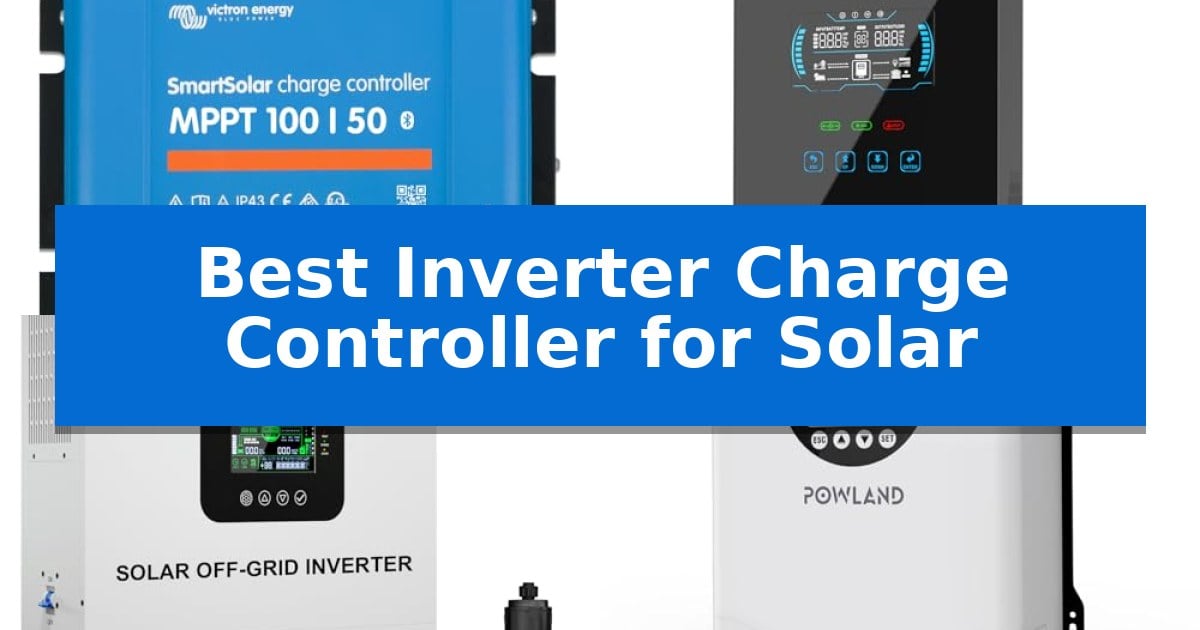
Finding the right equipment to manage your renewable energy harvest is essential for maintaining a stable off-grid power supply. Whether you are building a new system or upgrading an existing setup, selecting the Best Inverter Charge Controller for Solar requires balancing your specific voltage needs, battery chemistry, and total power requirements.
This guide examines five distinct power management solutions, ranging from compact RV controllers to high-capacity hybrid inverter chargers. We focus on how these devices handle energy conversion, battery compatibility, and system monitoring to ensure you can make an informed decision for your unique energy demands.
Best Inverter Charge Controller for Solar in 2026
Quick Comparison
| Product | Best For | Key Strength | Score |
|---|---|---|---|
| Victron Energy SmartSolar MPPT Charge Controller | Best Overall | Advanced MPPT technology maximizes power harvest even in shaded conditions. | 4.9 |
| SUMRY Hybrid Solar Inverter Charger | All-in-One Power Conversion | Pure sine wave output ensures compatibility with sensitive electronics. | 4.8 |
| ECO-WORTHY Solar Inverter Charger | Scalable Off-Grid Backup | Scalable architecture supporting parallel connection of up to 6 units for 30kW total output. | 4.8 |
| POWLAND MPPT Solar Charge Controller | Wide Voltage Compatibility | 98% conversion efficiency via advanced MPPT technology | 4.7 |
| Renogy Wanderer Li PWM Charge Controller | Compact RV Power Management | Multi-battery chemistry support for LiFePO4, AGM, Gel, and Flooded batteries. | 4.7 |
How We Chose
- Conversion Efficiency: Assessing the effectiveness of MPPT algorithms in maximizing power harvest from solar arrays.
- Battery Compatibility: Evaluating support for diverse battery chemistries including LiFePO4, AGM, and Gel.
- System Integration: Checking for built-in monitoring, app connectivity, and the ability to synchronize multiple units.
- Load Management: Analyzing the flexibility of output modes and protection features for connected appliances.
- Scalability: Considering the potential for parallel operation or modular expansion in larger power systems.
1 Victron Energy SmartSolar MPPT Charge Controller — Smart App-Based Optimization
Efficient energy management in solar installations often hinges on the quality of the charge controller. The Victron Energy SmartSolar MPPT Charge Controller distinguishes itself through its lightning-fast optimum power point tracking and intelligent charge algorithms, which work to ensure maximum power output even when solar panels face partial shading.
This device provides advanced system oversight via the VictronConnect app. Users can access real-time data and review 30-day performance history directly from a connected device. The app also facilitates system configuration, allowing for the management of battery presets, firmware updates, and the setting of custom alarms to maintain system health.
For larger setups, the controller supports synchronized charging, enabling multiple units to function as a single, cohesive system. This coordination ensures that all controllers switch through charge stages simultaneously, promoting battery longevity and overall energy optimization across the entire array.
The unit features an intelligent load output designed to power devices securely. It allows for the configuration of specific voltage thresholds, ensuring the controller automatically disconnects loads if the battery voltage drops too low, thereby protecting the battery from deep discharge damage.
With its 100V and 50A capacity, this controller is built to handle significant solar input while maintaining a compact footprint. It is certified to UL1741, providing a recognized standard for safety and performance in solar applications.
Best for: Solar system owners who require advanced remote monitoring, intelligent load management, and the ability to synchronize multiple controllers for larger arrays.
Skip if: Users seeking a basic, non-connected charge controller or those with solar systems exceeding the 100V/50A input specifications.
PROS
- Advanced MPPT technology maximizes power harvest even in shaded conditions.
- Integrated Bluetooth connectivity allows for easy monitoring and configuration via the VictronConnect app.
- Synchronized charging capability enables seamless integration of multiple controllers.
- Intelligent load output protects batteries from low-voltage damage.
CONS
- Requires mobile device access to utilize the full range of configuration and monitoring features.
- Specific voltage and amperage limits may restrict use in very large high-voltage solar arrays.
2 SUMRY Hybrid Solar Inverter Charger — All-in-One Power Conversion
Managing off-grid power requires a system that balances versatility with clear, real-time feedback. The SUMRY Hybrid Solar Inverter Charger distinguishes itself with a unique tempered glass top cover and a large 6.25-inch LCD display, providing a high-transparency interface for monitoring system status and power flow at a glance.
This unit functions as a robust 4000W rated power solution, capable of handling an 8000W peak output. It delivers a pure sine wave output, which is essential for protecting sensitive inductive appliances from electrical interference. With a built-in 140A MPPT charge controller, the system supports a maximum PV input of 5600W at 350VDC, achieving a conversion efficiency of up to 98%.
Flexibility is a core design choice, as the inverter can operate with or without a battery during daylight hours using PV DC current. While it supports a wide range of 24V battery types—including AGM, Gel, Lead-acid, Lithium-ion, and LiFePO4—it offers configurable priority settings for solar, battery, and utility power. This allows users to optimize energy storage and minimize grid consumption based on their specific off-grid or emergency backup needs.
Safety and reliability are addressed through the inclusion of three built-in cooling fans and integrated protection circuits against overload, overheating, over-current, and short circuits. The interface allows for precise parameter adjustments, such as battery charging current and energy priority, ensuring the system can be tailored to various installation requirements.
Best for: Off-grid users and homeowners seeking a versatile, battery-compatible inverter with high-visibility monitoring and pure sine wave output.
Skip if: Users requiring a system for 12V or 48V battery setups, as this unit is specifically designed for 24V architecture.
PROS
- Pure sine wave output ensures compatibility with sensitive electronics.
- Integrated 140A MPPT charge controller maximizes solar harvesting efficiency.
- Battery-less operation capability provides flexibility for daytime power usage.
- Comprehensive LCD interface with touchable buttons for easy parameter configuration.
CONS
- Strict 24V battery requirement limits compatibility with other voltage systems.
- Grid power consumption may occur if PV input is insufficient and no battery is connected.
3 ECO-WORTHY Solar Inverter Charger — Scalable Off-Grid Backup
The ECO-WORTHY Solar Inverter Charger provides a versatile foundation for off-grid energy systems by integrating a 5000W pure sine wave inverter, a 100A MPPT charge controller, and a 100A battery charger into a single chassis. This 3-in-1 design simplifies the setup for 48V systems, allowing users to manage power flow from solar arrays, utility grids, or batteries through a centralized interface.
Designed for scalability, the unit supports parallel operation of up to 6 units, enabling a total system capacity of 30kW. This modularity allows the system to be configured for single-phase or split-phase output, providing flexibility for growing energy demands. The inverter handles a wide PV input voltage range of 120-500V DC, accommodating various solar panel configurations.
Operational efficiency is managed through three output modes—mains priority, battery priority, and PV priority—which can be customized to optimize energy usage and reduce utility costs. The system includes four charging modes and programmable time periods for mains charging, ensuring that users can prioritize solar intake based on local conditions and energy availability.
Safety and monitoring are addressed through an integrated LCD display for real-time data tracking and multiple built-in protections, including PV input current limiting and over-voltage protection. The unit utilizes multiple cooling fans to manage thermal output during operation. Given the complexity of 48V off-grid installations, professional installation is recommended to ensure system safety and compliance.
Best for: Homeowners or off-grid enthusiasts building a scalable 48V solar power system who require integrated charging and inversion capabilities.
Skip if: Users without electrical expertise or those looking for a simple plug-and-play solution, as this unit requires professional installation for safe 48V system integration.
PROS
- Scalable architecture supporting parallel connection of up to 6 units for 30kW total output.
- Integrated 3-in-1 functionality combining a 5000W inverter, 100A MPPT controller, and 100A charger.
- Flexible customizable output and charging modes to prioritize solar energy and reduce grid dependency.
- Wide PV input voltage range of 120-500V DC for versatile solar array design.
CONS
- Professional installation required for 48V off-grid systems to ensure safety.
- Requires significant space and setup planning for parallel configurations.
4 POWLAND MPPT Solar Charge Controller — Wide Voltage Compatibility
Managing complex solar arrays requires precision, and the POWLAND 120A MPPT Solar Charge Controller addresses this with universal 12V-96V auto-sensing compatibility. This controller is designed for high-capacity systems, supporting a massive 120A charging current that accommodates a wide range of battery chemistries, including LiFePO4, AGM, GEL, and flooded lead-acid.
Efficiency is central to its design, utilizing an advanced MPPT algorithm that tracks the maximum power point in real-time. This technology achieves up to 98% conversion efficiency, which is engineered to extract significantly more energy compared to standard PWM controllers. This makes it a suitable component for off-grid homes, RV solar systems, and mobile power stations where maximizing energy harvest is a priority.
Safety and battery longevity are integrated through a 3-stage charging process (bulk, absorption, and float) and comprehensive protection features. The unit includes safeguards against reverse polarity, overload, and open-circuit conditions, helping to maintain battery health. Users can monitor system status, including PV input voltage and current, via the high-resolution LCD dashboard.
The controller is built for versatility, handling a maximum input voltage of 230V. It arrives as a complete kit with a user manual and is supported by a 24/7 technical assistance team to aid in installation and troubleshooting.
Best for: Large-scale off-grid solar systems and mobile power stations requiring high-amperage charging and wide voltage compatibility.
Skip if: Small-scale, low-voltage solar projects where a 120A capacity and 230V input limit are unnecessary or exceed the system's power requirements.
PROS
- 98% conversion efficiency via advanced MPPT technology
- Universal 12V-96V auto-sensing voltage compatibility
- Comprehensive protection including reverse polarity and overload safeguards
- Intelligent 3-stage charging to support various battery types
CONS
- High-capacity 120A rating may be oversized for smaller, entry-level solar setups
5 Renogy Wanderer Li PWM Charge Controller — Compact RV Power Management
Maintaining consistent power in off-grid environments requires a reliable interface between solar panels and battery banks. The Renogy Wanderer Li PWM Charge Controller provides a compact, 30A solution designed to manage energy flow for RVs, boats, and remote cabins. By utilizing smart PWM technology, this controller automatically selects the appropriate charging curve for various battery chemistries, including Lithium, AGM, Gel, and Flooded types, ensuring that each battery receives the specific voltage profile it requires for optimal health.
The device employs a 4-stage charging process—Bulk, Boost, Float, and Equalization—which systematically manages the charging cycle to maximize performance and extend battery lifespan. During the Bulk stage, the controller delivers maximum current for fast charging, while the Boost stage provides voltage stabilization. The Float stage then maintains a micro-current to keep the battery topped off, and the Equalization cycle helps prevent capacity loss in flooded batteries. Integrated safeguards protect against reverse polarity, overcharging, overload, and short circuits, providing peace of mind during unattended operation.
Engineered for space-constrained installations, the unit measures approximately 5.5” x 3.9” x 1.8” and features an IP32-rated waterproof casing to resist environmental moisture. Its design supports tool-free DIN rail or wall mounting, allowing for flexible placement in tight marine or RV compartments. The controller’s negative-ground design ensures compatibility with standard off-grid electrical systems, while the use of corrosion-resistant materials enhances long-term durability in varied climates.
For users seeking deeper insight into their power system, the controller integrates with the BT-1 Bluetooth module (sold separately). When paired, the DC Home App enables real-time monitoring of solar input and battery state-of-charge. Additionally, the system supports temperature compensation—ranging from -4°F to 140°F—which helps prevent undercharging during cold winter months and overvoltage during hot summer conditions, ensuring the system operates efficiently regardless of external temperatures.
Best for: The Renogy Wanderer Li PWM Charge Controller is best for RV and off-grid users needing a compact, versatile 30A controller with multi-battery chemistry support.
Skip if: Skip this model if your system requires MPPT efficiency for high-voltage solar arrays or if you need an integrated display screen for monitoring without purchasing external Bluetooth modules.
PROS
- Multi-battery chemistry support for LiFePO4, AGM, Gel, and Flooded batteries.
- Compact, IP32-rated waterproof design suitable for tight marine or RV compartments.
- 4-stage PWM charging with automated Bulk, Boost, Float, and Equalization cycles.
- Real-time monitoring capabilities via the optional BT-1 Bluetooth module and DC Home App.
CONS
- Bluetooth module sold separately, requiring an additional purchase for smart monitoring features.
- PWM technology is less efficient than MPPT controllers for larger solar arrays.
Best Inverter Charge Controller for Solar Buying Guide
Understanding MPPT vs. PWM Technology
The core difference between these two technologies lies in how they extract power from your panels. MPPT (Maximum Power Point Tracking) controllers are generally more efficient, as they dynamically adjust the input voltage to ensure the panels operate at their peak power point, which is especially useful in varying light conditions.
PWM (Pulse Width Modulation) controllers are simpler and often more cost-effective for smaller, fixed-voltage systems. While they lack the advanced tracking capabilities of MPPT, they remain a reliable choice for compact setups like small RVs or basic lighting systems where budget and simplicity are the primary constraints.
Battery Chemistry and Charging Profiles
Modern solar systems often utilize Lithium-ion (LiFePO4), AGM, or Gel batteries. It is critical to choose a controller that supports the specific charging profile of your battery bank to prevent premature degradation.
Look for controllers that offer customizable charge stages (Bulk, Absorption, Float). Advanced units allow you to set specific voltage thresholds, ensuring that your battery bank receives the precise care required for its chemistry.
Inverter Charger Hybrid Functionality
A hybrid inverter charger combines the functions of a charge controller and an inverter into one chassis. This all-in-one design simplifies installation and reduces the amount of wiring required in your power center.
These units are ideal for home backup systems or off-grid cabins where space is limited. By managing both DC-to-DC charging and DC-to-AC inversion, they provide a streamlined solution for powering standard household appliances.
Monitoring and Connectivity
Real-time data is essential for maintaining system health. Many modern controllers now feature Bluetooth connectivity or integrated LCD dashboards that provide instant visibility into current, voltage, and battery state-of-charge.
App-based monitoring allows you to adjust settings remotely, update firmware, and receive alerts if the system encounters a fault. This level of control is invaluable for troubleshooting and optimizing your energy usage over time.
Safety and Protection Features
Solar power systems involve high currents and voltages that require robust protection. Ensure your chosen controller includes overload protection, short-circuit safeguards, and reverse polarity protection to prevent damage to your equipment.
For larger systems, look for units with multiple cooling fans and thermal management features. These components help maintain optimal operating temperatures, which is vital for the longevity of the internal electronics.
Frequently Asked Questions
Can I use a hybrid inverter without a battery?
Some hybrid models allow for battery-less operation during the day, using PV current directly to power loads. However, for consistent power and to reduce grid reliance, a battery bank is highly recommended.
What is the benefit of parallel support?
Parallel support allows you to connect multiple inverter units together to increase your total power output, making it possible to scale your system as your energy needs grow.
Does my charge controller need to match my battery chemistry?
Yes, using the wrong charging profile can damage your batteries. Always ensure your controller has settings compatible with your specific battery type, such as LiFePO4 or AGM.
How do I choose between 12V, 24V, and 48V systems?
System voltage is typically determined by the size of your load and the capacity of your battery bank. Higher voltages (48V) are generally more efficient for larger systems as they reduce current and wiring thickness requirements.
What does UL1741 certification mean?
UL1741 is a safety standard for inverters and charge controllers, ensuring the equipment meets specific requirements for grid-tied or off-grid operation and electrical safety.
Conclusion: Our Top Pick
For most users seeking a balance of efficiency, monitoring, and reliability, the Victron Energy SmartSolar MPPT Charge Controller stands out as the top choice. Its advanced MPPT algorithm and robust app-based connectivity provide the granular control necessary to maximize energy harvest and protect battery health across various solar configurations.
While hybrid inverter chargers offer an all-in-one solution for those needing AC power, the Victron unit excels as a dedicated charge controller. It is particularly well-suited for users who prioritize system optimization and want the ability to synchronize multiple controllers for larger, more complex off-grid installations.