
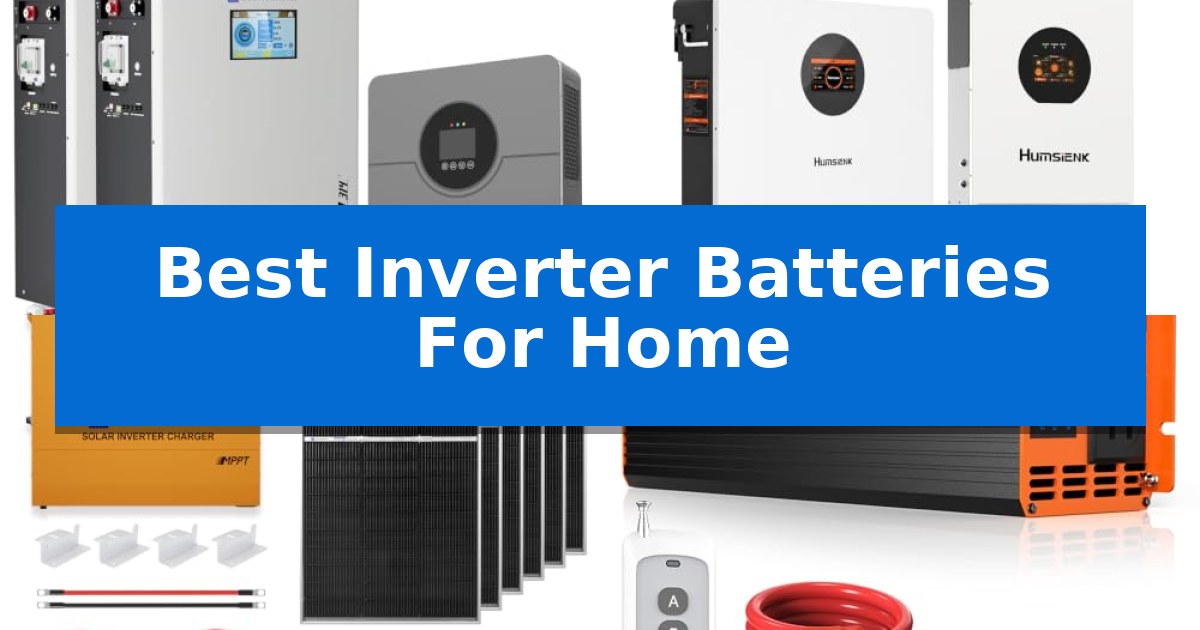
Finding the right energy storage solution is essential for maintaining power security during grid outages or managing off-grid energy needs. The Best Inverter Batteries For Home are those that balance high storage capacity with seamless integration, ensuring your critical appliances remain operational when you need them most.
We have evaluated several leading power systems to help you identify the most effective setup for your specific household requirements. From high-capacity whole-home solutions to space-saving wall-mount units, these systems offer diverse ways to manage your home's energy independence.

Best Inverter Batteries For Home in 2026: Reliable Whole-Home Backup
Quick Comparison
| Product | Best For | Key Strength | Score |
|---|---|---|---|
| ECO-WORTHY Powermega Home Backup System | Best Overall | 30kWh+ total energy capacity for extensive whole-home backup. | 4.9 |
| HumsiENK Wall-Mount Home Backup System | Space-Saving Off-Grid Power | High-cycle lifespan with over 6,000 cycles at 80% DoD. | 4.5 |
| ECO-WORTHY Solar Power Complete Kit | Complete Solar Energy Solution | High-efficiency N-type bifacial panels with 25% conversion rate. | 4.5 |
| TOPBULL Power Inverter | Heavy-Duty Appliance Support | 3000W continuous output with 6000W peak power for heavy-duty appliances. | 4.5 |
How We Chose
- Storage Capacity: Evaluating the total usable kilowatt-hours to ensure the system meets your specific load requirements.
- Inverter Compatibility: Checking for seamless integration between battery management systems and hybrid inverters.
- Safety and Protection: Prioritizing units with robust BMS, fire suppression, and multi-layer electrical safety features.
- Installation and Design: Assessing the physical footprint and ease of setup for both indoor and outdoor environments.
- Cycle Life and Durability: Reviewing the expected longevity of the LiFePO4 cells to ensure a long-term return on investment.
1 ECO-WORTHY Powermega Home Backup System — Whole-Home Energy Storage
Maintaining power during grid outages or managing off-grid energy requires a robust, high-capacity solution. The ECO-WORTHY Powermega Home Backup System addresses this by integrating a 10kW hybrid inverter with two 48V 314Ah LiFePO4 batteries to provide over 30kWh of usable energy storage.
This system is engineered for versatility, supporting both single-phase (120V) and split-phase (240V) output. The inclusion of an Active Balancing Smart BMS and multi-layer safety features—such as an aerosol fire suppression module and built-in circuit breakers—ensures stable operation. Users can track system health, voltage, and state-of-charge in real-time via the integrated LCD screen or through built-in Bluetooth and WiFi connectivity.
Designed for longevity, each battery is rated for 9000+ cycles at 80% DoD. The 10kW hybrid inverter features 99.9% MPPT tracking efficiency, which helps maximize energy harvest from solar arrays. For ease of movement, the battery units are equipped with wheels capable of supporting 100kg, simplifying the installation process.
While the system offers significant capacity, it is a comprehensive solution that requires space and a structured installation. The modular nature of the shipment means components may arrive in separate packages, though this does not impact the final performance or compatibility of the integrated setup.
Best for: Homeowners and off-grid users requiring a high-capacity, integrated 30kWh energy storage solution with smart monitoring capabilities.
Skip if: Users with limited floor space or those seeking a small-scale, portable power station for camping or temporary mobile use.
PROS
- 30kWh+ total energy capacity for extensive whole-home backup.
- 9000+ cycle life at 80% depth of discharge.
- Integrated smart monitoring via Bluetooth and WiFi.
- Advanced safety suite including aerosol fire suppression and active BMS.
CONS
- Large physical footprint requiring dedicated installation space.
- Multi-package shipping may result in staggered delivery times.
2 HumsiENK Wall-Mount Home Backup System — Space-Saving Off-Grid Power
Maintaining power during grid instability requires a robust solution that balances storage capacity with high-output delivery. The HumsiENK Wall-Mount Home Backup System addresses this by integrating a 5.12kWh LiFePO₄ battery with an 8000W hybrid split-phase inverter, providing a comprehensive power management unit for essential household appliances.
Engineered for longevity, the system utilizes Grade A+ LiFePO₄ prismatic cells capable of over 6,000 deep cycles at 80% depth of discharge. The unit features an integrated 100A BMS with 3A active balancing to maintain cell health, protected by an IP54-rated all-metal housing. Its compact wall-mount design measures 21.65" × 19.09" × 7.28", which helps reclaim floor space in utility rooms or basements.
The included 8000W inverter delivers a pure sine wave with a native 120/240V split-phase output, eliminating the need for external transformers. With a ≤10ms automatic transfer switching time, the system acts as a UPS to keep sensitive electronics like routers and medical devices running during outages. It also incorporates a 10000W MPPT solar charge controller, allowing for off-grid solar integration.
For scalability, the system supports parallel expansion of up to 15 batteries and 6 inverters, reaching a total capacity of 76.8kWh. While the single battery configuration handles most household loads, sustained usage exceeding 5,500W—such as running central AC and heavy machinery simultaneously—benefits from adding a second battery. Users can monitor performance via the integrated LCD touchscreen or the Bluetooth/WiFi-enabled mobile app.
Best for: Homeowners seeking a scalable, space-saving backup power solution for essential appliances and off-grid solar integration.
Skip if: Users requiring sustained power for heavy-duty loads exceeding 5,500W without the intent to expand to a multi-battery parallel configuration.
PROS
- High-cycle lifespan with over 6,000 cycles at 80% DoD.
- Native 120/240V split-phase output for versatile appliance compatibility.
- Space-saving wall-mount design that is 60% lighter than lead-acid alternatives.
- Integrated 10000W MPPT controller for seamless solar charging.
CONS
- Single battery limitation for sustained loads above 5,500W.
- Requires parallel expansion for maximum power output capacity.
3 ECO-WORTHY Solar Power Complete Kit — Complete Solar Energy Solution
The ECO-WORTHY Solar Power Complete Kit provides a comprehensive energy solution for residential or remote applications, utilizing 6pcs 195W N-Type Bifacial Solar Panels to generate approximately 4.68KWh per day under optimal sunlight conditions. This system is engineered to support essential home appliances, including refrigerators, TVs, and air conditioning units, through its integrated 3500W solar charger inverter.
Central to the system's performance is the 48V 50Ah LiFePO4 battery, which offers 2560Wh of usable energy. Weighing only 58.4 lbs, this lithium battery is significantly lighter and more compact than traditional lead-acid alternatives, while supporting over 4000 charge cycles. The included 3500W inverter features WiFi monitoring, an 80A MPPT controller, and 20ms UPS switching for stable power delivery.
The bifacial solar panels utilize 18 busbars and N-type high-efficiency cells to achieve a 25% conversion efficiency, with design improvements that offer superior high-temperature resistance. The inverter's versatility allows for parallel connection of up to 6 units, enabling a potential total output of 21kW for larger setups or three-phase power requirements.
Installation is streamlined by the inclusion of all necessary accessories, making this an all-in-one package for off-grid or backup power needs. The system is rated for operation across a range of temperatures, with lithium charging capabilities starting at 32℉ and discharging down to -4℉, ensuring reliable functionality in varied environmental conditions.
Best for: Homeowners or cabin dwellers seeking an all-in-one, scalable off-grid solar power system with integrated lithium storage.
Skip if: Users requiring a simple plug-and-play portable power station for short-term camping or those without space for a six-panel array.
PROS
- High-efficiency N-type bifacial panels with 25% conversion rate.
- Scalable architecture supporting parallel connection of up to 6 units.
- Long-cycle LiFePO4 battery offering over 4000 charge cycles.
- Integrated WiFi monitoring and 20ms UPS switching for stability.
CONS
- Requires professional or complex installation due to the multi-component nature of the kit.
- Temperature-sensitive charging limits battery intake to temperatures above 32℉.
4 TOPBULL Power Inverter — Heavy-Duty Appliance Support
Maintaining power continuity during outages or off-grid excursions requires reliable conversion technology, and the TOPBULL Power Inverter addresses this with a robust 3000W continuous output. Designed to handle heavy-duty loads, this unit converts 12V DC to 110/120V AC with over 93% efficiency, utilizing high-quality pure copper components and an advanced IPM power management system to support demanding appliances like refrigerators and air conditioners.
Usability is a core focus of the device, featuring a 200ft wireless remote control that allows for convenient one-button shutdown and restart. The integrated high-definition LED display provides real-time monitoring of essential metrics, including remaining battery charge, output power, and input voltage, ensuring users have clear visibility into their power system status at all times.
Safety remains paramount with the inclusion of ten-layer protection mechanisms, covering everything from short-circuit and overload to earth leakage and reverse connection faults. These safeguards are designed to protect both the connected battery bank and the appliances in use, automatically cutting output if an abnormality is detected to prevent damage.
The unit is built for versatility and durability, encased in a corrosion-resistant aluminum alloy housing that withstands harsh environments. Dual silent smart fans maintain optimal temperatures during operation, minimizing noise in sensitive settings like RVs or home offices. With a comprehensive 3-year warranty and included professional installation accessories, it provides a stable, long-term solution for diverse power needs.
Best for: Users needing a high-capacity, reliable power conversion solution for heavy-duty appliances in RVs, off-grid setups, or emergency home backup scenarios.
Skip if: Users with low-power requirements or those who do not have a 12V/12.8V battery system to pair with the unit.
PROS
- 3000W continuous output with 6000W peak power for heavy-duty appliances.
- 93% conversion efficiency due to pure copper components and IPM management.
- Ten-layer safety protection system for comprehensive electrical security.
- 200ft wireless remote control for convenient distance management.
- 3-year extended warranty providing long-term support.
CONS
- Heavy-duty design may be overkill for simple, low-wattage charging needs.
- Requires 12V/12.8V battery compatibility, limiting use for other voltage systems.
Best Inverter Batteries For Home Buying Guide
Understanding Energy Capacity
The total energy capacity, measured in kilowatt-hours (kWh), determines how long your home can run during a power outage. It is vital to calculate your daily energy consumption before selecting a system, as this dictates whether you need a single unit or an expandable modular setup.
Larger systems provide extended backup for high-draw appliances like air conditioners and refrigerators. Conversely, smaller, modular systems offer the flexibility to start with a lower capacity and add more battery units as your energy demands grow over time.
Inverter Integration and Efficiency
The inverter is the heart of your home backup system, responsible for converting DC battery power into usable AC electricity. A high-quality hybrid inverter should offer efficient MPPT tracking to maximize solar input and support both single-phase and split-phase outputs for standard household appliances.
Look for systems that feature smart communication protocols like CAN or RS485. These allow the battery and inverter to 'talk' to each other, ensuring optimized charging cycles and accurate real-time monitoring of your system's health via mobile apps.
Safety Standards and BMS
A sophisticated Battery Management System (BMS) is non-negotiable for residential energy storage. It monitors individual cell voltage, temperature, and current to prevent over-charging, over-discharging, and short circuits, which are critical for the safety of your home.
Advanced features such as active cell balancing and integrated fire suppression modules provide an extra layer of security. Always verify that the system meets recognized safety standards, such as UL1973 or UL1741, to ensure the equipment is built for long-term, stable operation.
Space and Installation Requirements
Where you plan to install your battery system significantly influences which model you should choose. Wall-mount designs are excellent for saving floor space in garages or basements, while floor-standing units with wheels offer better mobility if you need to relocate the system.
Consider the physical dimensions and weight of the units. While lithium-based batteries are significantly lighter than traditional lead-acid alternatives, they still require a stable mounting surface or a dedicated area that is protected from extreme environmental conditions.
Longevity and Cycle Life
The cycle life of a battery indicates how many times it can be charged and discharged before its capacity significantly degrades. LiFePO4 chemistry is currently the industry standard for home backup due to its superior cycle life, often exceeding 4,000 to 9,000 cycles at 80% depth of discharge.
Investing in a system with a high cycle life ensures that your backup power remains reliable for a decade or more. Check the manufacturer's warranty and the rated cycle life to gauge the long-term value of the system compared to the initial purchase price.
Frequently Asked Questions
Can I expand my energy storage system later?
Many modern home backup systems are modular, allowing you to connect multiple batteries in parallel to increase your total storage capacity as your needs evolve.
What is the benefit of a split-phase inverter?
A split-phase inverter provides both 120V and 240V output, which is necessary for powering large household appliances like central AC units, electric ovens, and well pumps.
Are these batteries safe for indoor installation?
Yes, LiFePO4 batteries are generally considered safe for indoor use when equipped with a robust BMS and proper ventilation, though you should always follow the manufacturer's specific installation guidelines.
How do I monitor my battery system?
Most current systems include built-in Bluetooth or WiFi connectivity, allowing you to track voltage, state of charge, and system health in real-time through a dedicated smartphone application.
What happens during a grid failure?
Systems with an integrated UPS (Uninterruptible Power Supply) function can switch to battery power within milliseconds, ensuring that sensitive electronics like computers and routers remain powered without interruption.
Conclusion: Our Top Pick
When selecting the right energy storage, the ECO-WORTHY Powermega Home Backup System stands out as a comprehensive solution for those needing significant power capacity. Its integrated 10kW hybrid inverter and high-capacity battery pairing make it a robust choice for whole-home backup and off-grid living.
While this system offers excellent performance and long cycle life, ensure your installation site can accommodate the weight and dimensions of the units. For smaller setups or specific space constraints, consider the other options reviewed, but for pure power and reliability, this remains our top recommendation.