
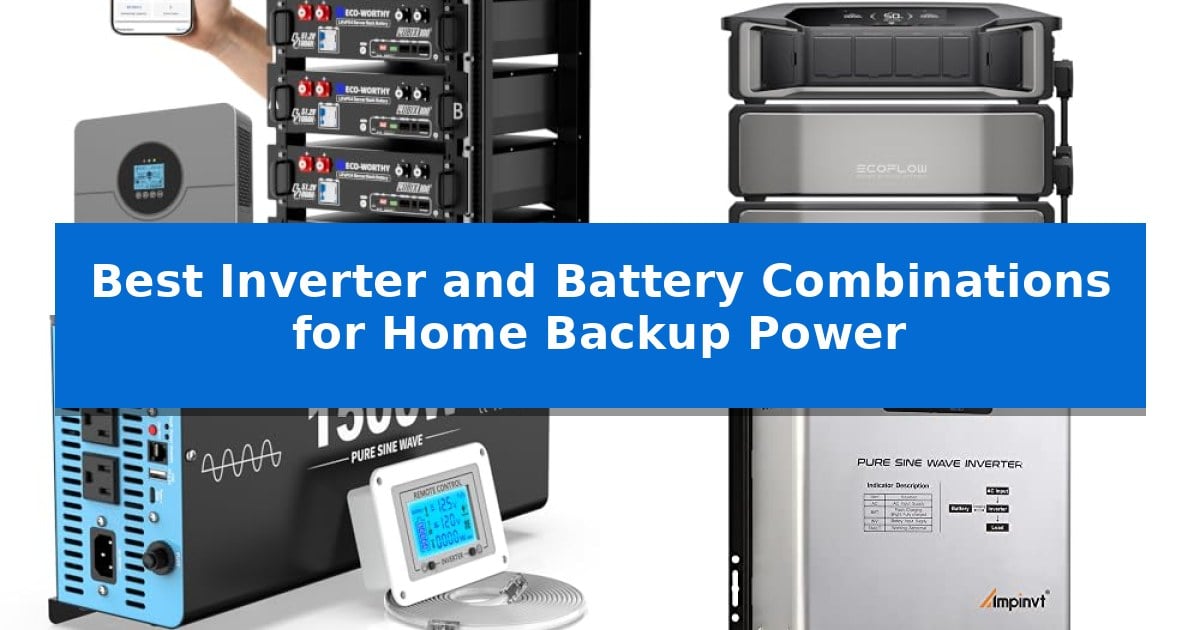
Power outages can disrupt your daily life, making it essential to have a reliable energy strategy in place. Finding the Best Inverter and Battery Combinations for Home Backup Power requires balancing your specific energy consumption needs with the technical requirements of your home's electrical system.
Whether you are looking to keep essential appliances running during a storm or aiming for full energy independence with an off-grid setup, the right pairing of an inverter and battery bank is critical. This guide examines top-tier options that offer the capacity, safety, and scalability necessary to maintain power when the grid fails.
Best Inverter and Battery Combinations for Home Backup Power in 2026
Quick Comparison
| Product | Best For | Key Strength | Score |
|---|---|---|---|
| ECO-WORTHY Home Backup Power System | Best Overall | Massive 30720Wh capacity with extensive expansion options up to 163.84kWh. | 4.9 |
| EF ECOFLOW DELTA Pro Ultra | Scalable Power for Long Outages | High 7200W output capable of running major household appliances. | 4.6 |
| OLTEANP Sump Pump Backup System | Essential Basement Flood Protection | Automatic transfer switch ensures continuous sump pump operation during power outages. | 4.5 |
| AMPINVT Pure Sine Wave Inverter | Versatile Multi-Battery Compatibility | Versatile battery compatibility supporting lithium, AGM, Gel, and flooded types. | 4.9 |
| CyberPower PFC Sinewave UPS | Reliable Protection for Sensitive Electronics | Pure sine wave output ensures compatibility with sensitive Active PFC power supplies. | 4.6 |
How We Chose
- Inverter output capacity and waveform stability for sensitive electronics.
- Battery chemistry and cycle life for long-term reliability.
- Scalability options for expanding storage and power output over time.
- Compliance with safety standards like UL1973 and UL1741.
- Integration features such as app monitoring and communication protocols.
1 ECO-WORTHY Home Backup Power System — Best for Whole-Home Off-Grid
Maintaining power during outages requires a robust, scalable solution capable of handling high-demand appliances. The ECO-WORTHY Home Backup Power System addresses this need by combining a 10000W pure sine wave inverter with a massive 30720Wh storage capacity, provided by six 51.2V 100Ah LiFePO4 server rack batteries.
This system is designed for versatility, featuring a 3-in-1 inverter that supports 120V single-phase or 120V/240V split-phase output. It integrates two independent MPPT controllers and a maximum 200A battery charger, ensuring efficient energy management. The unit is built for safety and compliance, having passed UL1973 and UL1741 testing by Intertek, meeting rigorous North American electrical and thermal management standards.
For users requiring future growth, the system offers significant expansion capability. You can connect up to 6 inverters in parallel for a 60kW AC output or link up to 32 batteries to reach a total storage capacity of 163.84kWh. The batteries utilize closed-loop communication via CAN/RS485 interfaces, allowing for intelligent integration with solar inverters and remote monitoring through the ECO-WORTHY app.
The complete kit includes the inverter, six batteries, a 6-layer server rack, and an RSD button. Because of the system's weight and scale, components are shipped separately to ensure safe delivery. With a 10-year warranty on the batteries, this setup provides a long-term, reliable foundation for off-grid living or whole-home backup power.
Best for: Homeowners seeking a scalable, high-capacity off-grid power solution for whole-home backup.
Skip if: Users with limited space or those who only require a portable, small-scale power station for occasional camping or minor electronics.
PROS
- Massive 30720Wh capacity with extensive expansion options up to 163.84kWh.
- UL1973 & UL1741 certified for enhanced electrical and thermal safety.
- Versatile 10000W inverter supporting both 120V and 240V split-phase output.
- Intelligent monitoring via integrated Bluetooth, WiFi, and CAN/RS485 communication.
CONS
- Large physical footprint requiring a dedicated server rack and space for installation.
- Complex delivery process as components are shipped separately for safety.
2 EF ECOFLOW DELTA Pro Ultra — Scalable Power for Long Outages
Maintaining power during an outage requires a robust system capable of handling heavy loads, and the EF ECOFLOW DELTA Pro Ultra provides a comprehensive solution by integrating an inverter and battery into a single, scalable unit. This system is designed to support both 120V and 240V, delivering an impressive 7200W output that can sustain demanding household appliances, including a 3-ton central air conditioner.
The system offers significant flexibility, allowing users to scale from a single 6144Wh battery to a massive 90kWh capacity, which can provide over 30 days of essential power for a standard North American home. To manage this energy, the EcoFlow app enables users to prioritize specific circuits, intelligently analyzing usage patterns to offset peak utility rates or maximize solar integration.
For sensitive electronics, the unit functions as an online UPS with 0-ms transfer time, ensuring continuous protection during grid failures. The design also emphasizes tranquility, with fans remaining off for the first 30 minutes when outputting up to 2000W, allowing for silent operation during daily use.
Charging efficiency is a priority, with a single 6144Wh battery capable of a full recharge in just 2 hours. Users have multiple input options, including solar, wall outlets, electric vehicle charging piles, or external generators, providing versatility for various home environments.
Best for: Homeowners seeking a scalable, high-output backup power system capable of running heavy appliances and sensitive electronics during extended outages.
Skip if: Users with limited floor space or those requiring a lightweight, portable power station for camping or mobile use, as this unit is heavy and designed for stationary home installation.
PROS
- High 7200W output capable of running major household appliances.
- Scalable capacity from 6.1kWh up to 90kWh for long-term backup.
- 0-ms transfer time for seamless UPS protection of sensitive devices.
- Fast charging capability, reaching full capacity in 2 hours.
CONS
- Heavy physical footprint requiring dedicated space for installation.
- Inverter and battery arrive in separate packages, requiring assembly.
3 OLTEANP Sump Pump Backup System — Essential Basement Flood Protection
Maintaining basement integrity during severe weather requires a reliable power strategy, and the OLTEANP Sump Pump Battery Backup System provides an automated solution for flood protection. This unit functions as a dedicated UPS, ensuring that your primary sump pump remains operational even when the grid fails by instantly transferring to battery power.
Engineered for versatility, the system features a 1500W pure sine wave inverter that delivers stable power to sensitive pump components. It is compatible with various 12V deep-cycle battery types, including LiFePO4, AGM, GEL, and Flooded chemistries, allowing users to choose the capacity that best suits their specific drainage needs.
The integrated 25A smart charger manages the battery health through a multi-stage process, incorporating essential protections against overcharge, overload, and short circuits. Users can monitor the system status through a wired remote controller with an LCD display, which provides real-time data on battery voltage and load levels.
Installation is designed for flexibility, supporting either wall-mounted or flat-surface placement. The unit includes an AC output terminal block for hardwired connections, featuring a floating neutral design. While the system is robust, it requires a separate battery purchase and sufficient space for proper ventilation to ensure long-term reliability.
Best for: Homeowners in flood-prone areas seeking an automated, pure sine wave backup power solution for their primary sump pump systems.
Skip if: Users who require an all-in-one unit with an integrated battery, as this system necessitates a separate 12V deep-cycle battery purchase.
PROS
- Automatic transfer switch ensures continuous sump pump operation during power outages.
- Pure sine wave output provides safe, stable power for sensitive pump electronics.
- High-efficiency 25A smart charger optimizes battery lifespan with multi-layer protection.
- Versatile compatibility with multiple 12V deep-cycle battery chemistries.
CONS
- Battery not included, requiring an additional purchase and setup.
- Floating neutral design requires specific attention to AC hardwiring constraints.
4 AMPINVT Pure Sine Wave Inverter — Versatile Multi-Battery Compatibility
Maintaining power during an outage requires a reliable bridge between your energy storage and home appliances. The AMPINVT Pure Sine Wave Inverter serves as a comprehensive hub, integrating an inverter, battery charger, and an AC auto-transfer switch into a single unit designed to manage home backup power effectively.
This device offers high transfer efficiency above 90% and provides a continuous stable pure sine wave output, which is essential for protecting sensitive electronics from surge interference. It features a built-in AVR stabilizer to maintain consistent voltage, ensuring that your connected equipment operates safely even when switching between power sources.
Flexibility is a core design choice, as the unit supports a wide range of battery types including Li-ion, LiFePO4, Sealed, Gel, AGM, and Flooded batteries. Users can customize the max charge current from 0-15A, allowing for precise control over how energy is replenished. With five distinct working modes—including AC priority, battery priority, and ECO mode—the system adapts to various grid or off-grid scenarios.
Safety is managed through a suite of integrated protections, including battery low/high voltage alarms, over-temperature protection, and short-circuit protection. The unit is built for durability with impact resistance and a robust load capacity, capable of handling temporary surges up to 160% for short durations.
Best for: Homeowners seeking a versatile, multi-mode power backup system that integrates charging and inversion for various battery chemistries.
Skip if: Users requiring a portable, plug-and-play power station with an integrated battery, as this unit requires external battery setup and professional installation.
PROS
- Versatile battery compatibility supporting lithium, AGM, Gel, and flooded types.
- Integrated AC auto-transfer switch for seamless transition during outages.
- Adjustable charging current up to 15A for customized battery maintenance.
- Five operational modes to prioritize either grid or battery usage.
CONS
- Requires external battery connection and configuration, unlike all-in-one portable power stations.
- Installation complexity due to the need for hardwiring and battery bank management.
5 CyberPower PFC Sinewave UPS — Reliable Protection for Sensitive Electronics
Maintaining power to sensitive electronics during outages requires a reliable bridge between your battery source and your hardware. The CyberPower CP1500PFCLCD PFC Sinewave UPS serves this role by providing 1500VA/1000W of capacity, specifically engineered to deliver a sine wave output that supports Active PFC and conventional power supplies without the signal distortion found in cheaper simulated wave units.
Beyond its core backup function, this unit acts as a comprehensive power management station. It features 12 NEMA 5-15R outlets, split evenly between battery-backed surge protection and standard surge-only protection. The inclusion of Automatic Voltage Regulation (AVR) is a critical design choice, as it stabilizes minor voltage fluctuations from the wall before they reach your equipment, potentially extending the lifespan of your connected devices.
Usability is centered around the multifunction, color LCD panel, which tilts up to 22 degrees for easier viewing. This display provides real-time data on battery health and power conditions, allowing for proactive management of your backup system. For modern connectivity, the front panel integrates two USB charge ports (1 Type-A, 1 Type-C), providing a convenient way to keep mobile devices powered during a grid failure.
The system is built for longevity and peace of mind, backed by a 3-year warranty that includes the battery. Users can further customize their power management through the downloadable PowerPanel Management Software. With its UL safety certification and a $500,000 connected equipment guarantee, this unit offers a robust, evidence-backed solution for protecting critical workstations and networking hardware.
Best for: Home office users and professionals requiring stable, clean power for sensitive equipment like Active PFC-equipped computers and network gear.
Skip if: Users needing extended off-grid runtime for high-draw appliances, as this is a compact UPS designed for short-term equipment protection rather than long-duration power storage.
PROS
- Pure sine wave output ensures compatibility with sensitive Active PFC power supplies.
- Automatic Voltage Regulation corrects power fluctuations without relying on battery power.
- Comprehensive 3-year warranty covers both the unit and the battery.
- Integrated USB-A and USB-C ports for convenient mobile device charging.
CONS
- Fixed battery capacity limits runtime for high-wattage equipment during prolonged outages.
Best Inverter and Battery Combinations for Home Backup Power Buying Guide
Understanding Power Capacity and Inverter Sizing
The first step in selecting a system is calculating your total wattage requirements. You must account for both the continuous load of your essential appliances, such as refrigerators and lighting, and the surge power required by motors in devices like air conditioners or sump pumps.
An inverter must be sized to handle the maximum peak load of your household. Choosing a pure sine wave inverter is crucial, as it provides clean, stable power that prevents damage to sensitive electronics, unlike modified sine wave alternatives.
Battery Chemistry and Longevity
Lithium Iron Phosphate (LiFePO4) has become the industry standard for home backup due to its superior safety profile and long cycle life. These batteries offer a consistent discharge rate and are significantly lighter and more compact than traditional lead-acid or AGM batteries.
When evaluating battery banks, look for integrated battery management systems (BMS) that provide protection against overcharging, overheating, and short circuits. A high-quality BMS ensures that your investment remains safe and functional for years.
Scalability and Future-Proofing
Your energy needs may grow over time, making modular expansion a vital feature. Systems that allow you to parallel multiple inverters or add extra battery modules provide a clear path to increasing your total storage capacity without replacing your entire setup.
Consider whether your chosen system supports closed-loop communication, which allows the battery and inverter to exchange data. This ensures the inverter always knows the precise state of charge, leading to more efficient energy management.
Safety and Regulatory Compliance
Home backup power involves high-voltage electricity, making safety certifications non-negotiable. Look for systems that have passed rigorous testing such as UL1973 for battery safety and UL1741 for inverter grid-tie and safety standards.
These certifications indicate that the equipment has been tested for thermal runaway management and electrical safety. Prioritizing certified hardware protects your home and ensures the longevity of your backup power investment.
Installation and Maintenance
While some portable power stations are plug-and-play, larger home backup systems often require professional installation, especially when integrating with your home's existing electrical panel. Always verify the installation requirements and whether the system includes necessary accessories like mounting racks or communication cables.
Regular maintenance is minimal with modern lithium systems, but you should still monitor your system via integrated apps or remote controllers. Keeping an eye on battery voltage and load levels helps you identify potential issues before they cause a power interruption.
Frequently Asked Questions
What is the difference between a pure sine wave and modified sine wave inverter?
A pure sine wave inverter produces power that mimics the clean electricity from the utility grid, making it safe for sensitive electronics like computers and medical devices. Modified sine wave inverters are less expensive but can cause humming or damage to certain appliances.
Can I expand my battery capacity later?
Yes, many modern systems are designed for modularity. You can add more battery units in parallel to increase your total kilowatt-hour capacity, provided your inverter supports the additional load and communication protocols.
Do I need a professional to install these systems?
Smaller portable units can be set up by the user, but whole-home backup systems that integrate with your electrical panel should be installed by a licensed electrician to ensure safety and code compliance.
How long will my batteries last during an outage?
The duration depends on your total battery capacity (measured in kWh) and your average power consumption. By prioritizing essential circuits, you can significantly extend the runtime of your system.
Are LiFePO4 batteries safe for indoor use?
Yes, LiFePO4 batteries are considered very safe for indoor use due to their stable chemistry and built-in management systems that prevent overheating and thermal runaway.
Conclusion: Our Top Pick
For homeowners seeking a robust, reliable, and scalable energy solution, the ECO-WORTHY Home Backup Power System stands out as the most comprehensive choice. Its ability to provide whole-home power, combined with its UL safety certifications and massive expansion potential, makes it an excellent foundation for energy independence.
While other options like the EF ECOFLOW DELTA Pro Ultra offer excellent portability and rapid charging, the ECO-WORTHY system provides the best value for those looking to permanently secure their home against long-term outages. Ensure you assess your specific load requirements before installation to maximize the performance of your chosen setup.