
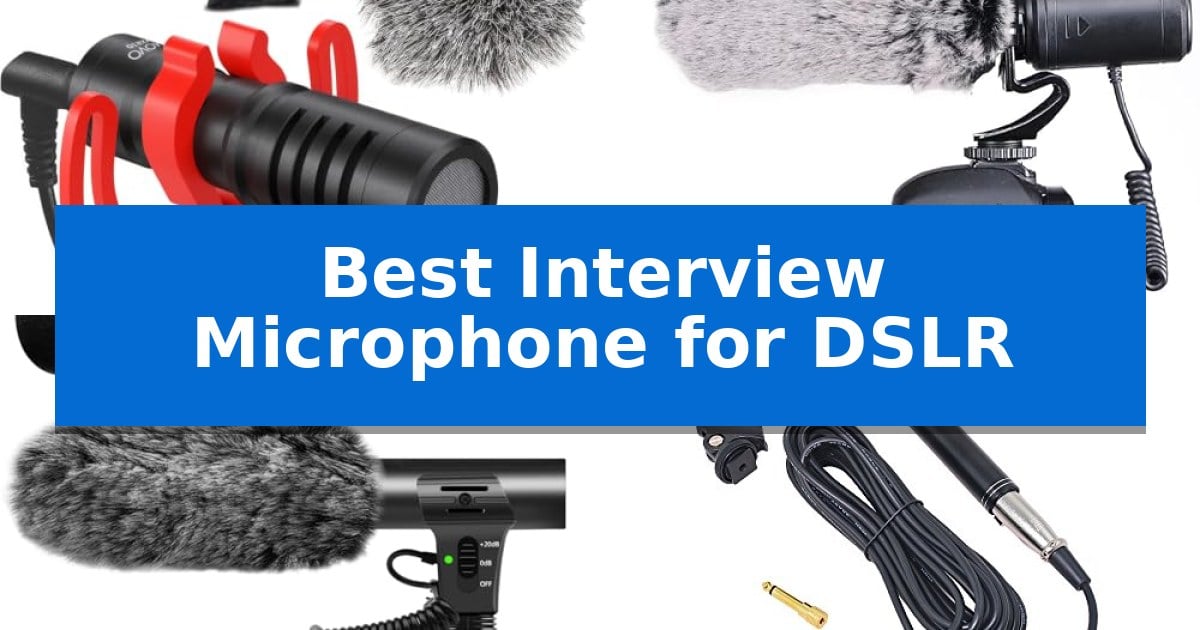
Capturing professional-grade audio during interviews requires more than just a built-in camera mic. When you need to isolate a subject's voice while minimizing ambient noise, a dedicated shotgun microphone becomes an essential tool for your production kit.
Selecting the Best Interview Microphone for DSLR setups involves balancing directional sensitivity with your specific recording environment. Whether you are filming on-location or in a controlled studio, the right microphone ensures your dialogue remains crisp, clear, and free from distracting background interference.
Best Interview Microphone for DSLR in 2026: Clear Audio for Every Shoot
Quick Comparison
| Product | Best For | Key Strength | Score |
|---|---|---|---|
| Movo VXR10 Shotgun Microphone | Best Overall | Battery-free operation using plug-in power from the host device. | 4.9 |
| Nicama SGM5 Shotgun Microphone | Background Noise Reduction | Cardioid polar pattern for effective background noise reduction. | 4.8 |
| Tikysky Shotgun Microphone | Close-Up Interview Focus | High-performance super-cardioid pickup pattern for focused audio. | 4.9 |
| Ruittos Interview Shotgun Microphone | Extended Reach Design | Cardioid pick-up pattern effectively isolates the main sound source. | 4.8 |
| Movo X3-II Shotgun Microphone | Professional Boom Compatibility | Dual power options via 48V phantom power or AA battery. | 4.6 |
How We Chose
- Directional pickup patterns that prioritize sound sources directly in front of the capsule.
- Physical compatibility with standard 3.5mm TRS camera inputs and hot-shoe mounting systems.
- Inclusion of essential accessories like windscreens and shock mounts to mitigate handling noise.
- Power requirements and battery efficiency for extended recording sessions.
- Build quality and portability for run-and-gun or on-location production environments.
1 Movo VXR10 Shotgun Microphone — Compact Directional Audio
The Movo VXR10 Universal Shotgun Mic distinguishes itself through its solid aluminum body and built-in shock mount, which work together to minimize handling noise and ensure durability during field interviews. This directional microphone is engineered to reject off-axis background distractions, focusing audio capture directly on the subject in front of the lens.
Designed for versatility, the Movo VXR10 connects to a wide array of devices including DSLRs, mirrorless cameras, camcorders, and smartphones. The package includes both TRS and TRRS cables, facilitating seamless integration with cameras and mobile devices, though users should note that newer smartphones may require a specific USB-C or Lightning-to-3.5mm adapter to maintain compatibility.
Usability is a core focus, as the microphone requires no batteries, relying instead on plug-in power from the connected device. To ensure high-quality audio, the manufacturer recommends positioning the microphone between 1 and 5 feet from the subject. The included fuzzy windscreen is a practical addition for outdoor recording, helping to reduce wind noise during on-the-go interviews.
This compact unit measures approximately 0.86 x 3.2 inches, making it an unobtrusive addition to a camera rig. By prioritizing a directional pickup pattern and providing essential accessories like a carrying case and shock mounts, the system offers a straightforward solution for creators looking to improve audio clarity for social media, vlogging, or interview projects.
Best for: Creators and videographers needing a compact, battery-free directional microphone for interviews and vlogging across multiple devices.
Skip if: Users who require advanced features like gain control, high-pass filters, or those using devices lacking a 3.5mm microphone input without an adapter.
PROS
- Battery-free operation using plug-in power from the host device.
- Directional pickup pattern that effectively isolates the subject from side noise.
- Durable aluminum construction built to withstand travel and field use.
- Comprehensive accessory kit including shock mounts, cables, and a windscreen.
CONS
- Requires specific adapters for modern smartphones lacking a 3.5mm jack.
- Limited compatibility with specific camera models that do not support external microphone inputs.
2 Nicama SGM5 Shotgun Microphone — Background Noise Reduction
Capturing clear audio during interviews requires a setup that minimizes unwanted ambient noise while maintaining a compact footprint on your camera. The Nicama SGM5 Shotgun Microphone addresses this by utilizing a cardioid polar pattern, which is specifically engineered to isolate the subject's voice by effectively reducing the pickup of surrounding environmental sounds.
Designed for versatility in field recording, this microphone features a 10dB sensitivity decrease and 200Hz low-frequency attenuation. These settings allow you to adjust the input signal to suit varying acoustic environments, ensuring that your audio levels remain balanced and clear even when recording in challenging conditions.
The physical construction prioritizes stability and ease of use. It features a shock-resistant structural design that works to mitigate mechanical noise caused by camera handling or vibrations during operation. Its standard universal connector ensures it can be quickly and securely fixed to a wide range of DSLR and mirrorless cameras, making it a practical addition to a mobile production kit.
Included in the package is a windscreen to further assist in maintaining audio integrity during outdoor shoots. While this microphone is built to enhance recording quality for video creators, users should note it is not compatible with Canon T5, T6, or T7 models, so verifying your specific camera body is essential before integration.
Best for: Video creators and interviewers seeking a compact, shock-resistant shotgun microphone to improve audio isolation on DSLR and mirrorless cameras.
Skip if: Users operating Canon T5, T6, or T7 camera bodies, as this specific model is not compatible with those units.
PROS
- Cardioid polar pattern for effective background noise reduction.
- Integrated shock-resistant structure to minimize mechanical vibration noise.
- Adjustable 10dB sensitivity and 200Hz low-frequency attenuation for flexible field use.
- Standard universal connector for broad camera compatibility.
CONS
- Incompatible with Canon T5, T6, and T7 camera models.
3 Tikysky Shotgun Microphone — Close-Up Interview Focus
Capturing clear audio during close-up interviews requires a specialized tool that minimizes ambient noise while maintaining high-definition sound resolution. The Tikysky Shotgun Microphone is engineered for this exact purpose, utilizing high-performance super-cardioid pickup technology to isolate subjects within a 3-meter range.
This microphone is designed for seamless integration with DSLR cameras equipped with a 3.5mm (1/8") TRS jack. It features a standard universal connector that fits a wide range of models from manufacturers like Canon, Nikon, Sony, and Panasonic. Its compact design, measuring approximately 5.4 inches in length, ensures it remains unobtrusive during handheld or tripod-mounted recording sessions.
Reliability in the field is supported by the use of AAA alkaline batteries, which provide long standby time for extended shooting sessions. The unit includes a low power indication function to help monitor battery status, and users are encouraged to power the device off when not in use to conserve energy. The microphone also comes with a windscreen to assist in managing airflow during outdoor shoots.
While highly effective for close-range work, this microphone is specifically tuned for distances up to 5 meters, with optimal performance within 3 meters. It is not intended for use with XLR or USB connections, nor is it compatible with mobile phones, tablets, or computers. This focus on a dedicated 3.5mm TRS interface ensures a streamlined setup for videographers who prioritize consistent, direct-to-camera audio.
Best for: Videographers and vloggers requiring a dedicated, battery-powered shotgun microphone for close-up interviews on DSLR cameras with a 3.5mm TRS input.
Skip if: Users who require XLR connectivity, mobile device compatibility, or long-distance audio pickup in high-noise environments.
PROS
- High-performance super-cardioid pickup pattern for focused audio.
- Standard 3.5mm TRS plug ensures broad compatibility with most DSLR cameras.
- Compact and lightweight form factor ideal for mobile setups.
- Low power indication helps manage battery life during shoots.
CONS
- Incompatible with XLR or USB interfaces and mobile devices.
- Limited pickup range not suitable for long-distance or high-noise environments.
4 Ruittos Interview Shotgun Microphone — Extended Reach Design
Capturing clear audio during interviews requires a microphone that isolates the speaker while remaining unobtrusive on camera. The Ruittos Interview Shotgun Microphone features an 11-inch length designed specifically to stay out of the frame, making it a practical choice for videographers using DSLR or camcorder setups.
This microphone utilizes a cardioid pick-up pattern to focus on the main sound source while minimizing background noise. It is built for versatility in various environments, including media interviews, conferences, and film production. The inclusion of an anti-wind foam cap and a stable stand helps to reduce unwanted noise from vibrations and air movement during recording.
Compatibility is straightforward, as the unit connects to devices with 3.5mm or 6.35mm microphone input sockets. It also features a hot shoe mount, though users with Sony or Minolta cameras will need to apply a separate hot shoe adapter. For extended recording sessions, the microphone is powered by a 1.5V battery, which provides approximately 26 hours of operation.
The package includes an 8-meter XLR cable, offering significant flexibility for different microphone placements. While the microphone is lightweight and compact, it is important to note that the required battery and the camera itself are not included in the purchase, so users should plan accordingly for their power needs.
Best for: Videographers and interviewers who need a directional, camera-mounted microphone with extended reach to capture clear vocals while keeping the hardware out of the shot.
Skip if: Users who require a wireless audio solution or those who prefer a microphone that does not rely on external 1.5V batteries for power.
PROS
- Cardioid pick-up pattern effectively isolates the main sound source.
- 11-inch compact design keeps the microphone out of the camera frame.
- Wide compatibility with standard 3.5mm and 6.35mm inputs.
- Long battery life of approximately 26 hours for extended shoots.
CONS
- Battery not included in the package.
- Requires a hot shoe adapter for specific camera brands like Sony or Minolta.
5 Movo X3-II Shotgun Microphone — Professional Boom Compatibility
The Movo X3-II Shotgun Microphone is an 11-inch supercardioid XLR microphone designed to provide focused, high-quality audio for filmmakers and content creators. Its specialized polar pattern is engineered to isolate sound sources, making it a practical choice for capturing clear dialogue during interviews or on-location shoots.
Versatility is a core component of this microphone's design, as it offers dual power options. It can operate via 48V phantom power or a single AA battery, allowing for compatibility with a wide range of recording devices, including DSLR and mirrorless cameras, field recorders, and professional boom setups. The inclusion of a high-pass filter further assists in managing low-end rumble during recording.
Built for durability, the microphone features a rugged aluminum body suitable for the demands of field production. To ensure clean audio, the kit includes a Rycote Lyre shockmount to minimize handling noise, along with both foam and furry windscreens for varying environmental conditions. The package also provides essential connectivity, including XLR to XLR and XLR to 3.5mm cables, alongside a 1/4” to 3/8” adapter for mounting.
This microphone balances professional-grade connectivity with the flexibility required for run-and-gun filming. By including a dedicated handgrip and a comprehensive set of cables, it serves as a ready-to-use solution for creators who need to transition quickly between different camera and audio setups.
Best for: Filmmakers and content creators requiring a versatile, professional-grade shotgun microphone for both camera-mounted and boom-pole interview setups.
Skip if: Users who require a compact, lightweight microphone for small vlogging cameras may find the 11-inch length and XLR-based workflow of this unit excessive for their needs.
PROS
- Dual power options via 48V phantom power or AA battery.
- Rycote Lyre shockmount included to effectively reduce handling noise.
- Comprehensive accessory kit including windscreens and multiple cable types.
- Rugged aluminum construction for field durability.
CONS
- Requires AA battery for non-phantom power operation (not included).
- 11-inch form factor may be bulky for smaller camera rigs.
Best Interview Microphone for DSLR Buying Guide
Understanding Directional Pickup Patterns
Most interview microphones utilize a cardioid or supercardioid polar pattern. These patterns are designed to be highly sensitive to sound coming from the front while rejecting noise from the sides and rear.
For interviews, a supercardioid pattern is often preferred because it offers a tighter, more focused pickup area. This helps isolate the interviewee's voice even in environments with moderate background noise, such as a busy office or an outdoor setting.
Connectivity and Compatibility
Before purchasing, verify the microphone's connection type. Most DSLR cameras use a 3.5mm TRS input. Some professional-grade microphones use XLR connectors, which may require an adapter or a dedicated audio interface to function with a standard camera.
Always check if your specific camera model supports external microphones. Some entry-level DSLRs lack a dedicated mic jack, which would necessitate an external digital recorder to capture audio separately.
The Importance of Shock Mounts
A shock mount is critical for any camera-mounted microphone. It physically decouples the mic from the camera body, preventing the transmission of mechanical vibrations, such as the sound of your fingers adjusting the lens or camera settings.
Look for systems that use high-quality suspension materials, like the Rycote Lyre design, which provides effective vibration isolation without the wear and tear associated with traditional rubber bands.
Managing Wind and Environmental Noise
Outdoor recording introduces wind noise, which can easily ruin a clean audio track. A fuzzy windscreen (often called a deadcat) is essential for diffusing wind before it hits the microphone capsule.
For indoor use, a standard foam windscreen is usually sufficient to reduce plosives and light air movement. Always ensure your chosen mic includes these accessories to avoid additional costs.
Powering Your Microphone
Microphones generally fall into two categories: those that draw plug-in power from the camera and those that require internal batteries or 48V phantom power.
Battery-powered mics offer more flexibility for use with various devices, including field recorders, but they require you to monitor battery levels. Plug-in power mics are more convenient for long shoots but rely on the camera's internal power supply.
Frequently Asked Questions
Do I need a battery for my shotgun microphone?
It depends on the model. Some microphones draw power directly from the camera's 3.5mm jack, while others require an internal battery (like an AAA or AA) or external phantom power to operate.
Can I use a shotgun mic with my smartphone?
Many shotgun mics are compatible with smartphones, but you may need a specific TRRS adapter or a Lightning/USB-C to 3.5mm dongle to ensure the phone recognizes the external audio source.
What is the difference between TRS and TRRS?
TRS (Tip-Ring-Sleeve) is the standard for cameras and audio recorders. TRRS (Tip-Ring-Ring-Sleeve) is typically used for devices with integrated microphones, such as smartphones and tablets.
How close should the microphone be to the subject?
For the best audio quality, position the microphone between 1 to 5 feet from the subject. Being too close can cause distortion, while being too far away often results in muffled, thin-sounding audio.
Will a shotgun mic eliminate all background noise?
While shotgun mics are excellent at rejecting off-axis sound, they cannot eliminate all background noise. They are most effective when the subject is closer to the mic than the source of the noise.
Conclusion: Our Top Pick
Choosing the right equipment is vital for professional results. The Movo VXR10 Shotgun Microphone stands out as a versatile, compact solution that integrates seamlessly with most camera setups. Its directional design effectively minimizes distracting ambient noise, making it a reliable choice for creators who need consistent audio quality without complex configurations.
While this microphone is highly capable, remember that your environment and microphone placement remain the most significant factors in audio quality. Always test your levels before recording to ensure the best possible signal-to-noise ratio for your specific interview setting.