
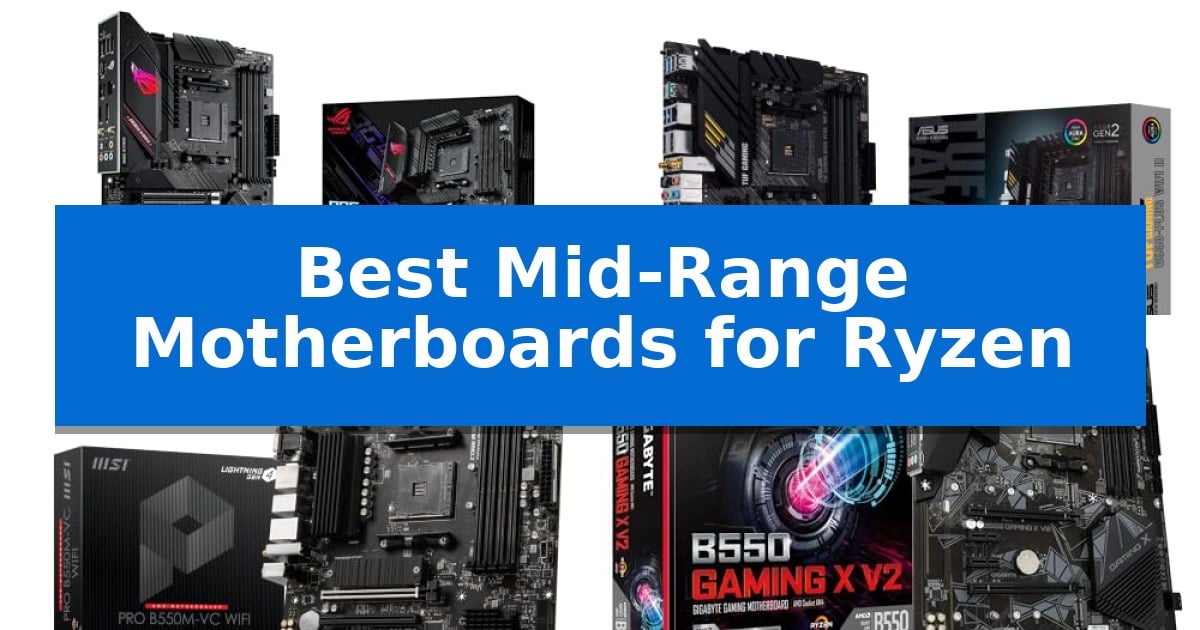
Selecting the right foundation for your PC is essential for stable performance and future upgrades. When building with AMD processors, finding the Best Mid-Range Motherboards for Ryzen requires balancing robust power delivery with the specific connectivity features your workflow demands.
Whether you are utilizing the mature AM4 platform or transitioning to the newer AM5 architecture, the right board ensures your CPU operates efficiently. This guide examines key models to help you identify which motherboard aligns with your hardware requirements and long-term upgrade path.
You may also want to compare Best Mid-Range Motherboard for i5-13600K, Best Mid-Range Motherboard, and Best Mid-Range Monitors.
Best Mid-Range Motherboards for Ryzen
Quick Comparison
| Product | Best For | Key Strength | Score |
|---|---|---|---|
| ASUS ROG Strix B550-F Gaming WiFi II | Best Overall | 12+2 teamed power stages for reliable power delivery | 4.9 |
| ASUS TUF Gaming B550-PLUS WiFi II | Durable Build for Reliable Performance | 8+2 DrMOS power stages for reliable power delivery | 4.5 |
| MSI PRO B550M-VC WiFi | Compact Value with Modern Connectivity | Integrated Wi-Fi 6E and Bluetooth 5.2 for modern wireless connectivity. | 4.4 |
| GIGABYTE B550 Gaming X V2 | Balanced ATX for Standard Setups | Q-Flash Plus allows for BIOS updates without a CPU or RAM installed. | 4.8 |
| GIGABYTE B850 AORUS Elite WIFI7 | Future-Ready for Next-Gen Ryzen | 14+2+2 power phase design for stable CPU performance. | 4.4 |
How We Chose
- Socket and chipset compatibility with target Ryzen processor generations.
- Power delivery design and thermal management capabilities for sustained loads.
- Availability of essential expansion slots, including PCIe 4.0 or 5.0 support.
- Integrated networking options such as Wi-Fi standards and Ethernet speeds.
- I/O connectivity, including USB port variety and modern display outputs.
1 ASUS ROG Strix B550-F Gaming WiFi II — Premium Features for Enthusiast Builds
Building a high-performance system requires a foundation that balances modern connectivity with reliable power delivery. The ASUS ROG Strix B550-F Gaming WiFi II centers its design around a 12+2 teamed power stage architecture, utilizing high-quality alloy chokes and durable capacitors to ensure stable voltage regulation for AMD Ryzen 3000 and 5000 series processors.
This motherboard is engineered for users who prioritize future-ready data transfer and networking. It features PCIe 4.0 support for high-speed storage and graphics, alongside WiFi 6E (802.11ax) and Intel 2.5 Gb Ethernet for low-latency connectivity. The inclusion of USB 3.2 Gen 2 Type-C and HDMI 2.1 outputs provides versatile options for both high-resolution displays and modern peripheral integration.
Usability is enhanced through the intuitive UEFI BIOS dashboard, which simplifies system tuning and monitoring. The board also includes BIOS Flashback for easy updates, ensuring compatibility without needing a processor installed. For aesthetic and thermal management, the integrated Addressable RGB headers support Aura Sync, allowing for synchronized lighting across your build.
While this board offers a robust feature set, it is specifically tailored for the AM4 platform. It includes a 60-day AIDA64 Extreme subscription, providing immediate access to diagnostic tools to monitor your hardware performance. With its comprehensive connectivity suite and solid power delivery, it serves as a reliable core for mid-range gaming or productivity rigs.
Best for: Enthusiasts building a high-performance AM4 system who require fast networking and PCIe 4.0 support.
Skip if: Users planning to upgrade to newer CPU sockets, as this board is limited to the AM4 platform.
PROS
- 12+2 teamed power stages for reliable power delivery
- Integrated WiFi 6E and 2.5 Gb Ethernet for fast networking
- PCIe 4.0 compatibility for modern storage and GPU speeds
- BIOS Flashback for convenient system maintenance
CONS
- AM4 socket limitation prevents use with newer CPU generations
2 ASUS TUF Gaming B550-PLUS WiFi II — Durable Build for Reliable Performance
Building a reliable foundation for a high-core-count processor requires a motherboard that balances power delivery with thermal management. The ASUS TUF Gaming B550-PLUS WiFi II centers its design around an 8+2 DrMOS power stage configuration, utilizing high-quality alloy chokes and durable capacitors to maintain stable power delivery for 3rd Gen AMD Ryzen CPUs.
Thermal stability is managed through a fanless VRM and PCH heatsink design, which works in tandem with multiple hybrid fan headers. Users can fine-tune their cooling profiles using the Fan Xpert 4 software or the UEFI Q-Fan Control utility, ensuring that airflow is optimized based on real-time system temperatures.
Connectivity is a primary focus for this ATX board, featuring WiFi 6 (802.11ax) and 2.5 Gb LAN with ASUS LANGuard for high-performance networking. The board supports modern standards including PCIe 4.0 for faster data throughput and includes dual M.2 slots for NVMe SSDs, with one slot dedicated to PCIe 4.0 x4 speeds.
The rear I/O and internal headers provide extensive expansion options, including USB 3.2 Gen 2 Type-C and Type-A ports, HDMI 2.1, and a Thunderbolt 3 header. With integrated Aura Sync and an addressable RGB header, the motherboard offers aesthetic customization while maintaining a focus on functional, durable hardware for gaming builds.
Best for: Builders seeking a durable, feature-rich ATX motherboard with WiFi 6 and PCIe 4.0 support for 3rd Gen Ryzen systems.
Skip if: Users requiring a smaller form factor like Micro-ATX or Mini-ITX, or those needing compatibility with non-AM4 processor sockets.
PROS
- 8+2 DrMOS power stages for reliable power delivery
- Integrated WiFi 6 and 2.5 Gb LAN for fast networking
- PCIe 4.0 support for high-speed storage and GPU connectivity
- Comprehensive thermal management with fanless heatsinks
CONS
- ATX form factor may be too large for compact PC cases
3 MSI PRO B550M-VC WiFi — Compact Value with Modern Connectivity
The MSI PRO B550M-VC WiFi offers a robust foundation for AMD Ryzen builds by integrating Wi-Fi 6E and Bluetooth 5.2 directly onto the board, providing high-speed wireless connectivity without requiring additional expansion cards. This mATX motherboard is engineered for efficiency, featuring a 2oz thickened copper PCB and a digital PWM IC design to maintain stable power delivery to the processor.
Thermal management is prioritized through the inclusion of the M.2 Shield Frozr, which utilizes a 7W/mK thermal pad to dissipate heat from high-speed storage drives. This ensures that the PCIe 4.0 interface remains stable during sustained workloads, protecting performance-critical components from thermal throttling.
System flexibility is supported by broad compatibility with AMD Ryzen 5000 and 3000 Series desktop processors, as well as the 4000 G-Series. Memory performance is enhanced via DDR4 Boost technology, allowing for overclocked speeds up to 4400 MHz, catering to users who need to maximize their system's memory bandwidth.
Designed for versatility, the board includes a comprehensive array of I/O options, including USB 3.2 Gen 2 ports for fast data transfer and multiple display outputs like HDMI and DisplayPort. The compact mATX form factor makes it a practical choice for builders aiming to balance feature density with a smaller physical footprint.
Best for: Builders seeking a compact, feature-rich AM4 motherboard with integrated Wi-Fi 6E for modern Ryzen desktop systems.
Skip if: Users requiring ATX-sized boards for multi-GPU setups or those using older Ryzen processors like the 3400G or 3200G.
PROS
- Integrated Wi-Fi 6E and Bluetooth 5.2 for modern wireless connectivity.
- M.2 Shield Frozr thermal solution for reliable storage performance.
- Support for high-speed DDR4 memory up to 4400(OC) MHz.
- Durable 2oz thickened copper PCB construction.
CONS
- Limited expansion due to the compact mATX form factor.
- Incompatibility with specific older APU models like the Ryzen 5 3400G.
4 GIGABYTE B550 Gaming X V2 — Balanced ATX for Standard Setups
Building a reliable PC requires a foundation that balances power delivery with modern connectivity, and the GIGABYTE B550 Gaming X V2 addresses this by integrating a 10+3 Power Phase design. This architecture, paired with premium chokes and capacitors, ensures stable power delivery for Ryzen 5000, 4000, and 3000 series processors, making it a practical choice for users focused on a stable, long-term build.
The board emphasizes thermal management through an Advanced Thermal Armor VRM heatsink, which works to dissipate heat during sustained operation. For those prioritizing assembly speed, the integrated I/O shield simplifies the installation process, while the Q-Flash Plus feature allows for BIOS updates without the need to install a CPU, RAM, or GPU, providing a significant advantage during the initial setup phase.
Connectivity is handled through a versatile array of ports, including PCIe 4.0 support for both the x16 slot and one M.2 slot, ensuring compatibility with high-speed storage and modern graphics cards. The inclusion of a front USB 3.2 Gen 1 Type-C header adds convenience for modern case designs, while the GbE LAN and Bluetooth 5.3 support provide reliable networking options for both wired and wireless environments.
The user experience is further refined by a refreshed BIOS featuring an Easy Mode interface, which allows for intuitive adjustments without navigating complex menus. By combining these functional features with a standard ATX form factor, the GIGABYTE B550 Gaming X V2 offers a balanced set of tools for builders who need a dependable platform for their Ryzen-based systems.
Best for: This motherboard is best for users building a balanced, reliable Ryzen-based PC who prioritize easy BIOS updates and modern connectivity options like PCIe 4.0.
Skip if: Skip this model if you require integrated Wi-Fi or advanced overclocking features beyond standard power delivery capabilities.
PROS
- Q-Flash Plus allows for BIOS updates without a CPU or RAM installed.
- 10+3 Power Phase design provides steady power delivery.
- PCIe 4.0 support for both primary graphics and storage slots.
- Integrated I/O shield simplifies the PC assembly process.
CONS
- No integrated Wi-Fi requires an additional card or adapter for wireless connectivity.
- Limited to one PCIe 4.0 M.2 slot, with the secondary slot restricted to PCIe 3.0.
5 GIGABYTE B850 AORUS Elite WIFI7 — Future-Ready for Next-Gen Ryzen
Building a high-performance system around the latest AMD processors requires a foundation that balances thermal management with modern connectivity. The GIGABYTE B850 AORUS Elite WIFI7 addresses this by integrating a robust 14+2+2 power phase design, ensuring stable power delivery for the Ryzen 9000, 8000, and 7000 series CPUs. This architecture provides the necessary electrical stability for sustained high-load tasks, making it a reliable choice for users pushing their hardware to its limits.
This ATX motherboard prioritizes efficient heat dissipation through dedicated VRM and M.2 Thermal Guard solutions. These components are essential for maintaining performance during heavy workloads, protecting sensitive storage drives from thermal throttling while keeping the power delivery circuitry cool under load. By preventing heat buildup, the board ensures that high-speed storage and processing remain consistent during intensive operations.
Connectivity is a primary focus, featuring PCIe 5.0 support and three M.2 slots to accommodate high-speed storage configurations. The inclusion of WIFI7 and 2.5GbE LAN provides flexible, high-bandwidth networking options, while the USB-C port ensures compatibility with modern peripherals and external devices. These features allow for faster data transfers and lower-latency networking, which are critical for professional workflows and high-speed data management.
Designed for ease of assembly, the board incorporates the EZ-Latch mechanism, simplifying the installation and removal of components. This feature reduces the risk of damaging delicate connectors during the build process. With a 5-year manufacturer warranty, this board is built to provide long-term reliability for users looking to maximize their AM5 platform investment.
Best for: Users building a modern, high-performance PC on the AM5 platform who require future-ready connectivity and robust thermal management.
Skip if: Users requiring a smaller form factor like Micro-ATX or Mini-ITX, as this board is strictly an ATX design.
PROS
- 14+2+2 power phase design for stable CPU performance.
- Integrated VRM and M.2 Thermal Guard for effective cooling.
- Future-ready PCIe 5.0 and WIFI7 connectivity.
- EZ-Latch design simplifies component installation.
CONS
- ATX form factor may not fit in compact PC cases.
Best Mid-Range Motherboards for Ryzen Buying Guide
Understanding Socket Compatibility
The most critical factor in your decision is the CPU socket. The AM4 platform remains a popular choice for budget-conscious builds, supporting a wide range of 3000 and 5000 series processors. Ensure your chosen board explicitly lists support for your specific Ryzen generation.
For those looking toward the future, the AM5 socket is necessary for newer Ryzen 7000, 8000, and 9000 series chips. These boards also introduce support for DDR5 memory, which offers a significant bandwidth increase over the DDR4 standard used in older platforms.
Power Delivery and Thermal Design
A motherboard's power phases determine how effectively it delivers electricity to the CPU. Higher-count power stages generally provide more stable power, which is vital if you intend to use high-core-count processors or perform heavy multitasking.
Effective thermal solutions, such as VRM heatsinks and M.2 shields, are essential for maintaining performance. These components dissipate heat generated by the power delivery system and high-speed storage, preventing thermal throttling during intensive tasks.
Expansion and Connectivity
Consider your storage and peripheral needs when reviewing PCIe slots and M.2 connectors. PCIe 4.0 is standard for most mid-range builds, while newer boards may offer PCIe 5.0 for future-proofing high-speed storage and graphics cards.
Connectivity options like Wi-Fi 6E or Wi-Fi 7 and 2.5Gb Ethernet provide faster and more stable network performance. Check the rear I/O panel to ensure you have enough USB 3.2 ports for your external devices.
Form Factor Considerations
The ATX form factor is the standard for most builds, offering the most expansion slots and space for components. It is ideal for mid-tower and full-tower cases where airflow and component spacing are priorities.
Micro-ATX (mATX) boards provide a more compact footprint without sacrificing core functionality. These are excellent for smaller builds, though they may have fewer PCIe expansion slots compared to their full-sized counterparts.
BIOS and Ease of Assembly
Modern motherboards often include features like BIOS Flashback, which allows you to update the firmware without needing a CPU or RAM installed. This is a significant advantage if you are using a newer processor on an older motherboard model.
Look for user-friendly BIOS interfaces that simplify settings adjustments. Features like EZ-Latch or integrated I/O shields can also make the physical assembly process much smoother for first-time builders.
Frequently Asked Questions
Can I use an AM4 motherboard with a Ryzen 9000 series processor?
No, Ryzen 9000 series processors require the AM5 socket. AM4 motherboards are only compatible with specific Ryzen 3000, 4000, and 5000 series processors.
Is DDR5 memory compatible with AM4 motherboards?
No, AM4 motherboards are designed exclusively for DDR4 memory. DDR5 memory is only compatible with AM5 motherboards.
What is the benefit of PCIe 5.0?
PCIe 5.0 offers double the bandwidth of PCIe 4.0, which can benefit future high-speed NVMe SSDs and next-generation graphics cards, though current components may not fully saturate this speed.
Do I need Wi-Fi 6E or 7 for gaming?
While a wired Ethernet connection is generally preferred for gaming, Wi-Fi 6E and 7 provide significantly improved speeds and lower latency compared to older Wi-Fi standards, making them excellent for wireless setups.
What does BIOS Flashback do?
BIOS Flashback allows you to update the motherboard's firmware using a USB drive, even if the CPU, RAM, or graphics card are not installed, which is helpful for ensuring compatibility with newer CPUs.
Conclusion: Our Top Pick
Selecting the right motherboard is a balance between your current hardware needs and your future upgrade path. For those on the AM4 platform, the ASUS ROG Strix B550-F Gaming WiFi II stands out as a reliable choice, offering robust power delivery, Wi-Fi 6E connectivity, and a comprehensive set of features that cater to both gamers and power users.
While other options provide excellent value or specific form-factor advantages, this model provides the most consistent performance and feature set for a mid-range build. Ensure you verify your CPU's socket requirements before finalizing your purchase to guarantee full compatibility.