
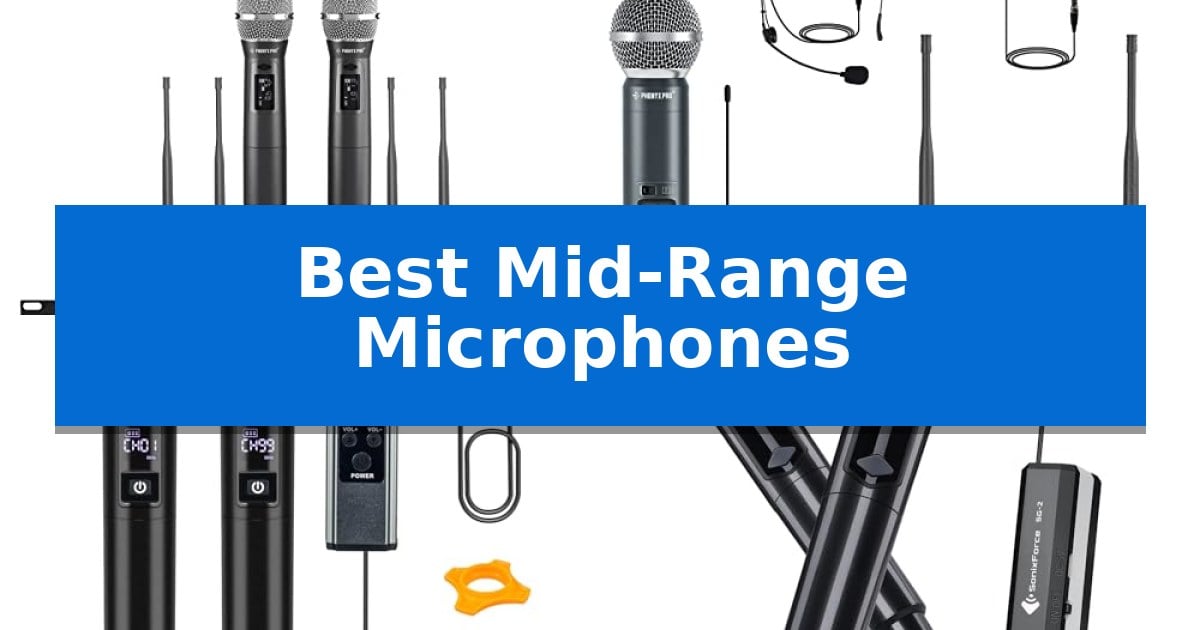
Finding the right audio equipment often feels like balancing budget against the need for professional-grade stability. Whether you are managing a small venue, hosting a podcast, or setting up a worship service, the Best Mid-Range Microphones offer a critical middle ground between entry-level gear and high-end broadcast systems.
These systems prioritize consistent signal transmission and vocal clarity without the complexity of top-tier touring rigs. By focusing on essential features like frequency management and build quality, these microphones provide the reliability necessary for consistent performance in various settings.
You may also want to compare Best Mid-Range Microphone, Best Mid-Range Mesh WiFi Systems, and Best Mid-Range Lenovo Laptops.
Best Mid-Range Microphones
Quick Comparison
| Product | Best For | Key Strength | Score |
|---|---|---|---|
| Phenyx Pro PTU-2U-2H Wireless Microphone System | Best Overall | True diversity circuitry for enhanced anti-interference performance. | 4.9 |
| Phenyx Pro PTU-71-1H1B Wireless Microphone System | Versatile Hybrid Transmitter Options | Versatile hybrid transmitter options including both handheld and bodypack units. | 4.8 |
| WONATU G26-2S Wireless Karaoke Microphone | Long-Lasting Battery for Marathons | 40-hour battery life for extended usage | 4.3 |
| SonixForce SG Wireless Karaoke Microphones | Rugged Build for Active Performers | 240ft wireless range for flexible stage movement | 4.9 |
| JOYO MW-2 Wireless XLR Microphone System | Cable-Free Freedom for Dynamic Mics | 2.4GHz automatic frequency hopping for stable wireless connection. | 4.5 |
How We Chose
- Signal Stability: Assessing the effectiveness of UHF or 2.4GHz frequency management to prevent dropouts.
- Build Quality: Evaluating the materials used in the receiver and microphone housing for long-term durability.
- Ease of Setup: Determining how quickly systems can sync frequencies and connect to existing PA or mixer setups.
- Versatility: Checking the availability of different transmitter types, such as bodypacks or handheld options, for diverse applications.
- Audio Performance: Reviewing the frequency response and noise-cancellation capabilities for vocal clarity.
1 Phenyx Pro PTU-2U-2H Wireless Microphone System — True Diversity for Stable Reception
Reliable audio transmission in complex RF environments is achieved through the Phenyx Pro PTU-2U-2H Wireless Microphone System, which utilizes true diversity circuitry to minimize interference. This dual-channel UHF system operates within the 530 – 580MHz band, providing stable reception across a line-of-sight range of up to 328 feet.
The system features 1000 selectable frequency groups, allowing for multi-set operations in crowded venues. Users can leverage the auto scan function to quickly locate the best available frequency, while the quick IR synchronization simplifies the pairing process between the receiver and the handheld microphones.
Engineered for durability, the receiver and the two handheld microphones are housed in heavy-duty all-metal casings. Each microphone is equipped with a dynamic polar pattern cartridge and a specialized sponge design to filter out pops, clicks, and ambient noise, ensuring clear vocal reproduction for live performances, weddings, or professional events.
The package includes the dual-channel receiver, four antennas, and essential accessories, including anti-rolling rings and AA batteries capable of providing 16 hours of continuous use. The receiver also incorporates squelch control and lock functions to maintain consistent settings throughout long events, making it a robust solution for mid-to-large scale sound reinforcement.
Best for: Professional sound reinforcement in mid-to-large scale venues where multiple wireless systems need to operate simultaneously without interference.
Skip if: Users requiring a compact, portable system for casual home use or those who do not need the advanced frequency management and heavy-duty metal construction of a professional-grade UHF setup.
PROS
- True diversity circuitry for enhanced anti-interference performance.
- 1000 selectable frequency groups supporting complex multi-set environments.
- Durable all-metal housing for both receiver and microphones.
- 16-hour battery life for extended event reliability.
CONS
- Heavier build due to the all-metal construction compared to plastic alternatives.
- Requires frequency coordination in highly congested RF areas.
2 Phenyx Pro PTU-71-1H1B Wireless Microphone System — Versatile Hybrid Transmitter Options
The Phenyx Pro PTU-71-1H1B Wireless Microphone System offers a flexible dual-transmitter setup, combining a durable metal-housed handheld microphone with a versatile bodypack transmitter. This system is engineered for diverse environments, including public speaking, church services, and live events, by providing both a headset and a lapel microphone for hands-free operation.
At the core of its performance is PLL frequency synthesized technology, which facilitates stable sound transmission and minimizes dropouts. The system operates across two channels with 100 selectable frequencies each, allowing for multi-set operations of up to 16 transmitters simultaneously. The inclusion of one-touch Auto Scan functionality enables the system to quickly identify the least-interference frequency, while the lock function prevents accidental setting changes during use.
Audio quality is managed through a cardioid polar pattern on the handheld mic, which is designed to reduce background noise and provide precise pickup. The unidirectional lapel and headset mics are specifically tuned to reject ambient noise, ensuring clear vocal capture. The system is built for longevity, with the included AA batteries supporting up to 16 hours of operation.
Setup is streamlined through quick IR synchronization, which pairs the transmitters to the receiver efficiently. Once paired, the system retains settings after power cycles, removing the need for repeated syncing. The receiver is housed in a metal chassis to support long-range operation, rated between 290 ft and 328 ft line of sight, making it suitable for larger venues.
Best for: Users needing a versatile, multi-transmitter wireless system for events, public speaking, or presentations that require both handheld and hands-free options.
Skip if: Users who require a simple, single-microphone setup or those who prefer a digital 2.4GHz system over a UHF-based frequency-tuned solution.
PROS
- Versatile hybrid transmitter options including both handheld and bodypack units.
- Enhanced signal reliability with 200 selectable UHF frequencies and auto-scan.
- Long battery life providing up to 16 hours of continuous use.
- Wide operational range of up to 328 feet line of sight.
CONS
- Requires AA batteries for operation rather than rechargeable internal cells.
- Complex multi-channel management may be more than needed for simple, single-mic applications.
3 WONATU G26-2S Wireless Karaoke Microphone — Long-Lasting Battery for Marathons
Achieving clear, reliable audio for events or performances requires hardware that maintains a consistent connection regardless of the environment. The WONATU G26-2S Wireless Karaoke Microphone addresses this by utilizing a 2.4G dual signal chip and 99 selectable channels, which work together to maintain a stable link up to 260 feet away. This design choice ensures that users can move freely between rooms without the signal drops often associated with single-chip systems.
For extended use, this system features a 40-hour rechargeable battery that charges via a Type-C fast port. This capacity allows for long-duration events, such as all-day parties or multi-day gatherings, without the need for frequent recharging. The inclusion of an advanced DSP audio chip with a cardioid pickup pattern provides anti-howling capabilities, which actively suppresses feedback and filters background noise to keep vocals distinct.
The physical construction of the microphones features a premium metal tube body with a matte grip finish, providing a durable feel compared to standard plastic alternatives. The receiver is designed for instant plug and play functionality, utilizing 6.35mm and 3.5mm dual-port compatibility to connect directly to PA systems, amplifiers, and karaoke machines. Setup is automated, requiring no external applications or manual pairing processes.
This system is built to support multi-mic environments, as the 99 independent channels allow multiple G26-S sets to operate in the same vicinity without cross-interference. This makes the WONATU G26-2S Wireless Karaoke Microphone a practical solution for duets or group settings where multiple performers require reliable, interference-free audio transmission.
Best for: This system is best for users who need a reliable, long-lasting wireless microphone setup for parties, events, or multi-performer scenarios.
Skip if: Skip this product if you require a professional-grade XLR-based system for studio recording or if your audio setup does not support 6.35mm or 3.5mm inputs.
PROS
- 40-hour battery life for extended usage
- 2.4G dual signal chip for stable 260ft range
- DSP anti-howling technology for clear vocals
- Durable metal construction with matte grip
CONS
- Limited to 6.35mm and 3.5mm receiver connections
- 1-month warranty period
4 SonixForce SG Wireless Karaoke Microphones — Rugged Build for Active Performers
The SonixForce SG Wireless Karaoke Microphones provide a robust 2.4G wireless system capable of maintaining a connection up to 240ft, ensuring freedom of movement for performers without the clutter of cables. This dual-microphone setup is engineered for reliability, utilizing a single receiver to manage both handheld units simultaneously for seamless group use.
Designed with a directional cardioid capsule, these microphones prioritize vocal clarity while integrating DSP noise reduction to suppress background interference and howling. The hardware features a rugged ABS body paired with a zinc die-cast steel mesh head, resulting in a balanced 238g weight that balances durability with comfort for extended use.
Setup is simplified through an instant auto-pairing process that activates upon power-up, requiring only a connection to a standard 6.35mm or 3.5mm microphone input. The system is powered by internal rechargeable batteries, offering up to 10 hours of performance on a single 2–3 hour USB-C charge, eliminating the need for disposable battery replacements.
These microphones are versatile tools for various applications, including weddings, lectures, and stage presentations. The package includes essential accessories such as anti-slip rings and a 3.5mm adapter, supporting a plug-and-play experience that fits directly into existing amplifiers, mixers, or karaoke machines.
Best for: Performers and presenters needing a reliable, long-range wireless dual-microphone system for events and karaoke.
Skip if: Users requiring Bluetooth connectivity or specific AUX/LINE-IN input compatibility, as this system relies on standard 6.35mm or 3.5mm microphone ports.
PROS
- 240ft wireless range for flexible stage movement
- 10-hour battery life with convenient USB-C charging
- Instant auto-pairing for hassle-free setup
- Rugged build quality with zinc die-cast mesh head
CONS
- Not compatible with Bluetooth or AUX/LINE-IN ports
5 JOYO MW-2 Wireless XLR Microphone System — Cable-Free Freedom for Dynamic Mics
Eliminating the constraints of a physical cable during live events, the JOYO MW-2 Wireless XLR Microphone System provides a dedicated 2.4GHz wireless link for dynamic microphones. This system is designed to simplify setup at venues like churches or weddings by allowing performers to move freely without managing trailing cords.
The system utilizes 24-bit/48kHz digital transmission to maintain audio detail, supported by a rated 105dB SNR and a 20Hz-20kHz frequency response. With a specified 16ms latency and a rated range of over 100ft in open areas, it balances signal stability with performance. Users can operate up to 4 sets simultaneously in a single venue by pairing each transmitter and receiver individually.
Power management is handled via integrated batteries that offer 6-8 hours of use per charge. Both the transmitter and receiver feature LED battery indicators and are recharged using the included dual USB-C cable in approximately 2 hours. Note that the units cannot be operated while charging, requiring a full power-up before the event.
To ensure a clean signal, the system requires specific operational habits: keeping 48V phantom power off on the mixer's XLR input and muting the channel before powering the units on or off to prevent audible pops. The compact design measures roughly 4.13 inches in length, making it a portable solution for those needing a reliable wireless interface for dynamic mics.
Best for: Performers and presenters using dynamic microphones who require a reliable, cable-free setup for live events and presentations.
Skip if: Users who rely on condenser microphones requiring 48V phantom power or those who need to operate their equipment while it is actively charging.
PROS
- 2.4GHz automatic frequency hopping for stable wireless connection.
- 6-8 hours of battery life suitable for most live events.
- 24-bit/48kHz audio transmission for clear vocal reproduction.
- Compact, portable design that is easy to transport.
CONS
- Cannot be used while charging, requiring pre-event planning.
- Requires specific mixer settings, such as disabling 48V phantom power.
Best Mid-Range Microphones Buying Guide
Understanding Wireless Frequency Bands
Wireless microphones typically operate on either UHF or 2.4GHz bands. UHF systems are often preferred for larger venues because they offer better range and are less prone to interference from common household Wi-Fi devices.
The 2.4GHz systems are generally easier to set up and do not require licensing, making them excellent for smaller, contained environments. However, they can be more susceptible to signal congestion in areas with heavy wireless traffic.
The Importance of True Diversity
True diversity circuitry is a significant feature in high-quality wireless systems. It uses two separate antennas and receiver circuits to compare signals constantly, automatically choosing the strongest one to prevent dropouts.
This technology is essential for performers who move around a stage, as it minimizes the risk of losing audio when the transmitter is obstructed or at a distance from the receiver.
Transmitter Versatility
Consider whether you need a handheld microphone or a bodypack transmitter. Handheld units are ideal for singers and presenters who need to pass the mic, while bodypacks allow for hands-free operation using lapel or headset microphones.
Some mid-range systems offer hybrid sets, providing both types of transmitters in one package, which is highly beneficial for organizations that host a variety of different events.
Build and Durability
Microphones used in live settings are subject to frequent handling and potential drops. Look for all-metal housings and steel mesh grilles, which offer superior protection compared to plastic alternatives.
A robust build not only extends the life of your equipment but also helps reduce handling noise, ensuring that the microphone remains quiet even when moved aggressively during a performance.
Battery Management
Reliable power is a non-negotiable requirement for any live event. Systems that use standard AA batteries provide the convenience of quick swaps, while rechargeable internal batteries offer long-term cost savings and environmental benefits.
Always check the rated battery life and ensure it exceeds the duration of your longest event to avoid mid-performance power failures.
Frequently Asked Questions
What is the main advantage of a UHF wireless system?
UHF systems typically provide a more stable, long-range connection and are less likely to experience interference from common 2.4GHz Wi-Fi networks.
Can I use multiple wireless microphone systems at the same time?
Yes, provided the systems have selectable frequency groups or channels. Always ensure your chosen system supports multi-set operation if you plan to use more than one mic simultaneously.
What does 'Auto Scan' do?
Auto Scan is a feature that allows the receiver to automatically search for and select the clearest available frequency in your immediate area, reducing the time spent on manual setup.
Do I need a license to use these microphones?
Most mid-range wireless systems operate in frequency bands that do not require a user license, but it is always best to check local regulations regarding RF usage.
How can I prevent feedback during a performance?
Feedback is often caused by the microphone being too close to the speakers. Using a microphone with a cardioid polar pattern and keeping the mic behind the speaker plane can significantly reduce feedback.
Conclusion: Our Top Pick
When selecting a wireless system, the priority should always be signal stability and build quality. The Phenyx Pro PTU-2U-2H Wireless Microphone System stands out as the top choice for its true diversity circuitry and robust all-metal construction, which together ensure a reliable audio experience even in challenging RF environments.
While other options offer excellent portability or rechargeable convenience, this system provides the most consistent performance for professional applications. Its ability to handle multiple channels and its long-range operation make it a versatile and dependable investment for any stage or studio setting.