
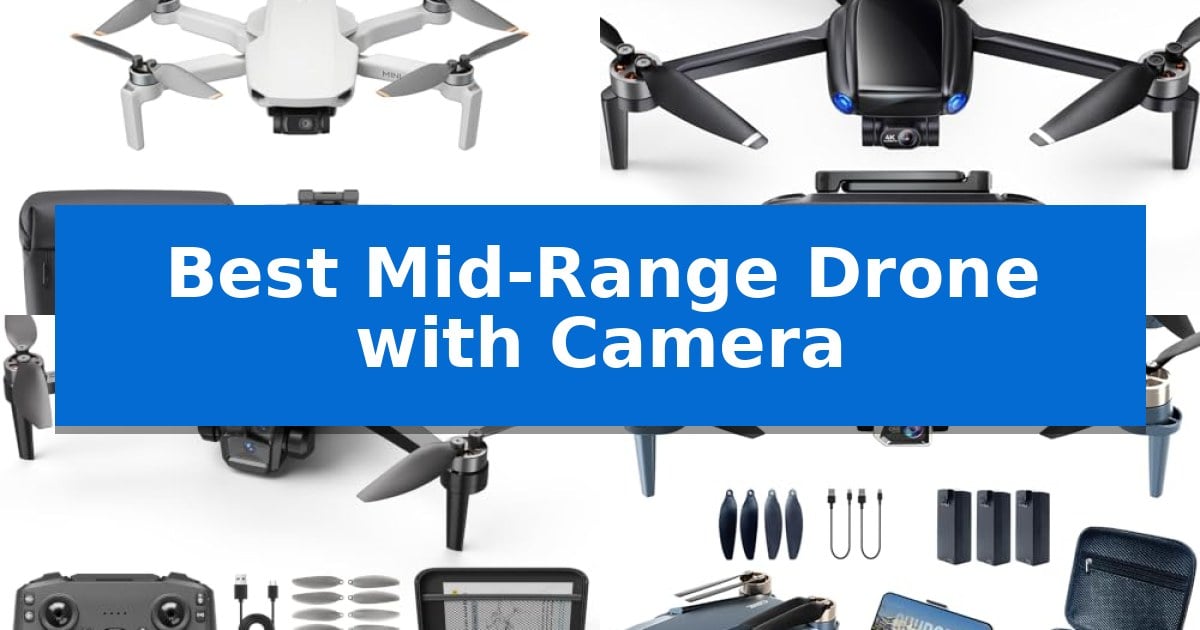
Finding the right aerial companion involves balancing flight stability, image quality, and ease of use. Whether you are a hobbyist looking to capture cinematic landscapes or a traveler needing a compact device for quick shots, selecting the Best Mid-Range Drone with Camera requires careful consideration of technical specifications like gimbal stabilization and flight time.
This guide examines five distinct models to help you identify which features align with your specific needs. From integrated screen controllers to long-range transmission capabilities, we break down the essential attributes that define a reliable flight experience, ensuring you make an informed decision without the guesswork.
You may also want to compare Best Mid-Range Drone, Best Mid-Range Dolby Atmos Soundbars, and Best Mid-Range Dolby Atmos Soundbar.
Best Mid-Range Drone with Camera
Quick Comparison
| Product | Best For | Key Strength | Score |
|---|---|---|---|
| DJI Mini 4K Camera Drone | Best Overall | Under 249g design eliminates the need for FAA registration. | 4.9 |
| Ruko U11MINI 4K Camera Drone | Professional Gimbal for Smooth Video | Integrated 5.5-inch touchscreen controller eliminates the need for phone tethering. | 4.6 |
| Vvoqeote GPS 4K Camera Drone | Integrated Screen Controller Convenience | Integrated 4.5-inch HD screen on the controller removes the need for a smartphone. | 4.8 |
| CHUBORY F89 4K Camera Drone | Extended Long-Range Flight Capability | 84-minute combined flight time with three included batteries. | 4.4 |
| LANSAND EC130 4K Camera Drone | Compact Design for Travel | Under 250g weight eliminates the need for FAA registration. | 4.5 |
How We Chose
- Flight Stability and Gimbal Performance
- Camera Resolution and Sensor Capabilities
- Operational Range and Transmission Reliability
- Battery Life and Total Flight Time
- Portability and Regulatory Compliance
1 DJI Mini 4K Camera Drone — Industry-Leading Flight Stability
The DJI Mini 4K Camera Drone simplifies aerial photography by integrating a 3-axis gimbal with a 4K UHD camera in a frame that weighs under 249 g. This design choice removes the need for FAA registration for recreational use, making it an accessible entry point for those looking to capture cinematic-quality footage without complex regulatory hurdles.
Performance is bolstered by brushless motors that provide Level 5 wind resistance, allowing for stable flight in various conditions at altitudes up to 4,000 meters. The drone utilizes a 10km max HD video transmission system, which offers reliable connectivity and anti-interference capabilities for exploring expansive landscapes.
For those new to piloting, the system includes beginner-friendly features such as one-tap takeoff and landing, precise GPS-based Return to Home (RTH), and stable hovering. Advanced users can leverage Intelligent QuickShots—including Helix, Dronie, and Rocket modes—to automate professional-level camera movements with minimal input.
The included combo package addresses longevity concerns by providing two batteries, enabling a combined 62-minute max flight time. While the DJI Fly app requires a manual download from the official website due to platform compatibility constraints, the overall ecosystem is designed to minimize setup time and maximize time in the air.
Best for: Beginners and hobbyists who need a lightweight, portable drone that avoids complex registration requirements while delivering high-resolution 4K video.
Skip if: Users who require advanced obstacle avoidance sensors or professional-grade raw image formats, as this model focuses on streamlined, beginner-oriented operation.
PROS
- Under 249g design eliminates the need for FAA registration.
- 3-axis gimbal stabilization ensures smooth, cinematic 4K footage.
- Level 5 wind resistance provides stability in varied outdoor environments.
- Intelligent QuickShots automate complex flight paths for professional results.
CONS
- Manual app installation required due to platform compatibility limitations.
- Limited to two batteries in the provided combo set.
2 Ruko U11MINI 4K Camera Drone — Professional Gimbal for Smooth Video
The Ruko U11MINI 4K Camera Drone streamlines the aerial photography experience by integrating a 5.5-inch 1080P touchscreen controller directly into the remote. This standalone design removes the need for smartphone tethering, complex app setups, or cable management, allowing users to focus entirely on flight and composition without mobile device distractions.
Built for visual fidelity, the drone features a 1/2-inch CMOS sensor capable of capturing 8K photos and 4K/30fps video. To ensure these visuals remain steady, a 3-axis mechanical brushless gimbal filters out flight vibrations, providing smooth, professional-grade footage. The R2 digital transmission system supports a stable live feed at distances up to 20,000 feet, offering reliable visual feedback in open environments.
Portability and regulatory compliance are central to its design, with a total weight under 249g that makes the unit FAA-exempt. The package includes two intelligent batteries providing a combined 64 minutes of flight time, with support for PD 3.0 fast charging to reduce downtime. Safety is maintained through a quadruple positioning system—incorporating GPS, barometric sensors, TOF, and optical flow—alongside automated features like one-key takeoff and failsafe returns for low battery or signal loss.
This system is an ideal Best Mid-Range Drone with Camera for those who prioritize a simplified, all-in-one workflow. By removing the dependency on external software ecosystems, the drone offers a direct, out-of-the-box experience suitable for travel, family events, and outdoor exploration.
Best for: Beginners and tech-minimalists who prefer a standalone, all-in-one flight system without the complexity of smartphone integration.
Skip if: Users who require advanced professional cinematic features or specific software-based flight planning tools found in smartphone-dependent drone ecosystems.
PROS
- Integrated 5.5-inch touchscreen controller eliminates the need for phone tethering.
- Under 249g weight ensures FAA-exempt status for easier travel.
- 3-axis mechanical gimbal provides stable, shake-free video capture.
- 64-minute total flight time with two included batteries.
CONS
- No smartphone app integration may limit advanced software-based flight features.
3 Vvoqeote GPS 4K Camera Drone — Integrated Screen Controller Convenience
Capturing aerial footage is simplified by the Vvoqeote GPS 4K Camera Drone, which eliminates the need for a smartphone by integrating a 4.5-inch HD screen directly into the remote controller. This design choice allows pilots to monitor live flight paths and camera angles immediately upon startup, providing a streamlined experience for those who prefer dedicated hardware over mobile app reliance.
The drone is powered by brushless motors that provide efficient, reliable performance during flight. With the inclusion of two rechargeable batteries, users can achieve a total flight time of up to 60 minutes, allowing for extended sessions of practice or photography. Its foldable design and lightweight frame, weighing under 249g, ensure the device remains portable for travel and outdoor excursions.
Equipped with a 4K camera and a remotely adjustable 90° lens, the drone offers flexibility for various shooting requirements, from landscape photography to structural inspections. The FPV real-time image transmission ensures that users can view their footage as it happens, while the included SD card provides a convenient method for storing and transferring high-definition content.
Safety and ease of use are supported by integrated GPS positioning, which enables features such as One-Key Return, Low Battery Return, and Signal Loss Return. Beginners can utilize Altitude Hold, Headless Mode, and One-Key Takeoff/Landing to manage the drone, while advanced users can experiment with smart flight modes like Follow Me, Tap Fly, and Point of Interest.
Best for: Beginners and travelers who want a complete, phone-free aerial photography system with extended flight time.
Skip if: Users requiring professional-grade stabilization, obstacle avoidance sensors, or higher-bitrate video transmission for commercial production.
PROS
- Integrated 4.5-inch HD screen on the controller removes the need for a smartphone.
- Dual-battery setup provides up to 60 minutes of total flight time.
- GPS-enabled safety features including automatic return-to-home functions.
- Foldable, lightweight design under 249g for easy portability.
CONS
- No obstacle avoidance sensors mentioned, requiring manual navigation in tight spaces.
- Fixed-lens camera system lacks the advanced gimbal stabilization found in high-end cinema drones.
4 CHUBORY F89 4K Camera Drone — Extended Long-Range Flight Capability
Capturing aerial footage requires a balance of portability and flight endurance, and the CHUBORY F89 4K Camera Drone addresses this by offering an 84-minute total flight time through its included set of three upgraded batteries. This design choice allows for extended sessions in the air without the constant need to land and recharge, making it a practical tool for those looking to explore drone photography.
The CHUBORY F89 4K Camera Drone features alloy brushless motors that provide increased wind resistance and quieter operation compared to standard brushed alternatives. With a 2,650-foot control range, it offers significant distance for navigation, supported by a 120° wide-angle 4K HD camera that can be switched with a bottom-mounted optical flow camera to monitor terrain while in flight.
Designed for ease of use, the unit includes optical flow positioning and altitude hold to assist with stability during operation. Its foldable, compact frame weighs less than 249g, which simplifies transport and eliminates the need for registration in many jurisdictions. The drone also comes with a portable carrying case to protect the hardware during travel.
Functionality is further expanded by features such as one-key take-off and landing, headless mode, and follow me capabilities. These tools are intended to lower the barrier to entry for beginners while providing enough control for varied flight maneuvers. The inclusion of a one-year warranty and permanent support provides a baseline for long-term ownership.
Best for: Beginners seeking an extended flight time and long-range control in a lightweight, registration-free package.
Skip if: Users who require professional-grade gimbal stabilization or advanced obstacle avoidance sensors for complex cinematography.
PROS
- 84-minute combined flight time with three included batteries.
- 2,650-foot control range for expansive flight paths.
- Lightweight, under-249g design avoids registration requirements.
- Brushless motors offer improved wind resistance and durability.
CONS
- No advanced obstacle avoidance sensors included.
- Fixed camera orientation lacks mechanical gimbal stabilization.
5 LANSAND EC130 4K Camera Drone — Compact Design for Travel
Capturing aerial footage while traveling is simplified by the LANSAND EC130 4K Camera Drone, which features a foldable design and includes a dedicated carry case. Weighing under 249g, this quadcopter is engineered to bypass FAA registration requirements, making it a practical choice for those who frequently hike, camp, or explore new environments.
The drone utilizes a 4K UHD camera with a 120° field of view and a 90° adjustable angle, allowing for clear 3840*2160 resolution imagery. Stability during flight is supported by optical flow positioning and altitude hold technology, which helps the craft maintain a steady hover for more consistent photo and video capture.
Equipped with brushless motors, the LANSAND EC130 4K Camera Drone provides enough power to resist wind while reaching speeds up to 21.6kmh. Pilots can monitor their shots in real-time through 5G FPV transmission technology, which streams video directly to a smartphone within a control range of 490-720 feet.
Operational longevity is managed by two rechargeable batteries that provide a combined 40 minutes of flight time. The system also includes safety features such as out-of-power and signal alerts, along with over-charging and short-circuit protection for the batteries, ensuring a more controlled flying experience for beginners.
Best for: Travelers and beginners seeking a lightweight, portable drone for casual aerial photography and video.
Skip if: Professional videographers requiring high-end stabilization gimbals or those needing a control range exceeding 720 feet.
PROS
- Under 250g weight eliminates the need for FAA registration.
- Foldable design with included carry case enhances portability.
- 40 minutes of total flight time via two included batteries.
- Brushless motors offer improved wind resistance and durability.
CONS
- Limited control range of 490-720 feet restricts long-distance exploration.
- Fixed-gimbal camera relies on software and altitude hold rather than mechanical stabilization.
Best Mid-Range Drone with Camera Buying Guide
Understanding Flight Stability and Gimbal Systems
A 3-axis gimbal is the gold standard for achieving smooth, cinematic footage. By mechanically compensating for the drone's movement in the air, it ensures that your video remains steady even during windy conditions or rapid maneuvers.
When evaluating drones, look for brushless motors which provide the necessary power and durability to maintain flight stability. These motors are generally more efficient and quieter than brushed alternatives, contributing to a more controlled and reliable flying experience.
Camera Quality and Resolution
While many drones advertise high resolution, the actual image quality depends on the sensor and lens configuration. A 4K UHD camera provides the detail needed for crisp, professional-looking aerial shots.
Consider the adjustable lens angle as a critical feature for composition. Being able to tilt the camera remotely allows you to capture diverse perspectives, from sweeping horizon shots to direct downward views for inspections or creative framing.
Transmission Range and Connectivity
The transmission system dictates how far you can fly while maintaining a live video feed. Advanced 5G FPV transmission or dedicated digital systems offer lower latency and better signal penetration, which is essential for navigating open fields or complex landscapes.
Some models feature integrated screen controllers, which eliminate the need to tether a smartphone. This setup is often preferred by those who want a distraction-free experience and a dedicated display that is ready to use immediately upon powering on.
Battery Life and Flight Duration
Flight time is a major constraint in aerial photography. Most mid-range models offer between 30 to 40 minutes per battery, but many packages now include multiple batteries to extend your total session time significantly.
Look for support for fast charging protocols, which can help you get back in the air quicker. Managing battery anxiety is easier when you have a clear understanding of your total flight capacity and the ability to swap power sources efficiently.
Portability and Regulatory Considerations
Weight is a significant factor for both travel convenience and legal compliance. Drones weighing under 249g are often exempt from specific registration requirements in many regions, making them highly accessible for casual users and travelers.
A foldable design is essential for portability. Drones that collapse into a compact form factor can easily fit into a backpack or carry-on, ensuring you can take your equipment on hikes, camping trips, or vacations without it becoming a burden.
Frequently Asked Questions
Do I need to register a drone under 249g?
In many jurisdictions, drones weighing under 249g are exempt from mandatory registration for recreational use. However, you should always check your local aviation authority's official website for the most current regulations.
Why is a 3-axis gimbal better than electronic stabilization?
A 3-axis mechanical gimbal physically stabilizes the camera, which is superior for removing vibrations and tilt during flight. Electronic stabilization often crops the image to smooth out shakes, which can reduce overall resolution.
Can I fly these drones without a smartphone?
Some models, such as those with integrated screen controllers, allow you to fly and view live footage without a smartphone. Others require a mobile app for full functionality, so check the specific controller features.
What is the benefit of brushless motors?
Brushless motors offer higher efficiency, better power-to-weight ratios, and increased durability compared to brushed motors. They are better at handling wind resistance and provide a more stable flight.
How does GPS help with flying?
GPS provides precise positioning, which enables features like stable hovering, automatic return-to-home, and intelligent flight modes. It significantly increases safety by helping the drone maintain its location even if the signal is temporarily lost.
Conclusion: Our Top Pick
For those seeking the most reliable and stable flight experience, the DJI Mini 4K Camera Drone stands out as the premier choice. Its combination of a 3-axis gimbal, 4K UHD camera, and impressive wind resistance makes it a highly capable tool for both beginners and experienced pilots.
While other models offer unique features like integrated screens or extended range, the overall build quality and flight stability of this model provide the most consistent results for high-quality aerial photography. It remains a top recommendation for anyone prioritizing performance and ease of use in a compact, travel-friendly package.