
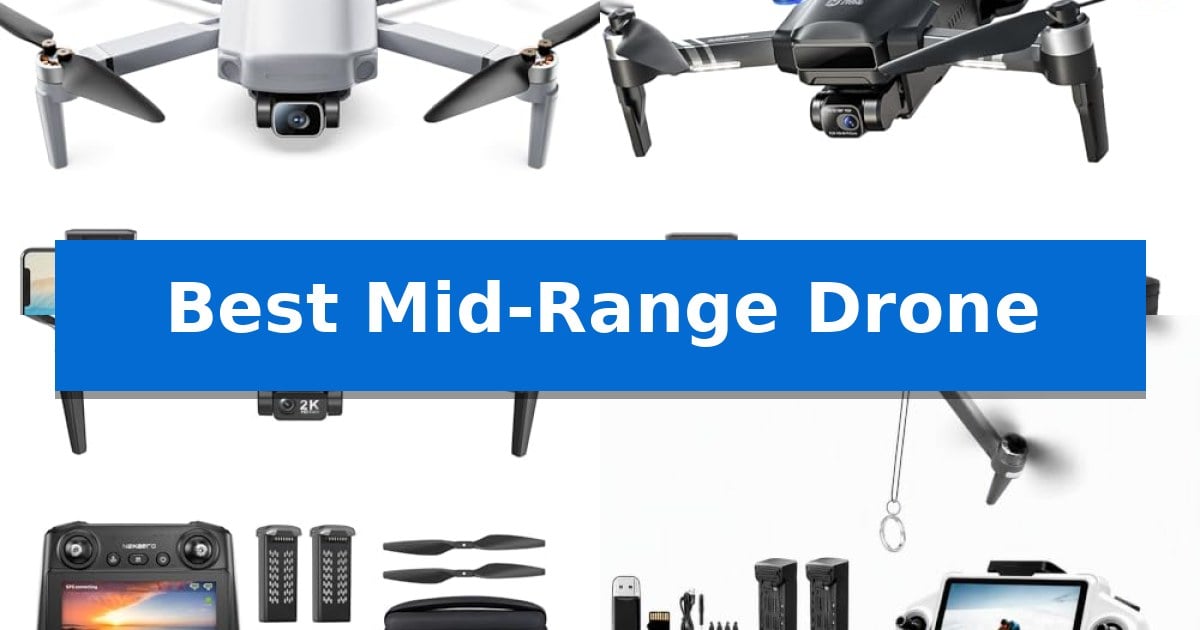
Choosing a reliable aerial platform often feels overwhelming due to the sheer variety of flight modes, sensor types, and transmission technologies available today. Whether you are a hobbyist looking to capture cinematic landscapes or a beginner needing intuitive flight controls, finding the Best Mid-Range Drone requires balancing portability with robust performance features.
Our guide focuses on drones that provide a significant step up from entry-level toys without the steep investment of professional cinema rigs. We have analyzed five distinct models to help you identify which flight capabilities, such as gimbal stabilization or long-range transmission, best align with your specific aerial photography goals.
You may also want to compare Best Mid-Range Dolby Atmos Soundbars, Best Mid-Range Dolby Atmos Soundbar, and Best Mid-Range DJ MIDI Controller.
Best Mid-Range Drone
Quick Comparison
| Product | Best For | Key Strength | Score |
|---|---|---|---|
| Holy Stone HS360D GPS Drone | Best Overall | Wired controller connection significantly reduces video latency. | 4.9 |
| Holy Stone HS600 GPS Drone | Stable 2-Axis Gimbal Stabilization | 2-axis gimbal with EIS stabilization for steady 4K video. | 4.8 |
| Dingdongwu F3 GPS Drone | Integrated Large Screen Remote | Integrated 7.22-inch screen remote removes the need for smartphone pairing. | 4.6 |
| Giffke YL059 GPS Drone | Includes 4-Way Obstacle Avoidance | Under 249g weight avoids FAA/Remote ID registration requirements. | 4.7 |
| PROONOS X38 GPS Drone | Reliable Wind-Resistant Performance | Brushless motors provide enhanced wind resistance for stable flight. | 4.6 |
How We Chose
- Flight Duration: We prioritized models offering extended battery life to maximize time in the air.
- Camera Quality: We assessed the resolution and stabilization technology, such as EIS or mechanical gimbals, to ensure clear imagery.
- Transmission Range: We looked for reliable FPV connectivity to maintain control at longer distances.
- Portability: We considered the weight and foldable design, focusing on FAA-friendly options under 249g.
- Control Interface: We evaluated the remote controller design, including integrated screens and wired connection options.
1 Holy Stone HS360D GPS Drone — Low-Latency Wired Controller Connection
Achieving stable, long-range aerial cinematography without the complexity of heavy-duty professional rigs requires a balance of portability and reliable connectivity. The Holy Stone HS360D GPS Drone addresses this by integrating a wired connection between the remote controller and your mobile device, which significantly reduces video latency compared to standard Wi-Fi-only systems.
Designed for extended flight sessions, this drone provides up to 80 minutes of total operation time using the two included batteries. Its 4K UHD camera utilizes a 1/3'' CMOS sensor and an 85° field of view, allowing for high-resolution 3840×2160 photo capture. The system is built for accessibility, featuring a foldable, FAA-friendly design that weighs under 249g, eliminating the need for registration.
Pilots benefit from a suite of Smart GPS Modes, including Follow Me, Waypoint Flight, and Circle Fly, which simplify complex maneuvers. For those focused on range, the drone supports a 6KM HD image transmission distance. The Holy Stone HS Fly App provides a platform for ongoing performance enhancements and feature updates, ensuring the hardware remains current.
The Holy Stone HS360D GPS Drone occupies a distinct space in the market by prioritizing a low-latency wired link for its 20,000ft transmission range. While it offers robust features for beginners and enthusiasts, users should note that the flight experience is optimized through the specific app ecosystem and the included controller hardware.
Best for: Travelers and beginner pilots who require a lightweight, FAA-compliant drone with low-latency wired video transmission for consistent aerial photography.
Skip if: Professional filmmakers requiring advanced obstacle avoidance sensors or interchangeable lens systems, as this model focuses on entry-level portability and ease of use.
PROS
- Wired controller connection significantly reduces video latency.
- Under 249g weight avoids the need for FAA registration.
- 80-minute total flight time provided by two included batteries.
- Smart GPS modes including Follow Me and Waypoint Flight.
CONS
- Fixed camera lens limits creative versatility for advanced cinematography.
- App-dependent features require ongoing software updates for full functionality.
2 Holy Stone HS600 GPS Drone — Stable 2-Axis Gimbal Stabilization
Achieving stable aerial photography requires more than just a steady hand; it demands a system capable of compensating for environmental variables. The Holy Stone HS600 GPS Drone addresses this through a 2-axis gimbal paired with EIS stabilization, ensuring that the 4K/30FPS footage captured by its Sony sensor-enhanced camera remains smooth even during flight maneuvers.
Designed for versatility, the drone features brushless motors that provide the power necessary to maintain control in Level-6 wind resistance conditions. This robust construction is complemented by a 541g lightweight frame, making it a practical choice for those who need a balance between durability and portability for field use.
Navigation and safety are managed through an integrated GPS system, which enables automated features such as one-key return, lost signal return, and low battery return. These functions provide a reliable safety net, allowing the drone to navigate back to its takeoff point automatically if the connection is interrupted or power levels drop.
For extended operation, the Holy Stone HS600 GPS Drone utilizes a WiFi repeater integrated into the remote controller, which extends the control and video transmission range up to 10,000 feet. The controller also supports a direct smartphone connection via a data cable, facilitating real-time image streaming without relying solely on wireless signals.
The drone offers multiple flight modes, including follow mode and waypoint mode, allowing users to transition from manual piloting to automated pathing. These tools provide the flexibility to focus on composition while the drone handles the flight path, making it a capable tool for capturing aerial perspectives.
Best for: Enthusiasts seeking a stable, GPS-enabled drone with long-range transmission and automated flight modes for photography.
Skip if: Users requiring professional-grade obstacle avoidance sensors or a 3-axis gimbal for more complex cinematic stabilization.
PROS
- 2-axis gimbal with EIS stabilization for steady 4K video.
- 10,000-foot transmission range via integrated WiFi repeater.
- Level-6 wind resistance supported by powerful brushless motors.
- Integrated Remote ID ensures compliance with FAA requirements.
CONS
- 2-axis gimbal may provide less stabilization than 3-axis alternatives.
- 541g weight requires registration in certain jurisdictions.
3 Dingdongwu F3 GPS Drone — Integrated Large Screen Remote
Capturing aerial footage without the complexity of smartphone pairing is the primary advantage of the Dingdongwu F3 GPS Drone, which features a dedicated 7.22-inch screen integrated directly into the remote controller. This design choice enables immediate, plug-and-play flight, ensuring that users can focus on navigation and recording without relying on external mobile devices or dealing with connection delays.
Designed for portability and ease of use, the Dingdongwu F3 GPS Drone weighs under 249g and utilizes a foldable frame, making it a convenient option for travel. The system is powered by 1503 brushless motors that provide Level 5 wind resistance, allowing for stable operation in breezy conditions. For extended sessions, the kit includes two intelligent 7.4V 2000mAh batteries, offering a combined 64 minutes of flight time.
The onboard camera captures 2K HD video (2048×1152) with a 90-degree adjustable lens and a 100-110 degree field of view. Stability and safety are managed through built-in GPS and an anti-lost program, which facilitates features such as precise hovering, one-key return, and automatic return upon low battery or signal loss. Additionally, the drone incorporates AI-driven object tracking and specialized night-shot capabilities to assist with varied lighting conditions.
This all-in-one package includes essential accessories such as a carrying case, spare propellers, and an SD card, providing a comprehensive setup for beginners. While the integrated screen remote simplifies the user experience, the system's reliance on its specific hardware ecosystem means it is best suited for those who prefer an out-of-the-box solution rather than advanced, app-based flight customization.
Best for: Beginners who prioritize a simplified, all-in-one flight experience with an integrated screen remote that eliminates the need for smartphone app connectivity.
Skip if: Users who require professional-grade 4K video resolution or advanced software-based flight planning features typically found in high-end, app-integrated drone systems.
PROS
- Integrated 7.22-inch screen remote removes the need for smartphone pairing.
- Under 249g foldable design ensures portability and avoids FAA Remote ID registration.
- Dual-battery system provides up to 64 minutes of total flight time.
- GPS-assisted flight includes reliable auto-return and precise hovering features.
CONS
- 2K resolution is limited compared to higher-end 4K aerial imaging systems.
- Hardware-dependent control lacks the flexibility of advanced third-party flight software.
4 Giffke YL059 GPS Drone — Includes 4-Way Obstacle Avoidance
Capturing aerial footage is simplified with the Giffke YL059 GPS Drone, which features a 4.3-inch HD screen integrated directly into the controller for real-time 5GHz FPV transmission. This setup allows pilots to monitor flight status and video feeds without needing a separate smartphone, making it a practical choice for those who prefer a dedicated, all-in-one flight interface.
The drone is engineered for stability and ease of use, utilizing brushless motors that maintain flight performance in 4-level wind conditions. Beginners can take advantage of 4-way obstacle avoidance and one-key takeoff/landing functions, which help reduce the risk of collisions during initial practice sessions. The unit also includes three speed adjustments to accommodate different skill levels.
Designed for portability, the Giffke YL059 GPS Drone weighs under 249g, meaning it does not require FAA or Remote ID registration in the United States. Its foldable frame makes it easy to pack for travel, while the included dual batteries provide a combined 60 minutes of flight time, allowing for extended sessions without frequent downtime.
Safety and reliability are supported by high-precision GPS, which enables an auto-return function if the battery runs low or the signal is lost. The 4K camera features a 120-degree wide-angle lens and a 90-degree adjustable pitch, providing the flexibility needed to inspect hard-to-reach areas or capture wide landscape shots.
Best for: Beginners and travelers who want a lightweight, registration-free drone with an integrated screen and long total flight time.
Skip if: Professional videographers requiring advanced gimbal stabilization or high-end sensor performance beyond standard 4K capabilities.
PROS
- Under 249g weight avoids FAA/Remote ID registration requirements.
- Integrated 4.3-inch HD screen removes the need for a separate phone.
- 60-minute total flight time provided by two included batteries.
- 4-way obstacle avoidance assists in preventing flight accidents.
CONS
- Requires manual pre-flight calibration and lens protector removal for optimal operation.
- Limited to 650 ft for high-precision GPS flight accuracy.
5 PROONOS X38 GPS Drone — Reliable Wind-Resistant Performance
Navigating the skies for aerial photography or site inspection requires a balance of stability and ease of use. The PROONOS X38 GPS Drone addresses this by integrating brushless motors that provide significant wind resistance, ensuring the craft remains steady even when conditions are less than ideal. Its combination of GPS and optical flow positioning allows for precise location locking, which is particularly useful for tasks like surveying rooftops or gutters without the need for ladders.
Designed with the novice in mind, this drone simplifies the flight experience through a suite of automated features. Users can rely on one-key takeoff and landing, headless mode, and a dedicated beginner mode to manage the aircraft without feeling overwhelmed. The inclusion of a 3-axis gimbal paired with a 4K UHD camera ensures that the footage captured remains smooth and high-quality, even during complex maneuvers.
The PROONOS X38 GPS Drone offers practical versatility for various adventures, featuring a maximum flight distance of 1640 feet and a stable video transmission range of 985 feet. To keep you in the air longer, the package includes two batteries, extending your operational time. The Return-to-Home functionality provides a critical safety net, automatically triggering if the battery runs low or the signal is lost, bringing the drone back to its takeoff point.
While the drone is built for durability, the manufacturer emphasizes careful handling of the remote control knobs and buttons to maintain longevity. The 110° wide-angle lens is electronically adjustable by 90°, allowing for flexible framing of shots. With its sturdy carrying case, the entire kit is designed to be easily transported, making it a reliable choice for those who need a capable, mid-range aerial tool.
Best for: Beginners and hobbyists who need a stable, GPS-enabled drone for basic aerial photography and property inspection.
Skip if: Professional videographers or those requiring long-range transmission beyond 985 feet will find the technical limitations of this model restrictive.
PROS
- Brushless motors provide enhanced wind resistance for stable flight.
- GPS and optical flow positioning ensure precise location locking.
- Return-to-Home safety feature protects the drone during low battery or signal loss.
- 3-axis gimbal stabilizes the 4K camera for smoother video capture.
CONS
- Limited video transmission range of 985 feet may restrict long-distance monitoring.
- Manual lens adjustment requires gentle handling to avoid mechanical wear.
Best Mid-Range Drone Buying Guide
Flight Stability and Motor Performance
The stability of a drone in the air is largely determined by its motor type and weight. Brushless motors are standard in this category, providing the necessary power to maintain a steady hover even in moderate wind conditions. Look for drones that specify wind resistance levels, as this directly impacts your ability to fly safely in outdoor environments.
Weight also plays a crucial role in both stability and regulation. Drones weighing under 249g are particularly popular because they often bypass the need for specific registration requirements in the United States, making them highly accessible for casual pilots and travelers.
Camera Capabilities and Stabilization
When evaluating camera quality, resolution is only part of the story. While 4K UHD is the industry standard for mid-range models, the method of stabilization is what truly defines the footage quality. Mechanical gimbals provide superior physical stabilization compared to electronic image stabilization (EIS), resulting in smoother video during maneuvers.
Consider the sensor size and field of view when choosing your model. A wider field of view allows for more expansive landscape shots, while a high-quality CMOS sensor ensures better light sensitivity for clearer photos and videos in varying lighting conditions.
Transmission and Control Connectivity
The connection between your remote and the drone determines your flight range and video latency. Many modern drones now offer wired connections between the controller and your smartphone, which significantly reduces video lag compared to traditional Wi-Fi-only setups.
Some advanced controllers feature integrated screens, which eliminate the need to mount your phone entirely. This setup provides a true plug-and-play experience, allowing you to focus on flying without worrying about app compatibility or phone battery drain.
Intelligent Flight Modes
GPS-assisted flight modes are essential for both safety and creative control. Features like Auto Return to Home ensure your drone can safely navigate back to its takeoff point if the battery gets low or the signal is lost. This provides peace of mind for beginners who are still learning to manage their flight path.
Creative modes such as Follow Me, Waypoint Flight, and Circle Fly allow the drone to perform complex maneuvers automatically. These features are invaluable for solo creators who want to capture professional-looking footage without needing a dedicated camera operator.
Portability and Travel Readiness
A mid-range drone should be easy to transport. Most models in this class feature a foldable design, allowing them to fit into compact carrying cases. This makes them ideal for hiking, travel, or simply keeping in your car for spontaneous flight opportunities.
Always check what is included in the kit. Packages that provide multiple batteries are highly recommended, as they effectively double your total flight time and allow for longer sessions without needing to stop and recharge.
Frequently Asked Questions
Do I need an FAA license for these drones?
Many of the drones listed weigh under 249g, which generally exempts them from FAA Remote ID registration in the United States for recreational use. However, always verify current local regulations before your first flight.
What is the benefit of a wired controller connection?
A wired connection between your remote controller and smartphone significantly reduces video latency (lag) compared to standard Wi-Fi transmissions, resulting in a smoother, more responsive FPV experience.
How does a gimbal differ from EIS?
A mechanical gimbal physically moves the camera to compensate for drone movement, providing superior stabilization. EIS (Electronic Image Stabilization) uses software to crop and stabilize the image, which is effective but generally less smooth than a mechanical gimbal.
Can I fly these drones in windy conditions?
Most mid-range drones with brushless motors are designed to handle light to moderate wind. Look for specifications regarding wind resistance levels to understand the limits of your specific model.
Are these drones suitable for beginners?
Yes, these models often include beginner-friendly features like one-key takeoff/landing, GPS positioning for stable hovering, and automated return-to-home functions, making them very accessible for new pilots.
Conclusion: Our Top Pick
After evaluating the current market, the Holy Stone HS360D GPS Drone stands out as the most balanced option for most users. Its combination of a 4K camera, lightweight design, and the low-latency wired controller connection makes it a highly reliable choice for both beginners and enthusiasts who prioritize a smooth, uninterrupted flight experience.
While other models offer unique features like integrated screens or obstacle avoidance, the overall performance and ease of use provided by the Holy Stone HS360D ensure it remains a top-tier contender. It provides the essential tools for high-quality aerial photography without the unnecessary complexity, making it an excellent investment for your next adventure.