
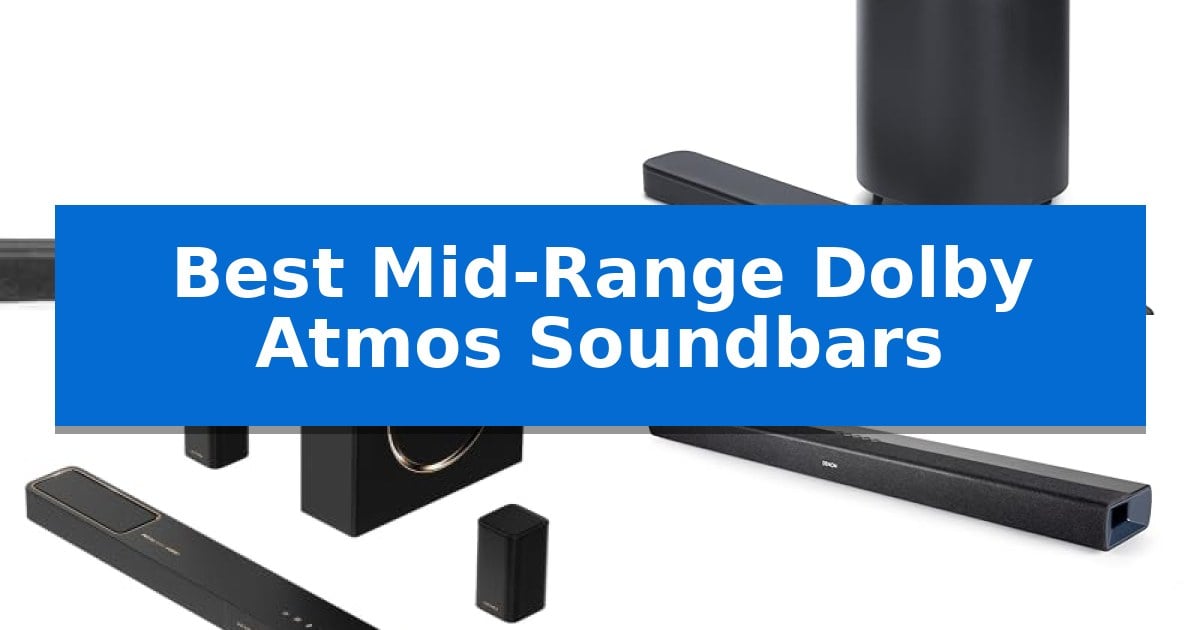
Finding the right audio upgrade for your living room often feels like a balancing act between cinematic immersion and budget constraints. If you are looking to elevate your home theater experience without the complexity of a full multi-speaker receiver setup, the Best Mid-Range Dolby Atmos Soundbars offer a streamlined path to 3D audio.
These systems utilize advanced spatial processing and dedicated height channels to bounce sound around your room, creating a more engaging atmosphere for movies and music. We have analyzed current market options to help you identify which soundbar aligns with your specific room layout and connectivity needs.
You may also want to compare Best Mid-Range Dolby Atmos Soundbar, Best Mid-Range DJ MIDI Controller, and Best Mid-Range DJ Controller.
Best Mid-Range Dolby Atmos Soundbars
Quick Comparison
| Product | Best For | Key Strength | Score |
|---|---|---|---|
| Polk Audio Signa S4 Soundbar | Best Overall | Dedicated up-firing speakers for immersive Dolby Atmos height effects. | 4.9 |
| JBL Bar 500 Soundbar | Powerful Bass Performance | 750W total power with a dedicated 10-inch wireless subwoofer for deep bass impact. | 4.7 |
| ULTIMEA Skywave F40 Soundbar | Complete Surround Experience | HDMI eARC support for high-bandwidth, lossless audio transmission. | 4.3 |
| Denon DHT-S218 Soundbar | Compact All-In-One Design | Integrated down-firing subwoofers save significant floor space. | 4.6 |
| TCL S60K Soundbar | AI-Driven Room Calibration | AI Sonic Auto Room Calibration for optimized sound output. | 4.8 |
How We Chose
- Spatial Audio Implementation: We prioritized systems featuring dedicated up-firing drivers or advanced beamforming technology to simulate height effects.
- Connectivity Standards: Each unit was assessed for HDMI eARC support, ensuring high-bandwidth, uncompressed audio transmission from modern 4K and 8K displays.
- Room Calibration: We looked for built-in software or AI-driven tools that automatically tune the audio output to account for unique room acoustics and furniture placement.
- Dialogue Clarity: We evaluated the presence of dedicated center channels or voice-enhancement processing to ensure speech remains intelligible during complex action sequences.
- Subwoofer Integration: We considered the power and wireless connectivity of the included subwoofers to ensure consistent low-frequency performance.
1 Polk Audio Signa S4 Soundbar — Dedicated Height Channels
Achieving a cinematic soundstage in a living room often requires complex wiring, but the Polk Audio Signa S4 Soundbar simplifies this by integrating dedicated up-firing height speakers directly into its ultra-slim chassis. This design choice allows the system to utilize Dolby Atmos height channels to project sound overhead, creating an immersive 3D audio environment without the need for additional satellite speakers.
Performance is driven by a 7-driver array, which includes dedicated left and right tweeters, racetrack mid-range drivers, and a center channel. The inclusion of a 5.9-inch wireless subwoofer ensures that low-end frequencies are handled separately, providing deep bass that complements the soundbar's clear dialogue reproduction. Polk’s proprietary VoiceAdjust Technology allows users to isolate and boost vocal clarity, ensuring that dialogue remains intelligible even during intense action sequences.
Installation is designed for efficiency, featuring a 1-cable setup that supports HDMI eARC for seamless integration with 8K, 4K, and HD televisions. The soundbar’s low 2.36-inch profile is specifically engineered to sit in front of most displays without obstructing the IR remote sensor or the bottom edge of the screen, making it a versatile fit for various home theater configurations.
While the system excels in providing a streamlined path to Dolby Atmos, users should note that the unit is not waterproof and is intended strictly for indoor home theater use. It serves as a comprehensive solution for those seeking to upgrade from standard TV speakers to a dedicated multi-channel system without the footprint of a traditional receiver-based setup.
Best for: Home theater enthusiasts seeking a compact, easy-to-install Dolby Atmos solution that prioritizes dialogue clarity and vertical sound projection.
Skip if: Users who require a waterproof audio solution or those looking for a modular system with expandable rear satellite speakers for true surround sound.
PROS
- Dedicated up-firing speakers for immersive Dolby Atmos height effects.
- VoiceAdjust Technology for customizable dialogue clarity.
- Ultra-slim 2.36-inch profile that avoids blocking TV IR sensors.
- Simple 1-cable setup via HDMI eARC for quick installation.
CONS
- Not waterproof, limiting placement options to dry indoor environments.
- Fixed configuration lacks the ability to add external rear speakers for expanded surround sound.
2 JBL Bar 500 Soundbar — Powerful Bass Performance
Achieving a theater-like audio experience at home requires more than just volume; it demands precise spatial placement and clear dialogue. The JBL Bar 500 Soundbar addresses this by combining a powerful 750W total system output with a dedicated 10-inch wireless subwoofer, ensuring that low-frequency effects are felt as much as they are heard.
This system utilizes Dolby Atmos and MultiBeam 3.0 technology to create an expansive soundstage that projects audio around the listener. By calibrating to the specific dimensions of your room, the soundbar ensures that 3D surround effects are optimized for your environment, regardless of the room's layout or furniture placement.
Dialogue clarity is managed through PureVoice 2.0, which dynamically adjusts voice levels to ensure lines remain audible even during complex, high-energy scenes. For connectivity, the unit features HDMI eARC with 4K Dolby Vision passthrough, allowing for high-quality, uncompressed audio transmission from your TV or gaming console.
Integration into existing smart home setups is handled via the JBL ONE app, which provides access to equalizer settings and software updates. The system also supports a wide range of streaming services, including AirPlay, Spotify Connect, and Tidal Connect, while offering hands-free control when linked to voice assistant-enabled speakers.
Best for: Users seeking a high-power, immersive 5.1 channel surround sound experience with automated room calibration for home cinema setups.
Skip if: Those with limited floor space for a large 10-inch dedicated subwoofer or users who prefer a compact, all-in-one soundbar without external components.
PROS
- 750W total power with a dedicated 10-inch wireless subwoofer for deep bass impact.
- MultiBeam 3.0 technology creates a wide, immersive soundstage without needing extra rear speakers.
- PureVoice 2.0 technology optimizes dialogue clarity during loud action sequences.
- HDMI eARC support ensures high-quality uncompressed audio and 4K video passthrough.
CONS
- Large 10-inch subwoofer requires significant floor space compared to slimmer soundbar-only systems.
3 ULTIMEA Skywave F40 Soundbar — Complete Surround Experience
Achieving a cinematic soundstage in a living room often requires complex wiring, but the ULTIMEA Skywave F40 Soundbar simplifies this by integrating a dedicated 5.1.2-channel system into a compact form factor. By utilizing up-firing drivers equipped with neodymium cores, this system directs audio vertically to create the height effects essential for a true Dolby Atmos experience.
The hardware is designed for precision, featuring SurroundX technology that coordinates two rear surround speakers with the main bar to establish a 360-degree sound field. This spatial configuration is intended to provide a more immersive environment for movies and media, allowing for clearer high-frequency dynamics and a more defined vertical sound image.
Connectivity is handled through an HDMI eARC interface, which supports up to 37Mbps bandwidth for lossless audio transmission. This standard ensures that the soundbar and television can communicate effectively, allowing for synchronized power and volume control via CEC, which minimizes the need for multiple remotes.
Users can further refine their listening environment through the Ultimea App, which offers a 10-band graphic EQ and 121 preset sound settings. The system also supports 13-step level adjustments, providing granular control over the surround sound balance to suit different room acoustics or personal preferences.
Best for: Home theater enthusiasts looking for a dedicated 5.1.2-channel Dolby Atmos system with granular app-based sound customization.
Skip if: Users who require compatibility with DTS audio formats or those looking for a simple plug-and-play system without app-based configuration.
PROS
- HDMI eARC support for high-bandwidth, lossless audio transmission.
- Dedicated up-firing drivers with neodymium magnets for enhanced height effects.
- Advanced app control featuring a 10-band EQ and 121 presets.
- Complete 5.1.2-channel system including rear surround speakers and a dedicated subwoofer.
CONS
- Not compatible with DTS audio formats.
4 Denon DHT-S218 Soundbar — Compact All-In-One Design
Achieving a cinematic soundstage in a compact living space often requires balancing performance with physical footprint. The Denon DHT-S218 Soundbar addresses this by integrating two powerful down-firing subwoofers directly into its 2-inch profile, eliminating the need for a separate, bulky bass module while still delivering 3D audio via Dolby Atmos.
Engineered with dual midrange drivers and tweeters, this 2.1-channel system focuses on audio clarity and versatility. Users can toggle between four distinct sound modes—pure, movie, music, and night—to tailor the output to their specific content. The inclusion of a dedicated Dialog Enhancer allows for sharper vocal reproduction, ensuring dialogue remains audible even during complex soundscapes without requiring constant volume adjustments.
Connectivity is a primary strength of this model, featuring 4K UHD HDMI with eARC for seamless integration with modern smart TVs. For those who prioritize wireless flexibility, the system supports Bluetooth Low Energy (LE) Audio, enabling high-quality streaming from multiple devices simultaneously. The multi-point and multi-pairing capabilities allow users to switch between smartphones, tablets, and laptops without manual disconnection.
Designed for versatility, the unit includes a wall-mounting template, making it an unobtrusive addition to any home theater setup. By utilizing Pure mode, the system bypasses surround processing, providing a clean audio signal for music listening. This approach balances the convenience of an all-in-one design with the precision expected from Denon’s long-standing audio engineering legacy.
Best for: Users seeking a space-saving, all-in-one home theater audio solution that integrates subwoofers directly into the soundbar chassis.
Skip if: Those who require a dedicated external subwoofer for maximum low-frequency impact or a multi-speaker surround sound system for larger rooms.
PROS
- Integrated down-firing subwoofers save significant floor space.
- Multi-point Bluetooth allows for seamless switching between multiple wireless devices.
- Slim 2-inch profile ensures the unit does not obstruct TV sensors.
- Dedicated Dialog Enhancer improves vocal clarity.
CONS
- All-in-one design may lack the deep bass intensity provided by standalone external subwoofers.
5 TCL S60K Soundbar — AI-Driven Room Calibration
Achieving a cinematic soundstage in a living room often requires complex setups, but the TCL S60K S Series 3.1 Channel Sound Bar simplifies this by integrating Dolby Atmos and DTS:X support into a streamlined, single-cable solution. By utilizing Ray Danz Technology, this system creates an expansive audio environment that aims to place listeners directly within the center of their movies, music, and games.
The system is engineered for clarity and depth, featuring a dedicated built-in center channel with a specific tweeter to ensure dialogue remains crisp even during intense action sequences. To complement these high frequencies, the included wireless subwoofer utilizes a 6.5-inch driver paired with Bass Boost technology, providing the low-end impact necessary for a complete home theater experience.
Usability is a core focus of the TCL S60K Soundbar, which incorporates AI Sonic Auto Room Calibration. This feature automatically adjusts the audio output to suit the specific acoustics of your room, ensuring optimal performance without manual tuning. Additionally, the ChoruSound feature allows the soundbar to work in tandem with existing TV speakers, further widening the soundstage for a more immersive effect.
Connectivity options are designed for modern convenience, supporting Bluetooth wireless streaming for mobile devices and tablets. Whether you are watching content with DTS Virtual:X for virtualized surround sound or streaming music, the system is built to handle diverse media types with ease, all housed within a compact profile measuring approximately 33.46 inches in width.
Best for: Users seeking an all-in-one, space-efficient soundbar solution that includes automated room calibration and dedicated dialogue enhancement.
Skip if: Users who require a true discrete multi-speaker surround sound system with physical rear channels for a traditional home theater configuration.
PROS
- AI Sonic Auto Room Calibration for optimized sound output.
- Dedicated center channel with tweeter for clear dialogue.
- Wireless subwoofer with 6.5-inch driver for enhanced bass.
- Ray Danz Technology for an expansive soundstage.
CONS
- 3.1 channel configuration lacks physical rear speakers for true surround sound.
Best Mid-Range Dolby Atmos Soundbars Buying Guide
Understanding Dolby Atmos Channels
Dolby Atmos is defined by its ability to place sounds in a three-dimensional space, including overhead. In a soundbar, this is typically achieved through up-firing drivers that reflect sound off your ceiling. It is essential to ensure your room has a flat, reflective ceiling surface to maximize these height effects.
When shopping, you will see configurations like 3.1 or 5.1.2. The final digit represents the number of dedicated height channels. A system with a '.2' designation indicates it has two upward-facing speakers, which is the baseline for a true Atmos experience.
The Importance of HDMI eARC
The HDMI eARC (Enhanced Audio Return Channel) standard is critical for mid-range soundbars. Unlike older ARC connections, eARC provides the necessary bandwidth to handle high-resolution, uncompressed audio formats like Dolby TrueHD and DTS:X.
Always verify that both your television and your soundbar support eARC. This single-cable connection allows your TV remote to control the soundbar volume, simplifying your setup and reducing cable clutter behind your entertainment center.
Room Calibration and AI Tuning
Every living space has different acoustic properties, such as carpeted floors or large windows, which can distort sound. AI-driven room calibration tools analyze how sound reflects off your walls and furniture to adjust the output for your specific environment.
If you have an irregular room layout, prioritize models that offer automated calibration. This feature ensures that the soundstage remains balanced and that surround effects are not lost due to poor room geometry.
Dialogue Enhancement Features
One of the most common complaints with home theater audio is that dialogue gets buried under background music or sound effects. Many modern soundbars include dedicated center channels and specific voice-optimization technology to isolate and boost speech frequencies.
Look for systems that allow you to adjust the volume of the center channel independently. This gives you granular control over how clear voices sound, regardless of the overall volume level of the movie or game you are playing.
Wireless Subwoofer Placement
A wireless subwoofer provides the deep, thumping bass necessary for a cinematic feel. Because low frequencies are omnidirectional, you have more flexibility in where you place the subwoofer in your room compared to the main soundbar.
Ensure your chosen location has access to a power outlet, as the wireless connection only applies to the audio signal. Placing the subwoofer in a corner can often reinforce bass output, but experiment with different spots to find the most balanced sound for your seating area.
Frequently Asked Questions
Do I need a 4K TV to use these soundbars?
While these soundbars are designed to work seamlessly with 4K and 8K TVs via HDMI eARC, they are generally backward compatible with older displays. However, you may lose some advanced features like high-bandwidth audio passthrough if your TV lacks the necessary HDMI ports.
Can I add more speakers later?
Most mid-range soundbars are designed as all-in-one or bundled systems. Unless a system specifically supports a modular expansion kit from the same manufacturer, you typically cannot add extra rear speakers or subwoofers later.
What is the difference between Dolby Atmos and standard surround sound?
Standard surround sound is channel-based, meaning audio is assigned to specific speakers. Dolby Atmos is object-based, allowing sound engineers to place audio anywhere in a 3D space, including overhead, for a more realistic and immersive experience.
Will these soundbars work with my voice assistant?
Many modern soundbars include integration with smart home ecosystems. Check the specific product specifications to see if the model supports Google Assistant, Siri, or other voice-controlled platforms for hands-free operation.
How do I know if my ceiling is suitable for up-firing speakers?
Up-firing speakers work best with flat, reflective ceilings that are between 7 and 12 feet high. Vaulted, popcorn, or extremely high ceilings may diffuse the sound too much, making the height effects less noticeable.
Conclusion: Our Top Pick
Selecting the right audio system depends on balancing your room's layout with your desire for immersive sound. For most users, the Polk Audio Signa S4 Soundbar stands out as a versatile choice due to its dedicated height channels and center-channel focus, which effectively handles both complex 3D soundtracks and dialogue-heavy content.
While other models offer unique features like AI calibration or high-wattage output, the Signa S4 provides a reliable, easy-to-install foundation for a home theater. Ensure your TV supports HDMI eARC to take full advantage of the high-fidelity audio capabilities this system offers.