
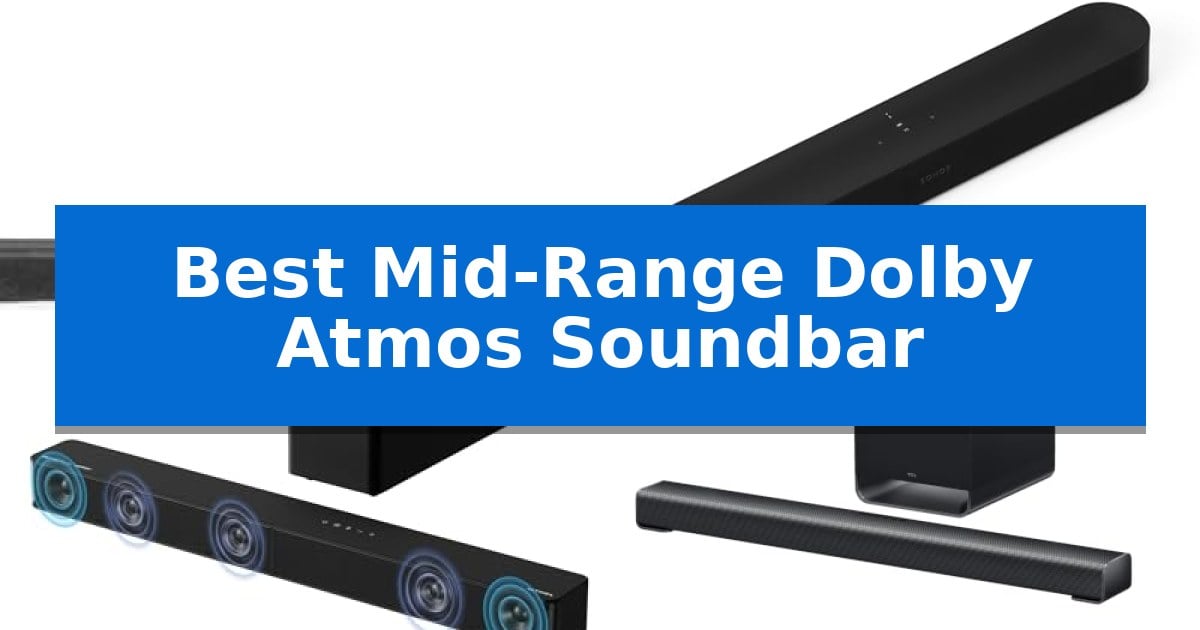
Finding the right audio upgrade for your living room often leads to a complex search for balance between cinematic immersion and living space constraints. A Best Mid-Range Dolby Atmos Soundbar serves as the ideal middle ground, offering sophisticated spatial audio without the logistical burden of a full-scale wired speaker system.
Whether you are looking to enhance dialogue clarity or experience the overhead effects of modern soundtracks, these systems provide a streamlined path to high-quality sound. We have evaluated the latest offerings to help you identify which configuration best aligns with your specific room layout and entertainment preferences.
You may also want to compare Best Mid-Range DJ MIDI Controller, Best Mid-Range DJ Controller, and Best Mid-Range Digital Voice Recorders.
Best Mid-Range Dolby Atmos Soundbar
Quick Comparison
| Product | Best For | Key Strength | Score |
|---|---|---|---|
| Polk Audio Signa S4 Soundbar | Best Overall | Dedicated up-firing height speakers for immersive 3D audio. | 4.9 |
| Sonos Beam Gen 2 Soundbar | Compact Panoramic Surround | Compact 5-driver array design saves space without sacrificing soundstage width. | 4.6 |
| Ultimea Poseidon M60 Soundbar | Affordable 5.1 Channel Immersion | HDMI eARC support for high-bandwidth, lossless audio transmission. | 4.9 |
| TCL S60K Soundbar | Expansive Room-Filling Audio | AI Sonic Auto Room Calibration for optimized sound in various spaces | 4.4 |
| Denon DHT-S218 Soundbar | Slim Profile Cinematic Sound | Slim 2-inch profile fits easily under most TVs without blocking sensors. | 4.6 |
How We Chose
- Spatial Audio Performance: Evaluating the use of up-firing or side-firing drivers to simulate 3D height effects.
- Connectivity Standards: Prioritizing HDMI eARC support for high-bandwidth, lossless audio transmission.
- Dialogue Enhancement: Assessing dedicated center-channel hardware or software processing for vocal clarity.
- Physical Footprint: Measuring dimensions to ensure compatibility with standard TV stands and wall-mounting setups.
- System Expandability: Checking for support for additional wireless subwoofers or rear speaker integration.
1 Polk Audio Signa S4 Soundbar — Immersive 3D Height Effects
Achieving a cinematic soundstage in a living room often requires balancing performance with physical space, and the Polk Audio Signa S4 Soundbar addresses this by integrating dedicated up-firing height speakers into a slim, 2.36-inch tall profile. This design allows the system to utilize Dolby Atmos height channels for immersive 3D audio without requiring a massive footprint that might obstruct a television screen or IR sensor.
The system features a 7-driver array, including a dedicated full-range center channel designed to enhance vocal clarity. To further refine the listening experience, the unit incorporates Polk’s exclusive VoiceAdjust technology, which allows users to isolate and adjust voice levels independently of the background audio. This is paired with a wireless subwoofer that handles low-end frequencies, ensuring deep bass without the need for additional wired connections.
Installation is simplified through a 1-cable setup utilizing HDMI eARC, making the system compatible with 4K, 8K, and HD televisions. The soundbar is designed for versatility, supporting multi-device streaming via Bluetooth, which allows for quick transitions between television audio and mobile content.
While the system provides a comprehensive 3D audio experience, its performance is anchored by the physical dimensions of its drivers, including 0.98-inch tweeters and 4.7-inch by 1.57-inch racetrack mid-drivers. The 3-year limited warranty provides long-term support for the hardware, ensuring the system remains a reliable component of a home theater setup.
Best for: Users seeking a low-profile, easy-to-install Dolby Atmos solution that prioritizes dialogue clarity and height effects in a mid-sized living space.
Skip if: Users who require a dedicated multi-speaker surround sound system with physical rear satellite speakers for true discrete channel separation.
PROS
- Dedicated up-firing height speakers for immersive 3D audio.
- VoiceAdjust technology for customizable dialogue clarity.
- Ultra-slim 2.36-inch design that avoids blocking TV screens.
- Wireless subwoofer for simplified, cable-free bass placement.
CONS
- No physical rear speakers included for true surround sound.
- Limited to a 1-cable HDMI eARC connection for primary high-quality audio input.
2 Sonos Beam Gen 2 Soundbar — Compact Panoramic Surround
Achieving a cinematic soundstage in a living room often requires bulky equipment, but the Sonos Beam Gen 2 Soundbar utilizes a sophisticated 5-driver array to deliver Dolby Atmos 3D surround sound from a remarkably compact frame. Measuring just 25.6 inches wide and 2.7 inches high, this soundbar is engineered to fit discreetly beneath most televisions while providing a panoramic audio experience.
Performance is driven by advanced processing that creates virtualized height and surround channels, resulting in vibrant bass and crystal clear dialogue. The system is designed for versatility, allowing users to stream music, podcasts, and audiobooks directly via WiFi or AirPlay 2 even when the television is powered off.
Integration into existing home setups is straightforward, requiring only two cables for an effortless setup process. The device supports HDMI eARC for high-quality audio transmission and features smart Trueplay tuning, which calibrates the sound output to the unique acoustics of your specific room environment.
For those looking to scale their audio setup, the unit is fully compatible with the broader Sonos ecosystem. It can be easily expanded over time by adding a Sonos Sub Mini for deeper low-end frequencies or dedicated rear speakers to achieve a more immersive, true surround sound configuration.
Control options are diverse and user-friendly, supporting the Sonos app, existing TV remotes, and voice commands via Alexa. This flexibility ensures that the soundbar integrates seamlessly into daily routines without requiring complex manual adjustments.
Best for: Users seeking a compact, expandable Dolby Atmos soundbar that integrates seamlessly into a smart home ecosystem.
Skip if: Users who require a dedicated physical subwoofer included in the box or those with a very large home theater space that demands a wider, multi-speaker array.
PROS
- Compact 5-driver array design saves space without sacrificing soundstage width.
- Dolby Atmos support provides immersive 3D audio virtualization.
- Seamless ecosystem expansion with optional Sonos subwoofers and rear speakers.
- Smart Trueplay tuning optimizes audio performance for specific room acoustics.
CONS
- Requires additional purchases to achieve a full multi-speaker surround sound setup.
- Limited physical connectivity options compared to larger soundbars with multiple HDMI inputs.
3 Ultimea Poseidon M60 Soundbar — Affordable 5.1 Channel Immersion
The Ultimea Poseidon M60 Soundbar utilizes a dedicated wired wooden subwoofer with an 18 mm high-excursion driver to deliver enhanced low-frequency performance, providing a foundation for its 300W peak power output. This system integrates five precision-tuned full-range drivers, including two side-firing units, to simulate a 5.1-channel surround sound environment without the need for additional rear speakers.
Designed for modern home theater setups, the system features HDMI eARC connectivity, which supports up to 37 Mbps of bandwidth to facilitate lossless Dolby Atmos audio. The inclusion of VoiceMX technology employs advanced DSP algorithms to isolate vocal frequencies, ensuring dialogue remains distinct from background music and sound effects during playback.
Users can manage audio settings through the Ultimea app, which provides access to a 10-band graphic EQ, 121 sound presets, and 13 adjustable surround levels. This digital interface allows for granular control over the sound profile, enabling customization based on specific room layouts and personal listening preferences.
Connectivity is further supported by Bluetooth 5.4, which offers improved stability and reduced interference compared to previous iterations. The system is engineered for efficiency, with a setup process that takes less than one minute and includes CEC integration for unified control between the soundbar and the connected television.
Best for: Users seeking a space-saving 5.1 Dolby Atmos solution that integrates advanced app-based EQ customization and dedicated subwoofer performance.
Skip if: Those who require a discrete multi-speaker surround sound system with dedicated rear satellite speakers for true physical channel separation.
PROS
- HDMI eARC support for high-bandwidth, lossless audio transmission.
- App-based customization featuring a 10-band EQ and 121 sound presets.
- VoiceMX technology for real-time dialogue enhancement.
- Bluetooth 5.4 for stable and responsive wireless streaming.
CONS
- Wired subwoofer connection limits placement flexibility compared to wireless models.
- Virtual surround sound relies on side-firing drivers rather than physical rear speakers.
4 TCL S60K Soundbar — Expansive Room-Filling Audio
Achieving an immersive home theater experience often requires balancing complex audio setups with limited living space. The TCL S60K Soundbar addresses this by integrating a 3.1 channel system that utilizes Ray Danz Technology to create an expansive soundstage, effectively filling a room without the need for multiple bulky speakers.
Designed for modern media consumption, this soundbar supports Dolby Atmos and DTS:X to deliver spatial audio that places sound effects from above and behind the listener. To ensure dialogue remains crisp during intense scenes, the unit features a dedicated built-in center channel and a built-in tweeter for precise high-frequency reproduction.
The system includes a wireless subwoofer equipped with a 6.5-inch driver and Bass Boost technology, providing deep low-end tones without the clutter of wired connections. Setup is streamlined through AI Sonic Auto Room Calibration, which adjusts the audio output to match the specific acoustics of your environment, while ChoruSound allows the soundbar to work in harmony with your existing TV speakers.
Connectivity is handled via a single HDMI cable for primary audio, complemented by Bluetooth wireless music streaming for versatile playback from smartphones and tablets. With its compact profile measuring approximately 33.46 inches in width, the TCL S60K Soundbar offers a practical solution for those seeking enhanced audio performance in a mid-range package.
Best for: Users seeking an immersive, space-saving audio upgrade with easy wireless subwoofer integration and automated room tuning.
Skip if: Users requiring a dedicated rear-speaker surround sound system or those with extremely limited shelf space for a 33-inch wide unit.
PROS
- AI Sonic Auto Room Calibration for optimized sound in various spaces
- Wireless subwoofer with 6.5-inch driver for deep bass
- Ray Danz Technology for an expansive soundstage
- Dedicated center channel for clear dialogue
CONS
- Fixed width may not fit smaller TV stands
- 3.1 channel configuration lacks physical rear satellite speakers
5 Denon DHT-S218 Soundbar — Slim Profile Cinematic Sound
Achieving a cinematic soundstage in a living room often requires bulky equipment, but the Denon DHT-S218 Soundbar manages to pack 2.1-channel 3D audio into a remarkably slim 2-inch profile. This unit is designed for those who want to upgrade their television audio without cluttering their entertainment center, utilizing two built-in down-firing subwoofers alongside dedicated midrange drivers and tweeters to create a comprehensive sound profile.
Performance is tailored through four distinct sound modes—pure, movie, music, and night—allowing users to adjust the output based on the content. The inclusion of the Denon Dialog Enhancer provides a specific solution for sharpening speech clarity, ensuring dialogue remains distinct even during complex audio sequences. For music lovers, the Pure mode strips away surround processing to provide a cleaner, unaltered listening experience.
Connectivity is a primary strength of this system, featuring 4K UHD HDMI with eARC for seamless integration with modern smart TVs. Beyond wired connections, the soundbar supports Bluetooth Low Energy (LE) Audio and offers multi-point pairing, which allows users to switch between multiple smartphones, tablets, or laptops without manual re-pairing. This makes it a versatile hub for both television audio and personal media streaming.
Installation is straightforward, as the system includes a mounting template for wall placement, ensuring the unit sits flush without obstructing the television's infrared sensor. With its combination of high-fidelity audio hardware and modern wireless standards, this soundbar serves as a practical, space-efficient centerpiece for a home theater setup.
Best for: Homeowners seeking a space-saving, slim-profile audio solution that integrates advanced Bluetooth multi-point connectivity and dedicated dialogue enhancement.
Skip if: Users who require a dedicated external subwoofer for deep, room-shaking bass or those looking for a multi-speaker surround sound system with rear satellite units.
PROS
- Slim 2-inch profile fits easily under most TVs without blocking sensors.
- Multi-point Bluetooth allows for quick switching between multiple mobile devices.
- Integrated down-firing subwoofers eliminate the need for a separate bulky bass module.
- Dialog Enhancer improves vocal clarity without requiring volume adjustments.
CONS
- Limited to 2.1-channel audio, which may not satisfy users seeking true discrete surround sound.
- Internal subwoofers cannot match the physical displacement or low-frequency impact of a dedicated external subwoofer.
Best Mid-Range Dolby Atmos Soundbar Buying Guide
Understanding Dolby Atmos Channels
Dolby Atmos relies on object-based audio to place sounds in a 3D space rather than just left or right channels. A mid-range soundbar typically uses either physical up-firing drivers or virtual processing to bounce sound off your ceiling, creating the sensation of height.
When shopping, consider your room's ceiling height and material. Flat, reflective ceilings generally provide the best results for height effects. If your room has vaulted or acoustic-tiled ceilings, virtualized surround modes may offer more consistent performance than bouncing sound.
The Importance of HDMI eARC
The HDMI eARC (Enhanced Audio Return Channel) standard is critical for modern home theater setups. It provides the necessary bandwidth to carry high-resolution, uncompressed audio formats like Dolby Atmos from your TV to your soundbar.
Ensure your television also supports eARC to take full advantage of these systems. While optical connections are available on some units, they lack the bandwidth required for true Dolby Atmos, limiting your audio quality to standard surround formats.
Dialogue Clarity and Voice Processing
Many users struggle with muffled dialogue in action-heavy movies. Look for soundbars that feature a dedicated center channel, which isolates vocal frequencies from background music and sound effects.
Some manufacturers include proprietary voice-adjustment technology that allows you to manually boost vocal levels. This is particularly useful for late-night viewing when you want to keep overall volume low without losing the ability to understand speech.
Subwoofer Integration
A wireless subwoofer is a standard component in many mid-range packages, providing the low-frequency impact that slim soundbars cannot produce on their own. The wireless connection allows for flexible placement, as you can tuck the sub in a corner or behind furniture.
Consider the size of your room when evaluating subwoofer power. A larger living space may require a more robust driver to fill the room with deep bass, while smaller apartments might benefit from a more compact, balanced sub that won't overwhelm neighbors.
System Versatility and Streaming
Modern soundbars are more than just TV speakers; they often serve as the primary audio hub for your home. Features like Bluetooth streaming and Wi-Fi connectivity allow you to play music directly from your smartphone or tablet.
Check for multi-point pairing or app-based control if you plan to use the soundbar for music playback. These features simplify switching between devices and allow for fine-tuning the equalizer settings to match your specific listening environment.
Frequently Asked Questions
Do I need rear speakers for Dolby Atmos?
While rear speakers provide the most authentic surround experience, many modern soundbars use advanced side-firing and up-firing drivers to simulate a 3D soundstage from a single front-facing unit.
Will a soundbar block my TV's remote sensor?
Most mid-range soundbars are designed with a low-profile height, typically under 3 inches, to ensure they sit below the bottom edge of most modern television screens without obstructing the IR sensor.
Can I use a soundbar with an older TV?
Yes, but you may be limited by the TV's output ports. If your TV lacks HDMI ARC or eARC, you might need to use an optical connection, which will not support the full bandwidth of Dolby Atmos.
Is a wireless subwoofer truly wireless?
The audio signal is transmitted wirelessly from the soundbar to the subwoofer, but the subwoofer still requires a connection to a standard wall power outlet.
What is the benefit of a dedicated center channel?
A dedicated center channel physically separates dialogue from the left and right speakers, resulting in much clearer speech that remains anchored to the screen even during loud action sequences.
Conclusion: Our Top Pick
Selecting the right audio system depends on your specific room dimensions and your priority for either a compact footprint or maximum cinematic impact. For most users, the Polk Audio Signa S4 Soundbar stands out as a versatile choice due to its dedicated center channel and effective up-firing height speakers.
This system balances ease of setup with the performance required for a true Dolby Atmos experience. If you have limited space but still demand high-quality 3D audio, the Signa S4 provides the necessary hardware to elevate your home theater without requiring a complex multi-speaker installation.