
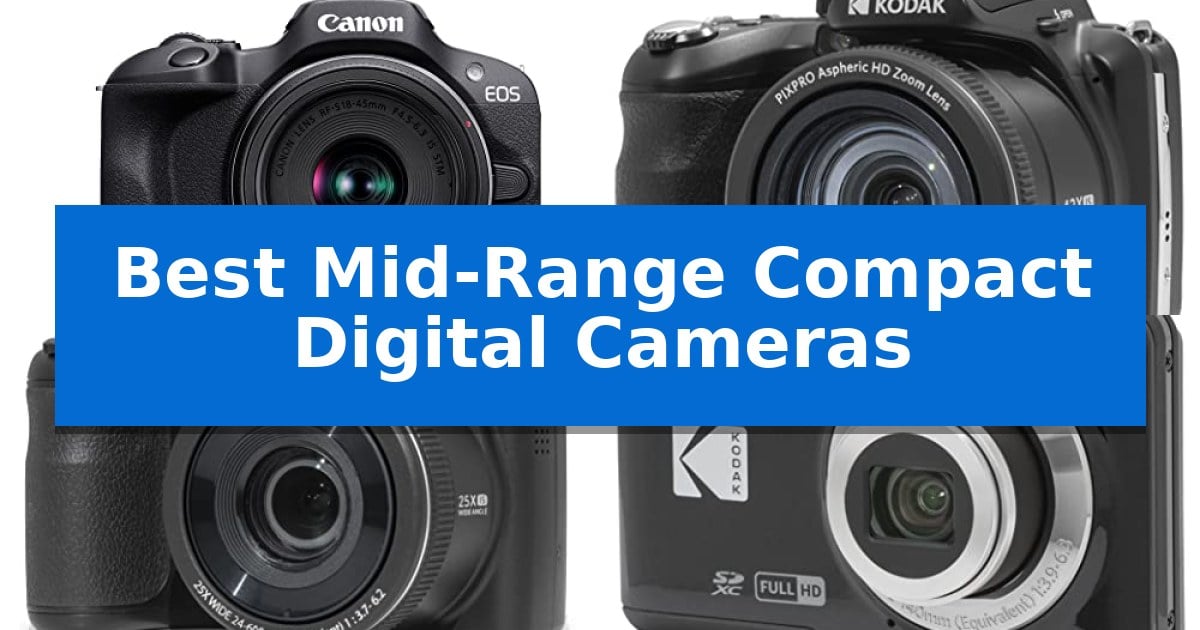
Finding the right camera often feels like a trade-off between bulky professional gear and smartphone convenience. If you are looking for a device that bridges this gap, the Best Mid-Range Compact Digital Cameras offer a versatile middle ground that enhances your photography without weighing you down.
Whether you are capturing wildlife from a distance or documenting daily life on the go, these cameras provide dedicated optical zoom and sensor performance that mobile devices often lack. We have evaluated the latest options to help you identify which features—from interchangeable lenses to extreme zoom ranges—best match your creative needs.
You may also want to compare Best Mid-Range Compact Camera for Low Light Under $250, Best Mid-Range CNC Machine, and Best Mid-Range Closed Back Planar Magnetic Headphones.
Best Mid-Range Compact Digital Cameras
Quick Comparison
| Product | Best For | Key Strength | Score |
|---|---|---|---|
| Canon EOS R100 Mirrorless Camera | Best Overall | Extremely compact and lightweight body for superior mobility. | 4.9 |
| Kodak Pixpro AZ425 Digital Camera | Extreme Zoom for Wildlife | 42x optical zoom provides exceptional reach for distant subjects. | 4.3 |
| Kodak Pixpro AZ255 Digital Camera | Travel-Friendly Optical Reach | 25x optical zoom provides genuine reach for distant subjects. | 4.6 |
| Kodak Pixpro FZ55 Digital Camera | Ultra-Portable Everyday Carry | Ultra-compact design that fits easily into pockets or small bags. | 4.8 |
| Kodak Pixpro FZ45 Digital Camera | Simple Point and Shoot | AA battery power for easy replacement while traveling | 4.3 |
How We Chose
- Optical Zoom Range: Evaluating the reach of built-in lenses for capturing distant subjects.
- Sensor Performance: Assessing megapixel counts and sensor types for image clarity and low-light utility.
- Portability and Build: Considering the physical dimensions and weight for travel and everyday carry.
- Ease of Use: Analyzing the interface, including screen size and menu accessibility for beginners.
- Power Versatility: Comparing proprietary lithium-ion battery systems against standard AA battery compatibility.
1 Canon EOS R100 Mirrorless Camera — Advanced Mirrorless Image Quality
The Canon EOS R100 Mirrorless Camera distinguishes itself as the most compact and lightweight body within the EOS R series, providing a highly portable solution for those transitioning to an interchangeable lens system. By centering its design around a 24.1 megapixel CMOS (APS-C) sensor, this camera delivers clear image quality with the ability to achieve natural bokeh, making it a capable tool for beginners and creators alike.
Performance is driven by the DIGIC 8 image processor, which facilitates responsive shooting and 4K video recording capabilities. The integration of Dual Pixel CMOS AF technology offers extensive coverage across 143 zones, featuring human face and eye detection to maintain focus on subjects. For those interested in diverse shooting styles, the system supports animal and vehicle detection, alongside a continuous shooting rate of up to 6.5 frames per second in One-Shot AF mode.
Video functionality is tailored for entry-level production, offering 4K recording at 24 fps, Full HD at 60 fps, and high-speed HD capture at 120 fps. The inclusion of built-in Wi-Fi and Bluetooth connectivity streamlines the process of transferring media, ensuring that users can manage their content efficiently. This combination of features establishes a functional foundation for photographers looking to explore manual controls and lens versatility without the bulk of larger systems.
While the Canon EOS R100 Mirrorless Camera provides a streamlined entry into mirrorless photography, users should consider its specific focus on portability and beginner-friendly operation. It serves as a dedicated tool for those prioritizing a lightweight form factor for everyday use and creative projects.
Best for: Beginner photographers and creators seeking a lightweight, portable mirrorless camera with interchangeable lens capabilities.
Skip if: Users requiring professional-grade high-speed burst rates or advanced video features beyond 4K at 24 fps may find this entry-level model limiting.
PROS
- Extremely compact and lightweight body for superior mobility.
- Dual Pixel CMOS AF with 143-zone coverage for reliable subject tracking.
- 24.1 megapixel APS-C sensor provides high image clarity and natural bokeh.
- Versatile video options including 4K at 24 fps and 120 fps HD slow-motion.
CONS
- Limited 4K frame rate restricted to 24 fps.
- Entry-level feature set may lack advanced controls found in higher-tier models.
2 Kodak Pixpro AZ425 Digital Camera — Extreme Zoom for Wildlife
Capturing distant subjects requires more than standard lens reach, and the Kodak Pixpro AZ425 Digital Camera addresses this with a powerful 42x optical zoom lens. This bridge camera is designed for those who need to transition from wide-angle group shots to tight close-ups of wildlife or sports without swapping lenses, utilizing a 24mm wide-angle perspective to frame diverse scenes.
At the heart of the device is a 20MP BSI CMOS sensor, which uses a backside-illuminated design to improve light gathering in challenging conditions, such as indoor gatherings or golden-hour landscapes. To ensure these high-resolution images remain sharp when shooting at maximum zoom, the camera features integrated Optical Image Stabilization (OIS), which compensates for hand movement to minimize blur.
Beyond still photography, the camera records 1080p Full HD video, providing a straightforward way to document events. It includes various scene modes for beginners while offering custom settings for those looking to experiment. The unit is powered by a rechargeable Li-Ion battery rated for approximately 240 shots per charge, and it supports SD/SDHC/SDXC cards up to 512GB for extensive storage.
The Kodak Pixpro AZ425 Digital Camera balances its extensive zoom capability with a manageable form factor, measuring roughly 4.44 inches in length. It serves as a versatile tool for users who prioritize reach and ease of use over the complexity of interchangeable lens systems.
Best for: Users who require a long-range zoom lens for wildlife and sports photography in a single, all-in-one bridge camera body.
Skip if: Users who prioritize pocketability or require advanced manual controls and raw image capture found in professional-grade mirrorless systems.
PROS
- 42x optical zoom provides exceptional reach for distant subjects.
- Optical Image Stabilization helps maintain clarity during handheld long-zoom shots.
- 20MP BSI CMOS sensor enhances performance in low-light environments.
- Supports high-capacity SDXC cards up to 512GB for extended shooting sessions.
CONS
- Limited battery life of approximately 240 shots per charge may require spares for long days.
- Fixed-lens bridge design lacks the versatility of interchangeable lens systems.
3 Kodak Pixpro AZ255 Digital Camera — Travel-Friendly Optical Reach
Capturing distant subjects without the bulk of interchangeable lens systems is the primary advantage of the Kodak Pixpro AZ255 Digital Camera. This bridge-style camera integrates a 25x optical zoom lens, allowing users to transition from wide-angle landscape shots to tight, detailed close-ups of wildlife or distant action without relying on digital cropping that degrades image quality.
The internal 16MP CMOS sensor is engineered to produce high-resolution imagery with accurate color reproduction across varying lighting conditions. To ensure handheld shots remain clear, the device features built-in Optical Image Stabilization (OIS), which actively compensates for hand shake—a critical feature when shooting at the maximum telephoto reach where even minor movements can cause blur.
Designed for versatility and travel, the camera operates on standard AA batteries, eliminating the need for proprietary chargers or the risk of being stranded by a depleted battery pack while on the road. It records 1080p Full HD video for capturing events, and files are easily managed via USB transfer or by using standard Class 10 SD, SDHC, or SDXC cards up to 512GB.
With its 3-inch LCD screen and compact form factor, the Kodak Pixpro AZ255 Digital Camera balances portability with the functional reach of a dedicated zoom lens. It serves as a practical solution for those who require significant optical range in a single, all-in-one package that is ready for immediate use.
Best for: Travelers and hobbyists who require significant optical zoom reach in a portable, battery-flexible package.
Skip if: Users who require advanced manual controls, interchangeable lenses, or high-speed burst performance for professional sports photography.
PROS
- 25x optical zoom provides genuine reach for distant subjects.
- Optical Image Stabilization minimizes blur during handheld, long-zoom shooting.
- AA battery compatibility ensures power availability in remote locations.
- Compact bridge design integrates a wide-angle lens and zoom in one unit.
CONS
- AA battery reliance may lead to higher long-term costs compared to rechargeable lithium-ion packs.
- Fixed lens system limits the ability to upgrade or swap optics for specific low-light or professional applications.
4 Kodak Pixpro FZ55 Digital Camera — Ultra-Portable Everyday Carry
Capturing clear images while maintaining a pocket-sized form factor is the primary appeal of the Kodak Pixpro FZ55 Digital Camera. This device is engineered for users who prioritize portability, featuring a slim profile that measures less than an inch in thickness, making it a practical choice for everyday carry or travel.
Equipped with a 16MP CMOS sensor, the camera delivers detailed still imagery suitable for casual photography. The integrated 5x optical zoom lens, which starts at a 28mm wide angle, provides the flexibility to frame subjects ranging from expansive landscapes to tighter indoor shots without needing to physically move closer.
Beyond still photography, the unit functions as a capable tool for capturing 1080p Full HD video. This makes it a straightforward option for recording quick travel clips or family moments. The 2.7-inch LCD screen serves as the primary interface for composing shots and reviewing captured media on the go.
Power management is handled by an included LB-012 lithium-ion battery, which charges directly inside the camera body via a USB connection. The system supports SD, SDHC, or SDXC memory cards with capacities up to 512GB, providing ample storage space for high-resolution files and video content.
Best for: Travelers and casual photographers who need a highly portable, easy-to-use camera for daily snapshots and simple video recording.
Skip if: Users requiring advanced manual controls, interchangeable lenses, or high-speed burst performance for professional photography.
PROS
- Ultra-compact design that fits easily into pockets or small bags.
- 5x optical zoom provides versatile framing options for various distances.
- In-camera USB charging simplifies the power management process.
- Broad memory support for cards up to 512GB.
CONS
- Fixed lens system limits creative control compared to interchangeable lens cameras.
- Limited physical interface may feel restrictive for users accustomed to advanced manual settings.
5 Kodak Pixpro FZ45 Digital Camera — Simple Point and Shoot
Capturing everyday moments requires a balance of portability and utility, and the Kodak Pixpro FZ45 Digital Camera addresses this with a compact design that fits easily into a travel bag. This point-and-shoot model emphasizes simplicity, utilizing standard AA batteries for power, which eliminates the need for proprietary charging cables when you are on the move.
The camera is equipped with a 16MP CMOS sensor designed to provide clear images for casual photography. For framing flexibility, it features a 4x optical zoom paired with a 27mm wide-angle lens, allowing users to capture both expansive landscapes and closer subjects without needing to swap hardware.
Beyond still photography, the device supports 1080p Full HD video recording, making it a straightforward tool for documenting family events or travel clips. The 2.7-inch LCD screen provides a clear interface for navigating settings and reviewing captured content immediately after shooting.
Storage is handled via standard Class 10 SD, SDHC, or SDXC cards, with support for capacities up to 512GB. This ensures that users have ample space for high-resolution images and video files without frequent card swaps, maintaining a consistent workflow during outings.
Best for: Travelers and families seeking a simple, battery-powered camera for casual daily photography and video.
Skip if: Users requiring advanced manual controls, high-speed burst modes, or professional-grade optical performance.
PROS
- AA battery power for easy replacement while traveling
- 4x optical zoom with a versatile 27mm wide-angle lens
- 1080p Full HD video capability for simple documentation
- High-capacity memory support up to 512GB
CONS
- Fixed lens system limits creative control compared to interchangeable lens cameras
- AA battery reliance may lead to higher long-term costs than rechargeable lithium-ion packs
Best Mid-Range Compact Digital Cameras Buying Guide
Understanding Sensor Size and Resolution
The sensor is the heart of your digital camera, responsible for converting light into the images you see. A larger sensor, such as the APS-C found in mirrorless models, generally captures more detail and performs better in challenging lighting conditions compared to smaller sensors.
While higher megapixel counts are often marketed as the primary indicator of quality, they are most effective when paired with a high-quality sensor. For most users, a balance between resolution and sensor size ensures that photos remain sharp even when cropped or printed in larger formats.
The Role of Optical Zoom
Optical zoom is a critical advantage of dedicated cameras, allowing you to get closer to your subject without losing image quality. Unlike digital zoom, which simply crops and enlarges an image, optical zoom physically moves the lens elements to magnify the scene.
Bridge cameras often feature extensive zoom ranges, making them ideal for wildlife or sports photography. If you frequently shoot subjects at a distance, prioritize a camera with a high optical zoom rating and built-in Optical Image Stabilization (OIS) to keep those long-range shots steady.
Portability Versus Performance
The best camera is the one you actually carry with you. Compact point-and-shoot models are designed for maximum portability, fitting easily into a pocket or small bag for everyday use. These are perfect for casual travel and social events where convenience is the priority.
Conversely, mirrorless cameras with interchangeable lenses offer greater flexibility and higher image quality but require carrying extra gear. Consider whether you need the specialized performance of a larger system or if the convenience of a fixed-lens compact camera better suits your lifestyle.
Battery and Power Options
Power management is a frequently overlooked aspect of camera selection. Many modern cameras use proprietary rechargeable lithium-ion batteries, which are lightweight and efficient but require a dedicated charger or USB connection.
Some bridge and compact models offer the convenience of running on standard AA batteries. This can be a significant advantage for travelers or those heading into remote areas where finding a power outlet to charge a proprietary pack might be difficult.
Video Capabilities and Connectivity
Most mid-range cameras now include 1080p Full HD or 4K video recording, making them capable tools for vlogging or capturing family memories. Check for features like frame rate options, which can help you achieve smoother motion in your clips.
Connectivity options like Wi-Fi and Bluetooth allow for easier transfer of files to your computer or mobile device. Ensure the camera supports the memory card types you already use, such as Class 10 SD, SDHC, or SDXC cards, to avoid additional setup costs.
Frequently Asked Questions
What is the main difference between a mirrorless camera and a bridge camera?
A mirrorless camera allows you to change lenses to suit different shooting scenarios, offering greater versatility and often better image quality. A bridge camera features a fixed lens with a very long zoom range, providing an all-in-one solution for those who do not want to carry multiple lenses.
Do I need a 4K camera for everyday photography?
4K capability is primarily a feature for video recording. If your main focus is still photography, a camera with a high-quality sensor and good lens optics will provide better results than a camera chosen solely for its video resolution.
Are AA batteries better than rechargeable lithium-ion packs?
AA batteries offer the convenience of being replaceable anywhere, which is helpful for long trips. Lithium-ion batteries are generally more compact, lighter, and designed specifically to optimize the camera's power consumption, making them standard for most high-performance models.
What does Optical Image Stabilization (OIS) do?
OIS helps compensate for minor hand movements while you are shooting. This is particularly important when using high zoom levels, as even tiny shakes can cause blur in your photos or videos.
Can I use my smartphone's memory card in these cameras?
Most of these cameras use standard SD, SDHC, or SDXC cards. If your smartphone uses a microSD card, you may need an adapter to use it in a camera, but it is generally recommended to use a dedicated, high-speed Class 10 card for reliable performance.
Conclusion: Our Top Pick
Selecting the right camera depends on your specific needs, whether you prioritize the flexibility of an interchangeable lens system or the convenience of a fixed-zoom bridge camera. For those seeking a balance of advanced image quality and a compact form factor, the Canon EOS R100 Mirrorless Camera stands out as a versatile choice for beginners and creators alike.
The Canon EOS R100 Mirrorless Camera provides a high-resolution sensor and the ability to swap lenses, making it a strong foundation for those looking to grow their photography skills. While it offers excellent clarity, ensure you are comfortable with the mirrorless system's requirements compared to the simpler, fixed-lens operation of the Kodak Pixpro series.