
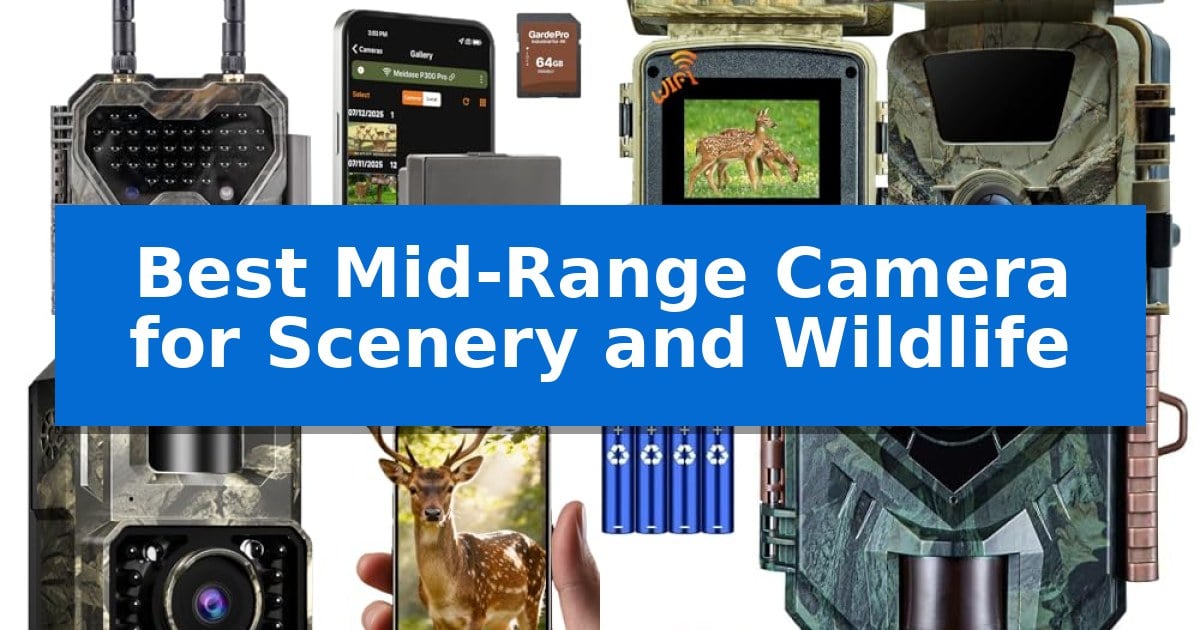
Finding the Best Mid-Range Camera for Scenery and Wildlife requires balancing high-resolution imaging with the rugged durability needed for outdoor environments. Whether you are tracking elusive animals in the woods or capturing expansive landscapes, the right equipment must be reliable, weather-resistant, and capable of capturing fast-moving subjects without hesitation.
Our selection focuses on specialized trail and wildlife cameras that offer advanced motion detection and high-definition recording. By prioritizing features like trigger speed, night vision capabilities, and power efficiency, we help you identify the ideal tool for your specific monitoring needs, ensuring you never miss a moment of natural activity.
You may also want to compare Best Mid-Range Business Laptops, Best Mid-Range Budget Gaming Laptops, and Best Mid-Range Bookshelf Speakers for PC.
Best Mid-Range Camera for Scenery and Wildlife
Quick Comparison
| Product | Best For | Key Strength | Score |
|---|---|---|---|
| Meidase P300 Pro Trail Camera | Best Overall | Long-lasting 7800mAh rechargeable battery for up to one year of operation. | 4.9 |
| LANTOOCAM Solar Trail Camera | Continuous Power for Remote Monitoring | Continuous power via integrated solar panel and 5200mAh battery. | 4.3 |
| MAXDONE Solar WiFi Trail Camera | Eco-Friendly Power with App Control | Solar-powered charging system reduces maintenance and battery waste. | 4.9 |
| KJK Mini Trail Camera | Compact Stealth for Wildlife Observation | 0.1s trigger time for rapid motion capture | 4.4 |
| LynHawk Mini Trail Camera | Ultra-Fast Trigger for Quick Motion | 0.05s trigger speed for capturing fast-moving wildlife. | 4.3 |
How We Chose
- Image and Video Resolution: Assessing the clarity of 64MP, 60MP, and 36MP sensors alongside 4K, 5K, and 2.7K video capabilities.
- Trigger Speed and Motion Detection: Evaluating the responsiveness of sensors to capture fast-moving wildlife instantly.
- Environmental Durability: Checking for IP66 or IP67 waterproof ratings to ensure reliable operation in rain, snow, or extreme temperatures.
- Power Management: Comparing battery capacity, solar-charging options, and overall energy efficiency for long-term remote deployment.
- Wireless Connectivity: Reviewing the ease of local WiFi or Bluetooth app control for settings adjustment and file retrieval without disturbing the site.
1 Meidase P300 Pro Trail Camera — Stable Long-Range Wireless Connectivity
Capturing elusive wildlife and expansive scenery requires equipment that balances high-resolution imaging with rugged, reliable operation. The Meidase P300 Pro Trail Camera distinguishes itself with a built-in 7800mAh rechargeable battery that provides up to one year of standby power, ensuring consistent monitoring without frequent maintenance.
Designed for seamless field management, this camera features Direct Phone WiFi Control, allowing users to pair their smartphone via Bluetooth to adjust settings, view live previews, and download footage through the dedicated app. This eliminates the need to physically remove the SD card or access the device in difficult-to-reach locations, provided the user remains within the dual-antenna wireless range of up to 165 ft.
The hardware is built for high-detail documentation, utilizing a sensor capable of 64MP photos and 1296P video. To ensure fast-moving subjects are captured effectively, the device employs a 0.1s fast trigger speed. Nighttime operations are supported by no-glow 940nm IR LEDs, which provide illumination without emitting visible light that might startle wildlife.
Durability is a core component of the design, featuring an IP66 waterproof housing that protects internal components against harsh outdoor elements. The package includes a 64GB industrial-grade SD card, making the system ready for deployment immediately out of the box. For extended monitoring, the unit is also compatible with optional Meidase solar panels to supplement the internal battery.
Best for: Property owners and wildlife enthusiasts who need a durable, non-cellular camera with convenient smartphone-based remote management.
Skip if: Users requiring remote access from outside the immediate 165-foot range or those needing cellular connectivity for real-time notifications on a home network.
PROS
- Long-lasting 7800mAh rechargeable battery for up to one year of operation.
- Direct WiFi and Bluetooth app control for easy settings adjustment and file management.
- Fast 0.1s trigger speed ideal for capturing quick wildlife movement.
- Rugged IP66-rated housing designed for reliable outdoor weather resistance.
CONS
- Limited wireless range restricted to 165 feet in open areas.
- No cellular or home network compatibility, requiring close proximity for wireless data transfer.
2 LANTOOCAM Solar Trail Camera — Continuous Power for Remote Monitoring
Monitoring remote wilderness areas or tracking wildlife requires a device that balances high-resolution capture with reliable, long-term power. The LANTOOCAM Solar Trail Camera addresses this with an integrated 5200mAh rechargeable battery paired with a top-mounted solar panel, ensuring continuous operation for extended field deployments.
This camera is engineered for high-fidelity documentation, featuring a starlight lens capable of recording 5K UHD video and capturing 60MP still images. To ensure clear results in low-light environments, it utilizes 940nm invisible infrared technology, providing a 65ft night vision range that remains discreet to wildlife.
Designed for durability in harsh environments, the unit features an IP66-rated weatherproof casing that functions in temperatures ranging from -10°C to 45°C. For security, the system includes password protection, allowing users to lock settings against unauthorized access when the camera is left in remote locations.
Setup is streamlined through a wire-free design that includes a 64GB microSD card and mounting accessories. While it offers wireless connectivity via Bluetooth and Wi-Fi for local management within a 65ft range, it is important to note that this is a direct-to-device connection and does not support cellular data or home network integration.
Best for: Remote wildlife monitoring and scenery tracking where consistent, solar-powered operation is required without frequent manual battery changes.
Skip if: Users who require remote access via cellular data or integration with an existing home Wi-Fi network for real-time cloud notifications.
PROS
- Continuous power via integrated solar panel and 5200mAh battery.
- High-resolution 5K video and 60MP photo capture capabilities.
- Password protection to secure device settings in public or remote areas.
- Durable IP66-rated weatherproofing for extreme temperature operation.
CONS
- No cellular or home Wi-Fi connectivity; limited to local 65ft wireless range.
- Requires manual formatting of the included microSD card for initial setup.
3 MAXDONE Solar WiFi Trail Camera — Eco-Friendly Power with App Control
Capturing wildlife activity without the need for frequent site visits is made possible by the MAXDONE Solar WiFi Trail Camera, which integrates a detachable, adjustable solar panel to maintain its built-in rechargeable battery. This design choice ensures the device remains powered in the field, reducing the need for manual battery swaps and providing a sustainable solution for long-term monitoring.
The camera is equipped with 850nm infrared LEDs that provide low-glow night vision up to 65 ft, allowing for discreet observation of nocturnal wildlife. To ensure image clarity, the system utilizes adaptive lighting to balance brightness levels automatically, which helps prevent overexposure or dark spots in varying lighting conditions.
For high-resolution documentation, the MAXDONE Solar WiFi Trail Camera captures 64MP photos and 4K videos through a 100° wide-angle lens. Data management is streamlined via H.264 compression, which optimizes storage space and facilitates faster file transfers. Users can manage settings and preview content directly on a mobile device using the TrailCam GO App over a WiFi/Bluetooth connection, provided they are within a 55 ft range.
Designed for durability and ease of use, the unit features an IP66 waterproof rating to withstand outdoor environments. The package includes essential mounting hardware and a pre-included SD card, allowing for immediate deployment. The camera also supports time-lapse mode and scheduled shooting, offering flexibility for specific research or tracking requirements.
Best for: Wildlife researchers and outdoor enthusiasts who require a self-sustaining, solar-powered camera with convenient wireless app-based file management.
Skip if: Users who require long-range remote access via home WiFi networks, as this device creates its own local connection and does not support external home network integration.
PROS
- Solar-powered charging system reduces maintenance and battery waste.
- WiFi and Bluetooth connectivity allows for app-based file management without removing the SD card.
- High-resolution 64MP image and 4K video capture capabilities.
- IP66 waterproof rating ensures reliable operation in outdoor conditions.
CONS
- Limited 55 ft wireless range requires close proximity for app connectivity.
- Local WiFi only means the camera cannot connect to existing home networks.
4 KJK Mini Trail Camera — Compact Stealth for Wildlife Observation
Capturing wildlife behavior without human interference requires equipment that balances stealth with rapid response. The KJK Mini Trail Camera excels in this environment by utilizing a 0.1s trigger time, ensuring that fast-moving subjects are recorded almost instantly upon detection within its 130° wide-angle field of view.
Designed for versatility in the field, this camera produces 36MP still images and 2.7K video resolution. Its 850nm low glow infrared LEDs provide illumination up to 75ft in total darkness, allowing for clear night observation without startling animals. The integrated 2.0-inch HD TFT screen and physical control buttons simplify navigation, removing the need for external apps or wireless connectivity during setup.
Durability is a core component of its design, featuring an IP66 waterproof rating that allows the unit to operate in temperatures ranging from -22°F to 158°F. Its compact dimensions make it easy to conceal, while the efficient PIR sensor design contributes to an impressive 17,000-image battery life, minimizing the frequency of maintenance visits to remote locations.
While the camera offers high-resolution capture and robust weather resistance, users should note that it does not include an SD card, which must be purchased separately to begin recording. The reliance on physical controls and manual setup makes it a straightforward, reliable tool for those who prefer a dedicated, standalone device for monitoring scenery and wildlife.
Best for: Wildlife enthusiasts and property owners needing a compact, weather-resistant, and fast-triggering camera for remote monitoring.
Skip if: Users who require remote access, live streaming, or instant notifications via Wi-Fi or cellular connectivity.
PROS
- 0.1s trigger time for rapid motion capture
- IP66 waterproof rating for extreme environments
- 17,000-image battery life for long-term deployment
- 130° wide-angle lens for expansive coverage
CONS
- No SD card included in the package
- No Wi-Fi or app connectivity for remote viewing
5 LynHawk Mini Trail Camera — Ultra-Fast Trigger for Quick Motion
Capturing elusive wildlife or monitoring remote scenery requires a device that balances portability with rapid reaction times. The LynHawk Mini Trail Camera distinguishes itself with a 0.05-second trigger speed, ensuring that fast-moving subjects are recorded instantly as they enter the detection zone. This responsiveness, combined with its compact 5.57" x 2.67" x 2.33" frame, allows for discreet placement in dense forests or gardens without drawing unwanted attention from animals.
Engineered for the rigors of outdoor environments, the camera features an IP67 waterproof rating, providing the necessary protection against rain and dust for year-round monitoring. Its infrared night vision capability enables the capture of clear imagery up to 70 feet away in total darkness, making it a reliable tool for nocturnal wildlife observation. The unit is designed for simplicity, relying on 4 AA batteries to maintain operation without the complexity of cellular or Wi-Fi connectivity.
The camera produces 36MP photos and 2K HD videos, delivering high-resolution detail that helps identify wildlife clearly. Because it lacks power-hungry wireless radios, the device prioritizes energy efficiency, which is beneficial for long-term deployments where frequent battery changes are impractical. The inclusion of a complete starter kit—featuring a micro SD card, card reader, and mounting straps—simplifies the initial setup process for users looking to start monitoring immediately.
While the compact design aids in concealment, the reliance on a physical micro SD card for data retrieval means users must visit the site to view their footage. This model is best suited for those who prefer a straightforward, manual approach to wildlife photography rather than those requiring real-time remote alerts. By focusing on essential hardware performance and rugged durability, it offers a functional solution for consistent outdoor observation.
Best for: Wildlife enthusiasts and property owners who need a compact, weather-resistant camera for reliable, offline motion-activated recording.
Skip if: Users who require real-time notifications or remote access to footage via Wi-Fi or cellular connectivity will find this offline-only model insufficient for their needs.
PROS
- 0.05s trigger speed for capturing fast-moving wildlife.
- IP67 waterproof housing ensures durability in harsh outdoor conditions.
- Compact, concealable design that is easy to mount in remote locations.
- Complete starter kit included for immediate out-of-the-box use.
CONS
- No wireless connectivity, requiring manual SD card retrieval for data access.
- Limited to offline operation, which may not suit users needing remote monitoring.
Best Mid-Range Camera for Scenery and Wildlife Buying Guide
Understanding Trigger Speed and Detection Range
The trigger speed is the time it takes for the camera to start recording once motion is detected. For wildlife, a speed of 0.1 seconds or faster is critical to ensure the subject is centered in the frame rather than just catching the tail end of an animal.
Equally important is the detection range. A wider field of view, such as 130 degrees, combined with a long-range infrared sensor, allows the camera to monitor larger areas, reducing the number of units needed to cover a property or trail.
Night Vision and Stealth
Most modern wildlife cameras utilize 940nm invisible infrared LEDs. This technology is essential because it provides clear night vision without emitting a visible glow that might startle or deter animals.
When selecting a camera, look for adaptive lighting technology which balances brightness automatically. This prevents the common issue of overexposure, where the center of the image is washed out while the background remains pitch black.
Power Solutions for Remote Monitoring
For cameras placed in remote locations, solar-powered units are highly advantageous. Models with built-in rechargeable batteries and detachable solar panels significantly extend the time between manual maintenance visits.
Consider the capacity of the internal battery, often measured in mAh. A higher capacity, such as 7800mAh, provides a buffer for cloudy stretches, ensuring the camera remains operational even when sunlight is limited.
Connectivity and Data Management
WiFi and Bluetooth connectivity allows for direct phone control, enabling you to adjust settings, view live previews, and download footage without physically removing the SD card or disturbing the camera's position.
Always check the local storage compatibility. Most cameras include or support high-capacity industrial-grade SD cards, which are designed to withstand the frequent read/write cycles of high-resolution video recording.
Weatherproofing and Durability
Wildlife cameras are exposed to harsh elements, so an IP66 or IP67 waterproof rating is non-negotiable. These ratings ensure the internal electronics are protected against heavy rain, dust, and humidity.
The physical build should also include secure mounting options, such as anti-slip straps or brackets, to keep the camera stable on trees or posts during high winds or temperature fluctuations.
Frequently Asked Questions
Do these cameras require a cellular subscription?
No, the models listed here use local WiFi or Bluetooth for direct smartphone connection and do not require cellular data plans or monthly subscriptions.
Can I use these cameras for home security?
Yes, their motion-activated recording and night vision capabilities make them effective for monitoring backyards, farms, and property perimeters.
How long do the batteries typically last?
Battery life varies based on usage, but solar-powered models can last for months or even up to a year with moderate activity, thanks to rechargeable internal batteries.
Are the night vision lights visible to animals?
These cameras use 940nm invisible infrared LEDs, which do not produce a visible glow, keeping the camera discreet and non-disturbing to wildlife.
What happens when the SD card is full?
Most of these cameras feature an auto-overwrite function, which replaces the oldest files with new footage once the storage capacity is reached.
Conclusion: Our Top Pick
Choosing the right camera depends on your specific environment and how often you can access the device. For those seeking a balance of long-range connectivity and robust power, the Meidase P300 Pro Trail Camera stands out as the most versatile option. Its dual-antenna system provides a stable wireless range of up to 165 feet, allowing for convenient app-based management without the need for cellular networks.
The Meidase P300 Pro Trail Camera is our top pick because it combines a high-capacity 7800mAh battery with a rugged IP66 design, making it highly reliable for long-term outdoor deployment. While other models offer specific advantages like solar panels or ultra-compact sizes, the P300 Pro provides the most consistent performance for both scenery and wildlife monitoring.