
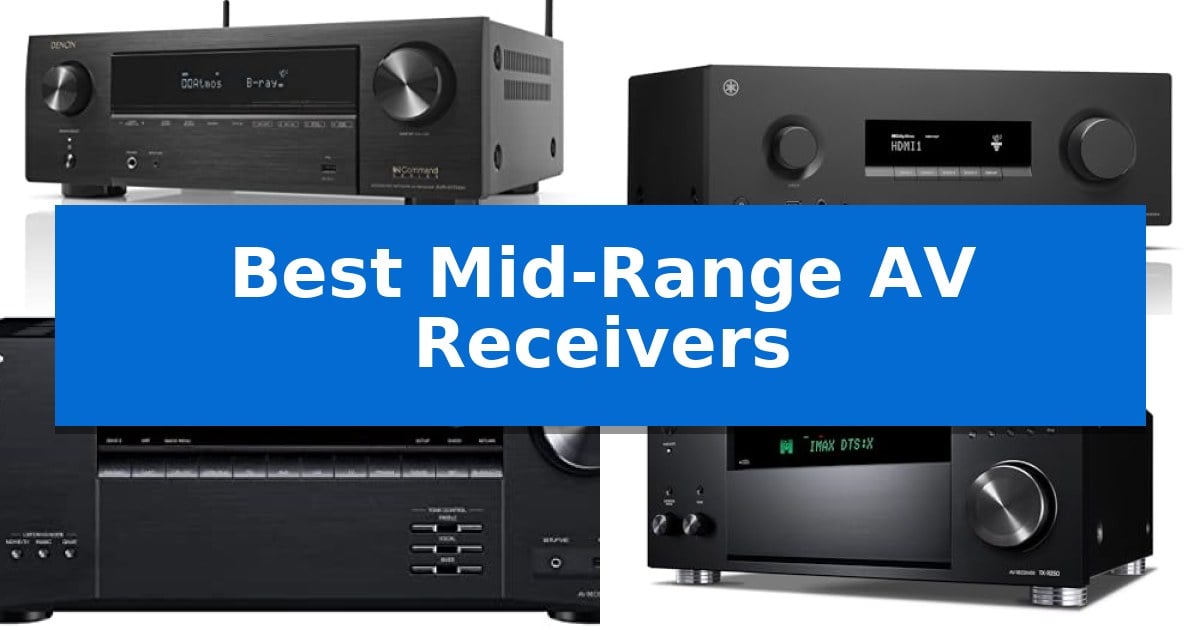
Finding the right centerpiece for your home entertainment system requires balancing power, connectivity, and modern audio-visual standards. The Best Mid-Range AV Receivers provide the necessary bridge between your high-resolution displays and immersive speaker setups, ensuring that every movie, game, or music track is delivered with clarity and depth.
Whether you are upgrading to support 8K video pass-through or seeking advanced room calibration to optimize your acoustics, these receivers offer the essential features to transform your living space. We have evaluated the latest models to help you identify which unit aligns with your specific speaker configuration and source device requirements.
You may also want to compare Best Mid-Range AV Receiver, Best Mid-Range Audiophile Speakers, and Best Mid-Range Audiophile Headphones.
Best Mid-Range AV Receivers
Quick Comparison
| Product | Best For | Key Strength | Score |
|---|---|---|---|
| Denon AVR-X1700H AV Receiver | Best Overall | Advanced 8K/60Hz and 4K/120Hz HDMI pass-through for high-performance gaming and media. | 4.9 |
| Yamaha RX300A AV Receiver | Versatile Bluetooth Multipoint Connectivity | Bluetooth Multipoint for seamless switching between two audio sources. | 4.5 |
| Onkyo TX-NR6100 AV Receiver | THX Certified Cinematic Sound | THX Certified Select for guaranteed cinematic sound performance. | 4.3 |
| Onkyo TX-RZ50 AV Receiver | Advanced Dirac Live Room Correction | Dirac Live Room Correction for precise acoustic tuning | 4.3 |
| Pioneer VSX935 AV Receiver | Immersive Height Virtualization | Dolby Atmos Height Virtualizer for immersive sound without ceiling speakers | 4.7 |
How We Chose
- Video Processing: Evaluation of HDMI 2.1 support, including 8K/60Hz and 4K/120Hz pass-through for gaming and high-resolution displays.
- Audio Standards: Assessment of multi-dimensional audio support such as Dolby Atmos and DTS:X, alongside height virtualization technologies.
- Room Calibration: Analysis of built-in acoustic optimization tools like Dirac Live or proprietary microphone-based setup systems.
- Connectivity and Integration: Review of HDMI input counts, eARC functionality, and wireless streaming options like HEOS or Bluetooth Multipoint.
- Power and Channel Configuration: Verification of amplifier channel counts and wattage output to ensure compatibility with diverse speaker layouts.
1 Denon AVR-X1700H AV Receiver — Reliable 7.2 Channel Performance
The Denon AVR-X1700H AV Receiver simplifies home theater management through its award-winning on-screen quick setup guide, which provides clear, color-coded instructions for organizing connections and optimizing surround sound. This 7.2 channel unit is designed for users seeking a balance of modern video standards and multi-dimensional audio support in a single, manageable chassis.
Equipped with advanced 8K HDMI video capabilities, the receiver features three dedicated 8K inputs and one output, supporting 8K/60Hz and 4K/120Hz pass-through. It is compatible with high-end video formats including HDR10, HDR10+, Dolby Vision, and HLG, ensuring high-contrast and clear visuals for gaming and cinematic content. The inclusion of 8K upscaling on all six inputs allows for improved clarity across various source devices.
Audio performance is anchored by Dolby Atmos, DTS:X, and DTS Virtual:X support, which provides immersive 3D audio. For setups lacking dedicated height speakers, the Dolby Atmos Height Virtualization Technology creates a simulated height effect. The device also functions as a central hub for multi-room, multi-source streaming via Wi-Fi, AirPlay 2, or Bluetooth, allowing different audio content to play in separate zones simultaneously.
Integration into a smart home environment is facilitated by full voice control compatibility with Alexa and Siri. The receiver also offers IP control and remote monitoring capabilities, making it suitable for integration with home automation systems. With a phono input for turntables and two subwoofer pre-outs, it provides the necessary versatility to connect both legacy audio equipment and modern home theater components.
Best for: Home theater enthusiasts who need a versatile, 8K-ready 7.2 channel hub with multi-room streaming and voice control integration.
Skip if: Users requiring more than seven channels of amplification or those who do not need 8K video pass-through capabilities.
PROS
- Advanced 8K/60Hz and 4K/120Hz HDMI pass-through for high-performance gaming and media.
- Award-winning on-screen setup guide simplifies initial configuration and cable management.
- Multi-room and multi-source streaming via HEOS, AirPlay 2, and Bluetooth.
- Versatile connectivity including a dedicated phono input and dual subwoofer pre-outs.
CONS
- Limited to 7.2 channels, which may not satisfy users looking for more expansive surround sound configurations.
2 Yamaha RX300A AV Receiver — Versatile Bluetooth Multipoint Connectivity
The Yamaha RX300A AV Receiver simplifies home theater integration by offering Bluetooth Multipoint connectivity, allowing users to pair two source devices simultaneously and switch between them instantly. This 5.2-channel receiver serves as a central hub for modern entertainment, providing 70W of authoritative power to support flexible speaker configurations, including 3.1.2-channel setups with up-firing or in-ceiling height speakers.
Designed for high-fidelity visuals, the unit supports 4K/120 and 8K/60 video pass-through, ensuring compatibility with next-generation gaming consoles and ultra-high-definition displays. It incorporates advanced gaming features such as ALLM (Auto Low Latency Mode) and VRR (Variable Refresh Rate), alongside Dolby Vision and HDR10+ for enhanced dynamic range. Audio immersion is handled by Dolby Atmos and DTS Virtual:X, which create dimensional soundscapes for movies and music.
Setup is streamlined through an included microphone for room correction, which automatically measures acoustics and speaker characteristics to optimize performance for any space. The interface is guided by an intuitive Quick Guide and an on-screen settings menu, making it accessible for users to configure inputs and sound modes. For added convenience, the Scene buttons allow for the creation of up to four custom presets to instantly recall preferred settings.
Connectivity is robust, featuring HDMI eARC/ARC for single-cable audio transmission from a TV. The receiver is built to handle multiple HDMI devices, providing a high-performance switching environment that keeps complex setups organized. With its 2-year limited warranty, this receiver balances modern technical standards with user-friendly operation for a variety of home audio environments.
Best for: Home theater enthusiasts seeking a versatile, easy-to-setup receiver with modern 8K video support and multi-device Bluetooth connectivity.
Skip if: Users requiring more than 5.2 channels for complex surround sound configurations or those needing advanced multi-room streaming features beyond Bluetooth.
PROS
- Bluetooth Multipoint for seamless switching between two audio sources.
- Supports 4K/120 and 8K/60 video for high-end gaming and display compatibility.
- Includes a setup microphone for automated acoustic room correction.
- Flexible 3.1.2-channel speaker layout options for immersive audio.
CONS
- Limited to a 5.2-channel configuration, which may not suit larger home theater rooms.
3 Onkyo TX-NR6100 AV Receiver — THX Certified Cinematic Sound
The Onkyo TX-NR6100 AV Receiver serves as a high-performance hub for home theater systems, distinguished by its THX Certified Select designation. This certification ensures that the receiver meets rigorous standards for cinema-level sound quality, specifically calibrated for medium-sized rooms where the listening position is approximately 10 to 12 feet from the screen. By maintaining consistent audio fidelity, it provides a reliable foundation for users seeking an immersive, theater-like experience at home.
Engineered for modern media consumption, this 7.2-channel unit supports 5.2.2-channel Dolby Atmos and DTS:X playback. This object-based audio support allows for precise sound placement, creating a three-dimensional soundstage that enhances cinematic immersion. The system is powered by an Onkyo-engineered Dynamic Audio Amplification system, rated at 210 W/Ch, which is designed to maintain signal clarity and dynamic range during intense action sequences or complex musical passages.
Connectivity is a primary focus, highlighted by three HDMI 2.1 inputs capable of handling 8K resolution at high bandwidths of up to 40Gbps. This technical capability is essential for gamers and media enthusiasts using high-performance consoles or modern display hardware, as it ensures rapid data throughput for high-fidelity visuals without bottlenecks. These ports allow the receiver to act as a central switching point for advanced video sources.
For multi-room utility, the receiver includes Discrete Zone 2 Audio and Video support. This feature enables users to route independent audio and video signals to a secondary room, offering flexibility for home entertainment without the need for additional amplification hardware. While the unit provides significant power and connectivity, its robust construction results in a weight of approximately 23 pounds, requiring a sturdy equipment shelf for installation.
Best for: Home theater enthusiasts requiring THX-certified audio and HDMI 2.1 support for 8K gaming and media.
Skip if: Users who require more than two zones of audio or need a system with more than 7.2 channels for complex multi-speaker configurations.
PROS
- THX Certified Select for guaranteed cinematic sound performance.
- HDMI 2.1 connectivity supporting 8K video and high-bandwidth gaming.
- Discrete Zone 2 audio and video output for multi-room flexibility.
- 210 W/Ch power output for dynamic audio amplification.
CONS
- Limited to 7.2 channels, which may not suit larger home theater layouts.
- Heavy design at approximately 23 pounds, requiring a sturdy equipment shelf.
4 Onkyo TX-RZ50 AV Receiver — Advanced Dirac Live Room Correction
Achieving a balanced home theater setup often hinges on the quality of room calibration, and the Onkyo TX-RZ50 9.2-Channel THX Certified AV Receiver addresses this with integrated Dirac Live Room Correction. This technology allows the receiver to analyze the acoustic characteristics of your specific listening space and adjust output accordingly, ensuring that audio performance is tailored to your room's unique dimensions and furniture layout.
Designed for modern connectivity, this 9.2-channel receiver supports 8K HDMI pass-through, making it a suitable hub for high-resolution gaming consoles and streaming devices. The inclusion of nine channels of amplification provides the flexibility to build out immersive surround sound configurations, such as 5.2.4 or 7.2.2 setups, depending on your speaker arrangement.
The Onkyo TX-RZ50 AV Receiver is built with a focus on versatility, serving as a central command for both media consumption and gaming. Its THX Certification indicates that it meets specific performance standards for sound quality, which is intended to replicate the experience of a commercial cinema environment within a residential setting.
When considering this unit, it is important to account for its physical footprint. Measuring approximately 17.13 inches in width and 7.94 inches in height, it requires adequate shelf space and ventilation to operate effectively. The receiver comes with a 3-year parts and labor warranty, providing coverage for the internal components and build quality.
Best for: Home theater enthusiasts who prioritize advanced acoustic calibration and high-resolution video pass-through for gaming and streaming.
Skip if: Users with limited shelf space or those who do not require more than five channels of audio amplification may find this 9.2-channel unit more complex and larger than necessary.
PROS
- Dirac Live Room Correction for precise acoustic tuning
- 8K HDMI support for high-resolution video sources
- 9.2-channel configuration for expansive surround sound
- 3-year warranty on parts and labor
CONS
- Large physical footprint requires significant cabinet space
- Complex setup due to the high channel count and calibration features
5 Pioneer VSX935 AV Receiver — Immersive Height Virtualization
Achieving a theater-like soundstage in a home environment relies on the processing power and channel flexibility of your central hub. The Pioneer VSX935 7.2 Channel Network AV Receiver provides a robust foundation for modern home cinema by offering 7 discrete channels of amplification, designed to drive complex speaker configurations with precision.
At the heart of its performance, the Pioneer VSX935 7.2 Channel Network AV Receiver delivers 80 W/ch (8 ohms, 20 Hz-20 kHz, THD 0.08 percent, 2ch Driven, FTC), ensuring clean power delivery for demanding audio tracks. For those seeking a more intense experience, it supports 170 W/ch (6 ohms, 1 kHz, THD 10 percent, 1ch Driven), providing the necessary headroom for dynamic peaks in high-action sequences.
The receiver excels in object-based audio immersion through its native support for Dolby Atmos and DTS:X. Even if your room layout cannot accommodate ceiling-mounted speakers, the integrated Dolby Atmos Height Virtualizer creates a sense of overhead sound, allowing for a three-dimensional audio experience without the need for additional hardware installation.
Usability is enhanced by the inclusion of Dolby Surround and DTS Neural:X Upmixers, which intelligently map legacy stereo or multi-channel content to your full speaker array. This ensures that older media libraries benefit from the same spatial depth as modern, encoded soundtracks, making this unit a versatile choice for diverse media collections.
Best for: Home theater enthusiasts who want to implement Dolby Atmos and DTS:X object-based audio in a 7.2 channel configuration.
Skip if: Users who require more than seven amplified channels or those with extremely large listening spaces that demand higher continuous power output across all channels simultaneously.
PROS
- Dolby Atmos Height Virtualizer for immersive sound without ceiling speakers
- 7.2 channel configuration for flexible surround sound layouts
- Versatile upmixing via Dolby Surround and DTS Neural:X
CONS
- Limited power output when driving all channels simultaneously compared to higher-end models
Best Mid-Range AV Receivers Buying Guide
Understanding Channel Configurations
The channel count of an AV receiver determines how many speakers you can power directly. A 7.2 channel receiver is the standard for most home theaters, supporting a traditional surround setup plus two subwoofers for enhanced bass. This configuration is ideal for 5.1.2 setups, which include overhead speakers for Dolby Atmos immersion.
If your space allows for a larger speaker array, a 9.2 channel receiver provides more flexibility. These models can power more complex layouts, such as 5.2.4 or 7.2.2, allowing for more precise sound placement and a more expansive soundstage in larger rooms.
The Importance of HDMI 2.1
For gamers and those using the latest consoles, HDMI 2.1 is a critical specification. It enables high-bandwidth features like 4K/120Hz pass-through and VRR (Variable Refresh Rate), which reduce screen tearing and lag during fast-paced gameplay. Ensure your receiver has dedicated 8K inputs if you plan to connect multiple high-performance sources.
Beyond gaming, HDMI 2.1 supports Dynamic HDR and advanced color sampling, ensuring your receiver does not become a bottleneck for your high-end TV. Always check that your receiver supports eARC (Enhanced Audio Return Channel), which allows high-quality, uncompressed audio to travel from your TV back to the receiver over a single cable.
Room Correction Technology
Every room has unique acoustic properties that can negatively affect sound quality, such as echoes or standing waves. Room correction software uses a dedicated microphone to measure your room's acoustics and automatically adjust the receiver's output to compensate for these issues.
Advanced systems like Dirac Live offer more granular control than basic microphone setups, allowing for a more balanced and accurate frequency response. Investing in a receiver with robust room correction can often yield a greater improvement in sound quality than upgrading your speakers alone.
Wireless Connectivity and Streaming
Modern receivers are more than just amplifiers; they are hubs for your digital music library. Features like HEOS or Bluetooth Multipoint allow you to stream audio from multiple devices or integrate the receiver into a multi-room audio system. This makes it easy to play music throughout your home without needing extra hardware.
Voice control compatibility with platforms like Amazon Alexa or Siri adds another layer of convenience, allowing you to adjust volume or switch inputs hands-free. When choosing a model, consider how well it integrates with your existing smart home ecosystem.
Power and Speaker Compatibility
While wattage ratings are important, they should be viewed in the context of your speaker's sensitivity and the size of your room. Most mid-range receivers provide sufficient power for standard bookshelf or floor-standing speakers in typical living room environments.
Always verify the impedance compatibility of your speakers. Most receivers are designed to handle a range of loads, but ensuring your speakers match the receiver's specifications will prevent overheating and ensure optimal long-term performance.
Frequently Asked Questions
What is the difference between 7.2 and 9.2 channel receivers?
A 7.2 channel receiver supports seven speakers and two subwoofers, while a 9.2 channel receiver supports nine speakers and two subwoofers. The latter allows for more complex surround sound layouts, such as adding extra height or rear speakers.
Do I need 8K support if I only have a 4K TV?
Not necessarily, but an 8K-capable receiver ensures your system is ready for future display upgrades. It also often includes newer HDMI 2.1 features that benefit current 4K gaming consoles.
What does THX certification mean for an AV receiver?
THX certification indicates that the receiver has met specific performance standards for power output, distortion, and sound quality, designed to replicate the experience of a commercial cinema.
Can I use my existing speakers with a new AV receiver?
Yes, provided the speakers fall within the impedance range supported by the receiver. Most modern receivers are highly compatible with a wide variety of passive speaker systems.
How does room correction improve my audio?
Room correction software measures how your room affects sound and applies EQ adjustments to minimize distortion and acoustic anomalies, resulting in clearer, more balanced audio at your listening position.
Conclusion: Our Top Pick
Selecting the right receiver depends on your specific audio-visual needs and the complexity of your speaker setup. For those prioritizing a balance of high-performance amplification, advanced 8K video processing, and seamless multi-room streaming, the Denon AVR-X1700H AV Receiver stands out as a versatile and reliable choice for most home theaters.
While other models offer specialized features like Dirac Live or THX certification, the Denon provides a comprehensive feature set that excels in everyday use. Ensure your chosen model aligns with your current speaker layout and future upgrade plans to get the most out of your home entertainment investment.