
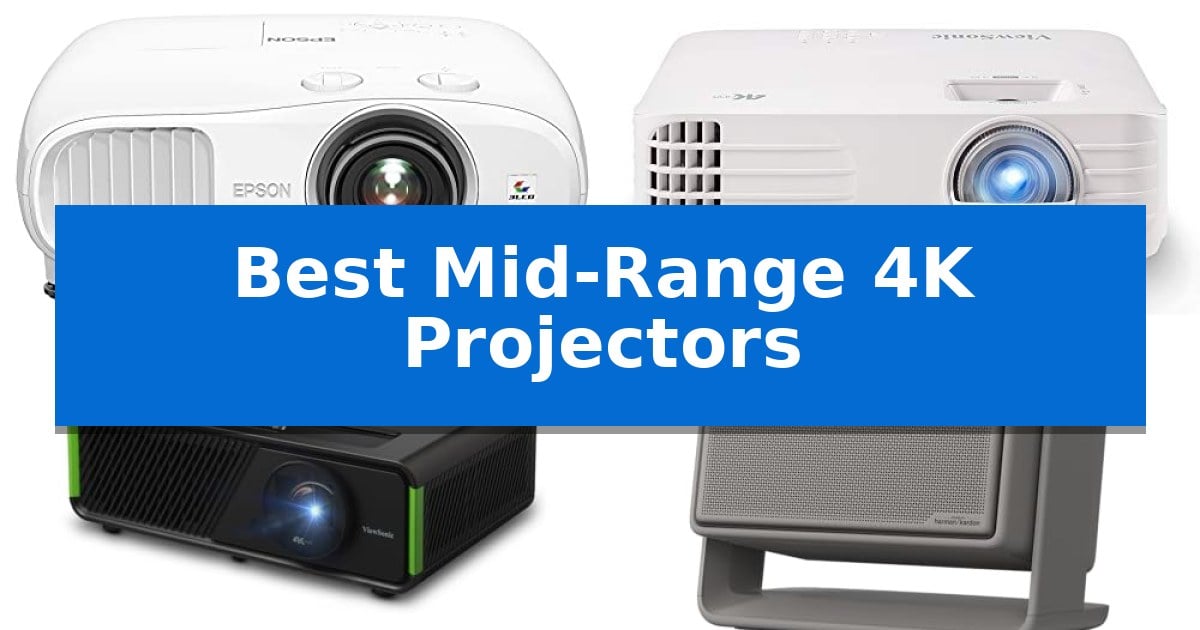
Finding the right display for a dedicated media room or living space requires balancing resolution, brightness, and installation flexibility. The Best Mid-Range 4K Projectors offer a significant step up from standard HD models, providing the pixel density needed for large-screen immersion without the extreme costs of high-end cinema units.
Whether you are looking for a dedicated movie experience or a high-refresh display for console gaming, these projectors utilize advanced processing to deliver sharp, detailed images. We have analyzed the current market to help you identify which features—such as laser light sources, color accuracy, or low-latency modes—best align with your specific home entertainment setup.
You may also want to compare Best Mid-Range 4K Monitors, Best Mid-Range 4K Gaming TVs, and Best Mid-Range 4K Gaming TV.
Best Mid-Range 4K Projectors
Quick Comparison
| Product | Best For | Key Strength | Score |
|---|---|---|---|
| Epson Home Cinema 3800 4K Projector | Best Overall | True 3-chip 3LCD design eliminates rainbow artifacts. | 4.9 |
| ViewSonic PX701-4K UHD Projector | High-Refresh Gaming Performance | Ultra-low 4.2ms input lag for responsive gaming. | 4.5 |
| ViewSonic X1-4KPRO LED Projector | Optimized for Console Gaming | Xbox native setting supporting 1440p at 120Hz | 4.3 |
| XGIMI Horizon 20 4K Projector | Triple Laser Cinematic Visuals | RGB Triple Laser engine provides high 3200 ISO lumens and deep contrast. | 4.8 |
| Optoma UHZ36 4K Laser Projector | Compact Laser Home Theater | 4K UHD resolution for high-detail image clarity. | 4.5 |
How We Chose
- Resolution and Image Processing: We prioritized models that utilize native 4K or high-quality pixel-shifting technology to ensure sharp, detailed reproduction of high-definition content.
- Brightness and Contrast: We assessed lumen output and contrast ratios to identify projectors capable of maintaining image clarity in rooms with varying levels of ambient light.
- Gaming Responsiveness: For models marketed toward gamers, we looked for evidence of high refresh rates and low input lag to ensure smooth, responsive performance.
- Installation Flexibility: We examined the inclusion of optical zoom, lens shift, and keystone correction, which are essential for achieving a perfectly aligned image in different room layouts.
- Connectivity and Smart Features: We reviewed the available ports and integrated smart platforms to determine how easily each unit connects to external media sources and streaming devices.
1 Epson Home Cinema 3800 4K Projector — Reliable 3LCD Color Accuracy
Achieving a theater-like experience at home requires balancing resolution, color accuracy, and brightness. The Epson Home Cinema 3800 4K Projector addresses these needs by utilizing 4K PRO-UHD pixel-shifting technology, which precisely controls three individual high-definition LCD chips to process millions of pixels for enhanced image detail.
This model features a true 3-chip projector design, ensuring that 100 percent of the RGB color signal is displayed for every frame. This configuration is specifically engineered to eliminate the "rainbow effect" often found in other projection technologies. With an impressive 3,000 Lumens of color and white brightness, it maintains visibility in various lighting conditions, supported by a contrast ratio of up to 100,000:1 for deep black detail.
For high-quality source material, the projector includes full 10-bit HDR support, allowing it to accept and reproduce the full range of HDR source information. The inclusion of full 18 Gbps HDMI 2.0 ports ensures compatibility with 4K HDR content at 60 Hz, providing a smooth experience for modern media players and gaming consoles.
Usability is enhanced by the Epson Precision Lens, which uses a multi-element glass structure to maintain edge-to-edge focus uniformity. Users can take advantage of precision vertical and horizontal axis lens shift adjustments for flexible installation. Additionally, the unit includes aptX Bluetooth for wireless audio connectivity and supports active 3D for immersive viewing.
Best for: Home theater enthusiasts seeking a bright, color-accurate 4K projection experience with flexible installation options.
Skip if: Users requiring a highly portable or ultra-compact device, as this unit weighs 15.2 pounds and is designed for permanent or semi-permanent home installation.
PROS
- True 3-chip 3LCD design eliminates rainbow artifacts.
- High 3,000 Lumens brightness for versatile room lighting.
- Precision glass lens with flexible vertical and horizontal lens shift.
- Full 18 Gbps HDMI 2.0 support for 4K HDR at 60 Hz.
CONS
- Significant physical footprint and weight may limit portability.
2 ViewSonic PX701-4K UHD Projector — High-Refresh Gaming Performance
Achieving a high-refresh gaming experience on a massive screen requires specific hardware, and the ViewSonic PX701-4K UHD Projector delivers this through a combination of a 240Hz refresh rate and an ultra-low 4.2ms input lag. This configuration is engineered to provide the responsiveness necessary for competitive gaming while maintaining the visual fidelity of a 3,200 ANSI lumens output.
Beyond its gaming capabilities, this projector functions as a versatile home theater solution. It supports 4K UHD (3840x2160p) resolution and utilizes SuperColor technology alongside HDR/HLG compatibility to enhance color depth and contrast. The unit is capable of projecting images up to 150 inches, with a 100-inch display achievable from a distance of 10.9 feet.
Installation and image calibration are streamlined through several integrated design choices. The device features auto-keystone correction, four-corner adjustment, and 1.1x optical zoom, which assist in squaring the image in various room layouts. Additionally, the projector supports curved screen projection for more specialized theater configurations.
The ViewSonic PX701-4K UHD Projector is built for flexibility in diverse lighting conditions, from dedicated media rooms to spaces with ambient light. With its dual HDMI connectivity and streaming-ready design, it serves as a central hub for high-resolution entertainment and gaming setups.
Best for: Competitive gamers and home theater enthusiasts who require high-refresh-rate performance and low input lag on a large-scale display.
Skip if: Users who require built-in smart streaming apps or advanced lens shift capabilities, as this model relies on external sources and manual image adjustments.
PROS
- Ultra-low 4.2ms input lag for responsive gaming.
- 240Hz refresh rate enables smooth motion.
- 3,200 ANSI lumens provides brightness for ambient light environments.
- Flexible image adjustment tools including auto-keystone and four-corner correction.
CONS
- 1.1x optical zoom offers limited placement flexibility compared to higher-end models.
- No built-in smart platform requires external streaming devices.
3 ViewSonic X1-4KPRO LED Projector — Optimized for Console Gaming
Transforming a living space into a dedicated gaming or cinema environment requires hardware that balances high-resolution output with responsive performance. The ViewSonic X1-4KPRO LED Projector addresses this by integrating a specialized Xbox native setting, which supports a 1440p resolution at a 120Hz refresh rate, ensuring that console gaming remains fluid and sharp on a screen size reaching up to 150 inches.
Beyond its gaming capabilities, this projector utilizes Cinema SuperColor technology to achieve a 125% Rec. 709 wide color gamut. This feature, combined with HDR/HLG content support, allows for a broader range of color reproduction and contrast, making it a versatile choice for both high-action movies and detailed cinematic viewing. The inclusion of 2500 ANSI lumens provides the necessary brightness to maintain image clarity in various lighting conditions.
Usability is enhanced through the integration of built-in Google TV, which simplifies access to streaming services like Netflix without requiring external hardware. Installation is further streamlined by flexible adjustment tools, including H/V Keystone and 4 Corner Adjustment, allowing users to square the image even when the projector cannot be placed perfectly centered. A 1.3x optical zoom provides additional physical placement flexibility within a room.
For those prioritizing high-speed performance, the device supports an ultra-fast 240Hz refresh rate, which is designed to minimize motion blur during fast-paced sequences. While it offers a robust suite of features for entertainment, users should note that its physical footprint measures 14 by 9.6 inches, necessitating a stable surface or mounting solution to accommodate its 8.1-pound weight.
Best for: Console gamers and home theater enthusiasts who require high refresh rates and integrated smart streaming capabilities.
Skip if: Users who require a portable, battery-powered projector or those with extremely limited shelf space for an 8.1-pound unit.
PROS
- Xbox native setting supporting 1440p at 120Hz
- 2500 ANSI lumens for bright image projection
- Built-in Google TV for seamless streaming access
- 125% Rec. 709 color gamut for lifelike visuals
CONS
- 8.1-pound weight requires a sturdy mount or surface
- Fixed physical footprint may not suit ultra-compact setups
4 XGIMI Horizon 20 4K Projector — Triple Laser Cinematic Visuals
Achieving a cinematic experience at home often hinges on the quality of the light source, and the XGIMI Horizon 20 4K Projector utilizes an RGB Triple Laser engine to deliver 3200 ISO lumens. This high-intensity output, paired with a 100,000:1 contrast ratio, provides the depth and color accuracy required for immersive viewing in various lighting conditions.
Beyond raw brightness, this projector integrates IMAX Enhanced, Dolby Vision, and HDR10+ certifications to ensure content is displayed with intended fidelity. The inclusion of Google TV with licensed Netflix simplifies the user experience by centralizing streaming services directly within the hardware, removing the need for external media players.
Setup flexibility is a core design choice, featuring optical zoom and lens shift capabilities. These tools allow for precise image alignment without the digital distortion often associated with keystone correction, ensuring a crisp, high-resolution picture regardless of the throw distance or mounting angle.
For those prioritizing gaming performance, the unit supports 240Hz refresh rates and a 1ms input lag mode. When combined with VRR (Variable Refresh Rate) and ALLM (Auto Low Latency Mode), it maintains fluid motion and responsive control, making it a capable display for high-speed gaming on a screen size up to 300 inches.
The system is rounded out by built-in Harman Kardon speakers, providing an all-in-one audio-visual solution. While the integrated stand and compact dimensions make it relatively easy to position, the unit's robust feature set is best suited for dedicated home theater environments where its specialized laser optics can be fully utilized.
Best for: Home theater enthusiasts and gamers who require a high-brightness, all-in-one 4K projection system with advanced motion handling.
Skip if: Users with limited space or those who prefer a modular audio setup may find the integrated speaker system and physical footprint unnecessary for their specific installation.
PROS
- RGB Triple Laser engine provides high 3200 ISO lumens and deep contrast.
- Pro-level gaming features including 240Hz refresh rate and 1ms input lag.
- Lossless optics with lens shift and optical zoom for distortion-free setup.
- All-in-one convenience with built-in Google TV and Harman Kardon audio.
CONS
- Physical footprint and weight may require dedicated mounting or stable surface space.
- Integrated audio may not replace a full-scale surround sound system for some users.
5 Optoma UHZ36 4K Laser Projector — Compact Laser Home Theater
Achieving a cinematic experience in a home theater often hinges on the clarity and color accuracy of the projected image. The Optoma UHZ36 4K UHD Laser HDR Home Theater Projector addresses this by leveraging 4K UHD resolution to deliver sharp, detailed visuals, ensuring that high-definition content is rendered with precision.
Designed for versatility, this projector incorporates FILMMAKER MODE, a feature that preserves the director's original vision by maintaining the intended color, contrast, and aspect ratio. This allows viewers to experience films as they were meant to be seen, without unnecessary processing or artificial smoothing.
The Optoma UHZ36 4K Laser Projector utilizes a laser light source capable of outputting 3500 Lumens, providing sufficient brightness to maintain image quality even in rooms with some ambient light. Its compact design, measuring approximately 10.8 by 8.5 by 4.5 inches, makes it a practical choice for users who need a powerful display without a massive footprint.
With HDR support, the projector enhances the dynamic range of the image, offering deeper blacks and brighter highlights. This combination of high-resolution output and advanced color processing makes it a compelling option for those seeking a dedicated home theater setup that balances performance with physical convenience.
Best for: Home theater enthusiasts seeking a compact, high-brightness 4K laser projector that prioritizes accurate cinematic color reproduction.
Skip if: Users requiring extreme portability or those who need a projector with integrated smart streaming apps, as this model focuses on core projection performance.
PROS
- 4K UHD resolution for high-detail image clarity.
- 3500 Lumens brightness suitable for various lighting conditions.
- FILMMAKER MODE for accurate, director-intended color and contrast.
- Compact form factor for easier placement in smaller home theaters.
CONS
- Fixed light source design lacks user-replaceable lamps, though it features a 20,000-hour light source warranty.
Best Mid-Range 4K Projectors Buying Guide
Understanding Projection Technology
The core of any projector is its imaging technology, typically divided between 3LCD and DLP systems. 3LCD projectors, such as those using Epson’s 3-chip design, are often favored for their ability to display 100% of the RGB color signal, which helps avoid the "rainbow effect" sometimes seen in other designs.
Alternatively, DLP projectors are frequently chosen for their high contrast and compact form factor. When selecting between these, consider your primary use case; if you are sensitive to color artifacts, 3LCD may be the more reliable choice, whereas DLP models often excel in gaming-focused environments.
Brightness and Ambient Light
Brightness is measured in lumens, and the necessary amount depends heavily on your environment. If you plan to use your projector in a room with some ambient light, look for models with at least 2,500 to 3,000 lumens to ensure the image remains vibrant and visible.
In a dedicated, light-controlled theater room, you may not need as much raw brightness, allowing you to prioritize contrast ratio for deeper blacks and more detailed shadow performance. Always check the manufacturer's specifications for both color and white brightness to get a complete picture of performance.
Gaming Performance Metrics
For those using a projector for gaming, input lag and refresh rate are critical. An input lag of under 20ms is generally considered ideal for competitive titles, while a 240Hz refresh rate can provide significantly smoother motion for high-action sequences.
Some modern projectors are specifically optimized for consoles, offering native support for higher resolutions at 120Hz. Ensure your chosen model supports the specific resolution and frame rate capabilities of your gaming hardware to avoid compatibility bottlenecks.
Installation and Placement
The physical placement of a projector is often limited by the room's dimensions. Features like optical zoom and lens shift are invaluable, as they allow you to adjust the image size and position without moving the projector itself or relying on digital keystone correction, which can degrade image quality.
Before purchasing, measure your throw distance—the distance from the lens to the screen—and compare it against the projector’s throw ratio. This ensures you can achieve your desired screen size within the constraints of your wall or ceiling mount.
Connectivity and Smart Integration
Modern projectors are increasingly becoming all-in-one entertainment hubs. Look for HDMI 2.0 or 2.1 ports to ensure compatibility with 4K HDR content at 60Hz or higher. Some units also include built-in smart operating systems, such as Google TV, which simplify access to streaming services without needing an external player.
If you plan to use external audio systems, check for Bluetooth connectivity or ARC/eARC support. These features allow you to route audio from the projector to a soundbar or receiver, significantly improving the overall cinematic experience.
Frequently Asked Questions
What is the difference between native 4K and pixel-shifting 4K?
Native 4K projectors have a physical chip with 8.3 million pixels. Pixel-shifting technology uses high-speed processing to shift a lower-resolution image multiple times per frame, creating a perceived 4K image that is highly detailed and often more affordable.
Do I need a special screen for a 4K projector?
While you can project onto a white wall, a dedicated projector screen is recommended to maximize contrast and color accuracy. High-quality screens are designed to reflect light more efficiently and can significantly improve the sharpness of 4K content.
How long do projector light sources last?
The lifespan depends on the light source. Laser projectors often offer significantly longer lifespans, sometimes exceeding 20,000 hours, compared to traditional lamps which may require replacement after a few thousand hours of use.
Can I use a 4K projector for gaming?
Yes, provided the projector has low input lag and high refresh rate support. Many mid-range models now include dedicated gaming modes that reduce latency, making them suitable for console and PC gaming.
What is HDR and why does it matter for projectors?
HDR (High Dynamic Range) allows the projector to display a wider range of colors and deeper contrast between light and dark areas. This results in a more lifelike image that is closer to what the director intended.
Conclusion: Our Top Pick
Selecting the right projector depends on your specific room environment and intended use. For those prioritizing color accuracy and a reliable, high-quality home theater experience, the Epson Home Cinema 3800 4K Projector stands out due to its 3-chip 3LCD design and precision lens structure, which ensure consistent color brightness and image clarity.
While other models offer specific advantages for high-refresh gaming or compact laser setups, this unit provides a balanced performance profile that excels in most home viewing conditions. By focusing on these core technical strengths, you can ensure your investment delivers a cinematic experience for years to come.