
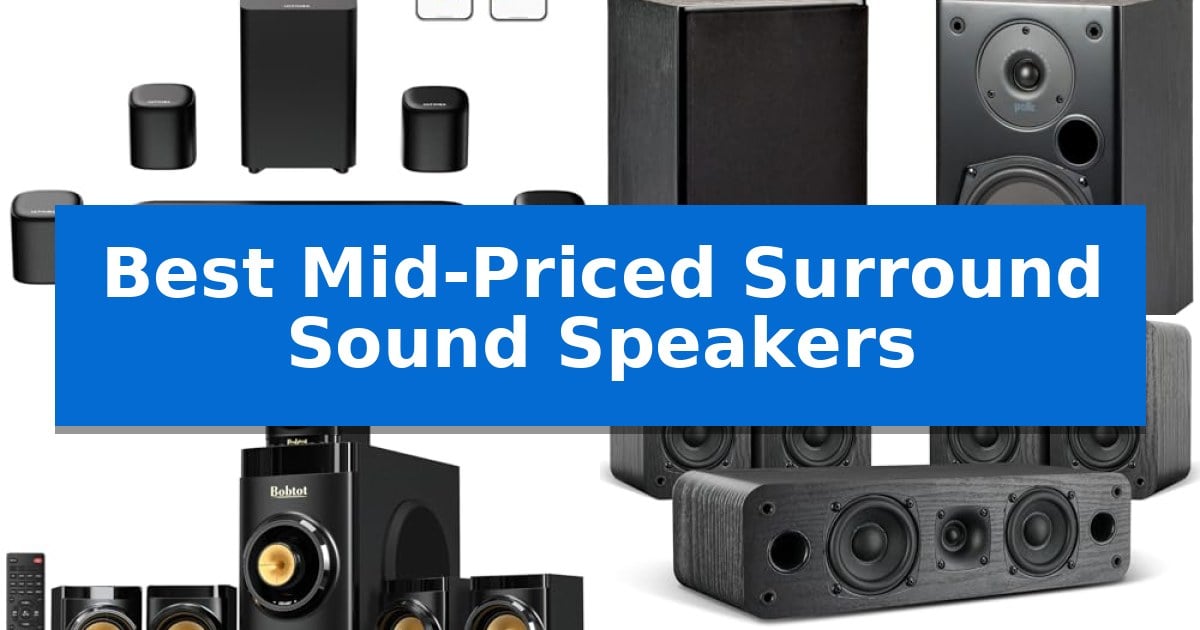
Building a home theater doesn't require a professional-grade budget to achieve a truly cinematic experience. Finding the Best Mid-Priced Surround Sound Speakers involves balancing room dimensions, connectivity requirements, and the desired level of immersion to ensure your audio matches your visual content.
Whether you are looking for a compact all-in-one system or a flexible passive setup that allows for future expansion, the right choice depends on how your space handles sound dispersion. We have analyzed current market offerings to help you identify which system aligns with your specific home entertainment needs.
You may also want to compare Best Mid-Priced Studio Headphones, Best Mid-Priced Stereo Speakers, and Best Mid-Priced Stereo Receivers.

Best Mid-Priced Surround Sound Speakers
Quick Comparison
| Product | Best For | Key Strength | Score |
|---|---|---|---|
| ULTIMEA Aura A60 Pro Surround System | Best Overall | Wireless rear speaker connectivity reduces cable clutter in the living space. | 4.9 |
| Polk Audio T15 Bookshelf Speakers | Foundation for Custom Surround Builds | Compact, wall-mountable design for flexible placement. | 4.6 |
| Bobtot Home Theater Surround System | Compact All-in-One Audio Solution | Compact 5.1-channel configuration ideal for small spaces. | 4.6 |
| Saiyin 5.0 Home Theater System | Classic Wood Grain Aesthetic | Dedicated center channel for improved dialogue clarity. | 4.8 |
| Saiyin On-Wall Passive Speakers | Space-Saving Wall Mount Design | Space-saving wall-mount design with a slim profile. | 4.7 |
How We Chose
- Channel Configuration: Evaluating whether the system provides true multi-channel surround sound or basic stereo enhancement.
- Connectivity Standards: Assessing the inclusion of modern interfaces like HDMI eARC, Bluetooth, or standard speaker wire terminals for receiver integration.
- Room Compatibility: Considering the physical footprint and mounting options for small to medium-sized living environments.
- Audio Customization: Checking for integrated EQ presets or app-based controls that allow users to fine-tune the sound profile.
- Build Flexibility: Distinguishing between all-in-one active systems and passive components that require external amplification.
1 ULTIMEA Aura A60 Pro Surround System — Immersive Dolby Atmos for Small Rooms
Achieving a cinematic soundstage in a compact living space often requires balancing power with physical footprint. The ULTIMEA Aura A60 Pro Surround System addresses this by integrating a 7.1-channel configuration that utilizes both wired and wireless components to minimize cable clutter while delivering multidimensional audio.
This system centers on a soundbar paired with four surround speakers—two wired front units and two wired rear units—designed to create an immersive 3D soundscape. The rear speakers connect wirelessly to the main bar, which helps maintain a cleaner aesthetic in rooms ranging from 108 to 270 square feet. For low-frequency impact, the setup includes a 5.25-inch wired subwoofer enhanced by BassMX technology, which optimizes the magnetic structure and diaphragm for deeper bass response.
Usability is managed through the Ultimea App, which provides granular control over the audio profile. Users can access 121 professionally tuned EQ presets or utilize a 10-band equalizer to manually adjust frequencies. The system also offers six tailored modes, including dedicated settings for movies, music, and gaming, allowing for precise tuning to match specific content types.
While the system provides significant flexibility for small-to-medium rooms, the wired nature of the front speakers and subwoofer requires careful placement near the soundbar. The inclusion of Dolby Atmos support ensures compatibility with modern multidimensional audio formats, making it a functional choice for those seeking to upgrade standard television audio without installing a complex, full-size receiver-based home theater.
Best for: Small to medium-sized rooms between 108 and 270 square feet where a compact, integrated surround sound solution is desired.
Skip if: Large open-concept living areas or rooms where a fully wireless speaker configuration is required, as the front speakers and subwoofer remain wired.
PROS
- Wireless rear speaker connectivity reduces cable clutter in the living space.
- Comprehensive app-based control with 121 EQ presets and 10-band manual adjustment.
- 7.1-channel Dolby Atmos support for immersive 3D audio performance.
- BassMX technology optimizes low-frequency output from the 5.25-inch subwoofer.
CONS
- Wired front speakers and subwoofer require proximity to the main soundbar unit.
- Room size limitations mean performance is optimized specifically for spaces under 270 square feet.
2 Polk Audio T15 Bookshelf Speakers — Foundation for Custom Surround Builds
Building a home theater system often begins with finding a reliable foundation for audio reproduction. The Polk Audio T15 Bookshelf Speakers provide a versatile starting point for surround sound setups, featuring a 0.75-inch tweeter and a 5.25-inch Dynamic Balance driver designed to deliver balanced audio output even at lower volume levels.
These passive bookshelf speakers are engineered for flexibility in home theater configurations. With a compact design measuring approximately 10.7 inches in height, they can be utilized as front, left, right, or rear channels. The inclusion of wall-mount capability allows for placement options that accommodate various room layouts, helping to integrate the speakers into existing entertainment spaces.
Setup is straightforward, requiring only standard speaker wire to connect to an AV receiver. The Polk Audio T15 units are designed to function as the initial components of a larger system, allowing users to expand toward a full 5.1 surround sound configuration by integrating additional components like tower speakers, a center channel, and a dedicated subwoofer as needs evolve.
Backed by a 5-year parts and labor warranty, these speakers offer a durable entry point for those beginning their home audio journey. By focusing on clear vocal reproduction and consistent sound quality, they serve as a practical choice for listeners looking to assemble a custom surround sound environment without requiring complex installation procedures.
Best for: Users starting a home theater journey who need a compact, modular foundation for a 5.1 surround sound system.
Skip if: Users requiring high-output power for large rooms or those who prefer integrated active speakers with built-in amplification.
PROS
- Compact, wall-mountable design for flexible placement.
- Dynamic Balance driver technology for clear, balanced audio.
- Modular compatibility allows for easy expansion to 5.1 systems.
- 5-year warranty on parts and labor.
CONS
- Passive design requires an external AV receiver for operation.
3 Bobtot Home Theater Surround System — Compact All-in-One Audio Solution
Achieving a balanced soundstage in a confined living space often requires equipment that prioritizes a compact footprint without sacrificing channel separation. The Bobtot Home Theater Surround System addresses this by utilizing a dedicated 5.1-channel configuration, featuring a central speaker, two front speakers, and two rear speakers driven by a 4-inch subwoofer with a built-in receiver.
Designed for versatility, this system supports multiple input methods including Bluetooth connectivity and wired connections, making it compatible with televisions, computers, and projectors. The inclusion of a 400W peak power output ensures that the system maintains high volume levels while delivering a range of frequencies, from crisp highs to deep lows, suitable for small to medium-sized rooms.
Installation is straightforward, relying on a wired setup where the five satellite speakers connect directly to the subwoofer's audio output slots. This all-in-one audio solution is specifically engineered for users who need to optimize audio dispersion in limited areas, such as apartments or studios, where traditional, larger sound systems might be impractical.
The system includes a remote control for managing settings and switching between modes, such as the dedicated Bluetooth input. By placing the satellite speakers strategically around the room, users can create an immersive listening environment that reproduces audio from multiple directions, enhancing the experience for movies, gaming, and music playback.
Best for: Small to medium-sized rooms or apartments where a compact, wired 5.1 surround sound configuration is required.
Skip if: Users who require a wireless speaker setup or those with large, open-concept living areas that demand higher power output.
PROS
- Compact 5.1-channel configuration ideal for small spaces.
- Versatile connectivity including Bluetooth and wired inputs.
- Integrated receiver within the 4-inch subwoofer simplifies the setup.
- Multi-directional audio reproduction for an immersive soundstage.
CONS
- Wired-only connection for satellite speakers requires cable management.
- Limited power output not suitable for large, open environments.
4 Saiyin 5.0 Home Theater System — Classic Wood Grain Aesthetic
Achieving a balanced audio profile for home entertainment often requires a dedicated multi-speaker setup that manages both ambient effects and vocal clarity. The Saiyin 5.0 Home Theater System addresses this by utilizing a five-component configuration, anchored by a professional center channel speaker specifically engineered to improve the accuracy and clarity of dialogue in movies and television.
This system features four high-power, full-range bookshelf speakers, each equipped with 3-inch drivers. By distributing these identical units around a room, the system creates a surround sound environment that captures audio from multiple angles. The enclosures are handcrafted with a classic retro wood grain finish, which serves the dual purpose of providing a distinct aesthetic while helping to reduce unwanted sound resonance during playback.
Flexibility is a core design choice for these speakers. Because they are compact and lightweight, they can be mounted on walls, placed on shelves, or positioned on stands to suit various room layouts. This modularity allows for customized speaker placement, ensuring that the soundstage can be optimized based on the specific dimensions of your home theater area.
It is important to note that this is a passive system. To function, the Saiyin 5.0 Home Theater System requires an external AV receiver or amplifier to provide power, as well as separate speaker wires, neither of which are included in the package. This setup provides the user with the ability to select their own amplification hardware to drive the 230W peak power capacity of the speakers.
Best for: Users who want a modular, retro-styled 5.0 surround sound system and already own or plan to purchase a compatible AV receiver.
Skip if: You require an all-in-one active system with built-in amplification, or you do not have the space and hardware to accommodate a separate receiver and wiring.
PROS
- Dedicated center channel for improved dialogue clarity.
- Handcrafted wood grain enclosures that reduce sound resonance.
- Flexible mounting options for walls, shelves, or stands.
- Compact 3-inch full-range drivers for consistent surround performance.
CONS
- Requires external amplifier or AV receiver to operate.
- Speaker wires not included in the package.
5 Saiyin On-Wall Passive Speakers — Space-Saving Wall Mount Design
Maximizing audio immersion in constrained environments requires hardware that balances acoustic performance with physical footprint. The Saiyin On-Wall Passive Speakers provide a specialized solution for home theater or office configurations, utilizing a slim, wall-mountable architecture that preserves floor and shelf space while delivering a 2-way audio experience.
These speakers feature 3.5-inch bass drivers paired with silk square horn tweeters, a combination engineered to produce clear high-frequency output up to 20,000 Hz. The enclosure design incorporates a down-firing bass port system, which assists in low-frequency response while allowing the units to be mounted flush against a wall surface without obstructing airflow.
Installation is facilitated by a customized mounting kit with 3mm bracket spacing, ensuring a secure, low-profile attachment to flat surfaces. As passive speakers, these units require an external amplifier or receiver to operate. They are designed with a 4-Ohm nominal impedance and a power handling range of 5-30 watts per unit, ensuring compatibility with a wide array of standard home theater processors and stereo receivers.
With a compact height of 13 inches and a depth of less than 3 inches, these speakers are suitable for users seeking to add dimensionality to their audio setup without the clutter associated with larger floor-standing models. Because they are passive, they offer the flexibility to integrate into existing audio chains, provided the user supplies the necessary amplification and speaker wire.
Best for: Users with limited floor space who require a discreet, wall-mounted surround sound solution for a home theater or office.
Skip if: Users who prefer a plug-and-play active speaker system, as this model requires a separate amplifier or receiver and speaker wire to function.
PROS
- Space-saving wall-mount design with a slim profile.
- Down-firing bass port enhances low-frequency performance.
- Silk horn tweeters provide clear high-frequency response.
- Flexible installation options for various room layouts.
CONS
- Requires separate amplifier or receiver for operation.
- Speaker wires are not included in the package.
Best Mid-Priced Surround Sound Speakers Buying Guide
Understanding Channel Configurations
Surround sound systems are defined by their channel count, such as 5.1 or 7.1. The first number represents the main speakers, while the '.1' indicates a dedicated subwoofer for low-frequency effects. Choosing the right configuration depends on your room size; a 7.1 system provides more directional detail but requires more space for optimal speaker placement.
For smaller rooms, a 5.1 system is often more than sufficient to create an immersive soundstage. It is important to ensure your chosen system matches the layout of your room, as placing rear speakers too close to the listening position can overwhelm the front soundstage.
Active vs. Passive Systems
Active systems include a built-in amplifier, making them a convenient 'plug-and-play' solution for most TVs. These are ideal for users who want to avoid the complexity of managing separate components and extra cabling.
Passive speakers, by contrast, require an external AV receiver. While this setup is more complex and requires purchasing additional speaker wire and an amplifier, it offers greater long-term flexibility. You can upgrade individual components over time, allowing your system to grow with your needs.
The Role of the Subwoofer
The subwoofer is responsible for the deep, impactful bass that defines action movies and gaming. In mid-priced systems, the size of the subwoofer driver—typically ranging from 4 to 5.25 inches—is a key indicator of its ability to fill a room with low-end frequencies.
Placement is critical for bass performance. Placing the subwoofer in a corner can often reinforce low frequencies, but it may also lead to 'boomy' or muddy sound if not properly balanced with the rest of your speakers.
Connectivity and Integration
Modern surround sound systems should integrate seamlessly with your existing hardware. HDMI eARC is the gold standard for TV connectivity, as it supports high-quality audio formats and allows you to control the volume with your standard TV remote.
For those using older hardware or projectors, ensure the system supports the necessary inputs, such as optical or Bluetooth. Always verify that your chosen system can communicate effectively with your primary media source to avoid synchronization issues.
Installation and Mounting
If floor space is limited, look for systems that offer wall-mounting capabilities. On-wall speakers can significantly reduce clutter while maintaining the necessary height for proper sound dispersion, which is essential for a balanced surround experience.
Consider the cable management requirements of your chosen system. Wireless rear speakers can simplify installation, but they still require a power source. Wired systems offer a more reliable connection but require careful planning to hide cables along baseboards or through walls.
Frequently Asked Questions
Do I need an AV receiver for all surround sound systems?
No, only passive speaker systems require an external AV receiver. Active systems, such as soundbars with satellite speakers, have built-in amplification.
What is the benefit of Dolby Atmos?
Dolby Atmos adds a height dimension to audio, creating a 3D soundscape where sounds appear to move around and above you, rather than just from the sides.
Can I mix and match speakers from different brands?
While technically possible with passive systems, it is generally recommended to keep the front three speakers (left, right, and center) from the same series to ensure a consistent 'timbre' or sound character.
How large of a room can these systems handle?
Most mid-priced systems are optimized for rooms between 100 and 300 square feet. Exceeding this size may result in a loss of sound pressure and clarity.
What is the purpose of a center channel speaker?
The center channel is dedicated primarily to dialogue. It ensures that voices remain clear and anchored to the screen, even during loud action sequences.
Conclusion: Our Top Pick
For those seeking a comprehensive and modern home theater experience, the ULTIMEA Aura A60 Pro Surround System stands out as the most balanced choice. Its 7.1 channel configuration, combined with Dolby Atmos support and wireless rear speaker connectivity, provides a sophisticated soundstage that is difficult to replicate at this price point.
While passive systems offer more long-term upgrade potential, the Aura A60 Pro is ideal for users who want an immediate, high-performance upgrade to their TV audio. With its app-based EQ customization and dedicated subwoofer, it provides the necessary tools to tailor the sound to your specific room acoustics without the need for additional external amplification.