
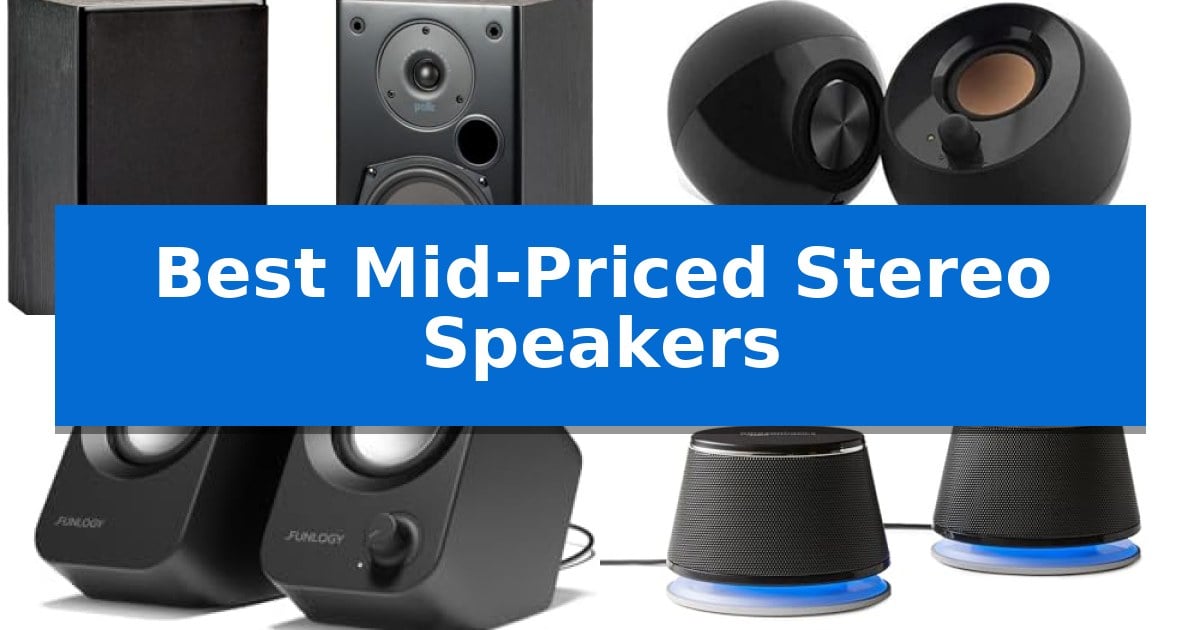
Selecting the right audio equipment often feels like a trade-off between budget-friendly convenience and high-end fidelity. Finding the Best Mid-Priced Stereo Speakers requires balancing your specific space constraints with the type of input sources you plan to use, such as dedicated AV receivers or simple USB-powered desktop connections.
Whether you are upgrading a home theater system or looking for an improved listening experience at your workstation, the market offers diverse solutions. This guide examines five distinct speaker sets, focusing on their physical design, power requirements, and compatibility to help you make an informed decision for your unique audio environment.
You may also want to compare Best Mid-Priced Stereo Receivers, Best Mid-Priced Speakers with Subwoofer, and Best Mid-Priced Speaker System.
Best Mid-Priced Stereo Speakers
Quick Comparison
| Product | Best For | Key Strength | Score |
|---|---|---|---|
| Polk Audio T15 Bookshelf Speakers | Best Overall | Wall-mountable design for flexible placement. | 4.9 |
| Creative Pebble 2.0 Desktop Speakers | Minimalist Desk Audio | Single USB cable connectivity for power and audio reduces cable clutter. | 4.5 |
| FUNLOGY Stereo PC Speakers | Optimized Upward Sound Projection | 30-degree tilt design for optimized sound projection | 4.3 |
| Amazon Basics Stereo PC Speakers | Simple Plug-and-Play Setup | USB-powered design removes the need for external power adapters. | 4.3 |
| Pyle Mini Cube Bookshelf Speakers | Compact Home Cinema Audio | Compact 3-inch form factor ideal for tight shelf spaces. | 4.6 |
How We Chose
- Compatibility with existing hardware, such as AV receivers versus USB-only interfaces.
- Physical dimensions and mounting options to ensure a proper fit for your desk or shelf space.
- Driver configuration and frequency response capabilities for balanced sound reproduction.
- Ease of setup, including cable requirements and power delivery methods.
- Build quality and design features that impact long-term reliability and desk aesthetics.
1 Polk Audio T15 Bookshelf Speakers — Immersive Home Theater Sound
Achieving a balanced soundstage in a home theater setup often begins with selecting versatile, compact components. The Polk Audio T15 Bookshelf Speakers utilize a 0.75-inch tweeter paired with a 5.25-inch Dynamic Balance driver to provide clear, consistent audio performance even at lower volume levels.
These passive speakers are designed for flexibility within a home audio system. They function effectively as front, left-right, or rear channels in a surround sound configuration. Their wall-mountable design allows for placement in rooms where floor space is limited, making them a practical choice for those beginning their home audio journey.
Integration into an existing setup is straightforward, requiring only standard speaker wire connections to an AV receiver. Users can start with a basic stereo pair and expand to a full 5.1 surround sound system later by incorporating additional components like the T50 tower speakers, a T30 center channel, and a dedicated subwoofer.
With a compact footprint measuring approximately 10.7 inches in height and 6.5 inches in width, these speakers fit easily onto shelves or mounting brackets. The 5-year parts and labor warranty provides long-term support for the hardware, ensuring the system remains a reliable part of an entertainment setup as it grows.
Best for: Homeowners starting a modular surround sound system who need compact, wall-mountable speakers.
Skip if: Users requiring high-output, large-room audio or those who prefer active speakers with built-in amplification.
PROS
- Wall-mountable design for flexible placement.
- Dynamic Balance driver technology for balanced sound.
- Modular compatibility with other T-series components for 5.1 expansion.
- Compact dimensions suitable for small shelf spaces.
CONS
- Passive design requires an external AV receiver.
- Limited bass depth compared to larger floor-standing towers.
2 Creative Pebble 2.0 Desktop Speakers — Minimalist Desk Audio
Achieving a clear, immersive soundstage on a crowded desk often requires balancing physical footprint with audio quality. The Creative Pebble 2.0 Desktop Speakers address this by utilizing 45° elevated drivers, which angle the sound directly toward the listener to improve projection and clarity in personal workspaces.
These speakers are designed for simplicity, relying on a single USB cable for both power and audio input. This eliminates the need for bulky power adapters, making them a practical choice for users with limited outlet space or those who prefer a clean, cable-managed setup. The modern and stylish aesthetics allow them to blend into various office environments without dominating the desk surface.
Performance is supported by a custom-tuned far-field driver solution paired with rear-facing passive radiators. This configuration is engineered to enhance bass reproduction and provide a fuller sound profile than standard integrated laptop speakers. With a frequency response of 100 Hz to 17 kHz, these speakers provide a balanced range for daily media consumption and general computer audio.
Usability is prioritized through front-facing volume controls, allowing for instant adjustments without reaching behind the unit or navigating software menus. Their compact dimensions—measuring approximately 4.8 inches in height—ensure they fit comfortably under most monitors or alongside compact laptop setups, providing a functional audio upgrade without the complexity of traditional multi-component speaker systems.
Best for: Users seeking a space-saving, USB-powered audio solution for personal desktop or laptop listening.
Skip if: Users who require high-fidelity studio monitoring or deep, room-filling bass that only a dedicated subwoofer can provide.
PROS
- Single USB cable connectivity for power and audio reduces cable clutter.
- 45° elevated drivers optimize sound projection for near-field listening.
- Compact, minimalist design fits easily into small or crowded workspaces.
- Front-facing volume control provides convenient, immediate access.
CONS
- No dedicated subwoofer limits the depth of low-frequency output.
- Fixed frequency response may not satisfy those requiring professional-grade audio accuracy.
3 FUNLOGY Stereo PC Speakers — Optimized Upward Sound Projection
Achieving clear, immersive audio in a confined workspace often requires a balance between footprint and output. The FUNLOGY Stereo PC Speakers address this by utilizing a distinctive 30-degree upward-facing tilt design, which directs sound output precisely toward the listener while minimizing the surface area occupied on a desk.
Engineered for versatility, these USB-powered speakers provide a total output of 14W. The internal hardware features dual 48mm full-range drivers paired with passive radiators to manage audio reproduction. To maintain signal integrity, the unit incorporates premium components and a gold-plated AUX input, which are specifically intended to reduce background noise during power cycles.
Integration into an existing setup is straightforward, relying on a standard USB and 3.5mm cable connection. This interface eliminates the need for driver installations or wireless pairing, ensuring compatibility with a wide range of hardware including desktop PCs, laptops, monitors, and gaming consoles.
The FUNLOGY Stereo PC Speakers are finished in a matte black aesthetic and are backed by a 1-year manufacturer warranty. Their compact dimensions—measuring approximately 5.2 inches in length and 4.3 inches in height—allow them to fit into tight configurations where larger traditional bookshelf speakers might be impractical.
Best for: Users with limited desk space who require a simple, plug-and-play audio solution for PCs, laptops, or gaming consoles.
Skip if: Users who require high-fidelity studio monitoring or wireless Bluetooth connectivity, as this system is strictly wired and optimized for near-field desktop use.
PROS
- 30-degree tilt design for optimized sound projection
- Compact, palm-sized footprint saves desk space
- Simple plug-and-play USB and 3.5mm connectivity
- Noise-reducing audio components for clear playback
CONS
- Wired-only connection limits placement flexibility
- 14W total output is designed for near-field rather than room-filling sound
4 Amazon Basics Stereo PC Speakers — Simple Plug-and-Play Setup
Achieving clear audio for a workspace often requires a balance between desk footprint and sound quality. The Amazon Basics Stereo 2.0 Speakers for PC or Laptop focus on this balance by integrating a bottom radiator designed to provide a more resonant, springy bass response than standard compact drivers. These speakers are built for those who need a straightforward audio upgrade without complex installations.
Designed for portability and ease of use, the Amazon Basics Stereo PC Speakers are USB-powered, eliminating the need for a separate wall outlet and reducing cable clutter. The system features an in-line volume control, allowing for quick adjustments without navigating through computer settings. The physical design includes a scratch-free padded base to protect desk surfaces and a metal finish that provides a stable, modern aesthetic.
Visual feedback is provided through integrated blue LED lights, which indicate when the system is active. With a compact footprint measuring approximately 3.94 inches in length and 2.6 inches in width, these speakers fit easily into crowded setups. The 3.5mm aux input ensures compatibility with most standard PC and laptop audio ports, making them a versatile choice for basic desktop sound amplification.
While these speakers excel in convenience and space-saving, they are intended for near-field listening environments. The reliance on a USB power source and the compact driver size means they are best suited for general media consumption, video calls, or casual listening rather than high-fidelity studio monitoring or large-room audio projection.
Best for: Users seeking a compact, USB-powered audio solution for laptops or desktop workstations with limited space.
Skip if: Audiophiles or users requiring high-output, room-filling sound or advanced connectivity options like Bluetooth.
PROS
- USB-powered design removes the need for external power adapters.
- Bottom radiator enhances low-end sound performance in a small form factor.
- In-line volume control offers immediate, tactile access to sound levels.
- Scratch-free padded base protects furniture from wear.
CONS
- Limited to 3.5mm aux input, lacking modern wireless connectivity.
- Near-field design may not provide sufficient volume for large rooms.
5 Pyle Mini Cube Bookshelf Speakers — Compact Home Cinema Audio
Integrating high-quality audio into a compact environment often requires balancing physical footprint with sonic performance. The Pyle 3" Mini Cube Bookshelf Speakers provide a dedicated output solution for listeners who need to maximize shelf or desktop space without sacrificing the ability to build a robust home cinema or stereo system.
These passive speakers utilize a 3-inch paper cone driver capable of a frequency response of 80Hz – 18 KHz, delivering full-range audio suitable for surround sound applications. Because they are passive, they require an external amplifier or receiver to function, which allows users to integrate them into existing audio setups rather than relying on internal amplification.
Engineered for versatility, each unit features video shielding to prevent magnetic interference with sensitive equipment, such as older CRT monitors, ensuring that nearby electronics remain unaffected during operation. Measuring a compact 3.6" x 3.6" x 4.6", these speakers are designed for flexible placement in tight areas where larger cabinets would be impractical.
With a 100-watt peak power handling and 8 Ohm impedance, these units are built to provide consistent resonance for home media. While they require an external power source and do not include speaker wire, their small form factor and specialized shielding make them a practical choice for secondary listening areas or space-constrained home theater configurations.
Best for: Small home theater or desktop audio setups where space is limited and an external amplifier is already available.
Skip if: Users seeking standalone active speakers with built-in amplification or those requiring high-fidelity audio for large, open-concept rooms.
PROS
- Compact 3-inch form factor ideal for tight shelf spaces.
- Video shielding protects nearby electronic equipment from magnetic distortion.
- 100-watt peak power handling provides sufficient resonance for home applications.
CONS
- Passive design requires a separate amplifier or receiver to operate.
- Speaker wire not included in the package.
Best Mid-Priced Stereo Speakers Buying Guide
Understanding Passive vs. Active Speakers
The most critical distinction when shopping for speakers is whether they are passive or active. Passive speakers, such as the Polk Audio T15 or Pyle Mini Cube, require an external amplifier or AV receiver to function. These are ideal for users building a modular home theater system where you want the flexibility to upgrade components individually over time.
Active or powered speakers, like the Creative Pebble 2.0 or FUNLOGY models, include built-in amplification. These are designed for convenience, typically connecting directly to a computer via USB or a 3.5mm auxiliary jack. They are the most efficient choice for desktop setups where space is limited and you want a simple plug-and-play experience.
The Importance of Speaker Placement
Where you place your speakers significantly impacts the audio quality. Bookshelf speakers are designed to be placed on stable surfaces or mounted to walls to direct sound toward the listener. Using wall-mountable options can help clear up valuable desk space while maintaining a proper soundstage.
Desktop speakers often benefit from specific design features like upward-facing drivers. Models with a 30-degree or 45-degree tilt are engineered to project sound directly toward your ears rather than your chest, which helps clarify mid-range frequencies and improves the overall listening experience in near-field environments.
Evaluating Driver Size and Bass Response
Speaker size is often a proxy for the physical capability of the drivers. Larger drivers, such as the 5.25-inch units found in some home theater bookshelf speakers, generally move more air and provide a more robust bass response compared to the smaller 3-inch drivers found in compact cube speakers.
If you lack the space for a dedicated subwoofer, look for speakers that incorporate passive radiators. These components help enhance low-frequency reproduction without requiring a massive enclosure, providing a fuller sound profile that is essential for music and movie enjoyment.
Connectivity and Power Standards
Always verify how your chosen speakers receive power and signal. USB-powered speakers are convenient for laptops but may be limited in total output wattage compared to speakers connected to a wall outlet via an amplifier. Ensure your computer's USB port can provide sufficient power to avoid audio clipping or distortion at higher volumes.
For those using a 3.5mm auxiliary input, consider the quality of the cable and the source device. A high-quality connection helps minimize signal noise, ensuring that your audio remains clear during both quiet passages and high-volume playback.
Build Quality and Shielding
Durability is a key factor for long-term use. Look for features like video shielding, which prevents magnetic interference with other electronics, and robust housing materials that reduce unwanted cabinet resonance. A well-constructed speaker cabinet will feel solid and minimize vibrations that can muddy the sound.
Consider the aesthetic impact as well. Whether you prefer a matte finish or a classic black look, your speakers will likely occupy a prominent place in your room. Choosing a design that complements your existing workspace or home theater decor ensures that your audio upgrade is also a visual improvement.
Frequently Asked Questions
Do I need a separate amplifier for all stereo speakers?
No. Passive speakers require an external amplifier or receiver, but active (powered) speakers have the amplifier built-in and connect directly to your audio source.
Can I mount bookshelf speakers on the wall?
Some models are designed with integrated wall-mounting hardware. Always check the product specifications to ensure the unit is rated for wall installation.
What is the benefit of upward-facing drivers?
Upward-facing or tilted drivers are designed to project sound directly toward the listener's ears in a desk environment, reducing sound reflection off the desk surface.
Are USB-powered speakers loud enough for a large room?
USB-powered speakers are typically designed for near-field, personal listening at a desk. For larger rooms or home theater applications, passive speakers paired with a dedicated receiver are recommended.
What does 'passive radiator' mean?
A passive radiator is a component that moves in response to the air pressure created by the main driver, helping to reinforce and extend the bass response without needing a powered subwoofer.
Conclusion: Our Top Pick
When choosing the right audio solution, the Polk Audio T15 Bookshelf Speakers stand out as a versatile choice for those building a dedicated home theater or a more substantial stereo system. Their ability to handle up to 100 watts and their wall-mountable design make them a flexible foundation that can be expanded into a full 5.1 surround setup as your needs grow.
While these speakers require a separate amplifier, the trade-off is a level of sound clarity and bass response that compact, USB-powered desktop alternatives often cannot match. If you are ready to move beyond basic computer audio, these speakers offer a reliable and immersive path forward.