
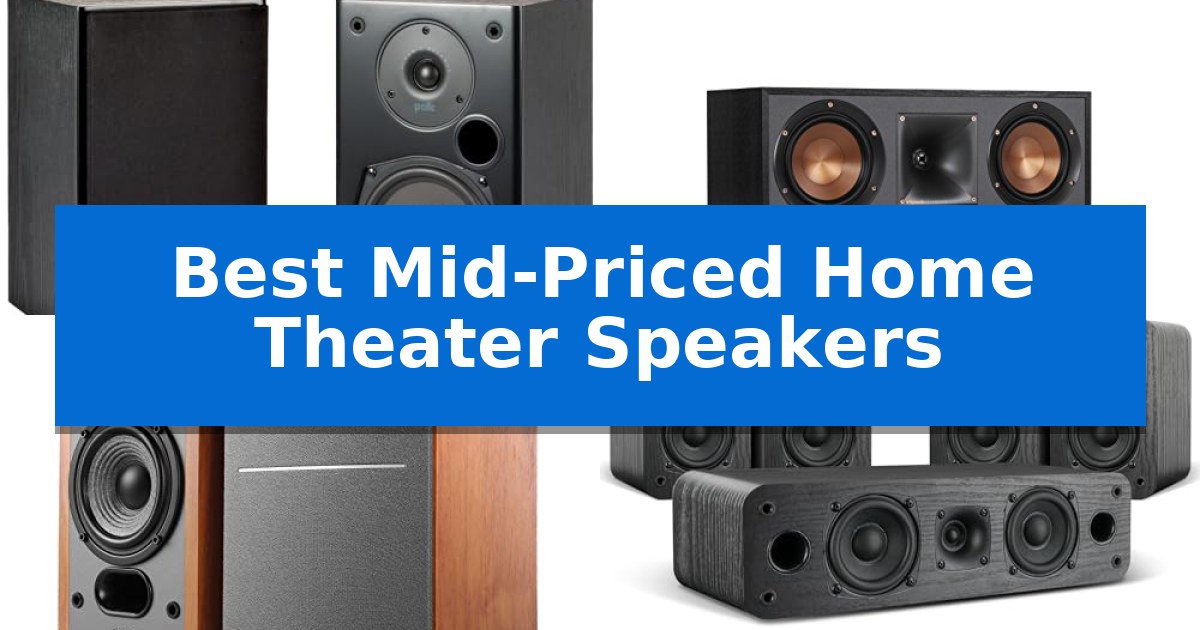
Building a high-quality home theater doesn't require an unlimited budget. Finding the Best Mid-Priced Home Theater Speakers involves balancing acoustic performance with the practical constraints of your room layout and existing amplification hardware.
Whether you are assembling your first 5.1 surround sound system or upgrading specific components for better dialogue clarity, selecting the right passive speakers is essential. We have analyzed a range of bookshelf, center channel, and in-ceiling options to help you identify the hardware that fits your specific audio goals.
You may also want to compare Best Mid-Priced Home Theater Receivers, Best Mid-Priced Home Theater Projector, and Best Mid-Priced Home Speakers.
Best Mid-Priced Home Theater Speakers
Quick Comparison
| Product | Best For | Key Strength | Score |
|---|---|---|---|
| Polk Audio T15 Bookshelf Speakers | Best Overall | Wall-mountable design for flexible placement options. | 4.9 |
| Klipsch R-52C Center Channel Speaker | Enhanced dialogue clarity | 90×90 Tractrix Horn technology for precise sound direction | 4.7 |
| Edifier P12 Passive Bookshelf Speakers | Wall-mountable surround solution | Built-in wall-mount bracket for flexible installation | 4.6 |
| Saiyin 5.0 Home Theater System | Complete passive multi-speaker kit | Dedicated center channel for enhanced dialogue accuracy. | 4.6 |
| Acoustic Audio In-Ceiling Speaker System | Discreet flush-mount surround | Full-range 3-way audio design with dedicated woofers, midranges, and tweeters. | 4.4 |
How We Chose
- Acoustic driver configuration and frequency response range.
- Compatibility with standard AV receivers and amplifiers.
- Physical footprint and mounting options for diverse room layouts.
- Build quality and resonance-reducing materials.
- Role-specific utility, such as center channel dialogue focus or surround sound dispersion.
1 Polk Audio T15 Bookshelf Speakers — Entry-level surround sound staple
Building a home theater system often begins with finding a reliable foundation for your audio. The Polk Audio T15 Bookshelf Speakers provide a versatile starting point, utilizing a 0.75-inch tweeter and a 5.25-inch Dynamic Balance driver to deliver clear, balanced sound. These speakers are designed to function effectively as front, left-right, or rear channels, making them a practical choice for those assembling a surround sound setup.
These speakers are engineered for straightforward integration into existing home audio environments. With a compact size measuring approximately 10.7 inches in height, they fit easily onto shelves or can be wall-mounted to save floor space. The passive design requires connection to an AV receiver via standard speaker wire, allowing for a quick and simple setup process that does not require complex configuration.
For users looking to expand their audio capabilities over time, these units are designed to work within a larger ecosystem. They can be integrated into a 5.1 surround sound configuration by adding compatible components such as the T50 tower speakers, a T30 center channel, and a dedicated subwoofer. This modular approach allows for gradual system growth based on specific audio needs.
The Polk Audio T15 Bookshelf Speakers are supported by a 5-year warranty on parts and labor, reflecting a focus on long-term utility. While they are capable of producing deep bass response, they are primarily intended as part of a multi-speaker system rather than as standalone full-range solutions for large rooms.
Best for: Entry-level home theater enthusiasts looking for a compact, modular, and wall-mountable speaker pair to begin a 5.1 surround sound system.
Skip if: Users seeking a standalone, high-output audio solution for large rooms or those who prefer active speakers with built-in amplification.
PROS
- Wall-mountable design for flexible placement options.
- Modular compatibility with other Polk T-series speakers for easy 5.1 system expansion.
- Compact footprint suitable for smaller shelves and home theater spaces.
- 5-year warranty on parts and labor.
CONS
- Passive design requires an external AV receiver for operation.
- Limited low-frequency output compared to larger floor-standing speakers or dedicated subwoofers.
2 Klipsch R-52C Center Channel Speaker — Enhanced dialogue clarity
Achieving clear, articulate dialogue in a home theater setup often hinges on the performance of the center channel, and the Klipsch R-52C Center Channel Speaker is engineered specifically to anchor that experience. By utilizing a 1" Aluminum LTS tweeter mated to a 90×90 square Tractrix Horn, this speaker is designed to direct high-frequency energy precisely toward the listening area, minimizing indirect sound reflections that can muddy vocal clarity.
The low-end foundation is handled by dual 5.25" spun-copper IMG woofers. These drivers provide the necessary mid-range presence to ensure that voices sound natural and grounded. With a frequency response of 89Hz – 21kHz (+/- 3dB), the unit is tuned to handle the critical vocal range effectively, while its 95dB sensitivity rating indicates it can reach significant volume levels without requiring excessive amplification.
Measuring 18.75 inches wide and 7.3 inches high, the speaker features a compact footprint that fits easily into most media consoles or on top of television stands. Its 400 watts of power handling capacity allows it to integrate into a wide variety of home theater systems, from modest setups to more robust configurations, provided the user has a compatible amplifier.
This speaker is backed by a 6-year parts and labor warranty, reflecting a commitment to long-term reliability. While it excels at dialogue-heavy content, users should ensure their existing receiver can accommodate its specific impedance and power requirements to get the most out of the Tractrix Horn technology.
Best for: Home theater enthusiasts looking to improve dialogue clarity and vocal presence in their surround sound system.
Skip if: Users with extremely limited shelf space or those who require a full-range speaker capable of deep bass extension without a dedicated subwoofer.
PROS
- 90×90 Tractrix Horn technology for precise sound direction
- High sensitivity of 95dB for efficient power usage
- Dual 5.25" spun-copper IMG woofers for clear mid-range
- 6-year warranty covering parts and labor
CONS
- Requires a separate subwoofer for low-frequency effects
- Size constraints may limit placement in tight media cabinets
3 Edifier P12 Passive Bookshelf Speakers — Wall-mountable surround solution
Integrating a dedicated surround sound setup requires components that balance performance with installation flexibility, and the Edifier P12 Passive Bookshelf Speakers address this by offering a compact, wall-mountable design. These speakers are engineered for users who prefer to curate their own audio chain, as they require an external amplifier or receiver to function.
The internal architecture features 19mm silk dome tweeters designed to handle high-frequency detail, paired with 4-inch bass drivers that utilize a bass reflex port to support lower-end output. With a 6 ohm impedance, these units are built to integrate into standard home theater configurations, particularly as rear surround channels where space is often at a premium.
Installation is simplified by the built-in wall-mount bracket, allowing for secure placement without the need for additional shelving or stands. The wood-finish aesthetic provides a neutral look that fits into various room decors, while the included speaker wires ensure that the setup process can begin immediately upon acquiring the necessary amplification.
Because these are passive speakers, the overall sound quality is heavily dependent on the power source and the quality of the receiver used. They are best suited for listeners who enjoy the process of selecting specific amplification hardware to match their personal audio preferences rather than relying on an all-in-one powered system.
Best for: Home theater enthusiasts looking for compact, wall-mountable rear speakers to integrate into an existing passive audio system.
Skip if: Users who do not own or wish to purchase a separate amplifier or receiver to power their speakers.
PROS
- Built-in wall-mount bracket for flexible installation
- Silk dome tweeters for detailed high-frequency reproduction
- Compact 4-inch driver design suitable for surround channels
- Included speaker wires for immediate setup
CONS
- Requires external amplifier or receiver to operate
- Passive design limits out-of-the-box functionality
4 Saiyin 5.0 Home Theater System — Complete passive multi-speaker kit
Achieving a balanced soundstage in a home entertainment area often requires a dedicated multi-speaker setup. The Saiyin 5.0 Home Theater System provides a complete solution by combining four identical 3-inch bookshelf speakers with a dedicated 3-inch center channel speaker. This configuration is engineered to deliver surround sound while specifically prioritizing dialogue clarity through its center channel, ensuring that spoken audio remains distinct during movies and television programs.
The system is built for versatility in placement, featuring a compact and lightweight design that allows for mounting on shelves, stands, or walls. This flexibility enables users to customize the speaker layout based on their specific room dimensions and seating arrangements. The enclosures are finished with a classic retro wood grain texture, which serves a functional purpose by helping to reduce sound resonance while maintaining a traditional aesthetic.
As a passive speaker system, the unit requires an external amplifier or AV receiver to function, as these components are not included in the package. Users will also need to provide their own speaker wiring to complete the installation. This requirement allows for integration into existing audio setups where a preferred receiver is already in use, though it necessitates additional hardware for those starting from scratch.
With a 230W peak power rating, this system is designed to handle a range of audio inputs for both TV and PC applications. The identical nature of the four bookshelf speakers ensures a consistent sound profile across the surround channels, while the dedicated center speaker handles the heavy lifting for vocal frequencies. This setup is a practical choice for those looking to assemble a component-based audio system rather than relying on an all-in-one soundbar.
Best for: Users who already own an AV receiver or amplifier and want a modular, surround-sound speaker setup with a dedicated center channel for improved dialogue.
Skip if: Users seeking an all-in-one, plug-and-play audio solution with built-in amplification, as this system requires a separate receiver and speaker wires.
PROS
- Dedicated center channel for enhanced dialogue accuracy.
- Flexible mounting options for walls, shelves, or stands.
- Consistent surround sound provided by four identical full-range bookshelf speakers.
- Retro wood grain enclosure designed to minimize sound resonance.
CONS
- Requires external amplifier or AV receiver for operation.
- Speaker wires not included in the package.
5 Acoustic Audio In-Ceiling Speaker System — Discreet flush-mount surround
Achieving a seamless surround sound experience often requires hardware that balances performance with architectural integration. The Acoustic Audio by Goldwood CS-IC83 8” 3-Way In Ceiling Home Theater Speaker System utilizes a flush-mount design to provide a clean, unobtrusive aesthetic while delivering full-range audio through its 3-way passive crossover architecture.
This system features 8-inch high-rigidity poly cone woofers equipped with progressive spiders and butyl rubber surrounds, paired with poly mica midranges and 13mm soft dome tweeters. Designed for versatility, the speakers offer a frequency response of 40Hz-20kHz and a sensitivity of 95dB at 8 ohms, ensuring they can be driven by standard home audio receivers or amplifiers ranging from 10 to 350 watts per channel.
Installation is simplified by a pressure-lock mounting system that clamps directly to drywall, requiring a 9.45-inch cut-out and a mounting depth of 3.78 inches. The durable ABS housings and removable grills are paintable, allowing the speakers to blend into various interior decor styles, while spring-loaded raw wire connections ensure secure integration with CL3-rated in-wall wiring.
As a passive speaker system, these units rely entirely on your existing amplification setup for power and signal processing. While they offer a wide sound dispersion pattern suitable for home theater or whole-house audio, they require a dedicated receiver or amplifier with raw speaker wire outputs to function, making them a practical choice for those building a custom wired audio environment.
Best for: Homeowners looking for a discreet, flush-mount surround sound setup that integrates into existing passive audio receiver systems.
Skip if: Users who prefer wireless connectivity or lack the ability to perform drywall cut-outs and run in-wall speaker wiring.
PROS
- Full-range 3-way audio design with dedicated woofers, midranges, and tweeters.
- Paintable grills and housings allow for seamless aesthetic integration with room decor.
- Pressure-lock mounting system facilitates straightforward installation in standard drywall.
- Wide sound dispersion engineered for effective coverage in home theater or whole-house applications.
CONS
- Requires external amplification via a home audio receiver or amplifier.
- Hardwired installation necessitates running CL3-rated speaker wire through walls.
Best Mid-Priced Home Theater Speakers Buying Guide
Understanding Passive Speaker Requirements
Most mid-priced home theater speakers are passive, meaning they do not contain built-in amplification. You must pair these with an external AV receiver or amplifier to drive the audio signal. Before purchasing, check the power handling specifications of the speakers to ensure they match the output capabilities of your existing receiver.
Impedance is another critical factor. Most home theater speakers operate at 6 or 8 ohms. Ensure your amplifier is rated to handle the impedance of your chosen speakers to prevent overheating or signal distortion during high-volume playback.
The Importance of a Center Channel
In a surround sound setup, the center channel speaker is responsible for the vast majority of dialogue in movies and television. A dedicated center speaker, like those featuring dual woofers and specialized tweeter waveguides, provides much clearer vocal reproduction than using a standard bookshelf speaker in that position.
When placing your center channel, aim for a position directly above or below your display. This ensures that the sound appears to originate from the actors on the screen, creating a more cohesive and immersive experience.
Bookshelf vs. In-Ceiling Placement
Bookshelf speakers offer the most flexibility for front and rear surround placement. They can be placed on dedicated stands, shelves, or wall-mounted using built-in brackets. This allows you to adjust the toe-in angle to optimize the soundstage for your primary seating area.
In-ceiling speakers are the ideal solution for those who prioritize a minimalist aesthetic or have limited floor space. These units are designed to be flushed into the ceiling, providing a wide dispersion of sound that is excellent for ambient surround effects, though they require more involved installation compared to bookshelf models.
Driver Materials and Sound Quality
The materials used in speaker cones and tweeters significantly impact the sound signature. Silk dome tweeters are often favored for their smooth, detailed high-frequency reproduction, while polypropylene or spun-copper woofers are chosen for their rigidity and ability to produce punchy, controlled bass.
Look for enclosures constructed from materials like MDF or wood grain finishes, which help reduce internal resonance. A well-damped cabinet ensures that the sound you hear is the audio signal itself, rather than vibrations from the speaker housing.
Expanding Your System
One of the primary benefits of choosing a modular passive system is the ability to scale over time. You can start with a pair of bookshelf speakers for a 2.0 stereo setup and gradually add a center channel, rear surrounds, and a subwoofer to reach a full 5.1 or 7.1 configuration.
When mixing and matching brands, try to keep the front three speakers (left, right, and center) from the same manufacturer and series. This ensures a consistent timbre, meaning the sound character remains uniform as audio pans across the front of your room.
Frequently Asked Questions
Do I need an amplifier for these speakers?
Yes, all the speakers listed are passive and require an external AV receiver or amplifier to function.
Can I mount these speakers on the wall?
Many bookshelf models included here feature built-in wall-mount brackets, while the in-ceiling systems are specifically designed for flush-mount installation.
What is the difference between a bookshelf and a center channel speaker?
A center channel is specifically tuned for dialogue clarity and is usually shaped to fit horizontally under a TV, whereas bookshelf speakers are designed for broader stereo or surround sound imaging.
Are speaker wires included?
Most passive speaker kits do not include speaker wire, as the required length depends on your specific room layout. You will need to purchase standard gauge speaker wire separately.
Can I use these for music as well as movies?
Absolutely. High-quality bookshelf speakers are excellent for stereo music listening, providing a balanced soundstage that works well for both music and cinema.
Conclusion: Our Top Pick
For those looking to build a versatile and reliable home theater foundation, the Polk Audio T15 Bookshelf Speakers stand out as the top choice. Their compact design and ability to function as front or rear surround units make them a highly adaptable starting point for any audio enthusiast.
While they offer excellent clarity and balance for the price, remember that they are passive units. Ensure you have a compatible receiver and sufficient speaker wire on hand to complete your setup. By investing in these as your primary or surround speakers, you gain a durable, high-performance component that can easily be integrated into a larger 5.1 system as your needs grow.