
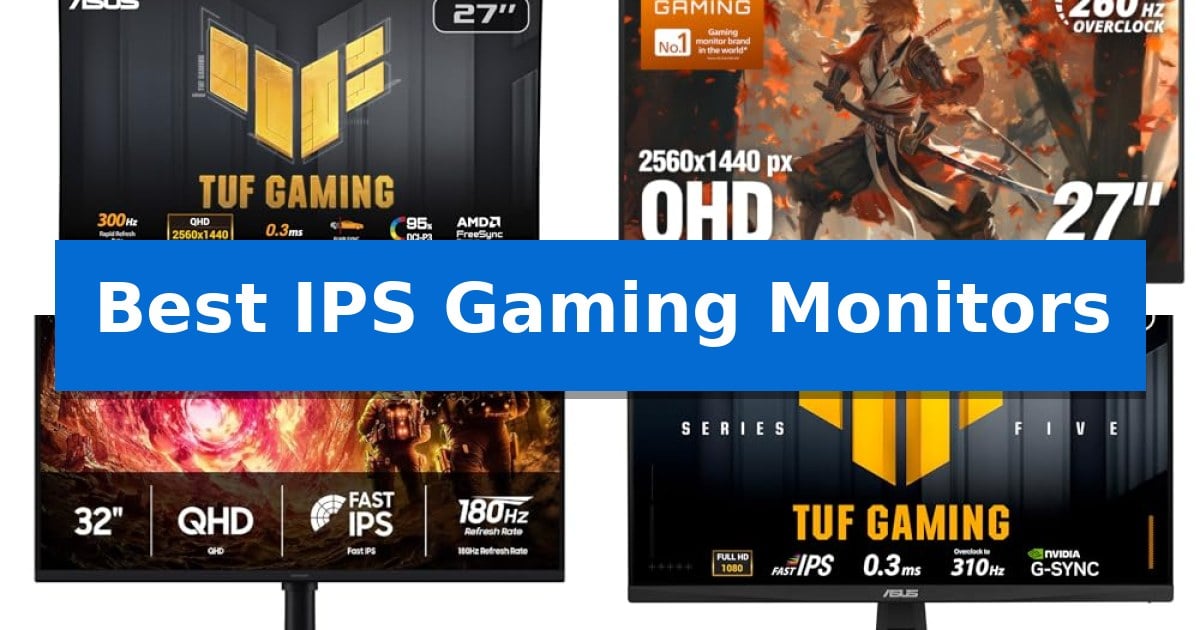
Finding the right display is essential for any serious setup, as the panel technology dictates both the visual fidelity and the responsiveness of your experience. When searching for the Best IPS Gaming Monitors, you are looking for a balance between vibrant color reproduction and the speed required for fast-paced titles.
Our analysis focuses on how these specific displays handle motion, color accuracy, and connectivity to ensure you get the most out of your hardware. Whether you prioritize high-refresh-rate esports performance or immersive resolution, these models offer distinct advantages for different types of players.
Best IPS Gaming Monitors in 2026
Quick Comparison
| Product | Best For | Key Strength | Score |
|---|---|---|---|
| ASUS TUF Gaming VG27AQM5A Gaming Monitor | Best Overall | 300Hz refresh rate for ultra-smooth motion | 4.9 |
| AOC Q27G41ZE Gaming Monitor | High-clarity QHD at 260Hz | 260Hz overclocked refresh rate for fluid motion | 4.7 |
| Samsung Odyssey G5 Gaming Monitor | Immersive 32-inch QHD display | 180Hz refresh rate and 1ms (GtG) response time for fluid motion. | 4.9 |
| ASUS TUF Gaming VG259QMR5A Gaming Monitor | Blazing 310Hz for esports | 310Hz overclocked refresh rate for fluid motion | 4.4 |
| Acer Nitro KG271U Gaming Monitor | Color-accurate QHD visuals | 180Hz refresh rate for smooth motion rendering. | 4.8 |
How We Chose
- Refresh Rate and Motion Handling: Assessing the monitor's ability to maintain fluid visuals during high-speed action.
- Response Time: Evaluating the panel's transition speed to minimize ghosting and motion blur.
- Color Accuracy and Gamut: Checking the display's ability to render vibrant, true-to-life colors for both gaming and creative tasks.
- Resolution and Clarity: Confirming the pixel density and visual sharpness provided by the panel.
- Connectivity and Ergonomics: Reviewing the available ports and stand adjustability for seamless integration into your desk setup.
1 ASUS TUF Gaming VG27AQM5A Gaming Monitor — Ultra-fast 300Hz competitive edge
Achieving a competitive edge in fast-paced titles requires hardware that keeps up with high frame rates, and the ASUS TUF Gaming VG27AQM5A Gaming Monitor is built specifically for this demand. Featuring a 300Hz refresh rate and a 27-inch QHD (2560×1440) display, this monitor provides the clarity and fluidity necessary for professional-grade gaming sessions.
The integration of Fast IPS technology allows for a 0.3ms (GTG) response time, which works to minimize ghosting during rapid on-screen movement. To further enhance visual sharpness, the monitor utilizes ASUS Extreme Low Motion Blur Sync (ELMB Sync), allowing variable-refresh-rate technologies to function alongside motion blur reduction for a tear-free experience.
For those who prioritize visual quality alongside performance, the monitor covers 95% of the DCI-P3 color gamut, ensuring vibrant and accurate color reproduction. The inclusion of Shadow Boost technology provides a tactical advantage by brightening dark areas of a scene without over-exposing the rest of the image, helping to reveal hidden details in low-light environments.
Usability is streamlined through the DisplayWidget Center, which allows users to adjust monitor settings directly via mouse input rather than navigating complex on-screen menus. The unit also features built-in speakers for basic audio needs and includes a 3-year manufacturer warranty, providing long-term support for your setup.
Best for: Competitive gamers seeking a high-refresh-rate QHD display with advanced motion blur reduction features.
Skip if: Users who require a 4K resolution display or those with limited desk space who would prefer a smaller monitor footprint.
PROS
- 300Hz refresh rate for ultra-smooth motion
- 0.3ms (GTG) response time via Fast IPS technology
- ELMB Sync eliminates ghosting and tearing
- 95% DCI-P3 color gamut for vibrant visuals
CONS
- QHD resolution may not satisfy users requiring 4K clarity
- Integrated speakers offer limited audio performance compared to dedicated systems
2 AOC Q27G41ZE Gaming Monitor — High-clarity QHD at 260Hz
Achieving fluid motion in competitive titles requires hardware that keeps pace with rapid inputs, and the AOC Q27G41ZE Gaming Monitor addresses this through a 260Hz overclocked refresh rate. This 27-inch display utilizes an IPS panel to maintain color accuracy and wide viewing angles, ensuring that visual fidelity remains consistent even during fast-paced movement.
For users prioritizing responsiveness, the monitor features an ultra-responsive 0.3ms MPRT and Adaptive-Sync support. This combination works to minimize screen tearing and input lag, providing a stable experience across both NVIDIA and AMD graphics cards. The inclusion of Shadow Control and dedicated Game Mode presets allows for quick adjustments to contrast and brightness, helping to maintain visibility in darker game environments.
The physical design incorporates a three-sided frameless aesthetic with a textured black and red finish, suitable for modern desk setups. Ergonomic adjustments are supported via a -3° to +21° tilt range, allowing for personalized positioning. Connectivity is handled through one DisplayPort 1.4 and two HDMI 2.0 ports, alongside an audio-out jack for external sound integration.
With a 300-nit brightness and a 1000:1 contrast ratio, the display provides clear, vibrant visuals for various lighting conditions. The QHD 2560×1440 resolution offers a balance between pixel density and performance, making it a functional choice for those who need high-refresh gaming without sacrificing screen real estate.
Best for: Competitive gamers seeking a high-refresh-rate QHD display with versatile connectivity and adaptive synchronization.
Skip if: Users who require advanced ergonomic features like height adjustment, swivel, or pivot, as this model is limited to tilt functionality.
PROS
- 260Hz overclocked refresh rate for fluid motion
- 0.3ms MPRT for reduced blur
- Adaptive-Sync compatibility for tear-free gaming
- QHD resolution on a 27-inch IPS panel
CONS
- Tilt-only ergonomics limit positioning flexibility
- 300-nit brightness may be insufficient for extremely bright rooms
3 Samsung Odyssey G5 Gaming Monitor — Immersive 32-inch QHD display
The Samsung 32” Odyssey G5 (G50F) Series QHD Gaming Monitor prioritizes visual clarity and fluid motion through its 180Hz refresh rate and 1ms (GtG) response time. These specifications are engineered to minimize screen tearing and lag, providing a responsive experience for fast-paced titles where frame-by-frame precision is essential.
Built with a Fast IPS panel, this monitor maintains consistent color accuracy across a 178° viewing angle. The QHD resolution (2560 x 1440) ensures that textures and environments appear sharp, while HDR10 support enhances the contrast between highlights and shadows to provide added depth to game visuals.
Functionality is further supported by integrated tools such as the Black Equalizer, which adjusts shadow detail to improve visibility in dark areas, and the Virtual Aim Point feature for targeting assistance. The Ergonomic Stand offers physical flexibility, allowing users to pivot, tilt, and swivel the display to suit their specific desk setup.
Connectivity and convenience are addressed through Auto Source Switch+, which detects and switches to active devices automatically. Compatibility is bolstered by NVIDIA G-Sync and AMD FreeSync support, ensuring the monitor synchronizes with a wide range of graphics cards to maintain smooth, stutter-free gameplay.
Best for: Gamers seeking a high-refresh-rate QHD display with versatile ergonomic adjustments and broad GPU synchronization support.
Skip if: Users requiring 4K resolution for professional-grade creative work or those with limited desk space who cannot accommodate a 32-inch footprint.
PROS
- 180Hz refresh rate and 1ms (GtG) response time for fluid motion.
- Fast IPS panel provides wide viewing angles and clear color reproduction.
- NVIDIA G-Sync and AMD FreeSync compatibility reduces screen tearing.
- Height-adjustable ergonomic stand supports tilt, pivot, and swivel.
CONS
- 32-inch size may be too large for compact gaming setups.
- QHD resolution is lower than 4K for users prioritizing maximum pixel density.
4 ASUS TUF Gaming VG259QMR5A Gaming Monitor — Blazing 310Hz for esports
The ASUS TUF Gaming VG259QMR5A Gaming Monitor is built for competitive play, featuring an overclockable 310Hz refresh rate that provides high frame rates for professional gaming. This 24.5-inch Fast IPS panel is engineered to deliver both speed and visual clarity, making it a specialized tool for those who prioritize motion performance in fast-paced titles.
Performance is bolstered by a 0.3ms (GTG) response time, which works alongside ASUS Extreme Low Motion Blur Sync (ELMB SYNC) technology. This combination allows gamers to enable motion blur reduction while simultaneously utilizing variable refresh rate technologies like FreeSync Premium and G-Sync compatibility, effectively minimizing ghosting and screen tearing during intense sequences.
Beyond raw speed, the monitor emphasizes color reproduction with 99% sRGB color gamut coverage, ensuring that visuals remain vibrant for both gaming and content creation tasks. The inclusion of TUF Gaming A.I technology further enhances the user experience, while the DisplayWidget Center software provides a streamlined interface for adjusting OSD settings directly through the mouse.
Designed for long-term reliability, the unit includes a 3-year manufacturer warranty and comes with a comprehensive accessory package, including a DisplayPort cable. Users also receive a complimentary 3-month Adobe Creative Cloud subscription, adding value for creators who require accurate color performance alongside their gaming setup.
Best for: Competitive gamers who require ultra-high refresh rates and minimal motion blur for fast-paced esports titles.
Skip if: Users who prioritize 4K resolution or larger screen real estate for cinematic immersion or professional-grade color grading work.
PROS
- 310Hz overclocked refresh rate for fluid motion
- 0.3ms (GTG) response time via Fast IPS technology
- ELMB Sync allows simultaneous blur reduction and adaptive sync
- 99% sRGB coverage for accurate color reproduction
CONS
- 1080p resolution may lack sharpness on larger displays compared to 1440p or 4K options
5 Acer Nitro KG271U Gaming Monitor — Color-accurate QHD visuals
The Acer Nitro KG271U Gaming Monitor distinguishes itself with a rapid 180Hz refresh rate and a 0.5ms GTG response time, designed to minimize input lag and motion blur during fast-paced gameplay. This 27-inch display utilizes an IPS panel to provide clear visuals at a 2560 x 1440 QHD resolution, ensuring that high-quality detail is maintained across the screen.
Beyond its gaming-focused performance, the monitor is engineered for color accuracy, supporting 95% DCI-P3 color gamut. This makes the device a functional choice for users who transition between gaming and color-critical tasks like graphic design or photo editing. The zero-frame design maximizes screen real estate by reducing the bezel footprint.
To maintain a smooth visual experience, the monitor integrates AMD FreeSync technology, which synchronizes the display's refresh rate with the graphics card to prevent screen tearing and stuttering. Connectivity is handled through two HDMI ports and a DisplayPort, allowing for flexible integration into various desktop setups.
The unit includes integrated speakers and is VESA mountable, providing options for desk space optimization. For extended use, the monitor features a bluelight filter and flickerless technology to assist in managing visual comfort during long sessions.
Best for: Gamers and creative professionals who require a balance of high refresh rates for motion clarity and wide color gamut coverage for design work.
Skip if: Users who require a 4K resolution display or those who prefer a curved screen design for increased immersion.
PROS
- 180Hz refresh rate for smooth motion rendering.
- 0.5ms GTG response time to reduce ghosting.
- 95% DCI-P3 color accuracy suitable for creative workflows.
- AMD FreeSync support for tear-free gaming.
CONS
- Fixed stand design may limit ergonomic adjustments compared to premium adjustable mounts.
Best IPS Gaming Monitors Buying Guide
Panel Technology and IPS Benefits
In-Plane Switching (IPS) panels are widely recognized for their superior color accuracy and wide viewing angles compared to TN or VA alternatives. This makes them an excellent choice for gamers who want their titles to look as intended, with rich colors that remain consistent even when viewed from the side.
Modern 'Fast IPS' technology has bridged the gap between color quality and speed. By optimizing the liquid crystal structure, these panels can achieve response times previously reserved for faster, less color-accurate panel types, allowing for a competitive edge without sacrificing image quality.
Refresh Rates for Competitive Play
The refresh rate, measured in Hertz (Hz), determines how many frames per second the monitor can display. For competitive shooters and fast-paced action games, a higher refresh rate is crucial for tracking targets smoothly and reducing input lag.
While 144Hz was once the standard, many modern gaming monitors now push well beyond 240Hz. Choosing the right refresh rate depends on your hardware's ability to output enough frames to saturate the panel, ensuring you are not paying for performance your GPU cannot deliver.
Resolution and Pixel Density
Resolution significantly impacts both visual clarity and the load on your graphics card. A 1440p (QHD) resolution is currently considered the sweet spot for many gamers, offering a substantial increase in sharpness over 1080p without the extreme performance demands of 4K.
When choosing between 25-inch and 27-inch or larger displays, consider your viewing distance. A higher pixel density on a smaller screen can look sharper, while larger screens provide a more immersive experience that fills more of your field of view.
Motion Blur Reduction and Sync Technologies
Technologies like G-SYNC and FreeSync are essential for eliminating screen tearing and stuttering by synchronizing the monitor's refresh rate with your GPU's output. These features ensure that your gaming experience remains fluid even when frame rates fluctuate.
Advanced motion blur reduction, such as ELMB Sync, allows you to use blur-reduction strobing simultaneously with variable refresh rate technologies. This combination is particularly useful for competitive players who need the absolute clearest image during rapid camera movements.
Ergonomics and Connectivity
A monitor's stand is often overlooked, but it plays a vital role in long-term comfort. Look for stands that offer height, tilt, and swivel adjustments, allowing you to position the screen at eye level to reduce neck strain during extended sessions.
Connectivity options like DisplayPort and HDMI are standard, but check the versions supported. DisplayPort is typically preferred for high-refresh-rate gaming, while additional features like built-in speakers or USB hubs can help simplify your desk setup and cable management.
Frequently Asked Questions
What is the main advantage of an IPS panel for gaming?
IPS panels provide excellent color accuracy and wide viewing angles, ensuring that images look vibrant and consistent from almost any position, which is a significant upgrade over traditional TN panels.
Do I need a 300Hz monitor for all games?
A 300Hz monitor is primarily beneficial for competitive esports titles where every millisecond counts. For slower-paced or single-player games, the visual benefits of higher resolution or HDR may be more noticeable than the extreme refresh rate.
What is the difference between G-SYNC and FreeSync?
Both are adaptive sync technologies designed to eliminate screen tearing. G-SYNC was originally proprietary to NVIDIA, while FreeSync is an open standard. Many modern monitors are now compatible with both, regardless of which GPU brand you use.
How does response time affect my gaming experience?
Lower response times, such as 0.3ms or 0.5ms, reduce ghosting and motion blur. This makes fast-moving objects appear sharper and clearer, which is critical for maintaining focus in high-speed competitive games.
Is QHD (1440p) better than Full HD (1080p) for gaming?
QHD offers significantly higher pixel density, resulting in sharper images and more screen real estate. It is generally considered the best balance for modern gaming, provided your graphics card can handle the increased resolution.
Conclusion: Our Top Pick
When selecting the best display for your needs, the ASUS TUF Gaming VG27AQM5A Gaming Monitor stands out as a top-tier choice. It combines a high 300Hz refresh rate with a sharp QHD resolution and Fast IPS technology, making it highly versatile for both competitive esports and visually demanding titles.
While other models offer specific benefits like larger screen sizes or different refresh rates, this monitor provides a well-rounded feature set that balances speed, color accuracy, and motion clarity. It is an excellent investment for gamers looking to upgrade their visual experience without compromising on performance.