
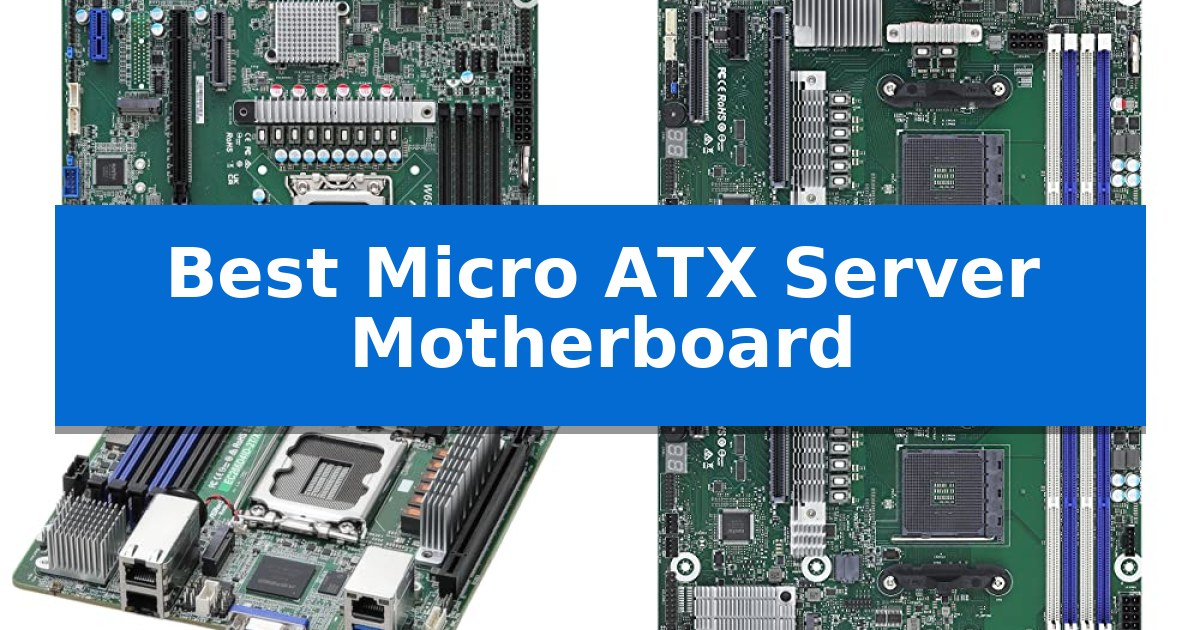
Building a high-density server requires a delicate balance between physical footprint and computational power. When space is constrained, selecting the Best Micro ATX Server Motherboard becomes the most critical decision in your infrastructure planning, as it dictates your CPU support, memory capacity, and expansion potential.
Our analysis focuses on specialized boards that provide the necessary stability and interface standards for professional environments. By evaluating chipset compatibility, networking capabilities, and storage connectivity, we help you identify the hardware foundation that aligns with your specific server requirements.
You may also want to compare Best Micro ATX Ryzen Motherboards, Best Micro ATX Power Supplies, and Best Micro ATX NAS Cases.
Best Micro ATX Server Motherboard
Quick Comparison
| Product | Best For | Key Strength | Score |
|---|---|---|---|
| ASRock Rack W680D4U-2L2T/G5 Server Motherboard | Best Overall | Dual 10G LAN ports for high-speed network throughput. | 4.9 |
| ASRock Rack X570D4U-2L2T Server Motherboard | Dual 10G Networking for Servers | Compact Micro-ATX form factor ideal for space-saving server builds. | 4.8 |
| ASRock Rack EPYC4000D4U Server Motherboard | High-Efficiency AMD EPYC Foundation | PCIe 5.0 x16 slot for high-speed expansion. | 4.8 |
| ASRock Rack X570D4U Server Motherboard | Reliable AM4 Server Integration | Compact Micro-ATX form factor ideal for space-constrained server chassis. | 4.7 |
How We Chose
- Socket and Chipset Compatibility: Ensuring the board supports the intended CPU generation and server-grade features.
- Memory Architecture: Assessing the number of DIMM slots and support for ECC memory to maintain data integrity.
- Networking and I/O: Evaluating the availability of high-speed LAN ports and PCIe expansion slots for add-in cards.
- Storage Connectivity: Analyzing the number of OCuLink or SATA ports for efficient drive management.
- Form Factor Precision: Confirming the board fits standard Micro-ATX chassis dimensions for consistent installation.
1 ASRock Rack W680D4U-2L2T/G5 Server Motherboard — Advanced Intel Workstation Performance
The AsRock Rack W680D4U-2L2T/G5 Server Motherboard provides a compact foundation for high-performance computing by integrating support for 12th and 13th Gen Intel Core processors within a space-efficient Micro-ATX form factor. This board is engineered for users who require dense server capabilities without sacrificing the flexibility of modern processor architectures.
Designed for versatility, the motherboard features 4 DIMM slots that support DDR5 ECC or non-ECC UDIMM memory, allowing for reliable data integrity in demanding environments. Connectivity is a primary focus, highlighted by the inclusion of dual 10G LAN ports and a robust array of expansion options, including one PCIe 5.0 x16 slot for high-bandwidth peripherals.
Storage and internal connectivity are managed through a comprehensive set of OCuLink connectors. The board provides three OCuLink ports for PCIe 4.0 x4 devices, with an additional OCuLink port that can be configured for either PCIe 4.0 x4 or four SATA 6Gb/s connections. This layout ensures that users can maximize their storage density while maintaining a clean, cable-managed build.
Measuring 9.6 inches by 9.6 inches, this board fits standard Micro-ATX chassis while offering the advanced feature set typically reserved for larger workstation platforms. It serves as a specialized solution for those building compact servers or workstations that demand high-speed networking and modern memory standards.
Best for: Users building a high-performance, compact server or workstation that requires 10G networking and support for the latest Intel processors.
Skip if: Users who require a larger ATX form factor for multi-GPU setups or those who do not have a need for 10G LAN and OCuLink-based storage configurations.
PROS
- Dual 10G LAN ports for high-speed network throughput.
- PCIe 5.0 x16 slot support for next-generation expansion cards.
- Flexible storage options via multiple OCuLink connectors.
- Support for DDR5 ECC UDIMM memory for enhanced system stability.
CONS
- Micro-ATX form factor limits the number of physical PCIe slots compared to larger ATX boards.
- Requires specific OCuLink-compatible cables or adapters for storage connectivity.
2 ASRock Rack X570D4U-2L2T Server Motherboard — Dual 10G Networking for Servers
The ASRock Rack X570D4U-2L2T Server Motherboard provides a specialized foundation for compact server builds, utilizing the AMD X570 chipset to support 3rd Gen and 2nd Gen AMD Ryzen processors. This Micro-ATX board is engineered for environments where space is at a premium but high-speed connectivity is required, featuring a PGA 1331 AM4 socket and a 105W power design.
Designed with server-grade utility in mind, the motherboard includes 4 DIMM slots supporting a 2DPC (2 DIMMs Per Channel) configuration, allowing for efficient memory density in a small form factor. Its layout is optimized for integration into standard server chassis, measuring approximately 11.89 inches by 11.14 inches.
This board prioritizes connectivity and stability for professional use cases. By leveraging the AMD X570 platform, it offers robust support for modern storage and peripheral interfaces, including SATA3 and USB 3.2 connectivity. The inclusion of these standards ensures compatibility with a wide range of enterprise-grade storage solutions and external devices.
For users requiring a reliable, long-term infrastructure component, the ASRock Rack X570D4U-2L2T comes with a 3-year warranty. Its construction reflects a focus on functional server performance, balancing the power requirements of Ryzen processors with the physical constraints of a Micro-ATX footprint.
Best for: Professional users building a compact, high-performance server using AMD Ryzen processors in a space-constrained environment.
Skip if: Users requiring ATX-sized expansion options or those who do not need the specific server-grade connectivity features provided by this board.
PROS
- Compact Micro-ATX form factor ideal for space-saving server builds.
- Support for 3rd and 2nd Gen AMD Ryzen processors.
- 4 DIMM slots for flexible memory configurations.
- Includes a 3-year warranty for long-term reliability.
CONS
- Limited physical space compared to standard ATX server boards.
- Requires specific AM4 socket compatibility.
3 ASRock Rack EPYC4000D4U Server Motherboard — High-Efficiency AMD EPYC Foundation
Building a compact server environment requires a motherboard that balances high-density processing power with efficient space utilization. The ASRock Rack EPYC4000D4U Server Motherboard is engineered specifically for this purpose, featuring a Deep mini-ITX form factor measuring 6.7" x 8.2" that fits into constrained chassis designs while supporting robust AMD EPYC 4000 and Ryzen 7000/8000/9000 series processors.
This board provides significant I/O flexibility through its three OCuLink connectors, which support a mix of PCIe 4.0 x4 and SATA 6Gb/s interfaces. This configuration allows for versatile storage and expansion setups, enabling administrators to maximize the utility of the limited physical footprint without sacrificing essential connectivity.
Memory performance is supported by 4 DIMM slots utilizing a 2DPC (2 DIMMs per Channel) architecture, which provides compatibility with DDR5 ECC UDIMM memory. This focus on error-correcting memory is critical for maintaining data integrity in server-grade applications, ensuring stability during intensive compute tasks.
For high-bandwidth expansion, the board includes a single PCIe 5.0 x16 slot. This interface ensures that the system can accommodate modern high-speed network cards or storage controllers, providing a future-ready foundation for demanding server workloads within a micro-ATX or deep mini-ITX environment.
Best for: The ASRock Rack EPYC4000D4U is best for system builders creating high-density, space-constrained server nodes that require AMD EPYC or Ryzen processor support and DDR5 ECC memory.
Skip if: Skip this motherboard if your server build requires multiple full-sized PCIe expansion slots or standard ATX mounting points, as its deep mini-ITX footprint is optimized for compact chassis.
PROS
- PCIe 5.0 x16 slot for high-speed expansion.
- DDR5 ECC UDIMM support for reliable server memory.
- Versatile OCuLink connectivity for flexible storage and peripheral integration.
- Compact Deep mini-ITX form factor ideal for small-footprint server builds.
CONS
- Limited physical size restricts the number of traditional PCIe expansion slots available.
4 ASRock Rack X570D4U Server Motherboard — Reliable AM4 Server Integration
The ASRock Rack X570D4U Server Motherboard provides a specialized foundation for compact server builds by utilizing the AMD X570 chipset within a space-efficient Micro-ATX form factor. This board is engineered for stability and integration, supporting Socket AM4 PGA 1331 processors with a dedicated 105W power design to handle sustained workloads.
Designed with memory density in mind, the board features 4 DIMM slots supporting 2DPC (2 DIMMs Per Channel) configurations. It offers broad flexibility for server-grade memory, accommodating both DDR4 ECC and non-ECC UDIMM modules. This dual-support capability allows users to prioritize data integrity through ECC memory or utilize standard UDIMMs depending on the specific requirements of their server environment.
Measuring 11.89 inches by 11.14 inches, the ASRock Rack X570D4U Server Motherboard is optimized for chassis environments where physical footprint is a primary constraint. The inclusion of SATA3 and USB 3.2 connectivity ensures that essential storage and peripheral interfaces are readily available for standard server deployments.
Backed by a 3-year warranty, this motherboard focuses on the core essentials required for reliable AM4 server integration. By stripping away non-essential consumer features, it provides a focused, professional-grade platform for those building dedicated server systems.
Best for: Small-form-factor server builds requiring AMD AM4 processor compatibility and ECC memory support.
Skip if: Users requiring extensive PCIe expansion slots or high-end consumer gaming features not supported by this server-focused design.
PROS
- Compact Micro-ATX form factor ideal for space-constrained server chassis.
- Supports DDR4 ECC UDIMM memory for enhanced data reliability.
- 4 DIMM slots with 2DPC configuration for flexible memory capacity.
- Dedicated 105W power design for stable server operation.
CONS
- Limited to AM4 socket processors, restricting future CPU upgrade paths to newer platforms.
Best Micro ATX Server Motherboard Buying Guide
Understanding Form Factor Constraints
The Micro-ATX form factor is a popular choice for server builds because it offers more expansion slots than Mini-ITX while maintaining a smaller footprint than standard ATX. When selecting your board, ensure your chassis supports the specific mounting points and clearance required for the board's dimensions.
Always verify the physical layout of the board, particularly the placement of CPU sockets and RAM slots, to ensure they do not interfere with your cooling solution or cable management paths within a compact server case.
Memory and ECC Support
Server-grade motherboards often prioritize ECC (Error Correction Code) memory support to detect and fix data corruption, which is vital for uptime. Check the motherboard specifications to confirm if it requires UDIMM or RDIMM modules, as mixing these types is generally not supported.
The number of DIMM slots determines your maximum RAM capacity. For virtualization or heavy database tasks, boards with four DIMM slots allow for better memory scaling compared to those limited to two slots.
Networking Requirements
Modern server workloads often demand high-bandwidth networking. Many specialized boards now include Dual 10G LAN ports to facilitate faster data transfers and redundancy. Consider whether your existing network infrastructure can support these speeds or if you need to upgrade your switches.
Integrated networking reduces the need for additional PCIe expansion cards, leaving those slots available for other hardware like storage controllers or specialized accelerators.
Storage and Expansion
Modern server motherboards utilize OCuLink connectors to provide high-speed PCIe lanes for NVMe storage. This interface is more efficient than traditional SATA cables for high-performance drives, though it requires compatible backplanes or cables.
Review the PCIe slot configuration to ensure you have enough lanes for your intended add-in cards. A PCIe 5.0 x16 slot provides significant future-proofing for high-speed network cards or storage controllers.
Power and Thermal Management
Server boards are designed to handle sustained loads, but they still require adequate airflow. Ensure your server chassis has sufficient fan headers and that the motherboard's power delivery components are rated for the TDP of your chosen processor.
Reliable power delivery is essential for 24/7 operation. Look for boards that feature robust VRM designs, which help maintain stable voltage levels even under heavy computational stress.
Frequently Asked Questions
Can I use a standard desktop CPU with these server motherboards?
It depends on the specific board and socket. For example, some ASRock Rack boards support Intel Core series processors, while others are strictly for AMD EPYC or Ryzen server-grade CPUs. Always check the CPU support list for the exact model.
Is ECC memory mandatory for these boards?
While many server boards support both ECC and non-ECC memory, ECC is highly recommended for server environments to ensure data integrity and system stability during long-term operation.
What is the advantage of OCuLink over SATA?
OCuLink provides a direct PCIe connection, allowing for much higher data transfer speeds compared to traditional SATA 6Gb/s connections, which is essential for modern NVMe storage arrays.
Will a Micro-ATX server board fit in a standard PC case?
Most Micro-ATX boards follow the standard 9.6" x 9.6" dimensions, meaning they should fit in most cases that support the Micro-ATX form factor. However, check for clearance issues with large CPU coolers or power supply units.
Do I need a special power supply for these motherboards?
Most server boards use standard ATX power connectors, but they may require additional EPS 12V connectors for the CPU. Ensure your power supply has the necessary cables and sufficient wattage to support your specific configuration.
Conclusion: Our Top Pick
Selecting the right foundation for your server is essential for long-term reliability and performance. The ASRock Rack W680D4U-2L2T/G5 Server Motherboard stands out as the top choice due to its support for 12th and 13th Gen Intel processors, DDR5 ECC memory, and high-speed PCIe 5.0 connectivity. Its dual 10G LAN ports and flexible OCuLink storage options make it a versatile platform for demanding workstation and server workloads.
While this board offers exceptional features, ensure your cooling solution and chassis are compatible with its specific layout. For users requiring different CPU architectures, the other models in our list provide reliable alternatives tailored to AMD Ryzen and EPYC platforms, ensuring there is a suitable option for various infrastructure needs.