
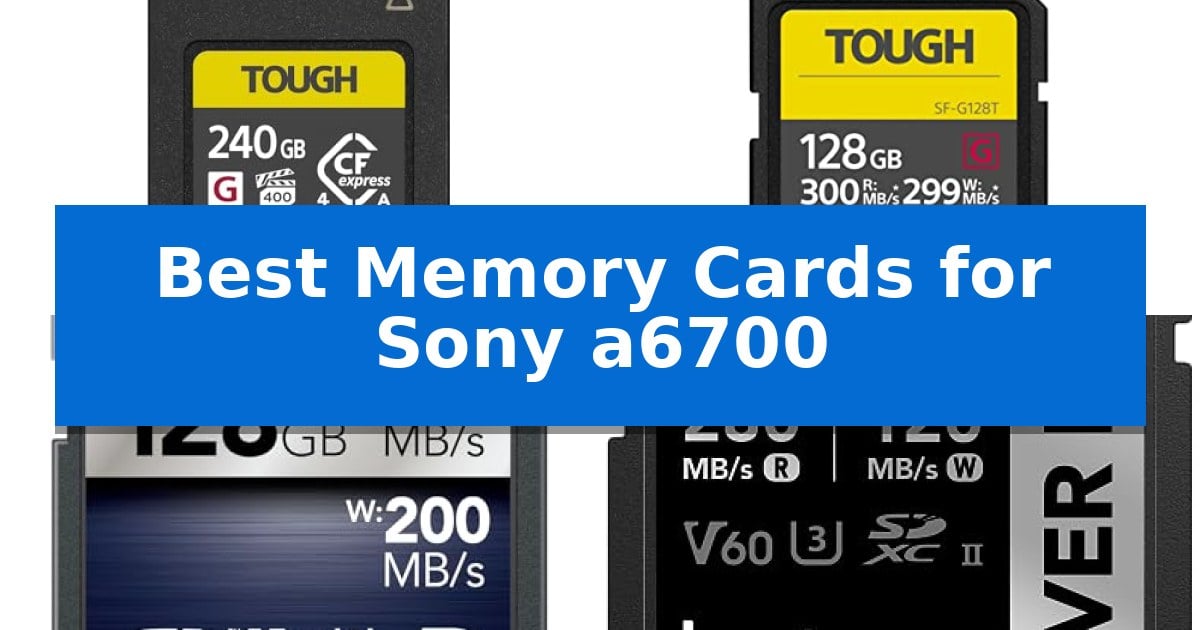
Capturing high-resolution stills and high-bitrate video with the Sony a6700 requires storage media that can keep pace with the camera's advanced processing capabilities. Choosing the wrong card can lead to dropped frames, buffer bottlenecks, or corrupted files during critical moments, making it essential to select media that matches your specific workflow needs.
Finding the Best Memory Cards for Sony a6700 involves balancing read and write speeds, durability, and compatibility with your shooting style. Whether you are a professional videographer requiring sustained high-speed data transfer or an enthusiast looking for reliable storage for daily photography, the right card ensures your camera performs at its peak without interruption.
You may also want to compare Best Memory Cards for Sony A9, Best Memory Cards for Sony A7R V, and Best Memory Cards for Sony A7R IV.
Best Memory Cards for Sony a6700
Quick Comparison
| Product | Best For | Key Strength | Score |
|---|---|---|---|
| Sony CEA-G Series CFexpress Type A Card | Best Overall | Ultra-fast PCIe Gen 4 performance for rapid file transfers. | 4.9 |
| Sony TOUGH-G Series SDXC UHS-II Card | Maximum Durability for Field Work | One-piece molded construction provides industry-leading bend strength. | 4.7 |
| ProGrade Digital Iridium SDXC UHS-II Card | Optimized for Cinematic Workflows | High-speed performance with up to 300 MB/s read and 200 MB/s write speeds. | 4.6 |
| Lexar SILVER PRO SDXC UHS-II Card | Reliable Performance for Enthusiasts | Blazing-fast transfer speeds up to 280MB/s read and 120MB/s write. | 4.5 |
| Sony TOUGH-M Series SDXC UHS-II Card | Rugged Reliability for Daily Shoots | 18x stronger than standard UHS-II cards for superior physical durability. | 4.8 |
How We Chose
- Interface Compatibility: Verifying support for UHS-II and CFexpress Type A standards to ensure full utilization of the camera's internal bus speeds.
- Sustained Write Performance: Evaluating VPG certification and rated write speeds to prevent buffer clearing delays during 4K or high-speed burst shooting.
- Durability Ratings: Assessing build quality, including waterproof, dustproof, and bend-strength specifications for field reliability.
- Workflow Efficiency: Comparing read speeds to determine how quickly large files can be offloaded to editing workstations.
- Reliability Features: Identifying cards with advanced heat dissipation or specialized recovery software to protect data integrity.
1 Sony CEA-G Series CFexpress Type A Card — Unmatched Speed for Pro Video
High-bitrate video recording and rapid burst photography demand storage media that can keep pace with the advanced sensor capabilities of the Sony a6700. The Sony CEA-G Series CFexpress Type A Memory Card CEA-G240T addresses this need by utilizing next-generation PCIe Gen 4 technology, which enables read speeds of up to 1800MB/s and write speeds reaching 1700MB/s.
Beyond raw speed, this card is engineered for reliability during intensive production workflows. It carries VPG400 certification, a critical standard that guarantees stable, high-bitrate video recording without dropped frames. This ensures that your footage remains consistent, whether you are capturing high-resolution 4K or 8K content.
Physical durability is a core component of the design, featuring a reinforced Tough construction that protects data against the rigors of field use. To maintain performance during prolonged sessions, the card incorporates enhanced heat dissipation, which helps prevent thermal throttling and ensures stable operation when the camera is pushed to its limits.
For creators who prioritize workflow efficiency, the extreme transfer speeds significantly reduce the time spent moving large files from the camera to a workstation. This card is specifically built to integrate seamlessly with high-performance hardware, making it a robust choice for those who require consistent, professional-grade reliability in their media storage.
Best for: Professional videographers and photographers who require sustained high-speed performance for 4K/8K recording and rapid burst shooting.
Skip if: Casual users or those who do not require the extreme write speeds and VPG400 certification of CFexpress Type A media may find more cost-effective storage solutions.
PROS
- Ultra-fast PCIe Gen 4 performance for rapid file transfers.
- VPG400 certification ensures stable high-bitrate video recording.
- Reinforced Tough construction for increased physical durability.
- Enhanced heat dissipation maintains performance during long sessions.
CONS
- Premium price point compared to standard SD memory cards.
2 Sony TOUGH-G Series SDXC UHS-II Card — Maximum Durability for Field Work
Reliability in the field often depends on the physical integrity of your media, and the Sony TOUGH-G Series SDXC UHS-II Card addresses this with a one-piece molded construction. This design achieves an extreme level of bend strength, rated 18 times greater than standard SD cards, providing a robust solution for photographers who frequently swap cards in demanding environments.
Beyond its structural resilience, this card features a ribless, no-write-protection-switch design. By removing these traditionally fragile components, the card minimizes potential failure points. It is also rated for IPX8 waterproof and IP6X dustproof protection, ensuring that internal data remains shielded against environmental hazards.
For high-speed workflows, the card supports UHS-II performance with transfer speeds up to 300 MB/s and write speeds up to 299 MB/s. These specifications are optimized for 4K video recording and high-speed continuous burst mode shooting, making it a capable companion for the high-resolution capabilities of the Sony a6700.
While the card is engineered for peak performance in UHS-II devices, it maintains backward compatibility with UHS-I equipment. In such setups, users can expect speeds up to 95 MB/s for transfers and 90 MB/s for writing, allowing for flexible use across a wider range of hardware.
Best for: Photographers and videographers who prioritize extreme physical durability and high-speed write performance for 4K recording in challenging field conditions.
Skip if: Users who primarily shoot casual, low-bitrate content and do not require the specialized structural reinforcement or high-speed UHS-II write capabilities.
PROS
- One-piece molded construction provides industry-leading bend strength.
- Ribless design removes fragile parts to increase long-term durability.
- IPX8 and IP6X ratings ensure high-level protection against water and dust.
- High-speed write performance supports demanding 4K video and burst shooting.
CONS
- Premium design features may exceed the requirements of casual photographers.
- Lack of a physical write-protection switch prevents manual locking of the card.
3 ProGrade Digital Iridium SDXC UHS-II Card — Optimized for Cinematic Workflows
The ProGrade Digital Iridium SDXC UHS-II Card is engineered for demanding cinematic workflows, featuring an optimized controller and firmware specifically designed to handle the high data requirements of 4K and 8K RAW video capture. This 128GB card provides a reliable storage foundation for the Sony a6700, ensuring consistent performance during intensive recording sessions.
Performance is defined by a read speed of up to 300 MB/s and a write speed of up to 200 MB/s, supported by a minimum sustained write speed of 90 MB/s. These specifications meet the U3 Speed Class requirements, allowing for efficient file transfers and stable data throughput during high-bitrate recording. The card is built for professional environments, undergoing rigorous 100% testing and serialized tracking of key manufacturing components.
To maintain long-term reliability, the card is compatible with ProGrade Digital Refresh Pro software, which allows users to sanitize the flash memory and monitor card health. This utility is particularly useful for identifying potential performance degradation before critical shoots. The unit is backed by a three-year warranty, reflecting the manufacturer's quality assurance standards for its flash memory products.
While this card offers robust specifications for high-resolution video, users should note that the Refresh Pro software is sold separately. The card is designed for broad compatibility across various camera systems, including Sony, Canon, and Nikon, making it a versatile choice for photographers and videographers managing multiple camera bodies.
Best for: Professional videographers and photographers using the Sony a6700 for 4K/8K RAW recording who require sustained write speeds and reliable data management.
Skip if: Casual users who do not require high-speed UHS-II performance or those who prefer an all-in-one software package without additional purchases.
PROS
- High-speed performance with up to 300 MB/s read and 200 MB/s write speeds.
- Optimized firmware specifically tuned for 4K and 8K cinematic workflows.
- Rigorous quality control including 100% testing and serialized component tracking.
- Health monitoring support via ProGrade Digital Refresh Pro software.
CONS
- Refresh Pro software is available separately rather than included.
- UHS-II interface may be overkill for basic photography needs.
4 Lexar SILVER PRO SDXC UHS-II Card — Reliable Performance for Enthusiasts
Capturing high-resolution 4K UHD video and burst-mode photography requires a storage solution that can keep pace with the demands of modern mirrorless systems. The Lexar 128GB SILVER PRO SD Memory Card is engineered to support these workflows by providing blazing-fast transfer speeds of up to 280MB/s read and 120MB/s write, ensuring that large files move from the camera to your editing suite without unnecessary delay.
Designed for versatility, this UHS-II card is built to handle the sustained write requirements of high-bitrate video capture, preventing dropped frames or buffering during recording. Its V60 rating ensures reliable performance for demanding video tasks, while the 128GB capacity provides ample space for extended shooting sessions, making it a practical choice for both photographers and videographers.
Compatibility is a primary focus for this storage medium. The card is backwards-compatible with UHS-I devices, allowing it to function seamlessly across a range of hardware, including cameras, drones, and existing card readers. This flexibility ensures that you can integrate it into your current setup immediately without needing additional proprietary adapters.
Reliability is supported by rigorous testing across various imaging devices, and the inclusion of a lifetime limited warranty provides long-term peace of mind. Users also gain access to the free Lexar Recovery Tool, which serves as a safeguard for data integrity. By balancing high-speed performance with broad compatibility, this card offers a stable foundation for professional and enthusiast workflows alike.
Best for: Photographers and videographers who require reliable, high-speed storage for 4K video capture and burst photography on UHS-II compatible cameras.
Skip if: Users who do not require UHS-II speeds or those looking for extreme-capacity cards beyond 128GB for long-form 8K production.
PROS
- Blazing-fast transfer speeds up to 280MB/s read and 120MB/s write.
- V60 and U3 ratings ensure stable 4K UHD video capture.
- Backwards-compatible with UHS-I devices for broad hardware support.
- Includes a lifetime limited warranty and access to recovery software.
CONS
- Performance limited to V60 standards, which may not meet the requirements of the highest-bitrate 8K video formats.
5 Sony TOUGH-M Series SDXC UHS-II Card — Rugged Reliability for Daily Shoots
Reliability during demanding shoots is a primary concern for photographers, and the Sony TOUGH-M Series SDXC UHS-II Card addresses this with a specialized Toughness design that is rated 18x stronger than standard UHS-II cards. This construction is designed to withstand the rigors of field work, providing a robust storage solution for the Sony a6700.
Beyond its physical durability, this card features IPX8 waterproof and IPX6 dustproof ratings, protecting your data against environmental hazards. It supports 4K video recording, making it a capable choice for high-resolution video workflows. With read speeds up to 277MB/s and write speeds up to 150MB/s, it facilitates efficient data transfer and reliable capture.
The 128GB capacity provides ample space for extended sessions, and the inclusion of a five-year limited warranty underscores the manufacturer's commitment to long-term performance. This card balances high-speed capabilities with a focus on structural integrity, ensuring that critical footage remains secure even in challenging shooting conditions.
When integrating this card into a Sony a6700 setup, users benefit from a design that minimizes the risk of breakage or environmental damage. While it offers high-speed performance suitable for 4K recording, it is specifically engineered for those who prioritize physical resilience alongside technical reliability.
Best for: Photographers and videographers who require high-speed 4K recording and maximum physical durability in harsh field environments.
Skip if: Users who primarily shoot low-bitrate content or operate exclusively in controlled studio environments where extreme physical toughness is not a requirement.
PROS
- 18x stronger than standard UHS-II cards for superior physical durability.
- IPX8 waterproof and IPX6 dustproof ratings for environmental protection.
- Supports 4K video recording with reliable write speeds.
- Includes a five-year limited warranty.
CONS
- Premium pricing compared to standard SD cards due to the reinforced construction.
Best Memory Cards for Sony a6700 Buying Guide
Understanding Memory Card Standards
The Sony a6700 utilizes an SD card slot that supports UHS-II technology. It is crucial to understand that while UHS-I cards will function, they will significantly limit the camera's burst mode and video recording capabilities. UHS-II cards provide a secondary row of pins that enable much faster data transfer rates, which are necessary for high-bitrate video formats.
For users who prioritize speed, understanding the Video Speed Class (V) is essential. A V60 or V90 rating indicates the minimum sustained write speed of the card. A V90 card is generally recommended for the most demanding 4K recording modes to ensure that the camera's data stream is never interrupted by a slow write process.
Durability and Environmental Protection
Memory cards used in mirrorless cameras are often exposed to harsh conditions. Tough-spec cards are designed with a one-piece molded construction that offers superior bend strength and resistance to impact compared to standard plastic SD cards. This design often removes fragile components like the write-protection switch, which can break off and damage the camera's card slot.
Look for IPX8 waterproof and IP6X dustproof certifications if you frequently shoot outdoors. These ratings confirm that the card can withstand submersion and fine particulate matter, protecting your footage from environmental hazards that could otherwise lead to data loss.
The Importance of Heat Dissipation
High-resolution video recording generates significant heat within the camera and the memory card itself. Cards that feature enhanced heat dissipation technology are less likely to throttle their performance during long recording sessions. This stability is vital for maintaining consistent frame rates in high-bitrate video modes.
If you notice your camera stopping recording unexpectedly, it may be due to the card reaching its thermal limit. Investing in cards engineered for stable high-bitrate recording can prevent these thermal shutdowns, allowing for longer, more reliable shooting sessions.
Workflow and Offloading Speeds
The speed of your memory card is not just about recording; it is also about how quickly you can move files to your computer. Cards with high read speeds—often reaching up to 300MB/s—drastically reduce the time spent waiting for large RAW photo files or 4K video clips to transfer to your editing software.
Using a high-speed card reader that supports the UHS-II interface is necessary to take advantage of these read speeds. Without a compatible reader, even the fastest card will be throttled to the speed of the connection, negating the benefits of your investment.
Data Recovery and Maintenance
Flash memory can experience performance degradation over time. Some manufacturers provide access to recovery software or proprietary tools that allow you to sanitize or refresh your card. These tools can help maintain peak performance and monitor the health of the card before an important shoot.
Always format your memory card in the camera before starting a new project. This ensures the file system is optimized for the specific camera's architecture, reducing the risk of file corruption and ensuring that the card's full capacity is available for your session.
Frequently Asked Questions
Can I use a UHS-I card in my Sony a6700?
Yes, you can use a UHS-I card, but it will not support the camera's highest performance modes. You will likely experience a slower buffer clearing time during burst photography and may be unable to record high-bitrate video.
What is the difference between V60 and V90 cards?
The 'V' rating stands for Video Speed Class. A V60 card guarantees a minimum sustained write speed of 60MB/s, while a V90 card guarantees 90MB/s. V90 is recommended for the most demanding 4K video settings.
Why do some cards have no write-protection switch?
Cards without a write-protection switch, often labeled as 'ribless' or 'Tough' design, are engineered to be more durable. Removing the switch eliminates a common point of failure that can break off and damage the camera's card slot.
Do I need a special card reader for UHS-II cards?
To achieve the maximum read speeds advertised on UHS-II cards, you must use a card reader that is specifically UHS-II compatible. A standard UHS-I reader will only read the card at slower, legacy speeds.
How often should I format my memory card?
It is best practice to format your memory card in the camera after you have successfully backed up your files to a computer. This keeps the file system clean and helps prevent errors.
Conclusion: Our Top Pick
For photographers and videographers seeking the highest level of performance and reliability, the Sony CEA-G Series CFexpress Type A Card stands out as the premier choice. Its integration of PCIe Gen 4 technology allows for exceptional read and write speeds, making it ideal for the most demanding high-resolution workflows and sustained high-bitrate video recording.
While other SD-based options provide excellent durability and sufficient speeds for most tasks, the Sony CEA-G Series offers the stability and throughput required to ensure that your camera's internal buffer is cleared quickly and your data remains secure. It is a robust investment for those who cannot afford to compromise on performance during critical shoots.