
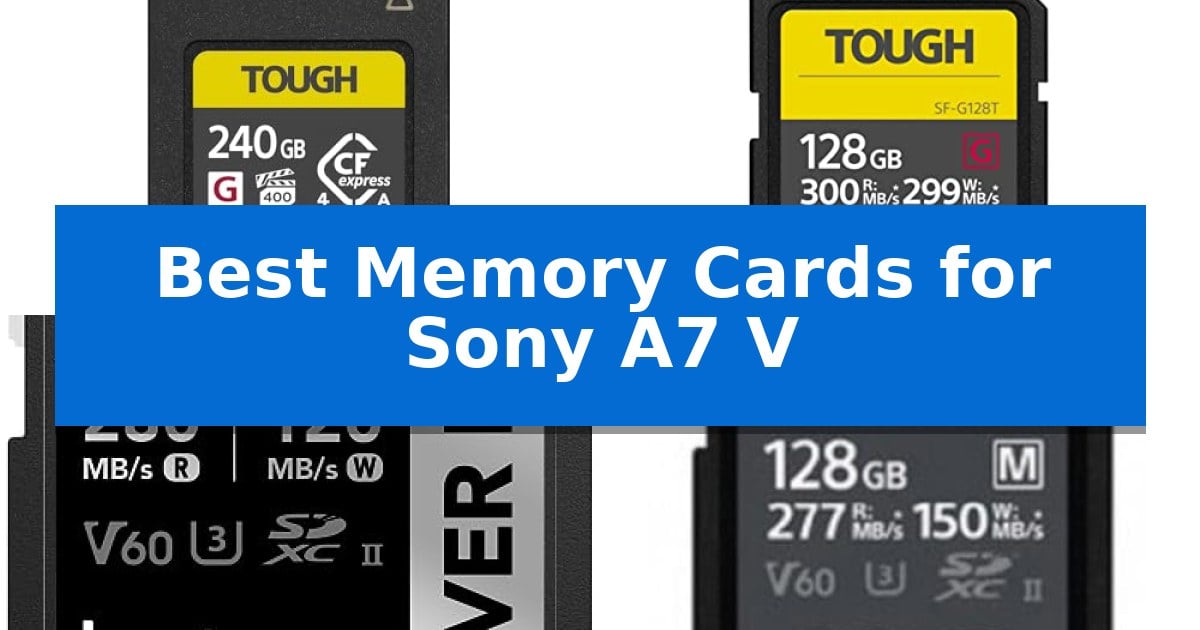
Selecting the right storage media is critical for maintaining the performance of your camera during demanding shooting sessions. Whether you are capturing high-resolution stills or recording high-bitrate video, the Best Memory Cards for Sony A7 V must provide the necessary write speeds to prevent buffer bottlenecks and ensure data integrity.
Our evaluation focuses on cards that meet the specific interface requirements of the Sony A7 V, balancing capacity, transfer speed, and physical durability. By choosing a card tailored to your specific shooting needs, you can ensure your camera remains responsive and your footage is safely stored during every assignment.
You may also want to compare Best Memory Cards for Sony A7 IV, Best Memory Cards for Sony A7, and Best Memory Cards for Sony 4K Cameras.
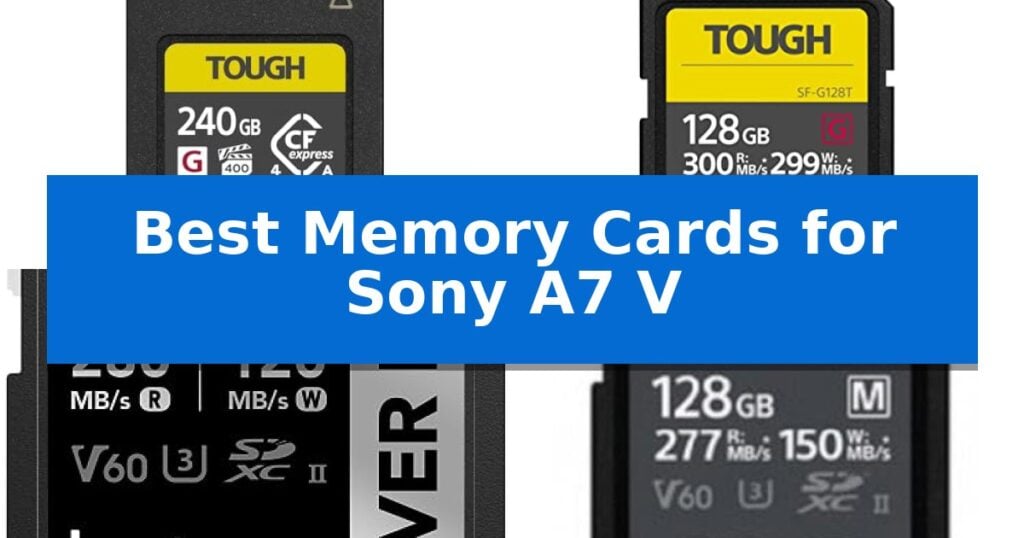
Best Memory Cards for Sony A7 V
Quick Comparison
| Product | Best For | Key Strength | Score |
|---|---|---|---|
| Sony CEA-G Series CFexpress Type A Card | Best Overall | Ultra-fast performance with up to 1800MB/s read and 1700MB/s write speeds. | 4.9 |
| Sony TOUGH-G Series UHS-II SD Card | Rugged Reliability for Burst Shooting | One-piece molded construction offers 18x greater bend strength than standard cards. | 4.8 |
| Lexar SILVER PRO UHS-II SD Card | Fast Transfers for High-Res Video | High-speed data transfer with up to 280MB/s read performance. | 4.9 |
| Sony TOUGH-M Series UHS-II SD Card | Durable Performance for 4K Capture | 18x stronger than standard UHS-II cards for superior physical durability. | 4.4 |
| SanDisk Extreme PRO UHS-I SD Card | Reliable Option for Standard Recording | UHS-I performance with sustained V30 video capture. | 4.3 |
How We Chose
- Interface Compatibility: Verifying support for CFexpress Type A and UHS-II SD standards to ensure full camera functionality.
- Sustained Write Performance: Evaluating VPG and speed class ratings to confirm stability during high-bitrate video capture.
- Transfer Efficiency: Comparing read speeds to determine how quickly data can be offloaded to workstations.
- Build Integrity: Assessing physical durability features like moisture resistance and bend strength for field reliability.
- Capacity Scaling: Considering storage volume relative to the data demands of high-resolution image formats.
1 Sony CEA-G Series CFexpress Type A Card — Maximum Speed for Pro Workflows
Capturing high-resolution imagery and high-bitrate video requires a storage medium capable of keeping pace with the advanced processing demands of modern cameras. The Sony CEA-G Series CFexpress Type A Memory Card CEA-G240T addresses this need by utilizing next-gen PCIe Gen 4 technology, providing a robust foundation for professional workflows that prioritize speed and data integrity.
Engineered for demanding environments, this card features reinforced Tough construction to withstand rigorous field use. Beyond physical durability, it incorporates enhanced heat dissipation to maintain consistent performance during extended recording sessions, preventing thermal throttling that could otherwise interrupt a shoot.
The card is specifically optimized for high-performance tasks, boasting read speeds up to 1800MB/s and write speeds up to 1700MB/s. These specifications ensure that clearing large buffers during burst photography or transferring massive video files to a workstation happens with minimal downtime.
For videographers, the VPG400 certification is a critical inclusion, guaranteeing stable, high-bitrate recording without dropped frames. This makes the card a reliable choice for complex 4K and 8K workflows, ensuring that the data captured matches the high fidelity of the camera's sensor output.
Best for: Professional photographers and videographers requiring high-speed, reliable storage for 4K/8K video and continuous burst shooting.
Skip if: Users who do not own a camera specifically compatible with the CFexpress Type A format or those who do not require high-bitrate recording capabilities.
PROS
- Ultra-fast performance with up to 1800MB/s read and 1700MB/s write speeds.
- VPG400 certification ensures stable high-bitrate video recording.
- Reinforced Tough construction provides increased physical durability.
- Enhanced heat dissipation maintains stable performance during intensive use.
CONS
- Proprietary format limits compatibility to specific CFexpress Type A devices.
2 Sony TOUGH-G Series UHS-II SD Card — Rugged Reliability for Burst Shooting
The Sony TOUGH-G Series UHS-II SD Card utilizes a distinctive one-piece molded construction that provides 18 times the bend strength of standard SD cards, making it a robust choice for photographers who frequently swap media in demanding environments. This design eliminates the traditional rib structure and write-protection switch, removing common failure points to ensure greater physical durability.
Designed for high-performance workflows, this card supports transfer speeds up to 300 MB/s and write speeds up to 299 MB/s. These specifications make it well-suited for 4K video recording and continuous burst mode shooting, allowing the camera to clear its buffer quickly. It is fully UHS-II, Class 10, and U3 compliant, ensuring compatibility with modern high-bitrate recording formats.
The card is built to withstand harsh conditions, featuring an IPX8 waterproof and IP6X dustproof rating. Its sealed monolithic structure allows it to operate across a wide temperature range, from -13°F to +185°F. While optimized for UHS-II cameras, it remains backward compatible with UHS-I equipment, though performance will be limited to standard UHS-I speeds.
Choosing this card involves balancing its extreme physical resilience against the lack of a physical write-protection switch. While the absence of the switch increases structural integrity, users who rely on that physical toggle to prevent accidental data erasure will need to manage file protection settings directly through their camera menu.
Best for: Professional photographers and videographers who require high-speed, durable storage for burst shooting and 4K video in challenging environments.
Skip if: Users who rely on a physical write-protection switch to manage their data security or those who do not require the high-speed benefits of UHS-II technology.
PROS
- One-piece molded construction offers 18x greater bend strength than standard cards.
- High-speed performance with up to 300 MB/s read and 299 MB/s write speeds.
- IPX8 waterproof and IP6X dustproof rating for reliable operation in extreme conditions.
- Ribless, switchless design removes fragile components prone to breakage.
CONS
- No physical write-protection switch, requiring reliance on camera-based software settings.
3 Lexar SILVER PRO UHS-II SD Card — Fast Transfers for High-Res Video
The Lexar 128GB SILVER PRO SD Memory Card is engineered to support demanding high-resolution workflows, offering read speeds up to 280MB/s and write speeds up to 120MB/s. This performance profile is designed to handle 4K UHD and 1080p Full-HD video capture without the risk of dropped frames or buffering, making it a capable companion for modern mirrorless cameras.
Beyond its raw speed, the card is built for professional reliability. It is UHS-II rated and V60 video speed class compliant, ensuring it maintains the sustained write speeds necessary for high-bitrate video recording. For photographers, the rapid read speeds significantly reduce the time required to offload large batches of high-resolution image files to a computer, streamlining the transition from the field to the editing suite.
Compatibility is a primary design focus, as the card remains backwards-compatible with UHS-I devices at their maximum supported speeds. This flexibility allows it to function across a range of equipment, from professional mirrorless bodies to secondary cameras or card readers. The unit is also rigorously tested for performance under pressure, ensuring consistent operation across varied environments.
To provide long-term utility, the card includes a lifetime limited warranty and access to the Lexar Recovery Tool for data management. These additions offer a layer of security for professional and enthusiast users who rely on their storage media for critical projects, ensuring the hardware is supported throughout its operational life.
Best for: Professional photographers and videographers requiring reliable, high-speed storage for 4K video capture and rapid file offloading.
Skip if: Users who require extreme write speeds exceeding 120MB/s for high-frame-rate raw burst photography may find the write speed a limiting factor.
PROS
- High-speed data transfer with up to 280MB/s read performance.
- V60 and U3 ratings ensure stable 4K video recording.
- Backwards compatibility with UHS-I hardware.
- Lifetime limited warranty and included recovery software.
CONS
- 120MB/s write speed may be a bottleneck for ultra-high-resolution continuous burst shooting.
4 Sony TOUGH-M Series UHS-II SD Card — Durable Performance for 4K Capture
Reliability in the field often hinges on the physical resilience of your storage media, and the Sony TOUGH-M Series UHS-II SD Card is engineered specifically to withstand demanding environments. Featuring a specialized Toughness design, this card is rated to be 18x stronger than standard UHS-II alternatives, providing a robust solution for photographers who frequently operate in unpredictable conditions.
Beyond its physical durability, this card offers the technical throughput required for high-resolution workflows. It supports 4K video recording and delivers read speeds up to 277MB/s alongside write speeds up to 150MB/s. These specifications ensure that data transfer from the card to your workstation remains efficient, minimizing downtime during post-production.
The card is built for longevity and protection, carrying an IPX8 waterproof and IPX6 dustproof rating. These environmental safeguards are complemented by a five-year limited warranty, offering a layer of support for long-term use. Its 128GB capacity provides sufficient space for extended shooting sessions without the constant need for media swaps.
Choosing this card involves balancing its high-durability construction against its specific performance tier. While it excels in ruggedness, users prioritizing maximum burst-mode buffer clearing for ultra-high-speed continuous shooting might compare these V60-rated write speeds against higher-tier V90 options to ensure they meet the specific frame-rate demands of their camera settings.
Best for: Photographers and videographers who require a highly durable, weather-resistant storage solution for 4K video and reliable field performance.
Skip if: Users who require the absolute fastest write speeds for high-frame-rate continuous burst photography may find higher-tier V90 cards more suitable for their specific buffer-clearing needs.
PROS
- 18x stronger than standard UHS-II cards for superior physical durability.
- IPX8 waterproof and IPX6 dustproof ratings for environmental protection.
- 4K video recording support with efficient 277MB/s read speeds.
- Includes a five-year limited warranty.
CONS
- V60 speed class may be a limiting factor for users needing the fastest possible write speeds for high-speed continuous shooting.
5 SanDisk Extreme PRO UHS-I SD Card — Reliable Option for Standard Recording
Capturing high-resolution imagery and 4K video requires reliable media that can keep pace with the demands of modern mirrorless cameras. The SanDisk 256GB Extreme PRO SD Memory Card is engineered to support intensive workflows, providing the necessary throughput for sequential burst mode photography and 4K UHD video recording.
This card is built to meet UHS Speed Class 3 (U3) and Video Speed Class 30 (V30) standards, ensuring a sustained write speed of at least 30MB/s for real-time video capture. With shot speeds up to 140MB/s, it handles rapid-fire shutter releases effectively, while the proprietary SanDisk QuickFlow Technology enables read speeds of up to 200MB/s when paired with compatible hardware like the SanDisk Professional PRO-READER.
Designed for durability and consistent performance, this 256GB storage solution offers ample capacity for long shooting sessions. The card is backed by a lifetime limited manufacturer warranty, providing long-term assurance for professional and enthusiast photographers alike.
While this card excels in standard recording environments, users should ensure their host device is compatible with the UHS-I interface to achieve optimal performance. It is a robust choice for those who prioritize reliable data management and efficient offloading speeds in their daily photography setup.
Best for: Photographers and videographers who need reliable, high-capacity storage for 4K video recording and sequential burst photography.
Skip if: Users requiring the extreme write speeds of UHS-II or CFexpress cards for high-bitrate professional cinema formats or ultra-fast buffer clearing.
PROS
- UHS-I performance with sustained V30 video capture.
- QuickFlow Technology enables fast offload speeds up to 200MB/s.
- High capacity of 256GB suitable for extensive shooting.
- Lifetime limited warranty for added peace of mind.
CONS
- UHS-I interface limitations compared to UHS-II or CFexpress standards.
- Maximum speeds require specific compatible card readers.
Best Memory Cards for Sony A7 V Buying Guide
Understanding Memory Card Interfaces
The Sony A7 V utilizes advanced memory slots that support different card standards. CFexpress Type A cards are essential for unlocking the camera's maximum potential, particularly for high-bitrate video and sustained burst shooting, as they leverage PCIe Gen 4 technology for superior throughput.
Alternatively, UHS-II SD cards offer a balance of performance and cost. While they do not reach the extreme speeds of CFexpress, they are highly capable for standard 4K recording and high-speed photography, provided they meet the necessary V90 or V60 speed class requirements.
The Importance of Speed Classes
Speed classes, such as V60, V90, or VPG400, are not just marketing labels; they define the minimum sustained write speed of the card. For the Sony A7 V, using a card that falls below the recommended speed class can result in dropped frames during video recording or a sluggish buffer during continuous shooting.
Always check the video bitrate settings on your camera. If you frequently record in high-quality modes, prioritize cards with VPG400 certification or V90 ratings to ensure the card can keep pace with the data stream generated by the sensor.
Durability and Field Reliability
Professional photography often takes place in unpredictable environments. Cards featuring reinforced Tough construction or monolithic molded designs provide significantly higher bend strength and impact resistance compared to standard cards.
Look for cards with high IPX8 waterproof and IPX6 dustproof ratings if you shoot outdoors. These features protect your data from environmental hazards, ensuring that your work remains safe even if the card is exposed to moisture or debris.
Optimizing Your Offload Workflow
The time spent transferring files from your card to your computer is a significant part of the creative process. Cards with high read speeds, such as those reaching up to 1800MB/s, drastically reduce wait times when moving large batches of high-resolution files.
To achieve these advertised speeds, ensure you are using a compatible high-speed card reader. Using an outdated or low-bandwidth reader will create a bottleneck, effectively nullifying the performance benefits of a high-end memory card.
Capacity Considerations
Choosing the right capacity depends on your file format and shooting volume. High-resolution RAW files and 4K/8K video consume storage rapidly, making 128GB or 256GB capacities the standard starting point for most professionals.
If you are shooting long-form video, consider the trade-off between using one large-capacity card versus multiple smaller ones. While a single large card is convenient, using multiple cards provides a layer of redundancy, ensuring that a single card failure does not result in the loss of an entire day's work.
Frequently Asked Questions
Can I use a UHS-I card in my Sony A7 V?
Yes, the camera is backward compatible with UHS-I cards. However, you will be limited by the slower write speeds of the UHS-I standard, which may prevent you from using certain high-bitrate video modes or high-speed burst settings.
What is the difference between V60 and V90 ratings?
The V60 rating guarantees a minimum sustained write speed of 60MB/s, while V90 guarantees 90MB/s. V90 is generally required for more demanding 4K video recording and faster continuous burst photography.
Why do CFexpress Type A cards cost more?
CFexpress Type A cards utilize advanced PCIe technology to achieve significantly higher read and write speeds compared to traditional SD cards. This performance is necessary for the most data-intensive workflows supported by the camera.
Do I need a special reader for these cards?
Yes, to realize the full transfer speed potential of CFexpress Type A or high-end UHS-II SD cards, you should use a card reader specifically designed for those interfaces.
Are these cards durable enough for extreme temperatures?
Many high-performance cards, particularly those with 'Tough' branding, are tested for operation in a wide temperature range. Always check the specific manufacturer's technical data sheet for the operating temperature limits of your card.
Conclusion: Our Top Pick
For photographers and videographers who require the absolute best performance from their equipment, the Sony CEA-G Series CFexpress Type A Card is the clear choice. Its integration of PCIe Gen 4 technology allows for industry-leading read and write speeds, making it the most reliable option for high-bitrate 4K and 8K video workflows and demanding burst photography.
While this card represents a significant investment, its VPG400 certification and reinforced construction provide the stability and durability necessary for professional environments. If your workflow involves heavy data demands, this card ensures your camera's buffer clears quickly and your footage is captured without interruption.