
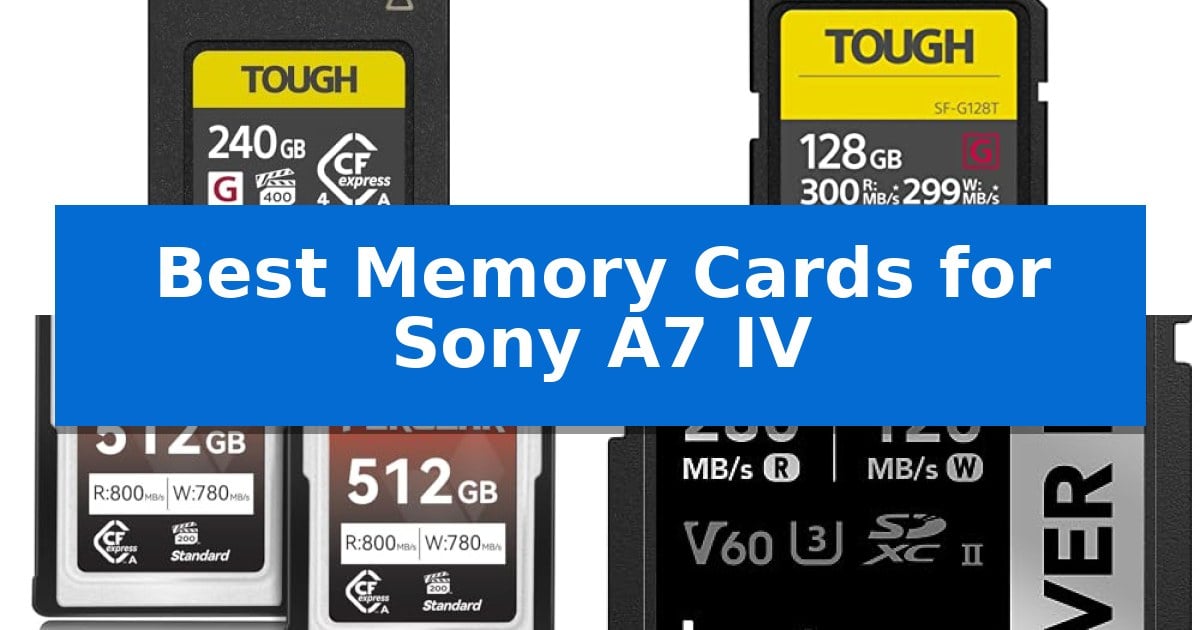
Selecting the right storage for your camera is essential for maintaining consistent performance during high-resolution shooting. The Best Memory Cards for Sony A7 IV must balance write speeds, capacity, and reliability to ensure your footage and images are captured without interruption.
Whether you are recording high-bitrate video or capturing rapid-fire bursts, the card you choose directly impacts your camera's buffer and offloading efficiency. This guide examines top-tier storage options to help you match your specific shooting requirements with the right media technology.
You may also want to compare Best Memory Cards for Sony A7, Best Memory Cards for Sony 4K Cameras, and Best Memory Cards for Smartphones.
Best Memory Cards for Sony A7 IV
Quick Comparison
| Product | Best For | Key Strength | Score |
|---|---|---|---|
| Sony CEA-G CFexpress Type A Card | Best Overall | Next-gen PCIe Gen 4 technology enables ultra-fast read and write speeds. | 4.9 |
| Sony TOUGH-G SDXC UHS-II Card | Ultimate Durability and Speed | 18x greater bend strength than standard SD cards due to one-piece molding. | 4.9 |
| Pergear CFexpress Type A Card | High Capacity for Long Shoots | High-capacity 512GB storage per card for extended 8K RAW recording sessions. | 4.4 |
| Lexar SILVER PRO SD UHS-II Card | Efficient Workflow Performance | Blazing-fast transfer speeds up to 280MB/s read. | 4.4 |
| Sony TOUGH-M SDXC UHS-II Card | Reliable Rugged Protection | 18x stronger than standard UHS-II cards for superior physical durability. | 4.3 |
How We Chose
- Interface compatibility with the Sony A7 IV dual-slot system.
- Sustained write speeds required for high-bitrate video formats.
- Physical durability and environmental protection ratings.
- Capacity options for long-form recording and burst photography.
- Transfer speeds for efficient post-production workflows.
1 Sony CEA-G CFexpress Type A Card — Maximum Speed for Pro Video
High-bitrate video production and rapid burst photography demand storage media capable of keeping pace with the Sony A7 IV. The Sony CEA-G Series CFexpress Type A Memory Card CEA-G240T addresses this requirement by utilizing next-gen PCIe Gen 4 technology to deliver robust data throughput.
Engineered for demanding workflows, this card provides read speeds up to 1800MB/s and write speeds reaching 1700MB/s. These specifications facilitate efficient offloading of large files and ensure the camera buffer clears quickly during intensive shooting sessions. The inclusion of VPG400 certification guarantees stable, high-bitrate video recording, which is essential for maintaining consistent quality in 4K and 8K projects.
Beyond raw speed, the card features a reinforced Tough construction designed to withstand the rigors of field use. To maintain performance during prolonged recording sessions, the card incorporates enhanced heat dissipation, which helps prevent thermal throttling and ensures reliable operation.
This card is a specialized tool for users who prioritize workflow efficiency and hardware reliability. While its performance is optimized for high-end video and photography, users should ensure their specific workflow requires the CFexpress Type A interface to fully leverage these capabilities.
Best for: Professional photographers and videographers using the Sony A7 IV who require high-speed, reliable storage for 4K/8K video and continuous burst shooting.
Skip if: Casual shooters or those whose primary output does not require high-bitrate recording, as standard SD cards may provide sufficient capacity and speed at a lower cost.
PROS
- Next-gen PCIe Gen 4 technology enables ultra-fast read and write speeds.
- VPG400 certification ensures consistent, stable high-bitrate video recording.
- Reinforced Tough construction provides increased physical durability.
- Enhanced heat dissipation maintains stable performance during intensive tasks.
CONS
- Premium price point reflecting its specialized high-performance interface.
2 Sony TOUGH-G SDXC UHS-II Card — Ultimate Durability and Speed
The Sony TOUGH-G series SDXC UHS-II Card 128GB is engineered with a unique one-piece molded construction that achieves 18 times the bend strength of standard SD cards. This structural integrity is paired with a ribless, switchless design that eliminates common failure points, making it a reliable choice for the demanding environment of professional photography and videography with the Sony A7 IV.
Performance is driven by UHS-II, Class 10, and U3 compliance, supporting high-speed data handling. The card delivers transfer speeds up to 300 MB/s and write speeds up to 299 MB/s, which are essential for sustained 4K recording and high-speed continuous burst shooting. Its robust build is further reinforced by an IPX8 waterproof and IP6X dustproof rating, ensuring operation in harsh conditions ranging from -13℉ to +185℉.
While optimized for UHS-II compatible cameras to reach maximum throughput, the card remains backward compatible with UHS-I equipment, albeit at lower speeds of up to 95 MB/s transfer and 90 MB/s writing. This versatility allows it to serve as a primary high-performance medium for the Sony A7 IV while maintaining utility across a wider range of legacy hardware.
Best for: Professional photographers and videographers requiring extreme physical durability and high-speed write performance for 4K video and burst shooting.
Skip if: Casual users or those who do not require high-speed UHS-II performance or the extreme physical protection offered by the reinforced one-piece design.
PROS
- 18x greater bend strength than standard SD cards due to one-piece molding.
- High-speed performance with up to 300 MB/s read and 299 MB/s write speeds.
- IPX8 waterproof and IP6X dustproof rating for extreme environmental protection.
- Ribless, switchless design removes fragile components prone to breakage.
CONS
- Higher cost compared to standard UHS-I or lower-rated UHS-II cards.
- Performance limited to UHS-I speeds when used in non-UHS-II compatible equipment.
3 Pergear CFexpress Type A Card — High Capacity for Long Shoots
The Pergear 512GB CFexpress Type A Memory Card 2-Pack provides a high-capacity storage solution specifically engineered for demanding high-resolution video production. By offering substantial space for continuous 8K RAW recording, this card set addresses the needs of professionals utilizing Sony Alpha and FX series cameras who require reliable, sustained data throughput during long-form shoots.
Engineered for stable performance, these cards support maximum read speeds of up to 800 MB/s and write speeds of up to 780 MB/s. The design ensures a sustained write speed of 380 MB/s, which is critical for maintaining the integrity of high-bitrate footage without frame drops. These specifications are optimized for the Sony A7 IV, A1, A7SIII, A7RV, FX3, FX6, and A9III, ensuring seamless integration with the camera's internal recording systems.
Usability is enhanced by the inclusion of a two-pack, allowing for immediate backup or extended recording sessions without needing to offload data mid-shoot. Users should note that these cards are exclusively compatible with CFexpress Type A slots and will not function in Type B, CompactFlash, or CFast 2.0 hosts. To achieve the maximum advertised transfer speeds, a dedicated CFexpress Type-A reader is required.
The manufacturer backs this series with a 5-year support policy, covering non-human damage and providing replacements even if the card reaches its end-of-life cycle. This commitment to long-term reliability provides a clear safety net for creators investing in their professional equipment, ensuring that the storage medium remains a dependable component of the camera rig.
Best for: Professional videographers and photographers using Sony Alpha or FX cameras who require high-capacity, sustained write speeds for 4K and 8K RAW recording.
Skip if: Users who do not own a camera specifically equipped with a CFexpress Type A card slot, as this card is incompatible with Type B, SD, or older CompactFlash interfaces.
PROS
- High-capacity 512GB storage per card for extended 8K RAW recording sessions.
- Sustained write speed of 380MB/s ensures stable performance for high-bitrate video.
- 5-year support policy provides long-term peace of mind and replacement coverage.
- Optimized compatibility with a wide range of Sony Alpha and FX professional cameras.
CONS
- Strict format compatibility limited only to CFexpress Type A hosts.
- Dedicated reader required to achieve maximum advertised transfer speeds.
4 Lexar SILVER PRO SD UHS-II Card — Efficient Workflow Performance
Capturing high-resolution 4K video and rapid-fire bursts requires a storage medium that can keep pace with the Sony A7 IV. The Lexar 128GB SILVER PRO SD Memory Card is engineered to handle these demanding workflows, offering blazing-fast transfer speeds of up to 280MB/s read and 120MB/s write. This performance ensures that large photo and video files move in seconds, minimizing downtime between shoots.
Designed for reliability, this UHS-II, V60, U3 rated card is built to perform under pressure, whether you are recording 4K UHD footage or high-resolution stills. It effectively prevents dropped frames and buffering, allowing for consistent capture during extended sessions. Its high-capacity design makes it a practical choice for mirrorless camera users who prioritize both speed and storage space.
Workflow efficiency is a primary benefit of the Lexar 128GB SILVER PRO SD Memory Card. The accelerated read speeds significantly reduce the time spent offloading footage to editing software, which is essential for professionals working under tight deadlines. Furthermore, the card maintains backwards compatibility at UHS-I speeds, ensuring it remains functional across a variety of older card readers and secondary camera bodies.
Durability and peace of mind are integrated into the product design. The card is rigorously tested for performance and reliability across various hardware environments. Additionally, it comes with a lifetime limited warranty and access to the free Lexar Recovery Tool, providing a safety net for your data and long-term confidence in your storage investment.
Best for: Professional photographers and videographers who require high-speed, reliable storage for 4K video capture and rapid burst photography.
Skip if: Users who require V90-rated cards for the most intensive high-bitrate video formats or those who do not utilize UHS-II compatible hardware.
PROS
- Blazing-fast transfer speeds up to 280MB/s read.
- V60 and U3 ratings ensure smooth 4K UHD capture.
- Lifetime limited warranty included for long-term support.
- Backwards compatible with UHS-I devices.
CONS
- V60 speed class may not meet the requirements for the highest bitrate video modes on all professional cameras.
5 Sony TOUGH-M SDXC UHS-II Card — Reliable Rugged Protection
The Sony TOUGH-M SDXC UHS-II Card is engineered with a specialized Toughness design that provides 18x greater bending strength compared to standard UHS-II cards, making it a robust choice for photographers who frequently work in demanding field environments. This 128GB card is built to withstand physical stress while ensuring the high-speed data handling required for modern mirrorless cameras.
Performance is anchored by read speeds up to 277MB/s and write speeds up to 150MB/s, which facilitate efficient file transfers and reliable data capture. The card is fully capable of 4K video recording, providing the sustained throughput necessary for high-resolution cinematography without compromising on stability.
Durability extends beyond structural integrity, as the card features IPX8 waterproof and IPX6 dustproof ratings. These protections help shield sensitive data from environmental hazards, offering peace of mind when shooting in unpredictable weather conditions. The unit is backed by a five-year limited warranty.
While the card offers significant physical protection, users should ensure their workflow benefits from the UHS-II interface to fully utilize the rated transfer speeds. It serves as a dependable storage solution for those prioritizing hardware longevity and consistent performance in the field.
Best for: Photographers and videographers who require high-durability storage that can withstand harsh environmental conditions and physical impact.
Skip if: Users who primarily work in controlled studio environments and do not require the specialized ruggedized housing or the specific UHS-II speed class.
PROS
- 18x stronger than standard UHS-II cards for superior physical durability.
- IPX8 waterproof and IPX6 dustproof ratings for environmental protection.
- High-speed performance with up to 277MB/s read and 150MB/s write speeds.
- Supports 4K video recording for demanding production needs.
CONS
- Premium pricing associated with the specialized ruggedized construction.
Best Memory Cards for Sony A7 IV Buying Guide
Understanding Card Interfaces
The Sony A7 IV features a dual-slot system that supports both CFexpress Type A and SD UHS-II cards. CFexpress Type A provides significantly higher throughput, which is necessary for the most demanding video codecs and sustained burst shooting. It is the preferred choice for professional workflows requiring maximum data transfer rates.
SD UHS-II cards remain a versatile and cost-effective alternative for general photography and standard video recording. While they do not reach the speeds of CFexpress, they are widely compatible and sufficient for many high-resolution projects. Understanding your specific bitrate needs is key to choosing between these two standards.
The Importance of Write Speeds
Sustained write speed is the most critical metric for videographers. If a card's write speed drops below the camera's required bitrate, you may experience dropped frames or unexpected recording stops. Look for VPG400 or V90 ratings, which guarantee minimum sustained write performance.
For photographers, fast write speeds are equally important for clearing the camera's buffer during continuous shooting. A faster card allows you to keep shooting longer without waiting for the camera to write data to the storage medium.
Durability and Reliability
Professional cameras are often used in challenging environments, making card durability a vital consideration. Many modern cards feature reinforced construction or monolithic designs that offer increased bend strength and resistance to impact compared to standard SD cards.
Environmental sealing, such as IPX8 waterproof and IP6X dustproof ratings, provides an extra layer of security for your data. These features are particularly beneficial for outdoor photographers and videographers who frequently work in unpredictable weather conditions.
Capacity Considerations
Your choice of capacity should align with your typical shoot length and file formats. Recording in high-bitrate RAW or 4K/8K formats consumes storage rapidly, making higher-capacity cards like 512GB options a practical choice for long-form projects.
For shorter sessions or standard photography, 128GB cards often provide a better balance of cost and utility. Always consider the trade-off between having one large card versus multiple smaller cards, which can provide redundancy in case of a card failure.
Workflow Efficiency
The speed of your memory card also impacts how quickly you can offload files to your computer. High-speed cards significantly reduce the time spent transferring large volumes of data, allowing you to move into the editing phase faster.
To realize these benefits, ensure you are using a compatible high-speed card reader. Using a slow reader with a fast card will create a bottleneck, negating the time-saving advantages of your investment.
Frequently Asked Questions
Can I use CFexpress Type B cards in my Sony A7 IV?
No, the Sony A7 IV is only compatible with CFexpress Type A cards. Type B cards are physically larger and will not fit in the card slot.
What is the difference between V60 and V90 SD cards?
The 'V' rating indicates minimum sustained write speed in MB/s. A V60 card guarantees 60MB/s, while a V90 card guarantees 90MB/s, making V90 better suited for high-bitrate video.
Do I need a special reader for CFexpress Type A cards?
Yes, you must use a dedicated CFexpress Type A card reader to achieve the maximum transfer speeds supported by the card.
Are these cards backward compatible with older cameras?
Most SD UHS-II cards are backward compatible with UHS-I devices, though they will operate at the slower speeds of the older standard.
Is a 512GB card overkill for the Sony A7 IV?
It depends on your workflow. If you record long-form 4K video or shoot extensive RAW photo bursts, the extra capacity is highly beneficial for avoiding frequent card swaps.
Conclusion: Our Top Pick
Choosing the right storage is a fundamental step in ensuring your Sony A7 IV performs at its peak. For users who prioritize speed and reliability for professional video and high-speed photography, the Sony CEA-G CFexpress Type A Card stands out as the most capable option.
By leveraging PCIe Gen 4 technology, this card provides the necessary throughput for the most demanding recording modes. While it represents a higher initial investment, its performance and durability make it an essential tool for those who cannot afford to lose footage or deal with buffer limitations.