
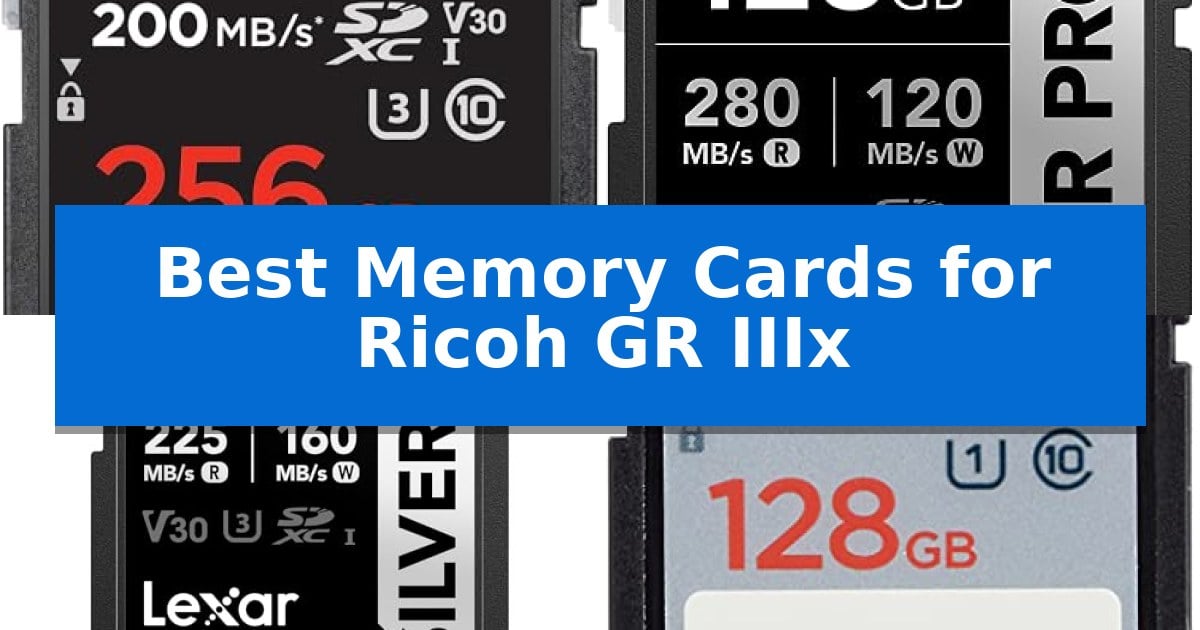
Selecting the right storage for your camera is a critical step in ensuring your creative process remains uninterrupted. When using a high-performance compact camera, the Best Memory Cards for Ricoh GR IIIx must balance write speeds with reliable data integrity to handle high-resolution images and video files without lag.
Whether you are capturing spontaneous street scenes or recording 4K footage, the right card prevents dropped frames and ensures your workflow remains efficient. We have evaluated four distinct options based on their technical specifications to help you find the storage solution that best matches your specific shooting requirements.
You may also want to compare Best Memory Cards for Raspberry Pi 5, Best Memory Cards for Point and Shoot Cameras, and Best Memory Cards for Photos and Videos.
Best Memory Cards for Ricoh GR IIIx
Quick Comparison
| Product | Best For | Key Strength | Score |
|---|---|---|---|
| SanDisk Extreme PRO SD Memory Card | Best Overall | High-speed data transfer with read speeds up to 200MB/s. | 4.9 |
| Lexar SILVER PRO SD Memory Card | Quickest Workflow Offloading | Fast 280MB/s read speeds for efficient file transfers. | 4.9 |
| Lexar Silver SD Memory Card | Reliable 4K Video Capture | Fast 225MB/s read speeds for efficient file offloading. | 4.7 |
| SanDisk Ultra SDXC Memory Card | Budget Friendly Everyday Storage | 128GB high-capacity storage for extensive photo and video collections. | 4.4 |
How We Chose
- Read and write speed capabilities for efficient file offloading and burst mode support.
- UHS and Video Speed Class ratings to ensure consistent 4K video recording performance.
- Capacity options to accommodate varying storage needs for long-term projects.
- Durability features that protect data in diverse environmental conditions.
- Compatibility with standard SD card readers and host devices.
1 SanDisk Extreme PRO SD Memory Card — Fastest Burst Mode Performance
Capturing high-resolution imagery and 4K video with the Ricoh GR IIIx requires a storage solution capable of handling sustained data throughput. The SanDisk 256GB Extreme PRO SD Memory Card provides the necessary overhead for demanding workflows, featuring UHS Speed Class 3 (U3) and Video Speed Class 30 (V30) ratings to ensure consistent performance during 4K UHD recording and sequential burst photography.
Engineered for efficiency, this card utilizes SanDisk QuickFlow Technology to achieve read speeds of up to 200MB/s, significantly reducing the time required to offload large files to a workstation. When paired with a compatible interface like the SanDisk Professional PRO-READER, users can maximize these transfer rates, streamlining the transition from the field to the editing suite.
The card is built to support high-intensity shooting scenarios, offering write speeds of up to 140MB/s. This capacity is vital for maintaining the responsiveness of the Ricoh GR IIIx during rapid-fire shooting, preventing buffer bottlenecks that can interrupt the creative process. With a 256GB capacity, it provides ample space for extensive shooting sessions without the need for frequent card swaps.
Reliability is a core component of the design, backed by a lifetime limited manufacturer warranty. The card's architecture is optimized for real-time video recording, ensuring that the data stream remains stable even during long-form 4K captures. It serves as a dependable foundation for photographers who prioritize both speed and data integrity in their daily operations.
Best for: Photographers and videographers requiring high-speed data transfer and reliable 4K video recording performance for their Ricoh GR IIIx.
Skip if: Users who do not require high-capacity storage or the specific QuickFlow read speeds for rapid file offloading may find lower-capacity or standard-speed cards more cost-effective.
PROS
- High-speed data transfer with read speeds up to 200MB/s.
- V30 and U3 ratings ensure stable 4K UHD video capture.
- Generous 256GB capacity for long-duration shooting.
- Lifetime limited warranty provides long-term peace of mind.
CONS
- Maximum read speeds require a compatible host device or reader.
- Premium pricing compared to lower-tier memory cards.
2 Lexar SILVER PRO SD Memory Card — Quickest Workflow Offloading
The Lexar 128GB SILVER PRO SD Memory Card is engineered to streamline high-resolution workflows, offering read speeds up to 280MB/s that significantly reduce the time spent offloading large photo and video files. This UHS-II, V60-rated card is built to maintain consistent performance during demanding 4K UHD and 1080p Full-HD capture, ensuring your camera remains responsive without dropped frames or buffering.
Designed for professionals and enthusiasts alike, this card provides 128GB of high-capacity storage, making it a reliable companion for the Ricoh GR IIIx when shooting high-resolution stills or extended video sequences. Its backwards compatibility with UHS-I devices ensures that it integrates seamlessly into your existing setup, whether you are using it in your camera or transferring data through a standard card reader.
Reliability is a core component of this storage solution, as it has been rigorously tested for performance and durability across various camera systems. To provide additional peace of mind, the card is backed by a lifetime limited warranty and includes access to the Lexar Recovery Tool, which assists in retrieving lost files should an unexpected data issue occur.
While the card offers high-speed performance, it is important to note that its maximum potential is realized when paired with UHS-II compatible hardware. For users primarily focused on casual, low-volume shooting, the advanced speed capabilities may exceed the immediate requirements of the camera, though it remains a future-ready investment for those planning to upgrade their broader photography equipment.
Best for: Photographers and videographers who require fast offload speeds and reliable, high-capacity storage for 4K video and high-resolution photography.
Skip if: Casual users who only shoot occasional JPEGs and do not require the high-speed transfer capabilities or the premium cost associated with UHS-II V60 technology.
PROS
- Fast 280MB/s read speeds for efficient file transfers.
- V60 and U3 ratings ensure stable 4K video recording.
- Lifetime limited warranty provides long-term confidence.
- Backwards compatible with UHS-I hardware.
CONS
- Premium pricing compared to standard UHS-I memory cards.
- Speed benefits are dependent on UHS-II compatible card readers.
3 Lexar Silver SD Memory Card — Reliable 4K Video Capture
Reliable storage is essential for capturing high-resolution images and video on the Ricoh GR IIIx, and the Lexar 128GB Silver SD Memory Card is engineered to meet these demands. With a V30 speed class rating, this card is capable of supporting 4K 60FPS video recording, ensuring smooth data capture for your creative projects.
Performance is defined by its 225MB/s maximum read speed, which significantly reduces wait times when transferring large files to your computer. For those who need to capture shots in quick succession, the 160MB/s maximum write speed provides the necessary throughput to keep the camera ready for the next frame without unnecessary delays.
Beyond raw speed, the card is built for challenging environments. Its durable design is wearproof, drop-proof, temperature-proof, x-ray-proof, shockproof, magnetic-proof, and vibration-resistant, offering peace of mind when shooting on location. It also includes a Lifetime Limited Warranty, reflecting a commitment to long-term reliability.
Whether you are a professional photographer or an enthusiast, this card offers broad compatibility across various camera systems. Its 128GB capacity provides ample space for extensive shooting sessions, making it a practical choice for those who prioritize efficiency and data integrity in their workflow.
Best for: Photographers and videographers who require reliable, high-speed storage for 4K video and high-resolution photography in varied environments.
Skip if: Users who require UHS-II or V60/V90 speed classes for specialized high-bitrate cinema workflows that exceed the V30 standard.
PROS
- Fast 225MB/s read speeds for efficient file offloading.
- V30 rating ensures stable 4K 60FPS video recording.
- Comprehensive durability features including shock and temperature resistance.
- Lifetime Limited Warranty for long-term support.
CONS
- UHS-I interface may limit maximum burst performance compared to UHS-II alternatives.
4 SanDisk Ultra SDXC Memory Card — Budget Friendly Everyday Storage
The SanDisk 128GB Ultra SDXC UHS-I Memory Card provides a reliable storage solution for photographers using the Ricoh GR IIIx who prioritize capacity and consistent performance for daily shooting. With its 128GB capacity, this card allows for extensive image storage and extended Full HD video recording, making it a practical choice for those who prefer to keep their workflow uninterrupted by frequent file transfers.
Engineered to meet UHS Speed Class 1 (U1) and Class 10 standards, this memory card is optimized for Full HD (1080p) video recording and high-quality still photography. The card supports quick transfer speeds up to 100MB/s, which assists in moving large batches of files from the camera to a computer efficiently, helping to streamline post-processing tasks.
Designed for durability and long-term utility, the card is backed by a 10-year limited manufacturer warranty. Its compact form factor ensures it fits seamlessly into the Ricoh GR IIIx card slot, while the robust build quality is intended to withstand the demands of regular use in various environments.
While this card excels at standard Full HD video and high-resolution still capture, users should note that performance can vary based on specific host device settings and file attributes. It serves as a dependable, high-capacity option for everyday photography needs without unnecessary complexity.
Best for: Photographers who need high-capacity, reliable storage for daily still photography and Full HD video recording.
Skip if: Users who require extreme write speeds for high-bitrate 4K video or professional-grade burst shooting sequences may need a higher-tier UHS-II or V-rated card.
PROS
- 128GB high-capacity storage for extensive photo and video collections.
- 100MB/s read speeds for efficient file transfers.
- Class 10 and UHS Speed Class 1 (U1) rating ensures stable Full HD video performance.
- 10-year limited manufacturer warranty provides long-term peace of mind.
CONS
- Write speeds may be lower than the maximum read speed depending on the host device.
- Not optimized for high-bitrate 4K video recording or ultra-fast buffer clearing.
Best Memory Cards for Ricoh GR IIIx Buying Guide
Understanding Speed Classes
Speed classes like V30 and U3 are essential indicators of a card's ability to handle sustained data writing. For the Ricoh GR IIIx, a V30 rating is generally the baseline requirement to ensure that 4K video recording does not suffer from buffering or dropped frames.
These ratings signify a minimum sustained write speed, which is critical for high-bitrate video. Choosing a card that meets or exceeds these standards guarantees that your camera's internal buffer clears quickly during rapid-fire photography.
The Importance of Read Speeds
While write speed is vital for capturing content, read speed determines how quickly you can transfer your files to a computer or editing suite. Cards featuring QuickFlow Technology or high-speed interfaces significantly reduce the time spent waiting for large batches of photos to import.
If you frequently shoot in RAW format, the file sizes can be substantial. Investing in a card with higher read speeds, such as those reaching 200MB/s, can drastically streamline your post-production workflow.
Capacity and Storage Management
Selecting the right capacity depends on your shooting habits and whether you prioritize video or still photography. A 128GB or 256GB card is often the sweet spot for most photographers, providing enough room for thousands of RAW files without the risk of losing everything on a single massive card.
Always consider the trade-off between having one large card versus multiple smaller ones. Using smaller capacities can act as a safety net, ensuring that a single card failure does not result in the loss of an entire trip's worth of work.
Durability and Reliability
Memory cards are often exposed to various environments, from dusty streets to humid climates. Look for cards that are explicitly rated as temperature-proof, shockproof, and x-ray-proof to ensure your data remains secure regardless of where you travel.
Reliability is not just about the physical build; it also involves the manufacturer's warranty. Opting for cards with a lifetime limited warranty provides peace of mind, knowing the manufacturer stands behind the longevity of their storage media.
Compatibility Considerations
While many modern cards are backwards compatible, it is important to ensure your card reader or camera interface supports the specific UHS-I or UHS-II standards of the card you purchase. Using a high-speed card in an older, slower reader will limit your transfer speeds to the reader's maximum capacity.
Always check the camera's manual to confirm the maximum supported capacity. While most modern cameras handle high-capacity cards well, verifying compatibility prevents potential errors during critical shooting sessions.
Frequently Asked Questions
Do I need a UHS-II card for the Ricoh GR IIIx?
The Ricoh GR IIIx is compatible with UHS-I cards. While UHS-II cards will work, you may not see the full speed benefits of the UHS-II interface unless the camera specifically supports it.
What does the V30 rating mean?
A V30 rating guarantees a minimum sustained write speed of 30MB/s, which is the standard requirement for reliable 4K video recording.
Can I use a 256GB card in my camera?
Yes, provided your camera's firmware supports SDXC cards, which most modern compact cameras do. Always check your specific camera model's documentation to confirm.
Why are my transfer speeds slower than the advertised speed?
Advertised speeds are often maximums achieved under ideal conditions. Actual speeds depend on your card reader, the USB port on your computer, and the host device's interface.
How often should I format my memory card?
It is recommended to format your memory card in-camera before every major shoot to ensure the file system is optimized and to minimize the risk of data corruption.
Conclusion: Our Top Pick
For photographers seeking the most consistent performance, the SanDisk Extreme PRO SD Memory Card stands out as the top recommendation. Its combination of V30 and U3 ratings ensures that it handles both high-resolution burst photography and 4K video recording with ease, making it a dependable choice for the Ricoh GR IIIx.
While other options offer faster theoretical read speeds for specific workflows, this card provides the best balance of reliability and speed for everyday use. Its robust design and proven performance in demanding conditions make it an essential accessory for any photographer looking to protect their work.