
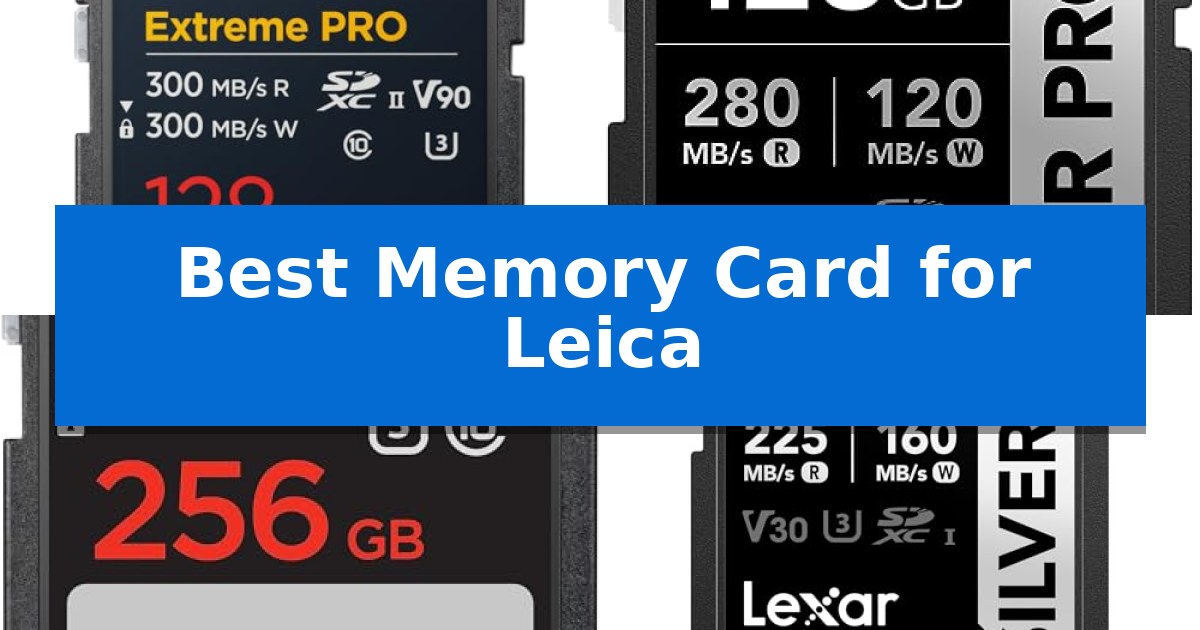
Selecting the right storage media is essential for maintaining the performance of your camera. When searching for the Best Memory Card for Leica, you must balance write speeds, capacity, and the specific interface requirements of your camera model to ensure seamless operation during burst shooting or high-bitrate video recording.
Our guide evaluates current SD card options, focusing on technical specifications like UHS-II and UHS-I standards, to help you understand which card best supports your specific shooting habits. Whether you prioritize rapid buffer clearing for street photography or reliable storage for long-form video, identifying the correct card is key to protecting your work.
You may also want to compare Best Memory Card for Laptop, Best Memory Card for Kodak Pixpro FZ45, and Best Memory Card for Kodak Pixpro Camera.
Best Memory Card for Leica
Quick Comparison
| Product | Best For | Key Strength | Score |
|---|---|---|---|
| SanDisk Extreme PRO UHS-II SD Card | Best Overall | High-speed 300MB/s write performance for rapid buffer clearing. | 4.9 |
| Lexar SILVER PRO UHS-II SD Card | Fast Workflow for High-Res Files | Blazing-fast transfer speeds up to 280MB/s read. | 4.7 |
| SanDisk Extreme PRO UHS-I SD Card | Reliable Speed for Burst Shooting | Sustained V30 performance for 4K UHD video recording. | 4.7 |
| Lexar Silver UHS-I SD Card | Optimized for Smooth 4K Video | V30 rating supports high-quality 4K 60FPS video capture. | 4.5 |
| Gigastone 4K Camera Pro SD Card | Budget Friendly High-Speed Capture | High-speed data transfer up to 170 MB/s for efficient file management. | 4.9 |
How We Chose
- Bus Interface: Evaluating UHS-II versus UHS-I support for compatibility with various camera models.
- Write Speed: Assessing the sustained write performance necessary for clearing the camera buffer during rapid burst sequences.
- Read Speed: Comparing offload times to determine how quickly files can be transferred to a workstation for editing.
- Durability: Reviewing manufacturer-stated resistance to environmental factors like water, dust, and physical impact.
- Capacity: Considering storage volume in relation to file size requirements for 4K and 8K video capture.
1 SanDisk Extreme PRO UHS-II SD Card — Professional Grade 8K Performance
Capturing high-resolution imagery requires a storage medium that can keep pace with the rapid data throughput of modern cameras. The SanDisk Extreme PRO UHS-II SD Card is engineered to handle intensive workflows, offering up to 300MB/s write speeds that ensure your camera's buffer clears efficiently during high-speed burst shooting.
Beyond its speed, this card provides substantial capacity for demanding projects. With up to 512GB of storage, you can record extensive 4K UHD video at 60 fps or 8K video at 30 fps without the interruption of swapping cards. The UHS-II interface and V90 video speed class support the sustained data rates required for these high-bitrate formats.
Durability is a core design focus for this storage solution. It is built to withstand challenging environments, featuring IP68 water and dust resistance and tested resilience against drops of up to 6 meters. This rugged construction provides peace of mind when shooting on location in unpredictable conditions.
Workflow efficiency extends to the post-production phase, where the 300MB/s read speeds significantly reduce the time required to offload large files to your workstation. Additionally, the card includes a two-year subscription to RescuePRO Deluxe data recovery software, offering a safety net for restoring files that may be accidentally deleted or corrupted during the transfer process.
Best for: Professional photographers and videographers requiring high-speed buffer clearing and reliable storage for 8K video workflows.
Skip if: Users with older cameras that do not support the UHS-II interface will not be able to utilize the card's maximum speed capabilities.
PROS
- High-speed 300MB/s write performance for rapid buffer clearing.
- IP68 water and dust resistance for field durability.
- Includes two years of RescuePRO Deluxe software for file recovery.
- V90 speed class ensures stable performance for 8K and 4K video.
CONS
- Premium pricing associated with high-performance UHS-II technology.
- Requires UHS-II compatible hardware to achieve advertised transfer speeds.
2 Lexar SILVER PRO UHS-II SD Card — Fast Workflow for High-Res Files
High-resolution photography demands reliable storage that can keep pace with the rapid data throughput of modern mirrorless cameras. The Lexar 128GB SILVER PRO SD Memory Card is engineered to handle these intensive workflows, offering blazing-fast transfer speeds of up to 280MB/s read and 120MB/s write. This performance ensures that large photo and video files are moved in seconds, significantly reducing downtime during post-processing.
Designed for versatility, this card is fully capable of capturing 4K UHD and 1080p Full-HD video without dropped frames or buffering. Its UHS-II interface provides the necessary bandwidth for demanding recording tasks, while maintaining backwards compatibility with UHS-I devices. This flexibility allows it to integrate seamlessly into existing camera setups or card readers without requiring immediate hardware upgrades.
Reliability is central to the design of the Lexar 128GB SILVER PRO SD Memory Card, which has been rigorously tested for performance across various cameras, drones, and camcorders. To provide long-term peace of mind, the card includes a lifetime limited warranty and access to the free Lexar Recovery Tool, ensuring that your data remains protected even in the event of accidental deletion or corruption.
For professionals and enthusiasts on tight deadlines, the ability to accelerate the entire workflow is a primary benefit. By minimizing the time spent offloading high-capacity files, you can focus more on the creative aspects of your photography. The card's robust construction and high-speed capabilities make it a practical choice for those who frequently switch between high-resolution still photography and video capture.
Best for: Professional photographers and videographers who require high-speed, reliable storage for 4K video capture and rapid file offloading.
Skip if: Users who only operate older cameras that do not support UHS-II speeds or those who do not require high-capacity storage for large video files.
PROS
- Blazing-fast transfer speeds up to 280MB/s read.
- 4K UHD and 1080p Full-HD video capture support.
- Backwards compatible with UHS-I devices.
- Lifetime limited warranty included.
CONS
- UHS-II interface may be underutilized in older, non-compatible hardware.
3 SanDisk Extreme PRO UHS-I SD Card — Reliable Speed for Burst Shooting
Capturing high-resolution imagery and 4K video requires reliable storage that can keep pace with the demands of modern digital cameras. The SanDisk 256GB Extreme PRO SD Memory Card is engineered to support these workflows, offering sustained performance for both burst photography and high-bitrate video recording.
This card is built to meet UHS Speed Class 3 (U3) and Video Speed Class 30 (V30) standards, ensuring a sustained video capture rate of at least 30MB/s. These specifications make it a capable choice for photographers and videographers who need consistent write speeds to prevent dropped frames during 4K UHD video recording or rapid-fire sequential shooting.
Beyond recording performance, the card features SanDisk QuickFlow Technology, which enables read speeds of up to 200MB/s when paired with compatible hardware like the SanDisk Professional PRO-READER. This significantly reduces the time spent offloading large files to a computer, streamlining the post-production process.
Designed for durability and practical use, this 256GB capacity card provides ample space for extensive shooting sessions. It is backed by a lifetime limited manufacturer warranty, providing long-term assurance for professional and enthusiast gear setups.
Best for: Photographers and videographers who require reliable 4K video recording and fast offload speeds for high-resolution files.
Skip if: Users who do not have hardware compatible with proprietary QuickFlow technology or who require higher-tier V60 or V90 speed classes for specialized cinema-grade codecs.
PROS
- Sustained V30 performance for 4K UHD video recording.
- Fast read speeds up to 200MB/s with QuickFlow technology.
- Generous 256GB capacity for high-volume shooting.
- Lifetime limited warranty for long-term reliability.
CONS
- Proprietary speed requirements necessitate specific readers for maximum offload performance.
4 Lexar Silver UHS-I SD Card — Optimized for Smooth 4K Video
Capturing high-resolution imagery requires a storage solution that balances capacity with consistent throughput. The Lexar 256GB Silver SD Memory Card is engineered to meet these demands, providing a reliable foundation for photographers and videographers who need to move large files efficiently. By utilizing a V30 speed class rating, this card is specifically optimized to support 4K 60FPS video recording, ensuring that high-bitrate footage is captured smoothly without the risk of dropped frames.
Efficiency in post-production is largely determined by how quickly media can be offloaded. With a 225MB/s maximum read speed, this card significantly reduces the time spent transferring data to a workstation. For active shooting scenarios, the 160MB/s maximum write speed allows the camera buffer to clear rapidly, which is essential for maintaining momentum during high-burst sequences or extended recording sessions.
Beyond its technical specifications, the card is built to withstand the rigors of field use. Its durable design is wearproof, drop-proof, temperature-proof, x-ray-proof, shockproof, magnetic-proof, and vibration-resistant. This robust construction provides assurance when working in challenging environments, while the Lifetime Limited Warranty underscores the manufacturer's commitment to long-term data integrity.
Compatibility is a primary concern for professionals using diverse equipment. This card is designed to integrate seamlessly with major camera systems, including Canon, Sony, and Nikon. Whether you are a professional photographer or a dedicated enthusiast, the Lexar 256GB Silver SD Memory Card offers a dependable balance of speed and capacity for demanding workflows.
Best for: Photographers and videographers requiring reliable, high-capacity storage for 4K video recording and rapid file transfers.
Skip if: Users needing extreme write speeds for high-bitrate cinema-grade RAW video or professional sports photography may require V60 or V90 rated cards.
PROS
- V30 rating supports high-quality 4K 60FPS video capture.
- 225MB/s read speed enables fast offloading of large media files.
- Comprehensive durability features protect against drops, temperature, and magnetic interference.
- Lifetime Limited Warranty provides long-term support.
CONS
- UHS-I interface limits maximum theoretical speeds compared to UHS-II alternatives.
5 Gigastone 4K Camera Pro SD Card — Budget Friendly High-Speed Capture
Reliable high-speed data handling is essential when shooting high-resolution imagery, and the Gigastone 4K Camera Pro SD Card provides a robust solution for photographers using Leica cameras. With data transfer speeds up to 170 MB/s, this card is engineered to manage the intensive write requirements of 4K Ultra HD video and rapid burst photography, ensuring your workflow remains efficient.
Built for versatility, this full-sized SD card is compatible with a wide range of devices, including DSLRs, HD camcorders, and digital point-and-shoot cameras. Beyond its speed, the card is designed for durability in challenging environments, featuring waterproof, temperature-proof, x-ray-proof, shock-proof, and magnetic-proof construction to safeguard your files.
Practicality is integrated into the package, which includes a mini case for secure storage when the card is not in use. To provide long-term peace of mind, the product is backed by a 5-year limited warranty, reflecting the manufacturer's commitment to quality and data integrity for professional and enthusiast users alike.
Choosing the right storage medium involves balancing capacity and performance. At 256GB, this card offers substantial space for extensive shooting sessions, reducing the frequency of card swaps. While it is optimized for high-definition video, it remains a dependable choice for still photography, fitting seamlessly into various creative setups.
Best for: Photographers and videographers who require reliable, high-capacity storage for 4K video and high-resolution still images.
Skip if: Users who require specialized high-speed standards beyond UHS-I or those using cameras that strictly mandate proprietary storage media.
PROS
- High-speed data transfer up to 170 MB/s for efficient file management.
- Durable construction that is waterproof, shock-proof, and temperature-proof.
- 5-year limited warranty for long-term reliability.
- Includes a mini case for convenient and safe storage.
CONS
- UHS-I interface may be a bottleneck for cameras requiring faster UHS-II or CFexpress standards.
Best Memory Card for Leica Buying Guide
Understanding SD Card Standards
The primary distinction in modern SD cards is the bus interface, specifically UHS-II versus UHS-I. UHS-II cards feature an extra row of pins, allowing for significantly faster data transfer speeds, which is critical for high-resolution cameras that generate large file sizes. If your camera supports the UHS-II standard, using a compatible card can drastically reduce the time spent waiting for the buffer to clear.
For those using older or more compact models, UHS-I cards remain a reliable and cost-effective choice. While they do not offer the same peak speeds as UHS-II variants, they are often sufficient for standard photography and 4K video recording. Always verify your camera's manual to confirm which standard it supports to avoid paying for performance you cannot utilize.
The Importance of Write Speeds
Write speed is the most critical metric for photographers who shoot in continuous burst mode. A card with a high sustained write speed ensures that the camera’s buffer does not fill up, which would otherwise force the camera to pause or slow down. Look for cards with V30, V60, or V90 video speed class ratings, as these indicate a guaranteed minimum write speed for video capture.
If you frequently shoot in RAW format or record high-bitrate video, prioritize cards that explicitly state their write performance. A card that is too slow will not only cause dropped frames in video but can also lead to missed shots during action sequences, as the camera waits for the data to be written to the card.
Durability and Data Protection
Because memory cards are often exposed to the elements, their physical construction matters. Many professional-grade cards are tested for water, dust, and shock resistance, providing an extra layer of security for your data. Features like IP68 ratings or drop-test certifications are valuable if you frequently shoot in challenging outdoor environments.
Additionally, consider the availability of data recovery software. Some manufacturers include access to tools that can help restore files accidentally deleted or corrupted. While this should never replace a robust backup strategy, having a recovery option provides peace of mind when working on important projects.
Capacity Requirements
Determining the right capacity depends on your file format and shooting volume. A 128GB or 256GB card is generally sufficient for most photographers, allowing for thousands of RAW images or hours of 4K video. However, if you shoot 8K video, you will consume storage much faster and may need to consider higher capacity options to avoid frequent card swaps.
It is often better to use two medium-capacity cards rather than one massive card. This strategy mitigates the risk of losing all your work if a single card fails. By rotating cards, you ensure that you always have a fresh, empty card ready for the next session.
Workflow Efficiency
The time it takes to transfer files from your card to your computer is a hidden factor in your overall workflow. Cards with high read speeds allow you to offload large batches of photos or long video files in a fraction of the time. Investing in a high-quality, compatible card reader is just as important as the card itself to achieve these advertised transfer speeds.
If you are on a tight deadline, the difference between a 100MB/s and a 300MB/s card can be significant. Faster offloading means you can start the editing process sooner, which is a major advantage for professional photographers and videographers managing large volumes of data.
Frequently Asked Questions
Can I use a UHS-II card in a UHS-I camera?
Yes, UHS-II cards are backwards compatible with UHS-I devices. However, the card will operate at the slower UHS-I speed, so you will not see the performance benefits of the UHS-II interface.
What does the V90 rating mean?
The V90 rating indicates a guaranteed minimum sustained write speed of 90MB/s. This is specifically designed for high-bitrate video recording, such as 8K or high-frame-rate 4K, ensuring the card can keep up with the data stream.
How often should I format my memory card?
It is recommended to format your card inside your camera before every major shoot. This ensures the file system is optimized for that specific camera and helps prevent potential data corruption.
Are all SD cards waterproof?
No, not all cards are waterproof. Always check the specific product specifications for details on water, dust, and shock resistance if you plan to shoot in harsh conditions.
Do I need a special reader for UHS-II cards?
To achieve the maximum transfer speeds of a UHS-II card, you should use a compatible UHS-II SD card reader. Using a standard UHS-I reader will limit the transfer speed to the slower interface.
Conclusion: Our Top Pick
For those seeking the most reliable performance for high-resolution imaging and video, the SanDisk Extreme PRO UHS-II SD Card stands out as the primary recommendation. Its high-speed interface and robust build quality make it an excellent choice for demanding workflows, ensuring that your camera's buffer clears quickly and your data remains secure.
While this card offers top-tier performance, ensure your camera body supports the UHS-II standard to fully utilize its capabilities. If your equipment is limited to UHS-I, you may find that a lower-cost UHS-I card provides sufficient performance for your needs without the added cost of the UHS-II interface.