
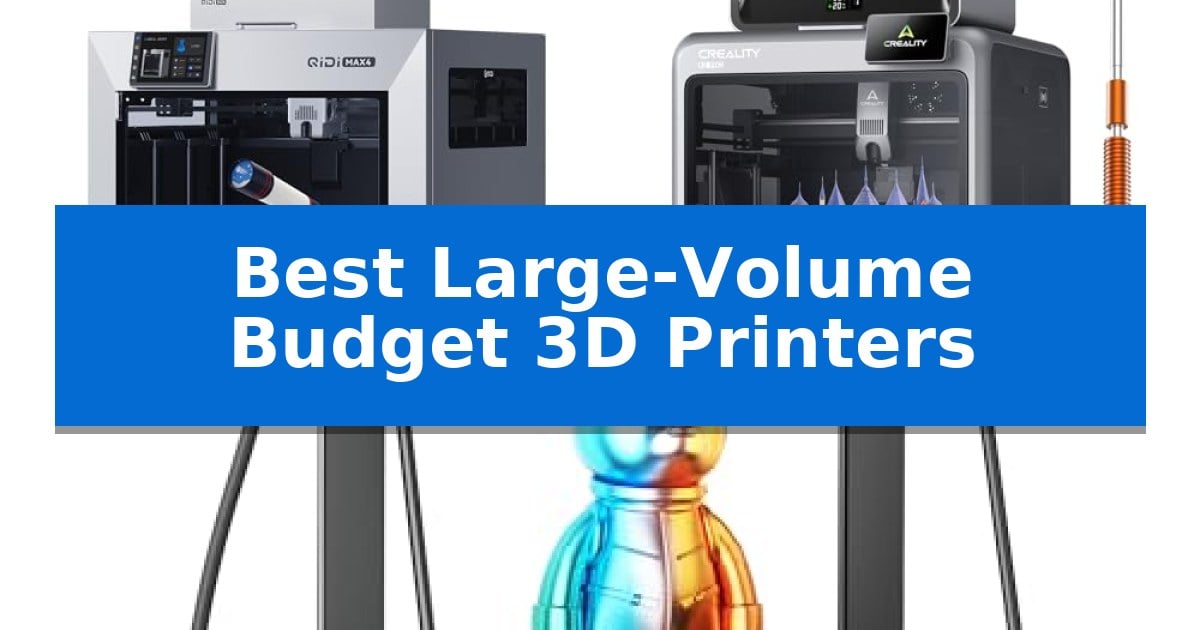
Finding the right machine for expansive projects often feels like a trade-off between build capacity and affordability. Whether you are prototyping custom molds or printing industrial-grade parts, the Best Large-Volume Budget 3D Printers offer the necessary space to bring your ambitious designs to life without the need for splitting models into smaller, fragile components.
Our guide evaluates current market options that prioritize structural stability, material compatibility, and ease of use. By focusing on machines that balance a generous build area with reliable, high-speed performance, we help you identify the hardware that best fits your specific production requirements and creative workflow.
Best Large-Volume Budget 3D Printers in 2026
Quick Comparison
| Product | Best For | Key Strength | Score |
|---|---|---|---|
| QIDI Max4 Combo 3D Printer | Best Overall | Massive 390×390×340mm build volume for large-scale parts. | 4.9 |
| Creality K2 Pro Combo 3D Printer | High-Speed Large Batch Printing | 16-color multi-material capability via the integrated CFS. | 4.4 |
| Longer LK5 Pro 3D Printer | Affordable Large-Scale FDM | Large 11.8" x 11.8" x 15.7" build volume for expansive printing projects. | 4.6 |
How We Chose
- Build Volume: We prioritized machines offering at least 300mm in primary dimensions to accommodate large prototypes.
- Thermal Management: We assessed active chamber heating and hotend capabilities for handling diverse materials like carbon fiber-reinforced filaments.
- Motion System Stability: We looked for reinforced structures, such as dual Z-axis lead screws and closed-loop motors, to ensure precision at high speeds.
- Automation Features: We evaluated the inclusion of auto-leveling, AI-driven failure detection, and multi-material management systems.
- Ease of Assembly: We considered the time and technical skill required to get each unit operational.
1 QIDI Max4 Combo 3D Printer — Massive Industrial Build Volume
The QIDI Max4 Combo 3D Printer is engineered for large-scale production, offering a substantial 390×390×340mm build volume that allows for the creation of complex molds and industrial parts without the need for splitting designs. This expansive printing area is supported by a full-surface silicone heated bed, which promotes even temperature distribution to improve first-layer adhesion and minimize warping during long print cycles.
Designed for speed and precision, the unit utilizes closed-loop motors on X/Y axes to achieve a maximum printing speed of 800mm/s and an acceleration of 30,000mm/s². The Z-axis features a 2mm lead screw and an anti-backlash nut to reduce vertical gaps, ensuring consistent surface quality even at high speeds. The 40mm³/s high-flow hotend with a hardened steel nozzle provides the necessary thermal capacity for both standard filaments and abrasive industrial materials.
Environmental control is managed through a 65℃ active heated chamber, which creates the stable conditions required for high-temperature materials like PC, ABS-CF, and PPS-CF. For added reliability, the printer includes an AI camera that monitors for printing abnormalities, such as spaghetti-like failures, and can pause operations to prevent material waste. Users can also integrate the QIDI BOX to enable multi-color and multi-material printing capabilities.
The system is built for professional workflows, featuring a large touch screen with an optimized interface for streamlined operation. While the Polar Cooler system is available to further enhance high-temperature material handling, it must be purchased separately. This machine provides a robust solution for users needing to balance large-volume capacity with the technical requirements of industrial-grade 3D printing.
Best for: Professionals and enthusiasts who require a large build volume for industrial-grade materials and high-speed production.
Skip if: Users with limited workspace or those who do not require an active heated chamber for specialized high-temperature filaments.
PROS
- Massive 390×390×340mm build volume for large-scale parts.
- High-speed performance with 800mm/s capability and closed-loop motors.
- Active 65℃ heated chamber for advanced material compatibility.
- AI-integrated monitoring to reduce material waste from print failures.
CONS
- Polar Cooler system is not included and requires a separate purchase.
- Large physical footprint may be restrictive for smaller workspaces.
2 Creality K2 Pro Combo 3D Printer — High-Speed Large Batch Printing
The Creality K2 Pro Combo 3D Printer distinguishes itself through its integrated CFS Smart Filament System, which enables multi-material and up to 16-color printing capabilities. Designed for high-output environments, this machine combines a substantial 300x300x300mm build volume with an advanced FOC step-servo motor system to reach print speeds of up to 600mm/s.
Performance stability is managed by active chamber heating, which maintains temperatures up to 60°C to mitigate warping in professional-grade materials like ASA and PPA-CF. The unit features a high-performance direct drive extruder with hardened steel gears, allowing for reliable extrusion of abrasive carbon-fiber composites at a flow rate of 40mm³/s.
Usability is enhanced by a dual AI camera system that provides 24-hour monitoring, failure detection, and real-time flow rate tuning via the nozzle camera. The printer utilizes an intelligent auto-leveling system that probes specific model areas to ensure consistent first-layer adhesion, significantly reducing manual calibration time.
Integration into existing workflows is supported by Creality OS and compatibility with major slicing software. The system includes WiFi/LAN connectivity for remote management and OTA updates, while features like filament detection and power-loss recovery provide necessary safeguards for long-duration, large-batch production tasks.
Best for: Professional creators and power users requiring high-speed, multi-material batch production within a large 300mm cubic build area.
Skip if: Users with limited workspace or those who only require basic, single-material printing may find the complexity and footprint of the CFS system unnecessary.
PROS
- 16-color multi-material capability via the integrated CFS.
- 600mm/s high-speed printing with precise FOC step-servo motors.
- Active chamber heating for professional material compatibility.
- Dual AI cameras for automated monitoring and flow optimization.
CONS
- Large physical footprint requires significant dedicated workspace.
- High-speed operation may necessitate specific maintenance intervals for the linear rails and extruder.
3 Longer LK5 Pro 3D Printer — Affordable Large-Scale FDM
Expanding your 3D printing capabilities often requires a larger build volume without the professional-grade price tag. The Longer LK5 Pro 3D Printer addresses this by offering a substantial 11.8" x 11.8" x 15.7" print area, providing a spacious canvas for complex models and large-scale projects.
Stability is central to the design of the Longer LK5 Pro 3D Printer, which utilizes a sturdy triangular structure with reinforced inclined rods to minimize resonance-related errors. This mechanical foundation is complemented by a silicon carbide lattice glass platform that promotes uniform heat distribution and reliable print adhesion, reducing the risk of warping during longer cycles.
For those prioritizing precision and efficiency, the printer supports high-speed operation up to 180mm/s while maintaining 0.1mm accuracy. The integration of an ultra-quiet TMC2209 driver ensures that the machine operates with minimal noise, making it suitable for home or classroom environments where quiet operation is preferred.
Usability is enhanced through a 90% pre-assembled design, allowing for a faster setup process for beginners. The machine also includes practical safety and recovery features, such as filament depletion detection and auto-resume printing capabilities, which intelligently manage power outages or material shortages to prevent failed prints and wasted resources.
The Longer LK5 Pro 3D Printer features open-source firmware, providing users the flexibility to modify G-code and customize printing parameters. This accessibility, paired with dual cooling fans and a reliable Teflon tube for smooth material flow, makes it a versatile tool for those looking to explore advanced FDM printing techniques.
Best for: Beginners and hobbyists who need a large build volume for complex projects and want a partially pre-assembled machine with quiet operation.
Skip if: Users who require an enclosed print chamber for advanced materials like ABS or those seeking a fully assembled, plug-and-play experience without any manual calibration.
PROS
- Large 11.8" x 11.8" x 15.7" build volume for expansive printing projects.
- Stable triangular structure with reinforced rods to minimize resonance.
- Ultra-quiet TMC2209 driver for reduced operating noise.
- 90% pre-assembled design simplifies the initial setup process.
CONS
- Open-frame design lacks the thermal containment of enclosed printers.
- Manual calibration may be required despite the pre-assembled state.
Best Large-Volume Budget 3D Printers Buying Guide
Understanding Build Volume and Structural Rigidity
The primary advantage of a large-format printer is the ability to print complex parts in a single session. However, as the build volume increases, maintaining structural rigidity becomes more difficult. Look for printers that utilize dual Z-axis lead screws or reinforced frames to prevent wobbling and vertical gaps during the printing process.
A larger build plate also requires a high-quality heating system to ensure even temperature distribution. Without a full-surface heated bed, you may encounter warping at the edges of your prints, which can ruin hours of work. Prioritize models with advanced bed-leveling technology to ensure consistent first-layer adhesion across the entire surface.
Material Compatibility and Chamber Control
Printing with industrial-grade materials like carbon fiber-reinforced nylon or PC requires more than just a hot nozzle. An active heated chamber is essential for maintaining a stable environment, which prevents the thermal contraction that leads to layer separation and corner warping.
Ensure your chosen printer supports a wide range of temperatures. A high-flow hotend is a critical component for high-speed printing, as it allows the machine to melt and extrude filament fast enough to keep up with the motion system without causing clogs or under-extrusion.
High-Speed Performance and Motion Systems
Speed is a major factor in productivity, but it must be balanced with precision. Printers using closed-loop motors or advanced step-servo systems are better equipped to handle high acceleration and velocity without skipping steps or losing accuracy.
When evaluating speed claims, consider the printer's maximum acceleration. High acceleration allows the machine to reach its top speed faster, significantly reducing total print time for complex geometries. Always check that the motion system is supported by linear rails for smooth, vibration-free movement.
Smart Features and Workflow Integration
Modern printers are increasingly equipped with AI cameras that monitor the build plate for common issues like spaghetti-like failures. These systems can pause the print automatically, saving both time and expensive filament. This is particularly valuable when running long, multi-day prints.
Connectivity and software integration also play a role in your daily workflow. Look for machines that support remote monitoring and OTA updates, allowing you to manage your prints and check status from your computer or mobile device, ensuring a seamless experience from design to finished part.
Multi-Material and Multi-Color Capabilities
If your projects require complex assemblies or aesthetic variety, consider printers that support multi-material or multi-color printing. Systems that integrate with external filament management units allow for automatic switching between materials, which is ideal for creating supports with breakaway filaments or multi-color prototypes.
Intelligent filament management, such as real-time level monitoring and automatic pause on depletion, ensures that your printer doesn't run out of material mid-print. This feature is a significant convenience for anyone managing long-term batch production.
Frequently Asked Questions
What is the main benefit of a large-volume 3D printer?
The primary benefit is the ability to print large industrial parts, complex molds, or multiple prototypes in a single batch without needing to split the model into smaller, weaker pieces.
Why is an active heated chamber important for large prints?
An active heated chamber maintains a stable temperature throughout the build, which is crucial for preventing warping and layer separation, especially when using high-temperature materials like ABS or PC.
Do I need an AI camera for my 3D printer?
While not strictly necessary, an AI camera is highly recommended for large-volume printers. It detects print failures like spaghetti-like errors and pauses the machine to save time and material.
How does a dual Z-axis lead screw system improve print quality?
It provides better support for the gantry, reducing vertical gaps and ensuring that the print head remains perfectly level, which results in smoother surface quality and higher precision.
Can these printers handle abrasive materials like carbon fiber?
Yes, provided the printer is equipped with a hardened steel nozzle and a high-flow hotend capable of reaching the necessary temperatures for industrial-grade filaments.
Conclusion: Our Top Pick
For those seeking the most robust solution for large-scale projects, the QIDI Max4 Combo 3D Printer stands out as the premier choice. Its massive build volume, combined with an active heated chamber and high-flow hotend, provides the stability and versatility required for professional-grade prototyping and industrial applications.
While other models offer high-speed batch printing or entry-level accessibility, the QIDI Max4 provides the most comprehensive feature set for users who cannot afford to compromise on build size or material performance. It is a reliable, future-ready investment for any serious maker or professional workshop.