
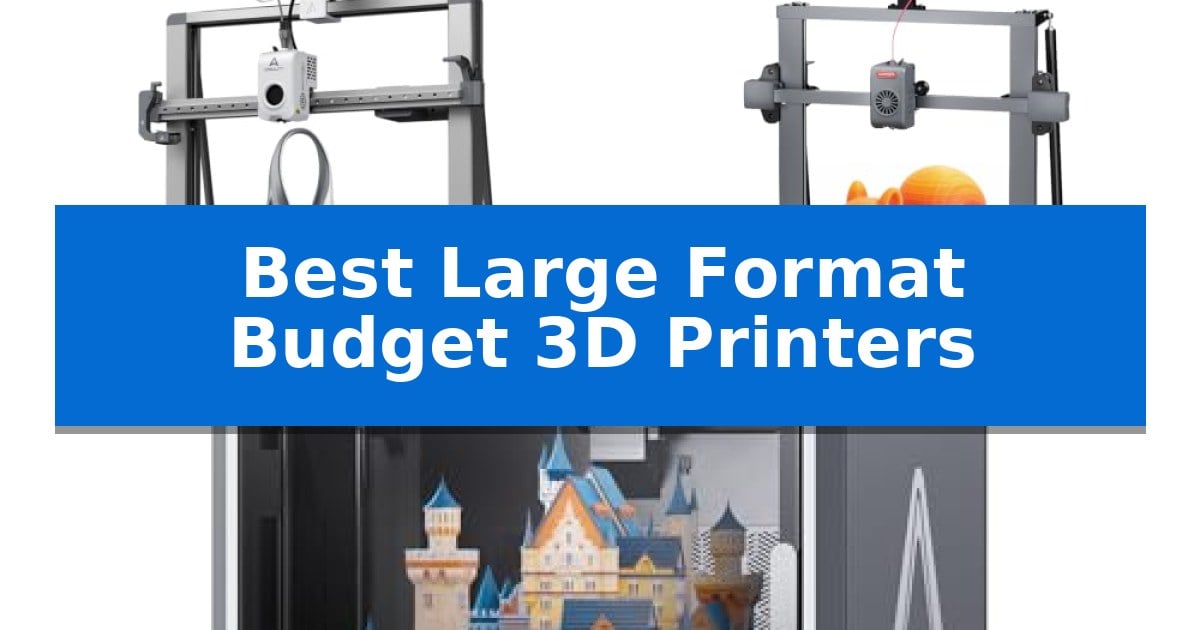
Finding the right machine for oversized projects often means balancing a massive build area with a reasonable price tag. Whether you are printing cosplay props, functional prototypes, or batch components, the Best Large Format Budget 3D Printers offer the space you need without requiring an industrial-grade investment.
These printers prioritize high-volume production while maintaining essential features like auto-leveling and high-speed capabilities. By focusing on machines that minimize assembly and maximize print reliability, you can spend more time creating and less time troubleshooting your hardware.
Best Large Format Budget 3D Printers in 2026
Quick Comparison
| Product | Best For | Key Strength | Score |
|---|---|---|---|
| Creality Ender 3 V3 Mega | Best Overall | 420mm³ large build volume for printing large-scale models in one piece. | 4.9 |
| LONGER LK10 Plus | Fast printing at scale | Large 320×320×400mm build volume for expansive projects. | 4.9 |
| Creality K2 Plus Combo | Advanced features for large builds | Large 350x350x350mm build volume for oversized models. | 4.9 |
How We Chose
- Build Volume: We prioritized machines offering at least 300mm in all dimensions to accommodate large-scale, single-piece prints.
- Material Compatibility: We assessed each printer's ability to handle diverse filaments, including flexible TPU and high-temperature engineering materials.
- Automation Features: We looked for integrated auto-leveling and filament management systems that reduce manual intervention during long print jobs.
- Print Speed and Stability: We evaluated the motion systems and vibration compensation technology to ensure quality is maintained at higher speeds.
1 Creality Ender 3 V3 Mega — Massive volume for large projects
Scaling up fabrication requires a machine capable of handling substantial dimensions without sacrificing precision. The Creality Ender 3 V3 Mega addresses this demand with a massive 420 × 420 × 420mm build volume, allowing users to produce large-scale prototypes, cosplay props, and functional components in a single piece to minimize assembly and seam visibility.
Engineered for high-throughput environments, the printer supports 500mm/s high-speed printing paired with vibration compensation to maintain surface quality even at an acceleration of 8,000mm/s². The system is further distinguished by its dual gear extruder, which is specifically optimized to handle 85A–95A TPU flexible filaments, broadening the range of materials available for functional parts like footwear or protective components.
Operational efficiency is managed through several automated features designed for long-duration tasks. The 81-point auto leveling ensures a consistent first layer across the expansive platform, while the automatic filament relay and runout/tangle detection allow the machine to switch spools seamlessly during extended prints. Maintenance is streamlined via a quick-swap hotend design, making it suitable for workshops and makers focused on consistent daily output.
While the large footprint offers significant creative freedom, it requires a dedicated workspace given its dimensions of approximately 23.22 x 23.14 x 27.46 inches. The inclusion of WLAN multi-printer control provides a modern interface for managing multiple units, making it a viable solution for small-batch production setups that prioritize workflow integration and material versatility.
Best for: Makers and small-batch production workshops requiring a large build volume for oversized prototypes and flexible TPU components.
Skip if: Users with limited workspace or those who primarily print small, high-detail parts that do not require an expansive build platform.
PROS
- 420mm³ large build volume for printing large-scale models in one piece.
- Optimized extrusion system for 85A–95A TPU flexible filament printing.
- High-speed performance up to 500mm/s with integrated vibration compensation.
- Smart filament management including automatic relay and tangle detection.
CONS
- Large physical footprint requires significant dedicated desk or workshop space.
- Weight of over 46 pounds makes the unit less portable than standard-sized printers.
2 LONGER LK10 Plus — Fast printing at scale
Scaling up your 3D printing projects requires a machine that balances a spacious build area with the speed necessary to complete large jobs efficiently. The LONGER LK10 Plus addresses this by offering a substantial 320×320×400mm build volume, providing the room needed for engineering prototypes, batch production, or large-scale creative models without the need for excessive part assembly.
Performance is driven by Klipper firmware, which enables high-speed printing up to 500mm/s and 10000mm/s² acceleration. This configuration significantly reduces wait times for complex prints while maintaining stability. The printer is equipped with a high-flow dual-gear direct drive extruder, ensuring consistent filament feeding across a wide range of materials including PLA, PETG, ABS, TPU, and Nylon.
Usability is enhanced through eddy current sensor technology for auto bed leveling, which compensates for surface conditions in real time. The inclusion of automatic Z offset calibration simplifies the setup process, particularly for those new to large-format machines. For added reliability, the unit includes filament runout detection and power-loss recovery to protect long-duration prints.
The hardware design focuses on stability and convenience, featuring a dual Z-axis design and TMC2209 silent drivers to minimize operational noise. Connectivity is handled via dual-band WiFi (2.4GHz & 5GHz), allowing for stable remote management of the printing process. With a lifetime of technical support provided by the manufacturer, this machine is built to serve as a reliable workhorse for both hobbyists and professionals.
Best for: Makers and professionals who need a high-speed, large-format printer for prototyping and batch production.
Skip if: Users with limited workspace or those who only print small, simple objects that do not require a 320mm-wide build area.
PROS
- Large 320×320×400mm build volume for expansive projects.
- Klipper firmware support for high-speed printing up to 500mm/s.
- High-flow dual-gear direct drive extruder for versatile material compatibility.
- Auto bed leveling and smart Z offset for reliable first layers.
CONS
- Large physical footprint may require significant dedicated desk or workbench space.
3 Creality K2 Plus Combo — Advanced features for large builds
Scaling up 3D printing projects requires hardware that balances expansive build volumes with high-speed precision. The Creality K2 Plus Combo addresses this need with a substantial 350x350x350mm build volume, allowing for larger models or high-throughput batch production without the need for partitioning.
Performance is driven by an industry-grade FOC step-servo motor system that enables printing speeds up to 600mm/s with an acceleration of 30000mm/s². To maintain accuracy at these speeds, the printer utilizes a Matrix frame structure made of aerospace-grade aluminum alloy, which provides the rigidity necessary to minimize resonance and deformation during operation.
The system is designed for complex material handling and automation. It features a high-temp nozzle capable of reaching 350°C and an active chamber heating system that maintains a constant 60°C, facilitating the use of high-end filaments like ASA and PPA. The integrated CFS (Creality Filament System) supports multi-color printing, with the ability to link four units for up to 16-color output, while also providing automatic filament selection and relay functions.
Operational reliability is managed through 18 smart sensors and dual AI cameras. One camera monitors for print failures like spaghetti detection, while the other handles flow rate optimization on the toolhead. The dual Z-axis system and four linear rods ensure the print bed remains stable, with automated bed tilt adjustment and leveling to improve overall success rates.
Best for: Users requiring a large-format 3D printer capable of multi-color output and high-temperature material compatibility for professional or batch production.
Skip if: Users with limited workspace or those who do not require multi-color capabilities or a 350mm build volume may find this unit's size and complexity unnecessary.
PROS
- Large 350x350x350mm build volume for oversized models.
- Multi-color printing support via the integrated CFS unit.
- High-speed performance with 600mm/s printing and 30000mm/s² acceleration.
- Advanced material compatibility with a 350°C nozzle and 60°C heated chamber.
CONS
- Large physical footprint requires significant dedicated workspace.
- Complex system with multiple integrated components may have a steeper learning curve.
Best Large Format Budget 3D Printers Buying Guide
Understanding Build Volume
The primary advantage of a large-format printer is the ability to print objects in one piece. A 400mm+ build volume significantly reduces the need for splitting models and post-processing seams, which is essential for structural integrity in functional parts.
When selecting a size, consider your specific workspace constraints. While larger volumes are beneficial, they also require a larger footprint and more stable surfaces to prevent resonance during high-speed movements.
Material Versatility
Not all large-format printers handle the same range of filaments. If your projects require flexible components like gaskets or footwear, ensure the extruder is specifically optimized for 85A–95A TPU.
For engineering applications, look for machines that support high-temperature filaments like ASA or PPA. These materials often require a stable, enclosed environment to prevent warping, which is a common challenge with larger prints.
Automation and Reliability
Large prints can take days to complete, making filament management critical. Features like automatic filament relay and runout detection allow the printer to switch spools mid-job, preventing failures that would otherwise waste significant time and material.
Auto-leveling is non-negotiable for large beds. A consistent first layer across a 400mm surface is difficult to achieve manually, so sensors that compensate for bed surface conditions in real-time are vital for success.
Speed and Motion Control
High-speed printing is increasingly common, but it must be paired with vibration compensation. Without this, the inertia of a large print head can cause ringing or ghosting on the surface of your model.
Look for printers that utilize advanced motor systems or Klipper firmware, which allow for high acceleration without sacrificing the dimensional accuracy required for large-scale engineering projects.
Maintenance and Setup
Large printers require regular maintenance to keep the motion system aligned. Features like quick-swap hotends and modular components make it easier to replace wear parts without disassembling the entire machine.
Always check the accessibility of the build plate. A machine that allows for easy nozzle access and simple Z-offset calibration will save you hours of frustration during routine maintenance cycles.
Frequently Asked Questions
Do I need an enclosure for large 3D prints?
An enclosure is highly recommended for large prints using materials like ABS, ASA, or PPA to maintain a consistent temperature and prevent warping. For PLA and PETG, an open frame is generally sufficient.
How does filament relay work?
Filament relay systems detect when a spool is empty and automatically switch to a second, pre-loaded spool, allowing for continuous printing on very long jobs.
Is auto-leveling accurate on large beds?
Yes, modern large-format printers use high-density point leveling (such as 81-point systems) to map the bed surface and compensate for minor irregularities, ensuring a perfect first layer.
Can I print flexible filaments on large-format printers?
Many modern large-format printers feature direct-drive extruders specifically designed to handle flexible materials like TPU without clogging or tangling.
What is the benefit of Klipper firmware?
Klipper firmware offloads the heavy processing tasks to a more powerful controller, enabling higher print speeds and better vibration compensation compared to traditional firmware.
Conclusion: Our Top Pick
For makers needing the most expansive workspace, the Creality Ender 3 V3 Mega stands out as the most capable option. Its 420mm build volume is ideal for large-scale prototyping and cosplay, while the integrated filament management and high-speed capabilities ensure that long prints remain reliable.
While it requires a dedicated space due to its size, the combination of auto-leveling and flexible filament support makes it a highly efficient tool for those who frequently produce large, complex models.