
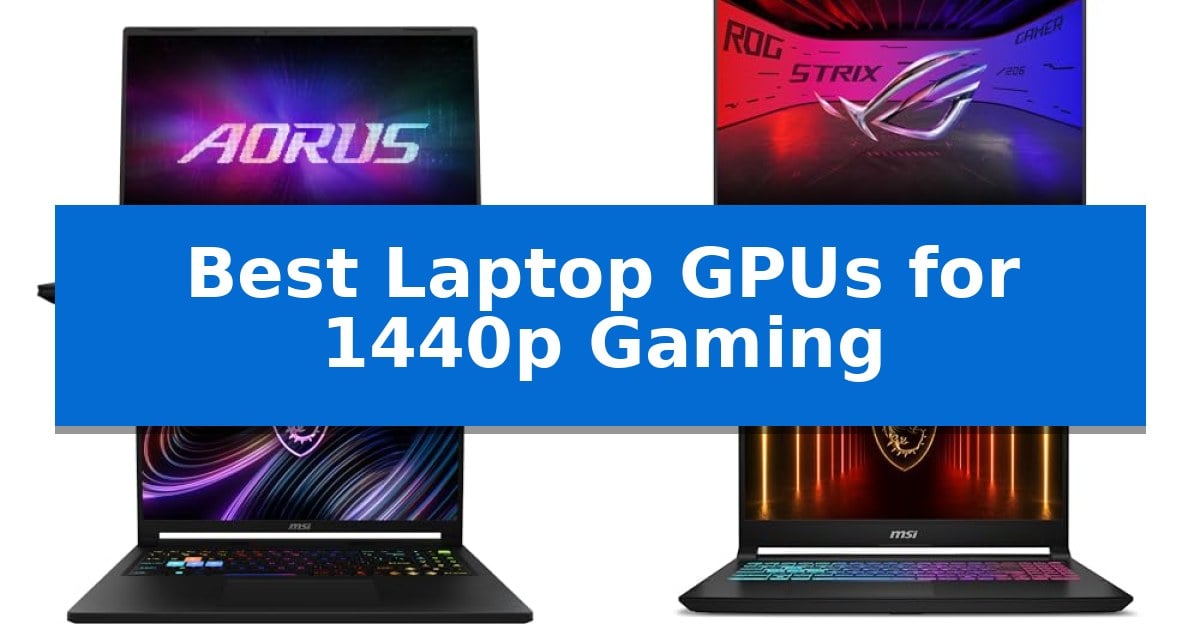
Finding the Best Laptop GPUs for 1440p Gaming requires balancing raw graphical power with thermal efficiency and display capabilities. As modern titles push for higher fidelity at QHD resolutions, selecting the right hardware ensures you maintain smooth frame rates without compromising on visual quality.
Our selection focuses on laptops equipped with the latest NVIDIA RTX 50-series architecture, which provides the necessary neural rendering and ray tracing support for demanding 1440p workloads. Whether you prioritize maximum settings or a balanced approach for competitive play, these systems offer the performance needed for a premium gaming experience.
Best Laptop GPUs for 1440p Gaming in 2026
Quick Comparison
| Product | Best For | Key Strength | Score |
|---|---|---|---|
| GIGABYTE AORUS Master 16 Gaming Laptop | Best Overall | NVIDIA GeForce RTX 5090 with DLSS 4 support for advanced 1440p rendering. | 4.9 |
| ASUS ROG Strix G16 Gaming Laptop | Elite Frame Rates at 1440p | Tool-free access for easy hardware upgrades. | 4.3 |
| MSI Raider A16 HX Gaming Laptop | Smooth Visuals for QHD Gaming | NVIDIA GeForce RTX 5080 with 16GB GDDR7 VRAM for high-fidelity gaming. | 4.5 |
| MSI Katana 15 HX Gaming Laptop | Balanced Power for QHD Resolution | High-performance RTX 5070 GPU for demanding ray-traced gaming. | 4.6 |
| Acer Nitro V 16S Gaming Laptop | Efficient 1440p Gaming Entry | NVIDIA GeForce RTX 5060 with advanced Blackwell architecture for ray tracing. | 4.6 |
How We Chose
- GPU Architecture: Prioritizing NVIDIA Blackwell-based cards for advanced DLSS 4 and ray tracing support.
- Thermal Management: Evaluating cooling solutions like vapor chambers and multi-fan arrays that prevent performance throttling.
- Display Quality: Ensuring the integrated panels support QHD resolutions with high refresh rates for fluid motion.
- System Integration: Assessing how CPU, RAM, and storage configurations complement the GPU to eliminate bottlenecks.
- Upgradeability: Checking for accessible slots that allow users to expand memory or storage as gaming requirements evolve.
1 GIGABYTE AORUS Master 16 Gaming Laptop — Unrivaled Power for 1440p Ultra
The GIGABYTE AORUS Master 16 Gaming Laptop leverages the advanced NVIDIA Blackwell architecture to deliver high-fidelity graphics, making it a powerful candidate for those targeting 1440p gaming. At the heart of this machine is the NVIDIA GeForce RTX 5090 Laptop GPU, which supports DLSS 4 neural rendering and cinematic ray tracing to maintain high visual quality at demanding resolutions.
Performance is further bolstered by the AMD Ryzen 9 9955HX3D processor, featuring 3D V-Cache Technology and 16 cores. This combination provides the necessary overhead for both intensive gaming and complex productivity tasks. The system is designed to handle a 175W Max TGP, ensuring the GPU has sufficient power headroom for sustained frame rates during high-resolution gameplay.
Thermal management is handled by the WINDFORCE Infinity EX Cooling system, which utilizes a large vapor chamber and 160-blade Frost Fan 2.0 to dissipate heat. To maintain stability during long sessions, the laptop incorporates 3D VortX air-channeling and a dedicated Cy Touch keyboard zone that keeps the primary control area cooler. The inclusion of GiMATE AI Cooling also allows for a 0dB ambient experience during lighter workloads.
The display is a 240Hz 2560×1600 WQXGA panel, providing the high refresh rate required to complement the RTX 5090's output. With 32GB of DDR5 RAM and a 2TB SSD, the laptop is equipped to handle modern game assets and large files without bottlenecking, fitting into a chassis that measures less than an inch in height.
Best for: Gamers and creators who require desktop-tier performance and high-refresh 1440p visuals in a portable form factor.
Skip if: Users who prioritize a lightweight, ultra-thin device or those who do not require the high-end thermal and power overhead provided by the 230W total system capacity.
PROS
- NVIDIA GeForce RTX 5090 with DLSS 4 support for advanced 1440p rendering.
- AMD Ryzen 9 9955HX3D with 3D V-Cache for high-performance processing.
- WINDFORCE Infinity EX Cooling with vapor chamber technology for sustained thermal management.
- 240Hz WQXGA display providing high-refresh-rate visual clarity.
CONS
- High power consumption profile requires a 230W total thermal design, which may limit battery runtime.
- 5.07-pound weight is substantial compared to thinner, lower-performance alternatives.
2 ASUS ROG Strix G16 Gaming Laptop — Elite Frame Rates at 1440p
The ASUS ROG Strix G16 (2026) offers a distinct advantage for high-resolution gaming through its ROG Nebula HDR 2.5K display, which supports a rapid 300Hz refresh rate and 3ms response time. This combination of resolution and speed provides a fluid visual experience, while the inclusion of a new AGLR film works to minimize glare and enhance contrast during intense gaming sessions.
Under the hood, this machine is built for demanding tasks, featuring an Intel Core Ultra 9 290HX processor paired with an NVIDIA GeForce RTX 5080 GPU. To maintain consistent performance, the system utilizes ROG Intelligent Cooling, which incorporates an end-to-end vapor chamber, tri-fan technology, and Conductonaut extreme liquid metal applied directly to the chipset to manage heat effectively.
Usability is enhanced by the MUX Switch with Advanced Optimus, which allows for a 5-10% boost in gaming performance by routing frames directly from the dedicated GPU. For those who prefer a clean aesthetic, the customizable full-surround RGB lightbar can be toggled via Stealth Mode to disable all lighting, making the device suitable for professional environments.
Maintenance and customization are simplified through tool-free access, allowing users to adjust RAM, SSD, and fans by sliding a single latch on the bottom of the chassis. The laptop also comes equipped with 32GB of DDR5-5600MHz memory and a 1TB PCIe Gen 4 SSD, providing a robust foundation for multitasking and large game libraries.
Best for: Gamers and creators who require a high-refresh 1440p display and tool-free hardware accessibility.
Skip if: Users seeking a lightweight, portable machine will find the 3.89-pound weight and performance-focused cooling system less ideal for frequent travel.
PROS
- Tool-free access for easy hardware upgrades.
- High-refresh 300Hz display with anti-glare film.
- Advanced thermal management using liquid metal and vapor chamber technology.
- MUX Switch for direct GPU frame routing.
CONS
- Heavier chassis design compared to ultrabook-style gaming laptops.
3 MSI Raider A16 HX Gaming Laptop — Smooth Visuals for QHD Gaming
Gaming at 1440p requires a balance of high-resolution rendering and fluid frame rates, and the MSI Raider A16 HX Gaming Laptop is built to handle this demand with its high-end internal components. By pairing the AMD Ryzen 9 8940HX processor with the latest NVIDIA GeForce RTX 5080 graphics, this machine provides the necessary overhead for demanding AAA titles and intensive AI-driven workloads.
The visual experience is anchored by a 16-inch QHD+ display that features a 240Hz refresh rate and 100% DCI-P3 color gamut. This combination ensures that fast-paced action remains smooth while maintaining color accuracy, which is beneficial for both competitive gaming and creative tasks. The inclusion of 16GB GDDR7 VRAM on the GPU allows for efficient handling of high-resolution textures and complex lighting effects.
Designed with longevity and maintenance in mind, the laptop features a Quick Access Panel that simplifies the process of upgrading system memory and storage. This allows users to expand the 32GB DDR5 RAM or the 2TB NVMe SSD as their requirements evolve, extending the practical lifespan of the hardware.
Connectivity is addressed through the integration of Wi-Fi 7, which supports faster data transfers and more stable streaming compared to previous standards. The chassis, measuring approximately 1.02 inches in thickness, houses these components while providing a functional layout for high-performance computing in a portable form factor.
Best for: Gamers and creators who require a high-performance, upgradeable 16-inch laptop capable of handling demanding 1440p and 4K gaming workloads.
Skip if: Users who prioritize a lightweight, ultra-thin device for frequent travel may find the 5.4-pound weight and 1.02-inch thickness less convenient than smaller, more portable alternatives.
PROS
- NVIDIA GeForce RTX 5080 with 16GB GDDR7 VRAM for high-fidelity gaming.
- Quick Access Panel allows for convenient memory and storage upgrades.
- 240Hz QHD+ display with 100% DCI-P3 color gamut for smooth, vibrant visuals.
- Wi-Fi 7 support for high-speed wireless connectivity.
CONS
- 5.4-pound weight and substantial chassis thickness may limit portability.
- High-performance components require a larger footprint compared to ultrabook-style gaming laptops.
4 MSI Katana 15 HX Gaming Laptop — Balanced Power for QHD Resolution
Achieving high-fidelity visuals at 1440p resolution requires a balance of raw processing power and efficient thermal management. The MSI Katana 15 HX Gaming Laptop addresses this demand by pairing the 24-core Intel Core i9-14900HX processor with the NVIDIA GeForce RTX 5070, a combination engineered for high frame rates and advanced ray tracing in modern titles.
The laptop features a 15.6-inch QHD 165Hz display that covers 100% of the DCI-P3 color gamut, ensuring that the graphical output of the RTX 5070 is rendered with high clarity and color accuracy. This display configuration is specifically suited for competitive gaming where reducing motion blur and maintaining visual detail are critical.
To sustain performance during extended sessions, the system utilizes the Cooler Boost 5 thermal architecture. This design incorporates dual fans and a 5-heat-pipe share-pipe system to dissipate heat from the CPU and GPU, helping to maintain stable operation under heavy workloads.
Connectivity and customization are integrated into the chassis, which includes a 4-zone RGB keyboard with highlighted WASD keys. The I/O selection is comprehensive, featuring USB-C Gen 2, HDMI output supporting up to 8K resolution, multiple USB-A ports, and RJ45 Ethernet, providing the necessary interface for a desktop-like gaming environment.
Best for: Gamers who require a high-refresh QHD display and robust thermal cooling for sustained 1440p gaming sessions.
Skip if: Users seeking a highly portable or lightweight device, as the 4.96-pound chassis is designed primarily for stationary performance.
PROS
- High-performance RTX 5070 GPU for demanding ray-traced gaming.
- QHD 165Hz display with 100% DCI-P3 color accuracy.
- Cooler Boost 5 thermal system for sustained component stability.
- Extensive connectivity including 8K-capable HDMI and RJ45.
CONS
- Significant weight of 4.96 pounds may limit portability.
- Stationary-focused design prioritizes cooling over ultra-thin form factors.
5 Acer Nitro V 16S Gaming Laptop — Efficient 1440p Gaming Entry
The Acer Nitro V 16S Gaming Laptop leverages the NVIDIA GeForce RTX 5060 Laptop GPU to provide a specialized foundation for high-fidelity gaming. By utilizing the NVIDIA Blackwell architecture, this system integrates fourth-gen RT Cores and fifth-gen Tensor Cores to facilitate advanced ray tracing and neural rendering, specifically targeting the demands of modern 1440p gaming environments.
Performance is further augmented by DLSS 4, which employs Multi Frame Generation and enhanced Ray Reconstruction to improve frame rates and image quality. This AI-driven approach is supported by the AMD Ryzen 7 260 CPU, which contributes up to 38 AI Overall TOPS, ensuring the processor can handle intensive gaming and content creation tasks alongside the graphics workload.
The visual experience is managed by a 16-inch WUXGA display with a 180Hz refresh rate, providing fluid motion for fast-paced titles. The panel offers 100% sRGB color coverage, which is essential for maintaining color accuracy during both gaming sessions and creative workflows. The hardware configuration is rounded out by 32GB of DDR5 5600MHz memory and a 1TB PCIe Gen 4 SSD, ensuring sufficient bandwidth and storage capacity for contemporary game libraries.
Designed for versatility, the laptop includes two PCIe M.2 slots for storage expansion, with one slot available for future upgrades. The chassis measures 0.79 inches in thickness and weighs 4.63 pounds, balancing portability with the thermal requirements of its internal components. Connectivity is supported via Wi-Fi 6, and the unit is backed by a one-year International Travelers Limited Warranty.
Best for: Gamers and creators who require a balance of AI-accelerated graphics performance and color-accurate display capabilities for 1440p gaming.
Skip if: Users who require a higher-resolution 4K display or those who prioritize a lighter, ultra-portable form factor over gaming-focused thermal and hardware specifications.
PROS
- NVIDIA GeForce RTX 5060 with advanced Blackwell architecture for ray tracing.
- 180Hz refresh rate display with 100% sRGB coverage for smooth, accurate visuals.
- 32GB DDR5 memory provides high-speed multitasking capacity.
- Expandable storage via an additional available PCIe M.2 slot.
CONS
- WUXGA resolution may not satisfy users seeking native 4K gaming fidelity.
- Wi-Fi 6 standard is one generation behind the latest Wi-Fi 7 connectivity.
Best Laptop GPUs for 1440p Gaming Buying Guide
Understanding GPU TGP and Performance
The Total Graphics Power (TGP) is a critical metric for laptop gaming. Even with the same GPU model, a higher TGP allows the card to draw more power, resulting in higher clock speeds and better performance at 1440p. Always check the manufacturer's specifications to ensure the laptop provides sufficient power headroom.
Higher TGP values often require more robust cooling systems. When choosing a laptop, look for designs that feature large vapor chambers or multi-fan cooling arrays, as these components are essential for maintaining peak performance during extended gaming sessions.
The Importance of DLSS and AI Upscaling
Modern AI-powered upscaling technologies like DLSS 4 are transformative for 1440p gaming. By rendering frames at a lower resolution and using neural networks to upscale them, these features allow you to achieve high frame rates in graphically demanding titles without sacrificing visual clarity.
When selecting a laptop, prioritize models that support the latest generation of tensor cores. This hardware-level acceleration is what enables features like Multi Frame Generation and Ray Reconstruction, which are vital for achieving cinematic visuals at QHD resolutions.
Display Refresh Rates and Resolution
A 1440p (QHD) display is the sweet spot for gaming laptops, offering a significant jump in pixel density over 1080p. However, the resolution must be paired with a high refresh rate—ideally 165Hz or higher—to ensure that the motion remains fluid and responsive during fast-paced gameplay.
Look for displays that offer 100% DCI-P3 or sRGB color coverage. Accurate color reproduction not only enhances the gaming experience but also makes the laptop a more versatile tool for content creation and media consumption.
Thermal Throttling and Cooling Design
Gaming laptops generate significant heat, and if the cooling system cannot keep up, the GPU will throttle, leading to dropped frames. Look for laptops that utilize liquid metal thermal interface materials or advanced air-channeling designs to maximize heat exchange.
Noise management is another factor. Some laptops include acoustic diffusers or smart fan control software that can reduce fan noise during lighter workloads, providing a more comfortable experience when you aren't pushing the system to its limits.
Memory and Storage Considerations
For 1440p gaming, 32GB of DDR5 RAM is increasingly becoming the standard. This capacity ensures that your system can handle modern game assets and background applications simultaneously without stuttering.
Storage speed is equally important. A PCIe Gen 4 SSD significantly reduces load times and ensures that high-resolution textures are streamed into the game engine without delay. If possible, choose a model with an available M.2 slot for future capacity expansion.
Frequently Asked Questions
Is 1440p better than 1080p for gaming?
Yes, 1440p offers a higher pixel density, resulting in sharper images and more screen real estate. It is widely considered the ideal resolution for 16-inch gaming laptops.
What is the role of a MUX switch?
A MUX switch allows the laptop to route frames directly from the dedicated GPU to the display, bypassing the integrated graphics. This can improve gaming performance by 5-10%.
Do I need 32GB of RAM for gaming?
While 16GB is sufficient for many games, 32GB provides a buffer for modern, memory-intensive titles and multitasking, making it a better choice for long-term use.
How does AI impact gaming performance?
AI-driven technologies like DLSS use dedicated tensor cores to boost frame rates and improve image quality through neural rendering, allowing for smoother gameplay at higher resolutions.
Can I upgrade the GPU in my gaming laptop?
No, the GPU is soldered to the motherboard in almost all modern gaming laptops. It is important to choose the right GPU at the time of purchase.
Conclusion: Our Top Pick
For gamers seeking the absolute best performance at 1440p, the GIGABYTE AORUS Master 16 Gaming Laptop stands out as the premier choice. Its combination of the powerful RTX 5090 GPU and advanced cooling technology ensures that you can run the most demanding titles at ultra settings with consistent frame rates.
While other models offer excellent value, the AORUS Master 16's focus on desktop-tier performance and intelligent AI-driven thermal management makes it a reliable investment for high-end QHD gaming. It provides the necessary headroom to handle future graphical advancements, ensuring your setup remains relevant for years to come.