
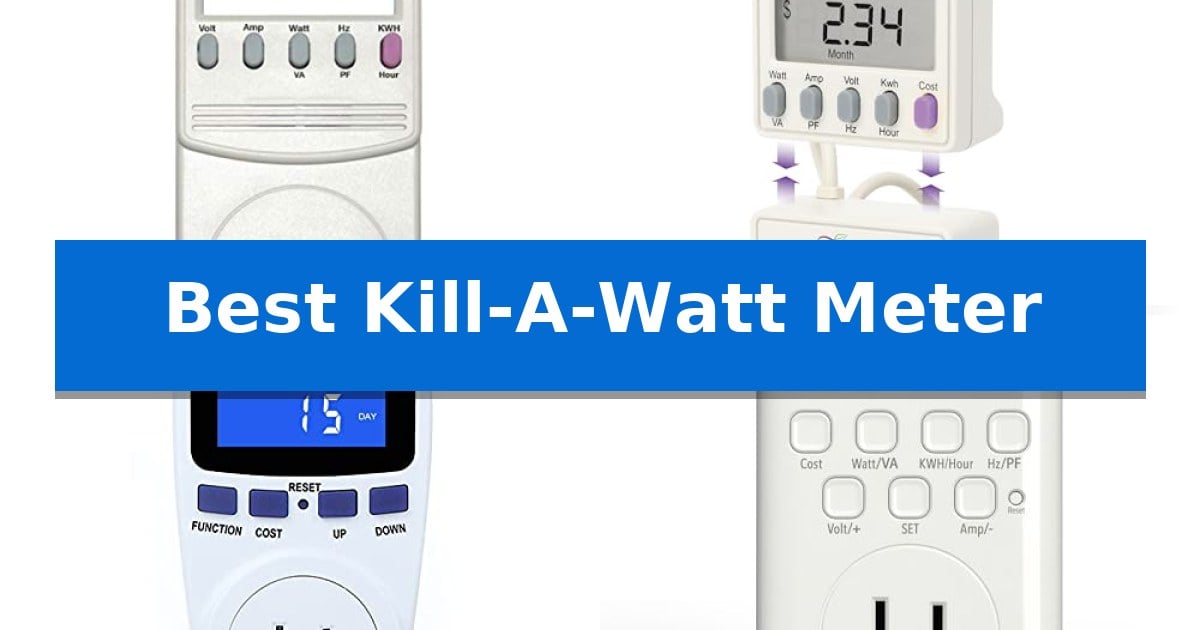
Understanding exactly how much energy your household appliances consume is the first step toward reducing your monthly electricity bills. A Best Kill-A-Watt Meter allows you to identify power-hungry devices, monitor real-time usage, and calculate the actual cost of running everything from refrigerators to gaming consoles.
Whether you are looking to troubleshoot a faulty appliance or simply want to optimize your home energy efficiency, these plug-in monitors provide the data you need. We have evaluated several top-rated models to help you find the right tool for your specific monitoring requirements.
Best Kill-A-Watt Meter in 2026: Track Appliance Energy Costs
Quick Comparison
| Product | Best For | Key Strength | Score |
|---|---|---|---|
| P3 Kill A Watt Usage Monitor | Best Overall | Four monitoring settings for flexible usage tracking | 4.9 |
| Kill A Watt Connect Monitor | Easier Access for Tight Spaces | 35-inch cord enables easy display placement away from the outlet. | 4.5 |
| MECHEER Watt Meter Power Plug | Clear Backlit Display | Large backlit LCD with wide viewing angles for easy data reading. | 4.9 |
| HBN Watt Meter Plug | Nine Comprehensive Data Modes | Backlit LCD display with wide viewing angles for easy reading. | 4.9 |
| KETOTEK Watt Meter Plug | Advanced Overload Alarm Alerts | One-click interface for rapid access to five different electrical parameters. | 4.7 |
How We Chose
- Measurement Accuracy: Ability to track vital parameters like voltage, current, and power factor.
- Display Readability: Quality of the LCD screen, including backlight features and viewing angles.
- Data Retention: Presence of internal memory to keep records during power outages.
- Ease of Use: Design features like cord length or button layout for navigating display modes.
- Overload Protection: Integrated safety alerts for high-wattage appliances.
1 P3 Kill A Watt Usage Monitor — The Original Industry Standard
Understanding exactly how much energy your household appliances consume is the first step toward managing utility costs. The P3 P4400 Kill A Watt Electricity Usage Monitor provides a direct, evidence-based way to track power draw by connecting directly between your appliance and a standard wall outlet.
Designed for use with AC 115-volt appliances, this device features a large LCD display that provides clear readouts of energy consumption measured in kilowatt-hours. It is engineered to help users assess the efficiency of various devices, offering the ability to calculate electricity expenses over specific intervals, including by the day, week, month, or year.
The P3 P4400 Kill A Watt Electricity Usage Monitor offers four distinct monitoring settings, allowing for flexible tracking of electrical usage patterns. Its design is straightforward, focusing on providing actionable data for users to identify which appliances may be contributing most to their energy footprint.
This monitor is also compatible with inverters, expanding its utility for those managing off-grid or alternative power setups. With its compact dimensions of 6.1 by 8.4 by 2.1 inches and a weight of 0.4 pounds, it is a portable tool for auditing energy use throughout a home or workspace.
Best for: Homeowners and renters looking to identify high-energy-consuming appliances and calculate their associated electricity costs.
Skip if: Users requiring monitoring for high-voltage industrial equipment or those needing advanced data logging and wireless connectivity features.
PROS
- Four monitoring settings for flexible usage tracking
- Calculates electricity expenses by day, week, month, or year
- Compatible with inverters for versatile power auditing
- Clear large LCD display for easy data reading
CONS
- Batteries not included for the unit
- Limited to AC 115-volt appliances
2 Kill A Watt Connect Monitor — Easier Access for Tight Spaces
Managing energy consumption in tight spaces or behind bulky furniture often proves difficult with standard wall-mounted meters. The Kill A Watt Connect P4498 Electricity Usage Monitor addresses this by utilizing a 35-inch cord, which allows the display unit to sit conveniently on a desk or shelf while the sensor remains plugged into an out-of-the-way outlet.
This device provides a comprehensive look at power usage by tracking Volts, Current, Watts, Frequency, Power Factor, and VA. Beyond real-time monitoring, it calculates the cost of an appliance across various timeframes, including hour, day, week, month, and year, helping users identify high-consumption electronics in their home.
Usability is a core focus of this design. The unit features a memory function that stores minimum and maximum readings, ensuring you do not lose data if the appliance is unplugged or power is interrupted. Its interface is designed to be accurate and easy to use, making it accessible for those who need precise data without navigating complex software.
While the corded design offers significant flexibility for placement, it does introduce a small trade-off in portability compared to direct-plug models. However, for users prioritizing readability and accessibility in cramped areas, the Kill A Watt Connect P4498 provides a practical solution for monitoring household energy efficiency.
Best for: Users who need to monitor power consumption in hard-to-reach outlets or behind furniture where a standard plug-in meter would be unreadable.
Skip if: Users who prefer a compact, direct-plug design without the extra bulk of a cord and external display housing.
PROS
- 35-inch cord enables easy display placement away from the outlet.
- Calculates appliance costs over multiple time intervals.
- Memory storage for minimum and maximum power readings.
- Comprehensive multi-metric monitoring including Power Factor and VA.
CONS
- Corded design occupies more physical space than direct-plug monitors.
3 MECHEER Watt Meter Power Plug — Clear Backlit Display
Monitoring electricity consumption is a practical step toward managing household energy costs, and the MECHEER Watt Meter Power Plug simplifies this by providing real-time data on power, energy, voltage, and amperage. This device features a 2.36 inch x 1.85 inch LCD screen with a backlight that offers a 180-degree viewing angle, ensuring that readings are visible from various positions without requiring you to bend over.
The unit is designed for versatility, offering 7 monitoring modes that track parameters such as wattage, cumulative energy in kWh, and even estimated electricity costs. To accommodate different lighting environments, the backlight duration is adjustable with five settings, ranging from 10 minutes to an 'always on' option, which is saved via the COST button configuration.
Safety and data integrity are core components of this meter. It includes an adjustable overload protection feature that warns users by displaying 'OVERLOAD' on the screen if the appliance exceeds a set threshold, defaulting to 3680W. Furthermore, the data memory function ensures that your consumption records are preserved during power failures or when the device is unplugged from the wall outlet.
This power analyzer is a straightforward tool for anyone looking to identify high-consumption appliances and optimize their energy usage. By providing detailed metrics like power factor and frequency (hertz) alongside standard voltage and current readings, it offers a comprehensive view of how your electrical devices perform.
Best for: Homeowners and renters looking to identify high-consumption appliances and track electricity costs in real-time.
Skip if: Users requiring smart-home integration, Wi-Fi connectivity, or remote app-based monitoring will find this standalone plug-in meter insufficient.
PROS
- Large backlit LCD with wide viewing angles for easy data reading.
- Adjustable overload protection to prevent electrical hazards.
- Data memory function that retains information during power outages.
- 7 distinct monitoring modes covering a wide range of electrical parameters.
CONS
- No wireless or smart connectivity for remote data tracking.
- Single-outlet design limits monitoring to one appliance at a time.
4 HBN Watt Meter Plug — Nine Comprehensive Data Modes
Monitoring electricity consumption is a practical step toward managing household utility costs, and the HBN Watt Meter Plug simplifies this process with its backlit LCD display. Designed with a 160° wide viewing angle, this device ensures that data remains legible regardless of the lighting conditions or your position relative to the outlet.
This meter provides comprehensive insights by tracking 9 types of electrical parameters, including wattage (W), voltage (V), current (A), and electricity cost. The interface is navigated via a single button, allowing users to toggle through metrics such as power factor (PF), frequency (Hz), and total energy consumption (kWh) with minimal effort.
Reliability is supported by the unit's data storage capability, which preserves non-real-time information during power outages. For safety and compatibility, the meter is rated for 125VAC, 60Hz and supports a maximum load of 15A or 1875W, making it suitable for a variety of standard home appliances.
To maintain efficiency, the backlit display is programmed to turn off automatically after 15 seconds of inactivity. If a monitored device exceeds the meter's maximum display range, the screen will flash to alert the user, and cumulative data can be cleared by holding the reset button for 3 seconds.
Best for: Homeowners and renters looking to identify high-consumption appliances and calculate electricity costs for specific devices.
Skip if: Users requiring advanced smart-home integration, Wi-Fi connectivity, or remote monitoring via a mobile application.
PROS
- Backlit LCD display with wide viewing angles for easy reading.
- Tracks 9 distinct electrical parameters for detailed usage analysis.
- Non-volatile data storage prevents information loss during power outages.
- Simple single-button interface for quick navigation.
CONS
- Backlight auto-off feature limits visibility after 15 seconds of inactivity.
- Lacks wireless or smart-home connectivity for remote data logging.
5 KETOTEK Watt Meter Plug — Advanced Overload Alarm Alerts
Monitoring energy consumption at the outlet level provides actionable data for reducing utility costs, and the KETOTEK Watt Meter Plug simplifies this process with a one-click switching interface. By inserting this device between an appliance and a wall socket, users can track real-time power usage, including active power in Watts, apparent power in VA, and true RMS voltage and current.
Designed for versatility, this monitor features an upgraded LCD display with wide viewing angles, ensuring that data remains readable even when the unit is installed in tight spaces or at awkward heights. The device is capable of measuring appliances running at power levels greater than 2 watts, making it suitable for a wide range of household electronics such as computers, refrigerators, and washing machines.
Safety and data integrity are core to its design, incorporating multiple protection features that trigger visual alerts on the LCD and a flashing LED when load power, energy consumption, or cost thresholds are exceeded. The default overload power limit is 3680W, which can be adjusted to suit specific appliance requirements. Furthermore, a built-in high-precision chip ensures that your settings and accumulated data are preserved during power failures.
The KETOTEK Watt Meter Plug offers a practical balance of utility and ease of use. While it provides comprehensive metrics, users should note that it is primarily intended for indoor household monitoring. Its ability to calculate electricity costs and store data makes it a functional tool for those looking to identify high-consumption appliances in their home.
Best for: Homeowners and renters looking to identify high-energy appliances and track electricity costs through real-time monitoring.
Skip if: Users requiring outdoor-rated equipment or those needing to monitor extremely low-draw devices under 2 watts.
PROS
- One-click interface for rapid access to five different electrical parameters.
- Data storage capability retains settings and measurements during power outages.
- Visual overload alarms with adjustable thresholds for safety.
- Wide-angle LCD display improves readability in various mounting positions.
CONS
- 2-watt minimum threshold means it cannot track the standby power of very low-draw devices.
- Manual configuration required to adjust overload settings for specific appliances.
Best Kill-A-Watt Meter Buying Guide
Understanding Power Metrics
Most energy monitors track more than just wattage. Key metrics include voltage (V), current (A), and power factor (PF). Understanding these helps you see if an appliance is drawing power efficiently or if it is placing an unnecessary strain on your electrical circuit.
The kilowatt-hour (kWh) measurement is the most critical for cost calculations, as this is the unit utility companies use for billing. Look for a meter that allows you to input your local electricity rate to get an accurate cost estimate.
Display and Visibility
Because these meters are often plugged into outlets near the floor or behind heavy furniture, the LCD display quality is vital. Models with backlit screens and wide viewing angles are significantly easier to read without needing to crawl on the floor.
Some advanced units offer adjustable backlight settings, allowing you to save energy or keep the screen visible for longer periods. Always consider where you plan to place the meter before choosing a display type.
Data Storage and Memory
A reliable data memory function ensures that your hard-earned usage statistics are not erased if the power flickers or if you unplug the device to move it to a different outlet. This is essential for long-term tracking of specific appliances.
Without non-volatile memory, you would have to start your calculations from scratch every time the device loses power, making it difficult to track usage over days, weeks, or months.
Safety and Overload Protection
Since these devices sit between your wall outlet and your appliance, overload protection is a critical safety feature. It prevents the meter from being damaged if an appliance draws more power than the device is rated to handle.
Look for models that provide clear visual or audible alerts when the load exceeds safe limits. This protects both your meter and your home electrical system from potential hazards.
Physical Design and Compatibility
The physical form factor of the meter can determine its utility. A corded design is often superior for tight spaces or outlets located behind large appliances, as it allows you to keep the display in a readable position.
Ensure the meter is compatible with your standard 115-volt or 125-volt AC appliances. Most consumer-grade meters are designed for standard household use, but always verify the maximum wattage rating to ensure it matches your intended equipment.
Frequently Asked Questions
Can these meters track multiple appliances at once?
Most plug-in watt meters are designed to monitor a single appliance at a time. If you need to monitor multiple devices, you would need to move the meter between them or use a power strip, though using a power strip may aggregate the data rather than isolating individual device usage.
Do I need batteries for these meters?
Many models do not require batteries as they draw power directly from the outlet. However, some units may use internal batteries to maintain data memory during power outages. Always check the specific product documentation.
What is the purpose of the power factor reading?
The power factor indicates how effectively an appliance uses electricity. A lower power factor often means the device is drawing more current than it is actually using to perform work, which can be a sign of inefficiency.
Are these meters accurate for all appliances?
They are highly accurate for most standard household appliances. However, some very low-wattage devices may not be detected by certain meters, as many have a minimum threshold (often around 2 watts) before they begin recording data.
Will the meter reset if I unplug it?
It depends on the model. Many modern energy monitors feature a data memory function that saves your information even when the device is unplugged, while older or more basic models may reset their cumulative data upon losing power.
Conclusion: Our Top Pick
When selecting the right tool for your energy monitoring needs, the P3 Kill A Watt Usage Monitor remains the industry standard for its reliability and straightforward approach to tracking electrical consumption. It provides the essential data required to make informed decisions about your home energy usage without unnecessary complexity.
While other models offer additional features like backlighting or extended cords, the P3 unit's proven track record makes it a dependable choice for those who prioritize accuracy and simplicity. Always ensure your chosen meter is compatible with the voltage and wattage requirements of the specific appliances you intend to test.