
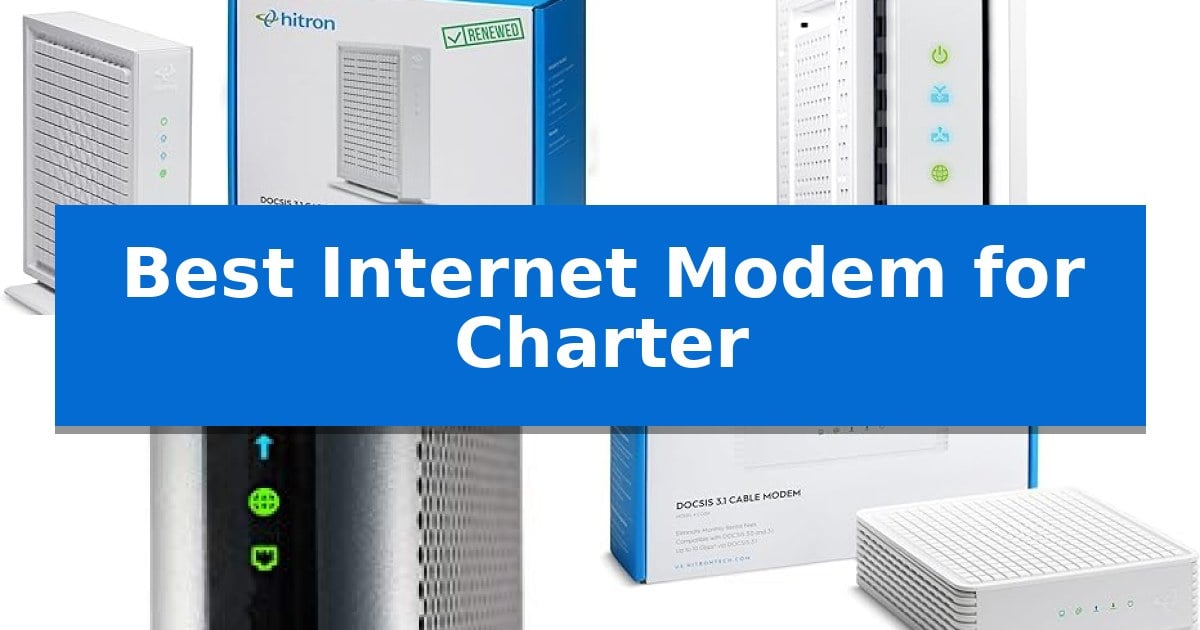
Finding the right hardware for your home network is essential for maintaining consistent speeds and reliable connectivity. When you subscribe to cable internet, the equipment you choose directly impacts your daily experience, from streaming high-definition content to participating in video calls without interruption.
Selecting the Best Internet Modem for Charter requires balancing your specific internet plan speed with the technical standards supported by your provider. By owning your own hardware, you can often avoid recurring monthly rental fees while ensuring your connection is optimized for your household's digital demands.
Best Internet Modem for Charter in 2026
Quick Comparison
| Product | Best For | Key Strength | Score |
|---|---|---|---|
| Hitron CODA56 Cable Modem | Best Overall | Multi-gigabit performance supporting up to 2.5 Gbps speeds. | 4.9 |
| ARRIS SURFboard SB8200 Cable Modem | Reliable Gigabit Connectivity | Supports DOCSIS 3.1 for high-speed performance. | 4.7 |
| Motorola MB8600 Cable Modem | Optimized for Low Latency | DOCSIS 3.1 support for high-speed internet tiers. | 4.3 |
| Hitron CODA Cable Modem | Essential DOCSIS 3.1 Upgrade | Eliminates monthly rental fees for significant long-term savings. | 4.9 |
| Netgear CM600 Cable Modem | Proven DOCSIS 3.0 Performance | DOCSIS 3.0 technology with 24×8 channel bonding for efficient data handling. | 4.9 |
How We Chose
- DOCSIS standard compatibility to ensure future-proof performance.
- Maximum supported internet speed tiers to match your specific service plan.
- Ethernet port configuration for seamless router integration.
- Certification status with major cable internet providers.
- Physical dimensions and design for easy home installation.
1 Hitron CODA56 Cable Modem — Multi-Gigabit Speeds
Managing high-speed internet connectivity requires hardware capable of handling modern data demands, and the Hitron CODA56 Cable Modem is built specifically to support multi-gigabit performance. By utilizing DOCSIS 3.1 technology, this device provides a foundation for high-bandwidth activities such as 4K streaming, online gaming, and video conferencing, while maintaining backward compatibility with older DOCSIS 3.0 networks.
Designed for users who want to optimize their home network, this modem features a 2.5 Gbps Ethernet port to ensure that your connection is not bottlenecked at the hardware level. It is important to note that this unit is a modem-only device; it does not include built-in Wi-Fi. To establish a wireless network, you must connect it to a separate router or mesh system.
Compatibility is a primary consideration for this hardware. The Hitron CODA56 Cable Modem is certified for use with major cable providers including Xfinity, Charter Spectrum, and Cox. Before installation, users should confirm their ISP supports customer-owned equipment and that their service plan is compatible with the modem's capabilities. Proper activation through your service provider is required to bring the device online.
Beyond performance, owning your modem can offer potential long-term savings by eliminating monthly rental fees typically charged by internet service providers. The unit is supported by 30 years of networking expertise, including 7-day technical support and warranty coverage, providing a reliable path for those looking to upgrade their Best Internet Modem for Charter setup.
Best for: This modem is best for users on high-speed cable internet plans of 1 Gbps or faster who want to pair their service with a high-performance, third-party Wi-Fi router.
Skip if: Skip this product if you require an all-in-one device with built-in Wi-Fi or if your internet service is provided via fiber, DSL, or satellite.
PROS
- Multi-gigabit performance supporting up to 2.5 Gbps speeds.
- DOCSIS 3.1 technology optimized for low-latency streaming and gaming.
- Potential cost savings by removing monthly ISP equipment rental fees.
- Certified compatibility with major providers like Xfinity, Spectrum, and Cox.
CONS
- No built-in Wi-Fi, requiring the purchase of a separate router.
- Single Ethernet port limits direct wired connections to one device.
2 ARRIS SURFboard SB8200 Cable Modem — Reliable Gigabit Connectivity
Reliable high-speed data transfer begins with the ARRIS SURFboard SB8200 Cable Modem, which utilizes DOCSIS 3.1 technology to support internet plans up to 1 Gbps. This device is engineered for users who want to move beyond older standards, offering 4 OFDM channels to optimize bandwidth efficiency for modern cable internet service providers.
Designed specifically for compatibility, the ARRIS SURFboard SB8200 Cable Modem is approved for use with major U.S. providers including Cox, Spectrum, and Xfinity. It features two 1-Gigabit Ethernet ports, allowing for flexible wired connectivity to your router or networking equipment. Note that this unit is strictly a modem; it does not include Wi-Fi and does not support cable digital voice services.
The hardware is built with 32 downstream and 8 upstream DOCSIS 3.0 bonded channels, ensuring backward compatibility if your local network has not yet fully transitioned to the newer 3.1 standard. Its compact footprint, measuring approximately 5.25 inches in height, allows it to fit easily into most home office setups without occupying excessive shelf space.
When selecting this modem, verify that your specific ISP supports the SB8200 model, as it is not compatible with fiber optic, DSL, or satellite services. By separating the modem from your Wi-Fi router, you maintain the ability to upgrade your wireless networking hardware independently in the future while keeping a stable, high-performance foundation for your internet connection.
Best for: Users on high-speed cable internet plans who prefer a dedicated, high-performance modem without integrated Wi-Fi.
Skip if: Users who require an all-in-one gateway that includes built-in Wi-Fi or those subscribed to fiber, DSL, or satellite internet services.
PROS
- Supports DOCSIS 3.1 for high-speed performance.
- Equipped with two 1-Gigabit Ethernet ports.
- Broad compatibility with major U.S. cable providers.
- Includes 4 OFDM channels for efficient data handling.
CONS
- No built-in Wi-Fi functionality.
- Lacks support for cable digital voice services.
3 Motorola MB8600 Cable Modem — Optimized for Low Latency
Managing your home network efficiency starts with the hardware you choose to connect to your provider. The Motorola MB8600 DOCSIS 3.1 Gigabit Cable Modem is engineered to support high-speed internet plans up to 1000 Mbps, making it a relevant candidate for users looking to optimize their connection with Charter Spectrum and other major cable services.
This device utilizes DOCSIS 3.1 and 3.0 32×8 capabilities to handle multi-gigabit speed tiers, ensuring compatibility with modern high-bandwidth requirements. By incorporating Active Queue Management (AQM), the modem is designed to reduce internet latency, which can assist in maintaining responsiveness during interactive tasks like video conferencing and online gaming.
Designed for flexibility, the unit features a 1 Gbps Ethernet port that allows for a direct connection to a single device, such as a high-performance Wi-Fi router or a mesh system. It operates strictly as a modem, meaning it does not include built-in wireless routing or telephone capabilities, allowing users to select their own preferred networking equipment.
Beyond performance, the Motorola MB8600 includes proactive network security features to help defend against denial-of-service attacks. Its full-band capture digital tuner is included to help enhance speed and manage energy consumption, providing a functional hardware solution for those aiming to eliminate monthly rental fees.
Best for: Users on high-speed cable internet plans who want to eliminate rental fees while maintaining the flexibility to choose their own router.
Skip if: Users who require a built-in Wi-Fi router or integrated telephone port functionality, as this device is a dedicated modem only.
PROS
- DOCSIS 3.1 support for high-speed internet tiers.
- Active Queue Management to help reduce latency.
- Eliminates monthly modem rental fees from service providers.
- Flexible compatibility with any third-party Wi-Fi router.
CONS
- No built-in wireless router or telephone capability.
- Single Ethernet port limits direct wired connections to one device.
4 Hitron CODA Cable Modem — Essential DOCSIS 3.1 Upgrade
Eliminating monthly equipment rental fees is the primary advantage of the Hitron CODA Cable Modem, which serves as a direct replacement for leased hardware provided by your ISP. By transitioning to this DOCSIS 3.1 device, you can potentially save up to $168 annually on rental costs while upgrading your home network to a modern standard.
The Hitron CODA Cable Modem is engineered for high-speed performance, supporting internet plans up to 1 Gbps. It utilizes next-gen DOCSIS 3.1 technology with two downstream and two upstream OFDM channels, a design choice specifically intended to reduce latency during activities like streaming, gaming, and video conferencing. It remains backward compatible with DOCSIS 3.0 networks, ensuring flexibility across different service tiers.
Designed for straightforward integration, this modem features a simple three-step setup process: connect the coaxial cable, attach the power supply, and link your existing WiFi router or mesh system via the 1 Gbps Ethernet port. Note that this unit is a dedicated modem and does not include built-in WiFi routing capabilities, requiring a separate router to provide wireless connectivity to your devices.
Compatibility is a core strength, as the device is certified for use with major providers including Charter Spectrum, Comcast Xfinity, and Cox. It is a compact solution measuring approximately 6.73 by 6.73 inches, making it easy to integrate into existing home office or entertainment setups without occupying significant space.
Best for: Users looking to eliminate ISP equipment rental fees while upgrading to a DOCSIS 3.1 standard for internet plans up to 1 Gbps.
Skip if: Users who require a single-unit solution with integrated WiFi or those subscribed to DSL, Fiber, or Satellite internet services.
PROS
- Eliminates monthly rental fees for significant long-term savings.
- Supports high-speed DOCSIS 3.1 for reduced latency.
- Broad compatibility with major cable ISPs including Charter Spectrum.
- Simple three-step setup process.
CONS
- No built-in WiFi functionality requires a separate router.
- Not compatible with non-cable services like DSL, Fiber, or Satellite.
5 Netgear CM600 Cable Modem — Proven DOCSIS 3.0 Performance
Reliable connectivity for your home network starts with hardware that matches your service provider's requirements. The Netgear CM600 Cable Modem is designed specifically to handle high-speed data demands, utilizing DOCSIS 3.0 technology to provide a stable foundation for your internet connection.
This device features 24×8 channel bonding, which allows for efficient data throughput. It is engineered to support internet service plans up to 300Mbps and is recommended for speed tiers reaching 500Mbps. With a maximum download capacity of 960Mbps, it is well-suited for high-bandwidth activities like streaming 4K UHD content and online gaming.
The Netgear CM600 Cable Modem is a dedicated modem, meaning it does not include built-in Wi-Fi. Users will need to connect a separate wireless router to the 1 Gigabit Ethernet port to distribute the signal throughout their home. This modular approach allows you to choose a router that best fits your specific wireless coverage needs.
Compatibility is a primary consideration for this unit, as it is certified for use with major providers including Charter, Comcast Xfinity, Cox, and Time Warner Cable. Please note that this modem is not compatible with DSL providers such as Verizon, AT&T, or CenturyLink. Its compact design, measuring approximately 3.78 by 8.47 by 9.97 inches, ensures it fits easily into most home office setups.
Best for: Users on Charter or similar cable internet plans who want a dedicated, high-speed modem to pair with their own preferred wireless router.
Skip if: You require an all-in-one device that includes built-in Wi-Fi functionality or you use a DSL-based internet service provider.
PROS
- DOCSIS 3.0 technology with 24×8 channel bonding for efficient data handling.
- Certified for use with major cable providers including Charter, Comcast, and Cox.
- Supports high-speed tiers up to 500 Mbps.
- Dedicated 1 Gigabit Ethernet port for reliable wired connectivity to a router.
CONS
- No built-in Wi-Fi, requiring the purchase of a separate router.
- Not compatible with DSL or fiber services like AT&T or Verizon.
Best Internet Modem for Charter Buying Guide
Understanding DOCSIS Standards
The Data Over Cable Service Interface Specification (DOCSIS) is the technology that allows high-speed data transfer over your cable TV lines. Currently, DOCSIS 3.1 is the industry standard for high-speed plans, offering significantly improved efficiency and lower latency compared to the older DOCSIS 3.0 standard.
Choosing a modem that supports the latest standard ensures your hardware can handle modern network traffic effectively. While DOCSIS 3.0 devices may still function on many networks, they often lack the capacity to support the multi-gigabit speeds offered by modern internet service providers.
Compatibility and ISP Certification
Before purchasing any modem, it is critical to verify its compatibility with your specific internet service provider. Most providers maintain a list of approved devices that have been tested to work correctly on their network infrastructure.
Using an unapproved or incompatible device can lead to activation issues or suboptimal performance. Always check the official website of your provider to confirm that your chosen model is certified for your specific speed tier.
The Role of Ethernet Ports
A cable modem acts as the bridge between your ISP and your local network. Most standalone modems feature a single Ethernet port that connects directly to your wireless router. If you have a high-speed plan exceeding 1 Gbps, ensure your modem features a 2.5 Gbps Ethernet port to avoid a bottleneck at the connection point.
Remember that these devices are typically 'modem-only' units and do not provide wireless signal. You will need to pair your modem with a separate WiFi router or mesh system to distribute internet access throughout your home.
Eliminating Rental Fees
One of the primary financial benefits of owning your own modem is the potential to stop paying monthly equipment rental fees. These charges can add up significantly over the course of a year, often making the purchase of a modem a cost-effective investment.
When calculating your potential savings, compare the cost of the modem against the monthly rental fee charged by your provider. In many cases, the device pays for itself within the first year of use.
Optimizing for Latency and Gaming
For users who prioritize online gaming or real-time video conferencing, features like Active Queue Management (AQM) are highly beneficial. AQM helps manage data traffic more efficiently, which can reduce network latency and prevent lag during intensive tasks.
A modem with advanced processing capabilities ensures that your connection remains stable even when multiple devices are active on the network simultaneously. Look for models that emphasize low-latency performance to improve your overall digital experience.
Frequently Asked Questions
Do I need a separate router with these modems?
Yes. All the models listed are standalone cable modems and do not include built-in WiFi. You must connect them to a separate wireless router to create a home network.
Will these modems work with fiber or DSL internet?
No. These devices are designed exclusively for cable internet (DOCSIS) services. They are not compatible with fiber, DSL, satellite, or fixed wireless internet connections.
How do I activate my new modem?
Activation typically requires contacting your internet service provider or using their official mobile app. You will need to provide the modem's MAC address, which is usually found on the device label.
Can I use a DOCSIS 3.0 modem on a DOCSIS 3.1 network?
Most DOCSIS 3.1 modems are backward compatible with DOCSIS 3.0 networks. However, using an older DOCSIS 3.0 modem on a high-speed 3.1 network may limit your maximum achievable speeds.
What happens if I have a voice-bundled service?
These modems do not support telephone voice services. If your internet plan includes a landline phone bundle, you will likely need a specific telephony-enabled modem provided or approved by your ISP.
Conclusion: Our Top Pick
When selecting the right hardware for your home, the Hitron CODA56 Cable Modem stands out as a robust choice for those seeking to maximize their internet plan's potential. Its support for multi-gigabit speeds and 2.5 Gbps Ethernet connectivity makes it well-suited for modern, high-bandwidth households.
By choosing this model, you gain a reliable foundation for your network that is designed to handle the demands of 4K streaming and gaming. Ensure you have a compatible WiFi router ready to pair with this unit to complete your high-performance home setup.